Tempo Markings
Andante
Pronounced ahn-DAHN-teh
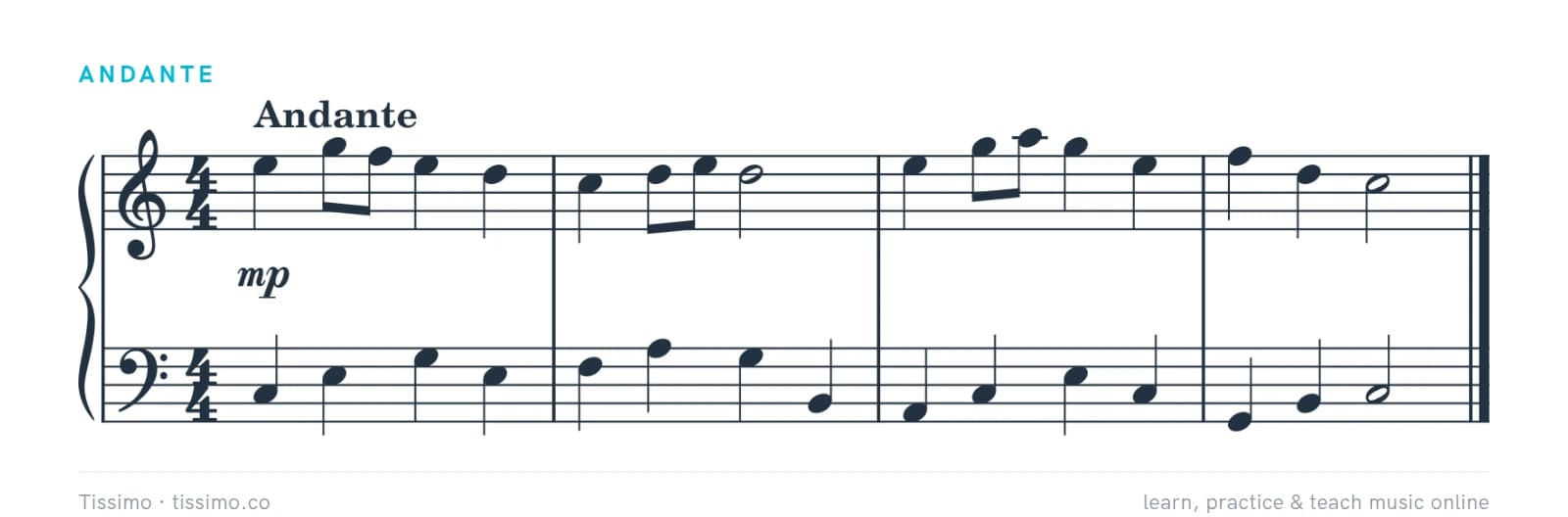
Andante is a tempo marking meaning at a walking pace: moderately slow, flowing and unhurried. It sits between adagio and moderato, often around 76 to 108 beats per minute.
Andante comes from the Italian verb andare, "to go" or "to walk", and the best way to feel it is exactly that: a relaxed walking pace. It is faster than adagio and slower than moderato. Many charts give roughly 76 to 108 beats per minute, a wide range, because a stroll and a purposeful walk are both walking.
Moving, not dragging
Andante is often described simply as "slow", and that leads players to drag it. The word means going: the music should keep moving forward. A useful test is to walk around the room while you sing the melody. If you have to slow your steps unnaturally, your andante is too slow.
Andante with other words
Composers often refine andante with a second word:
- Andante con moto: walking, "with motion", a little more flowing. Beethoven's Fifth Symphony has an Andante con moto second movement.
- Andante cantabile: walking and singing.
- Andante sostenuto: walking but sustained, a little broader.
- Andante ma non troppo: walking, but not too much.
The diminutive andantino means "a little andante", and today it usually means a little faster.
Andante in real music
The slow movement of Haydn's "Surprise" Symphony (No. 94) is an Andante: a quiet, simple tune at a walking pace, interrupted by a sudden loud chord. The second movement of Mozart's Piano Sonata in C, K. 545, is also marked Andante.
Find andante on the speedometer in Tempo & the Metronome and on the Musical terms & signs chart, place it on the tempo ladder in Dynamics & Tempo Ladders, and hunt for it in the Music word search.
Common questions
Is andante slow or fast?
In between: a moderately slow walking pace, faster than adagio and slower than moderato. Think of it as moving along comfortably rather than as slow.
What is the difference between andante and adagio?
Adagio ("at ease") is slower and more relaxed; andante ("walking") keeps moving forward. On most charts adagio ends at about the speed where andante begins.
Practice it: free worksheets
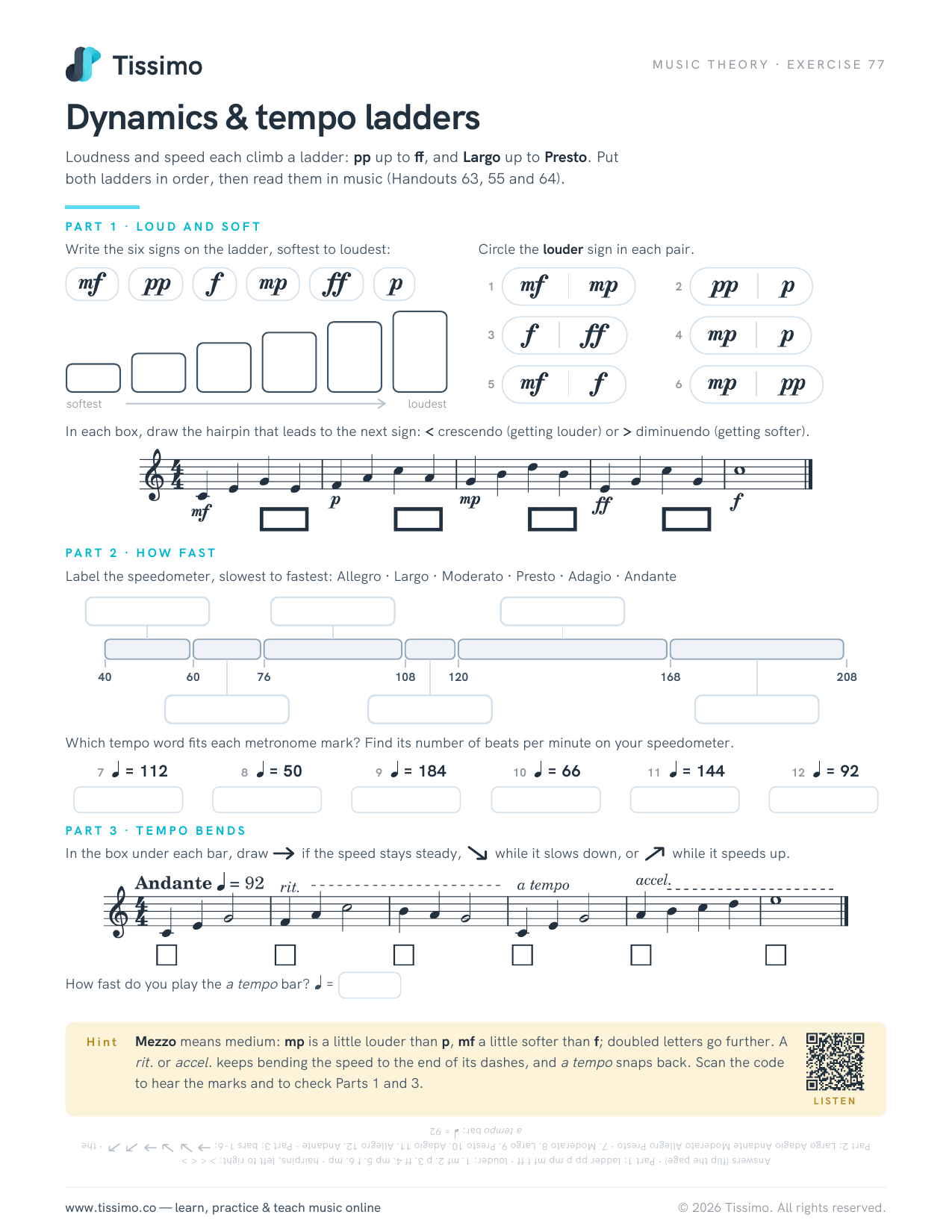 Dynamics & tempo laddersLoudness and speed each climb a ladder: pp up to ff, and Largo up to Presto. Put both ladders in order, then read them in music (Handouts 63, 55 and 64).
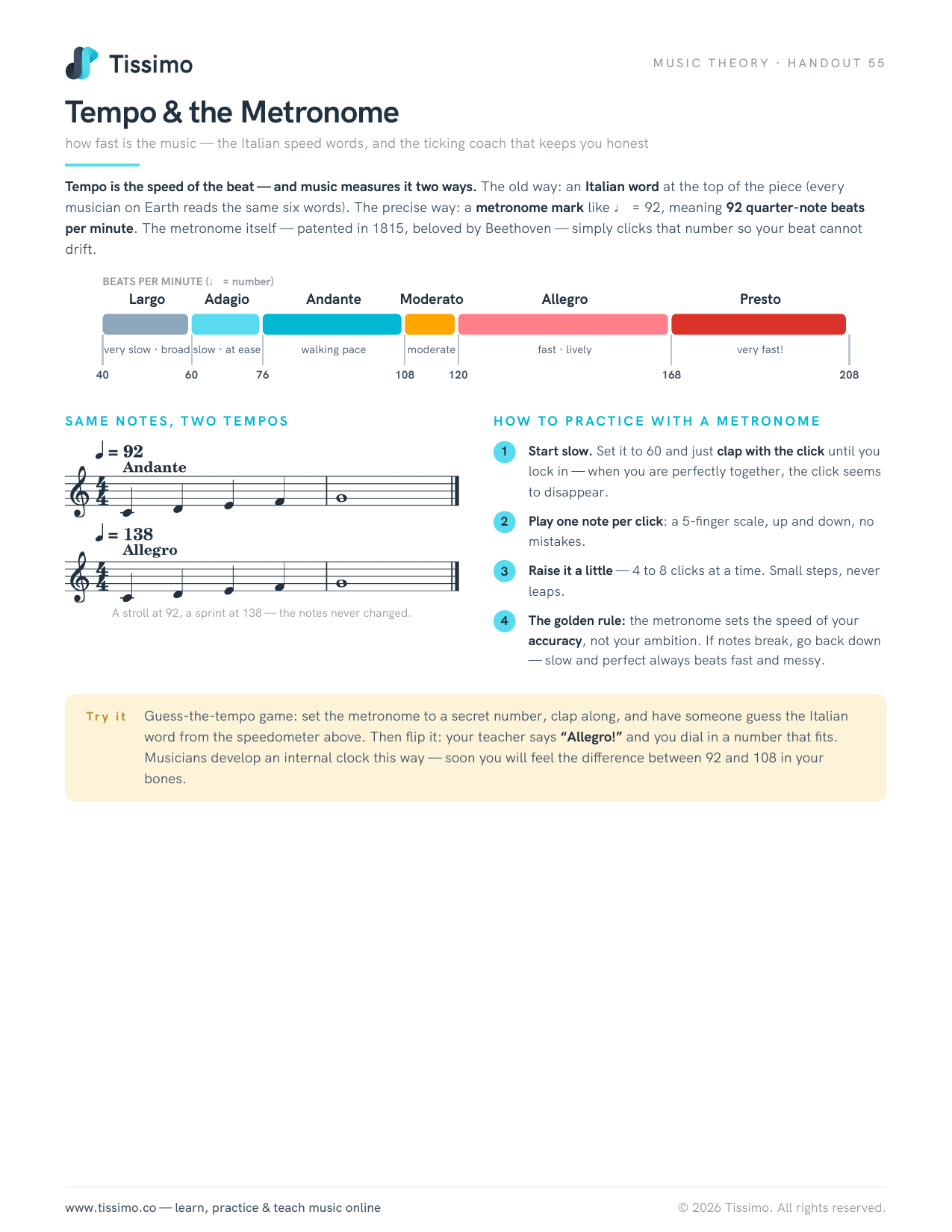 Tempo & the Metronomehow fast is the music — the Italian speed words, and the ticking coach that keeps you honest
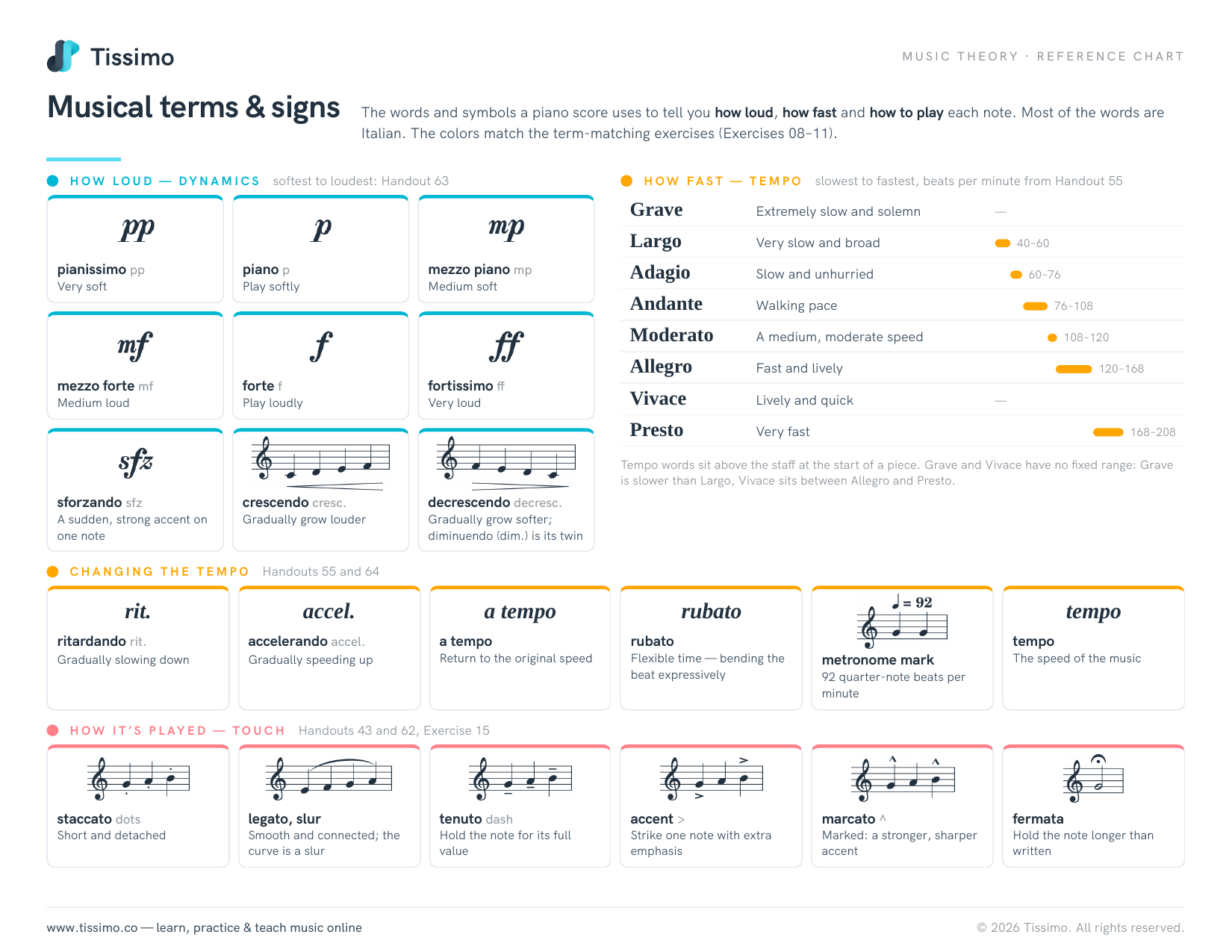 Musical terms & signsThe words and symbols a piano score uses to tell you how loud, how fast and how to play each note. Most of the words are Italian. The colors match the term-matching exercises (Exercises 08–11, 74 and 75).
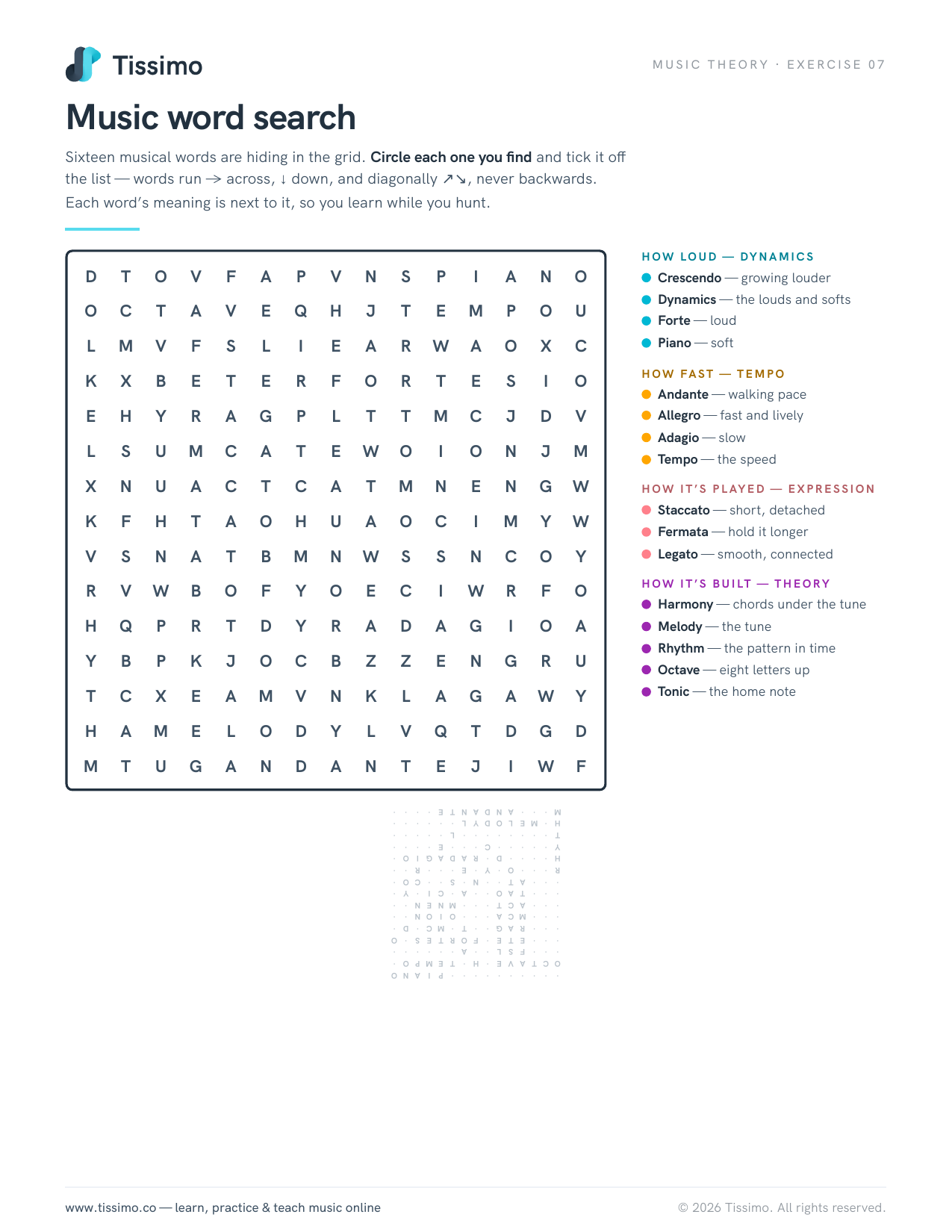 Music word searchSixteen musical words are hiding in the grid. Circle each one you find and tick it off the list — words run → across, ↓ down, and diagonally ↗↘, never backwards. Each word’s meaning is next to it, so you learn while you hunt.