Dynamics & Expression
Con Moto
Pronounced kohn MOH-toh
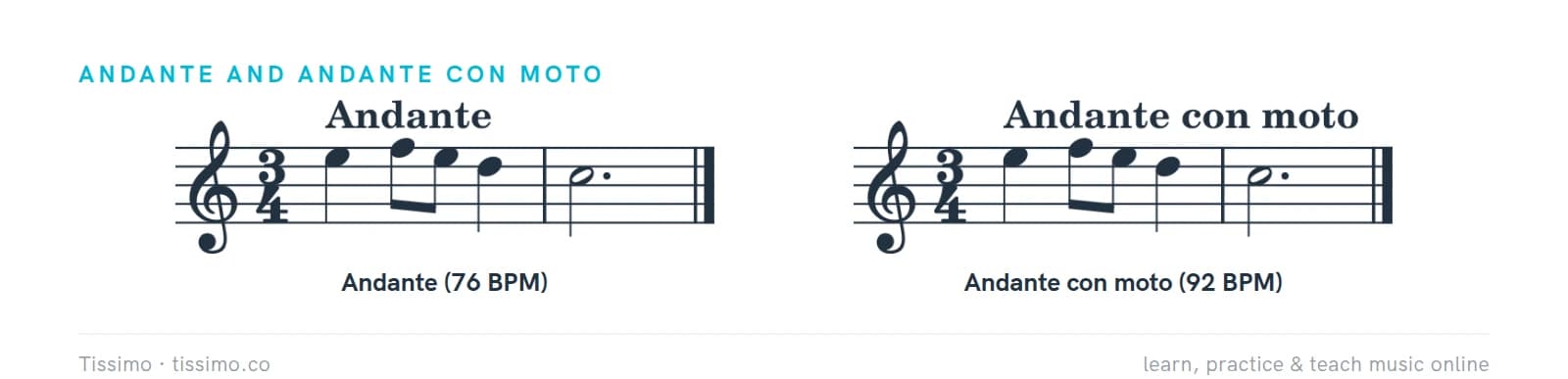
Con moto means 'with motion': keep the music moving forward, a little more flowing than the tempo word alone would suggest. It is most familiar in Andante con moto.
Con moto means "with motion". Joined to a tempo word, it asks for a little more movement than that word on its own: Andante con moto is an andante that flows forward, Allegro con moto an allegro with extra drive. On its own, con moto simply means "with movement", don't let it drag.
Con moto in real music
- The second movement of Beethoven's Fifth Symphony is marked Andante con moto.
- So is the second movement of Schubert's "Unfinished" Symphony.
Both are slow movements that must never feel static. The con moto is a warning against letting an andante sink toward adagio.
Tempo or character?
A bit of both. Con moto usually means a slightly quicker tempo than the plain word, but it is also about the feeling of motion: phrases that lead forward, a bass line that walks rather than plods, and no lingering at bar lines. Two performances at the same metronome speed can feel very different depending on whether the player thinks "with motion".
Related words
- Più mosso, "more motion": a definite change to a faster tempo, starting at once.
- Poco moto, "with a little motion": Beethoven marks Für Elise this way (see our Für Elise study).
- Animato: animated, with livelier spirit.
- Sostenuto pulls in the opposite direction: sustained and a little broader.
Common questions
What does andante con moto mean?
At a walking pace, with motion: an andante that keeps flowing forward, usually a little quicker than a plain andante.