Dynamics & Expression
Dynamics
Dynamics are the levels of loudness in music and the changes between them. They are written as Italian words and letters such as p (soft) and f (loud), and as hairpins for getting gradually louder or softer.
Dynamics are the louds and softs of music: how loud or quiet each note, phrase or section should be, and how the volume changes. Composers write them with Italian words and their abbreviations, printed below the staff (between the two staves in piano music), and with wedge-shaped hairpins for gradual changes.
The dynamic marks
From softest to loudest, the standard levels are:
- Pianissimo (pp): very soft
- piano (p): soft
- Mezzo piano (mp): moderately soft
- Mezzo forte (mf): moderately loud
- Forte (f): loud
- Fortissimo (ff): very loud
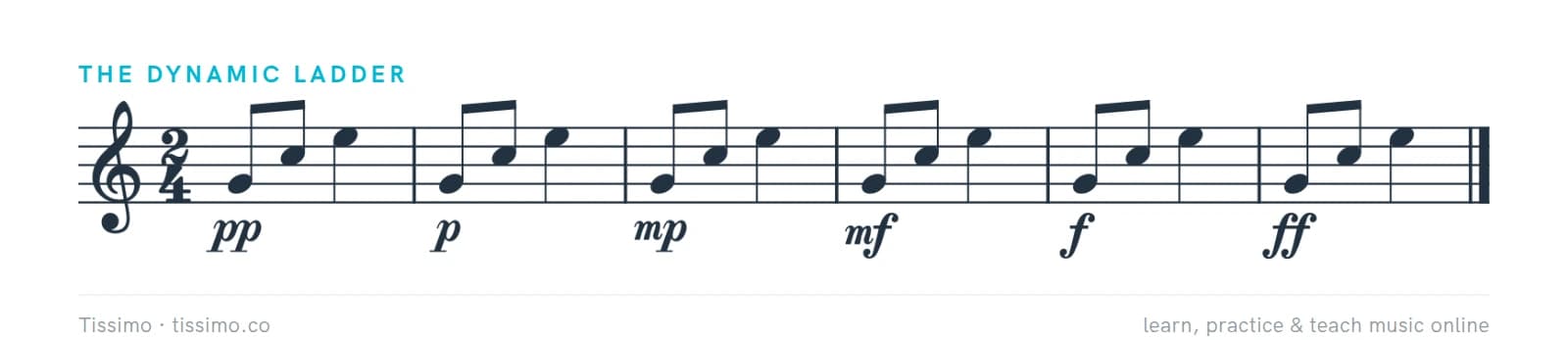
Composers sometimes go further. ppp and fff are fairly common, and a few scores go beyond: Tchaikovsky wrote pppppp in his Sixth Symphony. The letters are printed in a special bold italic type, which keeps them from being confused with note names.
Changing the level
- Gradually: crescendo (cresc., or an opening hairpin) grows louder; decrescendo, also called diminuendo (decresc., dim., or a closing hairpin), grows softer. Morendo fades away to nothing.
- Suddenly: a new mark changes the level at once, and subito p or subito f makes the suddenness explicit.
- On one note: sforzando (sfz, sf) gives a single note a sudden strong attack, and fortepiano (fp) is loud, then immediately soft.
Dynamics are relative
A dynamic mark is not a decibel reading. Forte on a solo flute is softer than forte for a full orchestra, and forte in a Mozart sonata is lighter than forte in a big Romantic concerto. What matters is the contrast inside the piece: mp should sound clearly softer than mf, and ff louder than f, with room for any still louder markings in the score. The room, the instrument and the other players all change the actual volume.
Dynamics at the piano
The piano's full name, pianoforte, means "soft-loud": unlike the harpsichord before it, it could play soft or loud depending on touch. Loudness comes from the speed of the key going down, not from pressing harder once it is down. Use relaxed arm weight for loud playing and a light touch close to the keys for soft playing. Once a note is struck it can only fade, so you shape a crescendo across several notes, never on one held note.
The Musical terms & signs chart lists the common dynamic signs, Match the terms and the Music word search test the basic words, and Voicing and Balance shows how to play two dynamics at once: a louder melody over a softer accompaniment.
Common questions
What are dynamics in music?
Dynamics are how loud or soft the music is played, and how that changes. They are marked with Italian terms such as piano (soft) and forte (loud), their letter signs (p, f, mp, mf, pp, ff), and hairpins for gradual changes.
What is the loudest dynamic marking?
Of the six standard levels, fortissimo (ff) is the loudest. Composers can add more f's (fff, ffff), but there is no fixed top: each piece sets its own scale.
Practice it: free worksheets
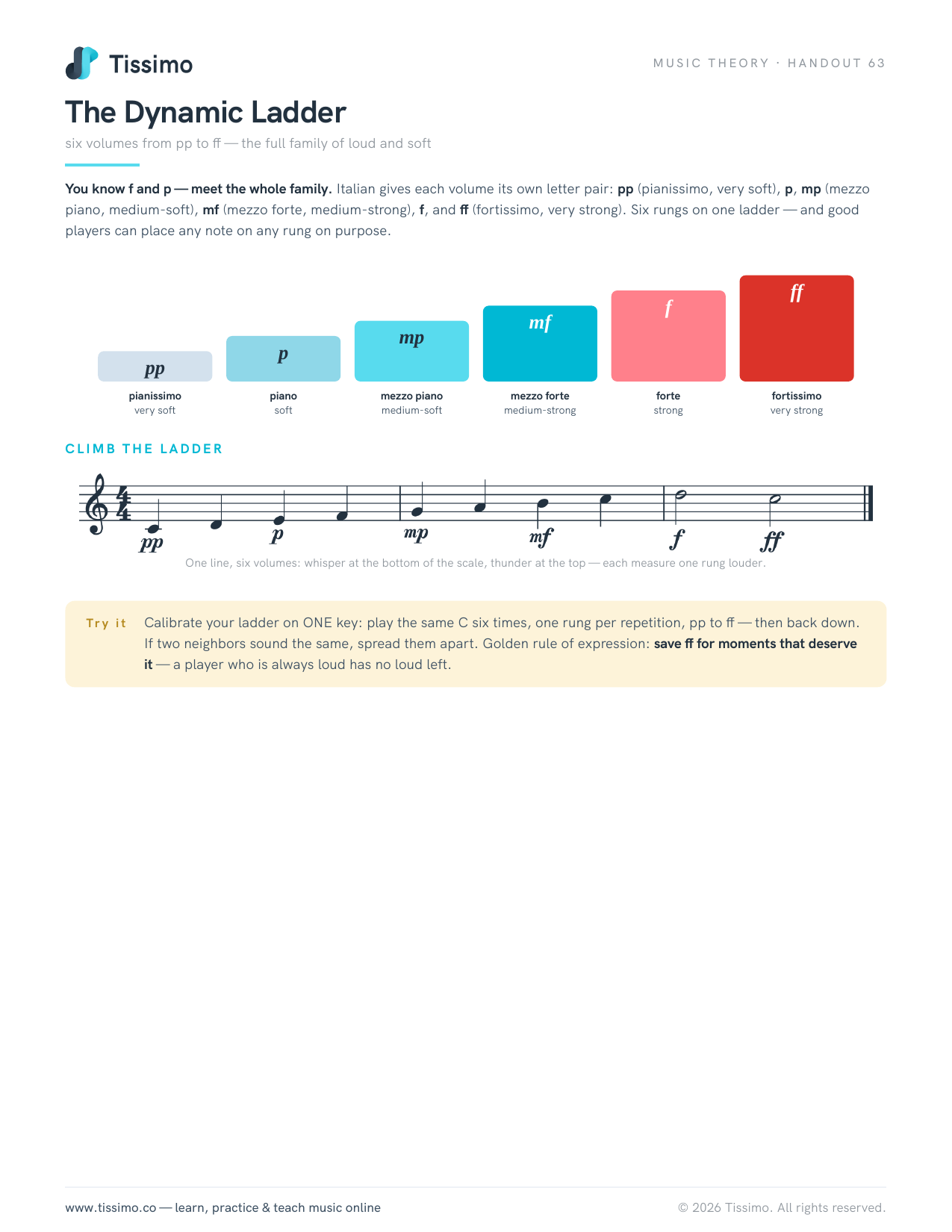 The Dynamic Laddersix volumes from pp to ff — the full family of loud and soft
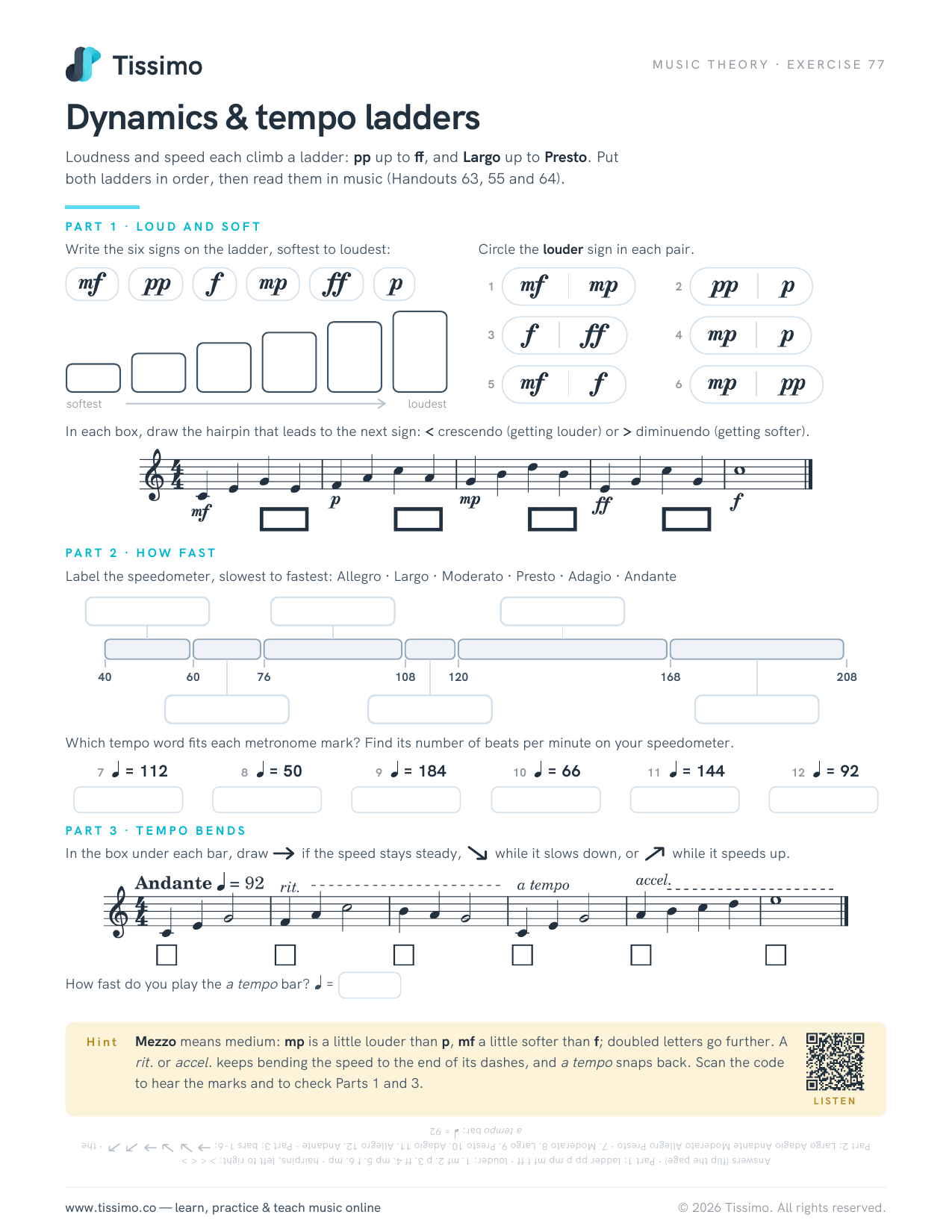 Dynamics & tempo laddersLoudness and speed each climb a ladder: pp up to ff, and Largo up to Presto. Put both ladders in order, then read them in music (Handouts 63, 55 and 64).
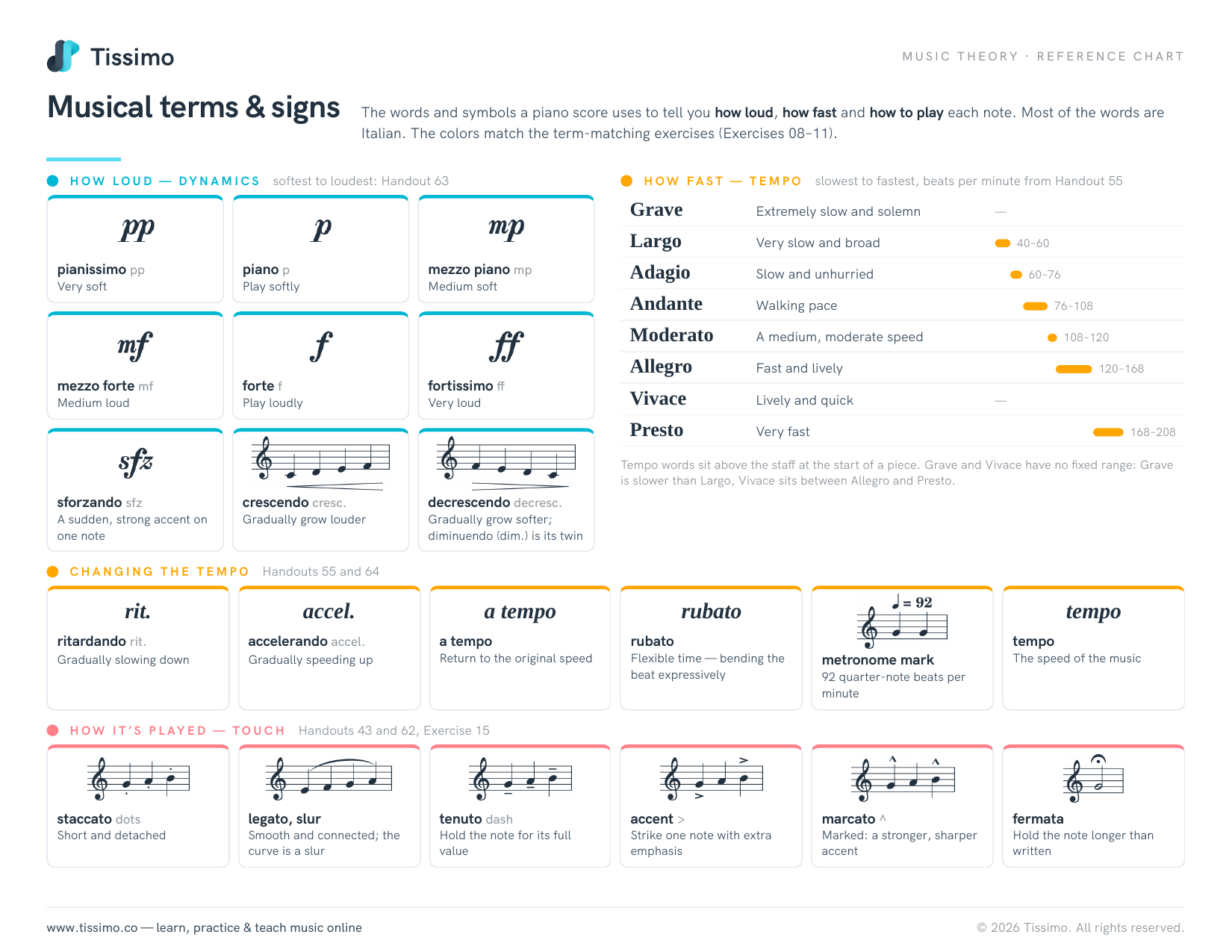 Musical terms & signsThe words and symbols a piano score uses to tell you how loud, how fast and how to play each note. Most of the words are Italian. The colors match the term-matching exercises (Exercises 08–11, 74 and 75).
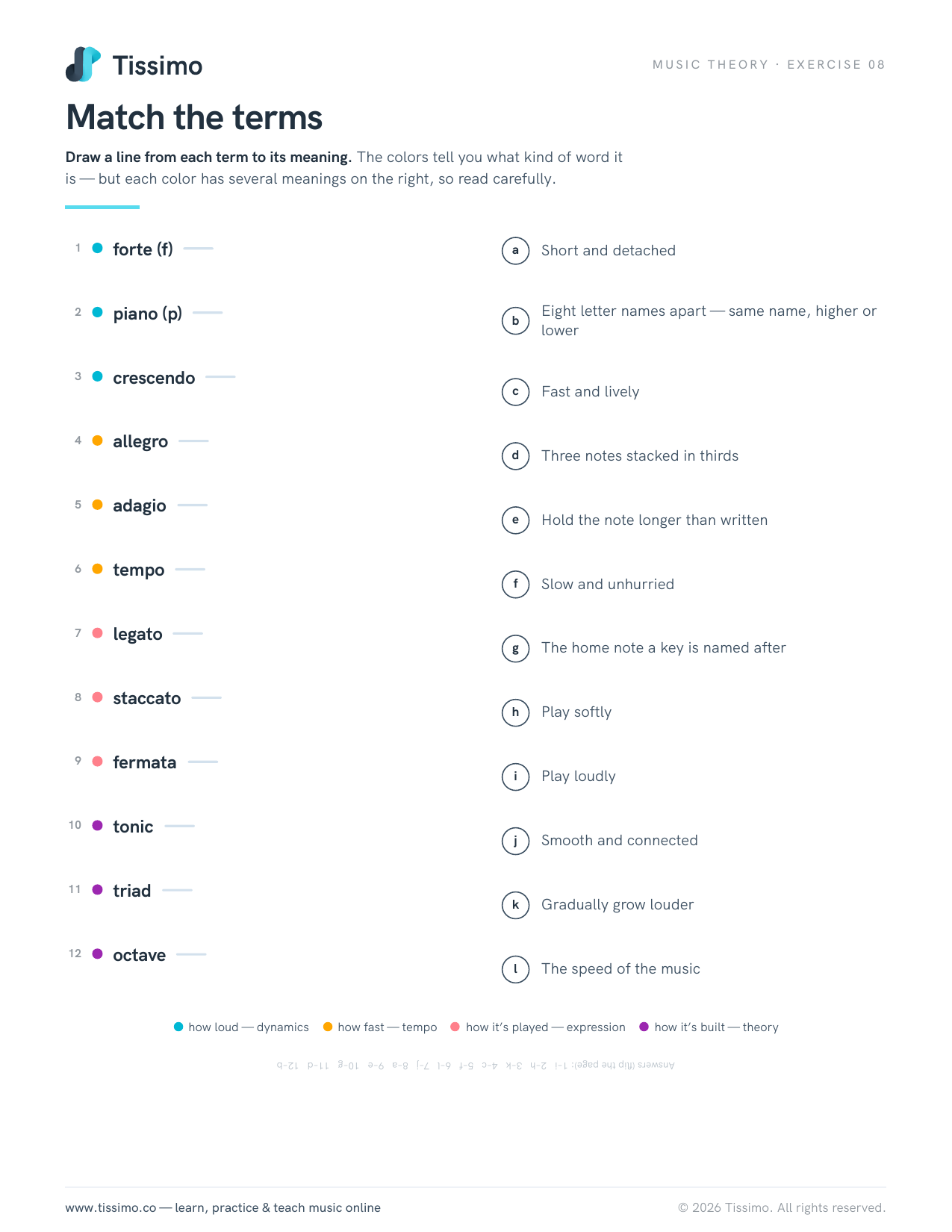 Match the termsDraw a line from each term to its meaning. The colors tell you what kind of word it is — but each color has several meanings on the right, so read carefully.
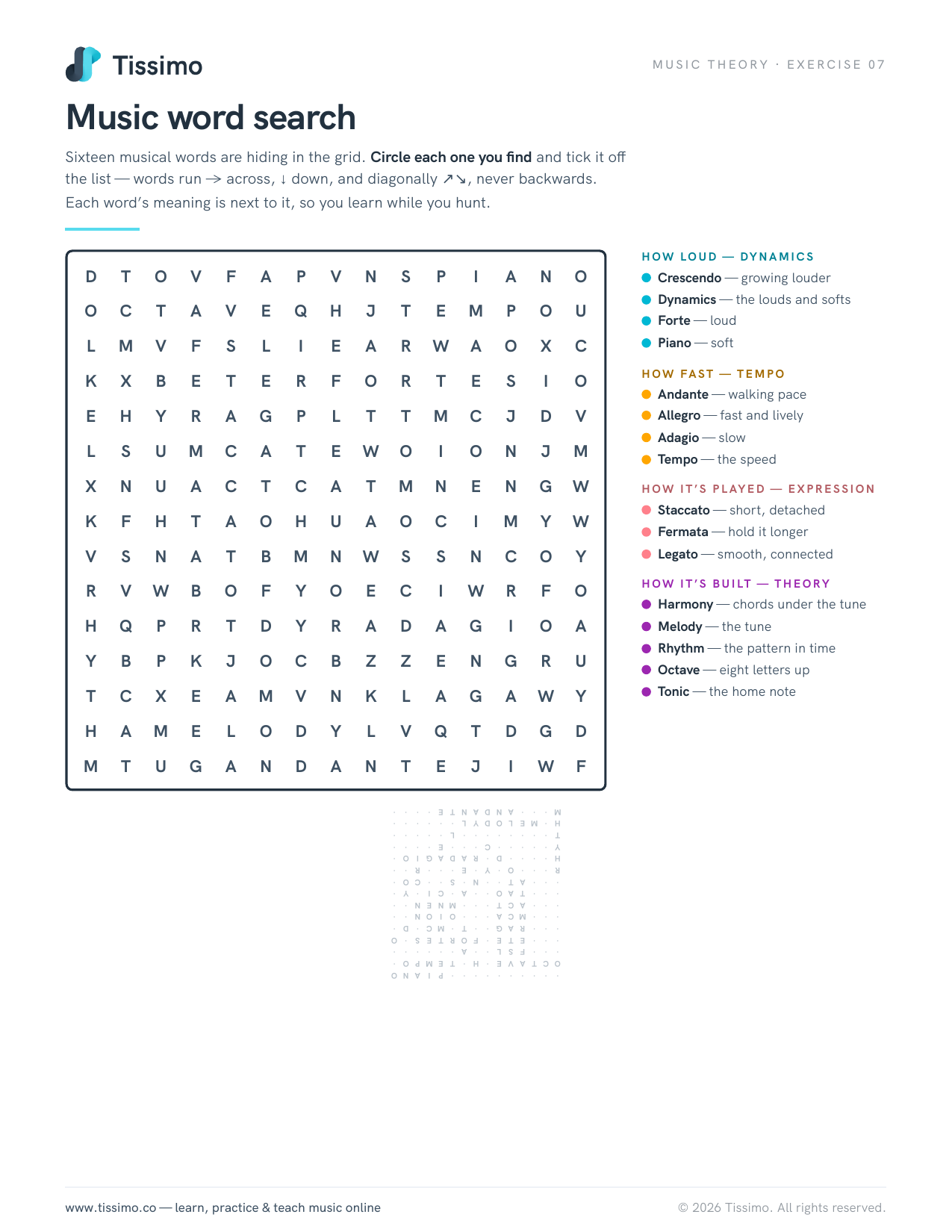 Music word searchSixteen musical words are hiding in the grid. Circle each one you find and tick it off the list — words run → across, ↓ down, and diagonally ↗↘, never backwards. Each word’s meaning is next to it, so you learn while you hunt.
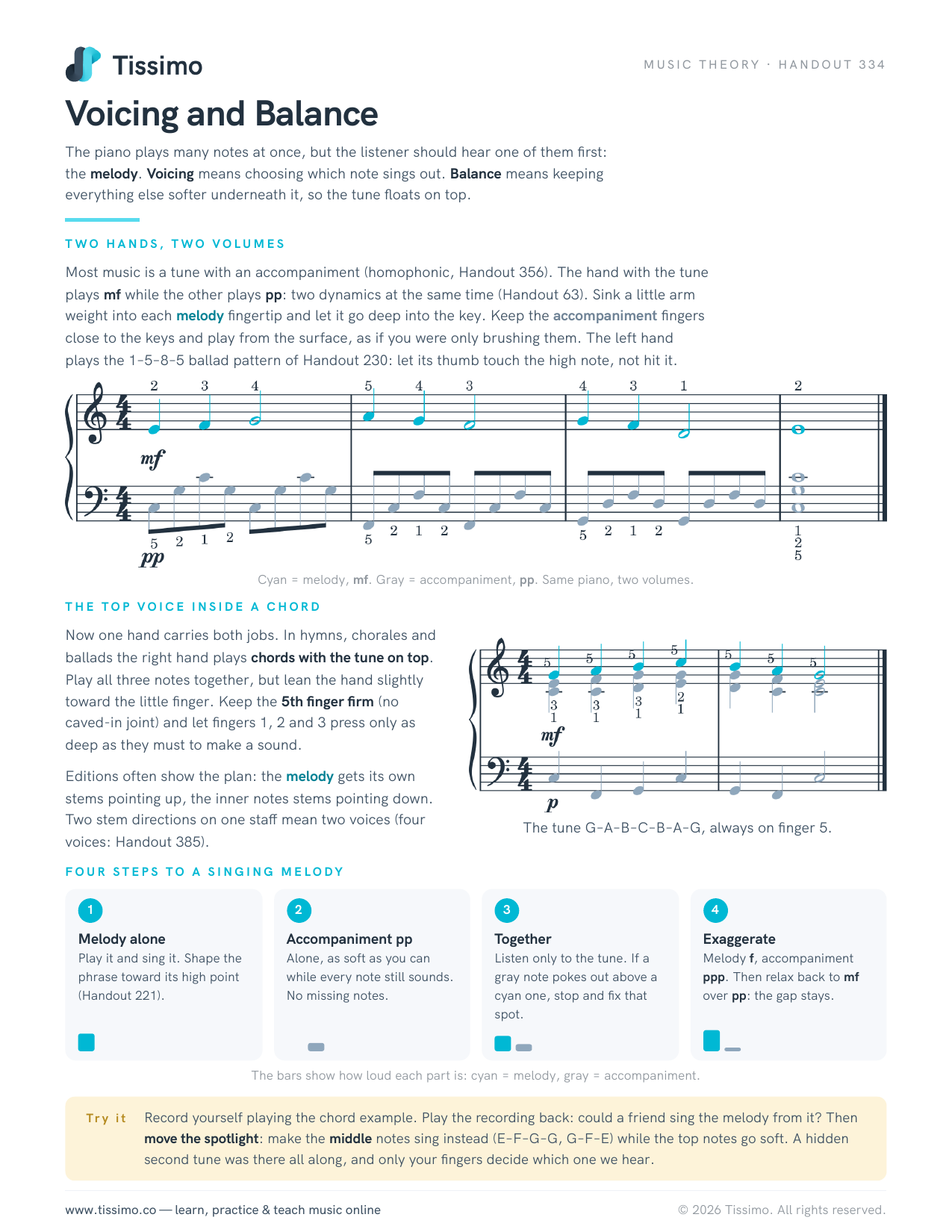 Voicing and BalanceThe piano plays many notes at once, but the listener should hear one of them first: the melody. Voicing means choosing which note sings out. Balance means keeping everything else softer underneath it, so the tune floats on top.