Dynamics & Expression
Morendo
Pronounced moh-REN-doh
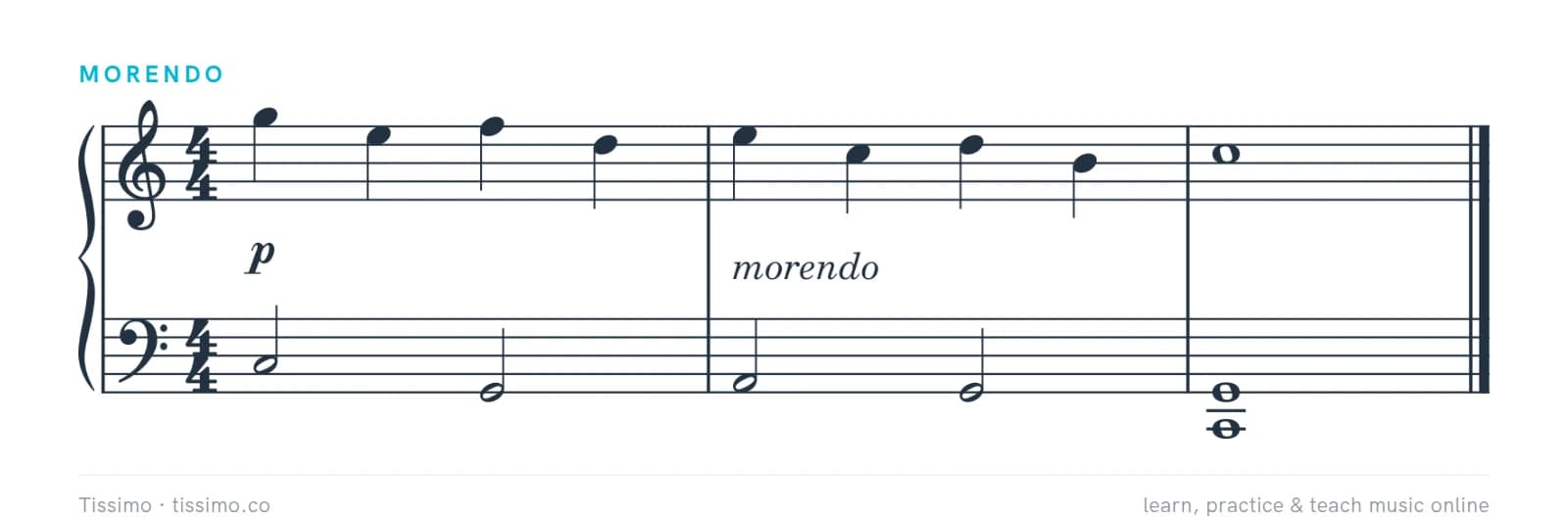
Morendo means 'dying': let the music fade away, getting softer and usually slower until it almost disappears. It most often appears at the end of a piece or a quiet section.
Morendo means "dying", and it asks the music to die away: gradually softer and, in most readings, gradually slower too, until the sound is almost gone. It usually appears near the end of a piece or a section, written below the staff in italics.
More than a diminuendo
A decrescendo only gets softer. Morendo adds a sense of the music running out of life: the tempo relaxes along with the volume, as at the end of a breath. How much to slow down is a judgment call. Some musicians take morendo as purely dynamic, but most allow some easing of the tempo, as the recording does.
Its relatives
Several Italian words describe a similar fading:
- smorzando (smorz.): "extinguishing", fading and slowing, as a flame goes out. Chopin uses it in his Prelude in E minor (Prelude in E minor study).
- perdendosi: "losing itself", fading into silence.
- calando: "dropping", softer and a little slower.
The differences between them are small and not used consistently, so read each in context.
Playing morendo
- Plan the last sound. Decide how soft the final note will be and work back from it, so you do not fade out too soon.
- Keep the line connected. The notes get softer and longer, but the melody should still be heard as one phrase.
- Hold the silence. After the last note, keep still for a moment. The ending is part of the effect.
Common questions
Does morendo mean slowing down?
Mainly it means fading away, getting softer. Most musicians also let the tempo relax a little, since the music is "dying", but the amount of slowing is up to the performer.