Dynamics & Expression
Crescendo
Pronounced kreh-SHEN-dohWritten as cresc.
A crescendo is a gradual increase in loudness. It is written as an opening hairpin (<) under the notes or as the word cresc., and it continues until a new dynamic is reached.
Crescendo means "growing": get gradually louder. It is one of the most common instructions in music, and it can be written two ways:
- An opening hairpin, a wedge that widens to the right, under the notes it covers. The crescendo lasts as long as the hairpin.
- The word cresc. (sometimes with a dashed line, cres - - cen - - do), which lasts until the next dynamic mark. Composers use the word for longer crescendos, where a hairpin would have to stretch over many bars.
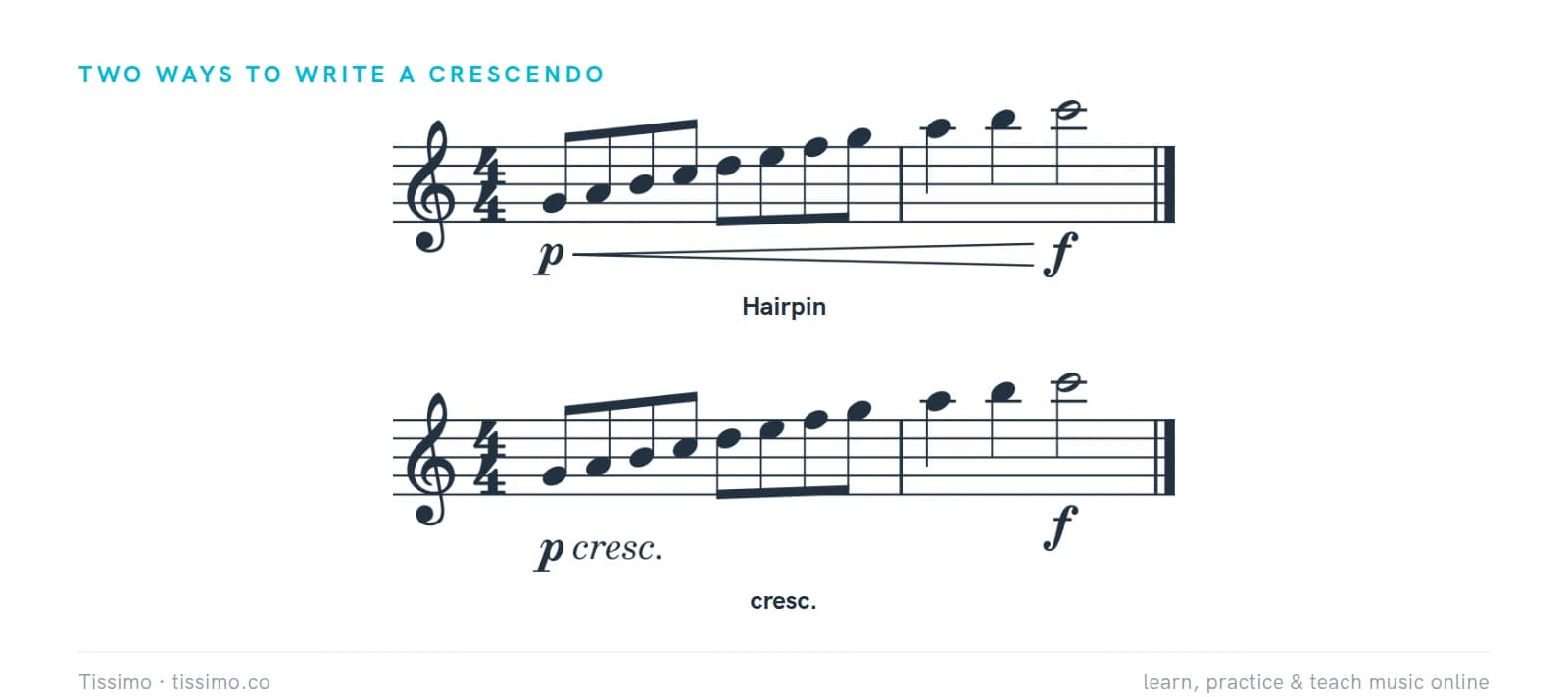
Where it starts and where it goes
A crescendo starts from the dynamic you are at and grows toward the next mark: p < f, or mp < mf. If no target is written, simply grow by a reasonable amount and wait for the next mark to tell you more. Modifiers change the size and pace: poco cresc. grows a little, molto cresc. a lot, and poco a poco cresc. spreads the growth over a long passage.
How to play a good crescendo
- Start soft. Teachers often say "crescendo means piano": stay at the starting level first, or you will be loud too early and have nowhere to go.
- Spread it evenly. Plan the growth note by note. On the piano, each note is struck a little more firmly than the last, because a single held note can only fade.
- Let the music help. Crescendos often follow a rising line or growing harmonic tension. Shape the volume to match.
- Keep the tempo. Many players rush as they get louder. Unless an accelerando is written, the beat stays the same.
A common confusion
In everyday English, "reaching a crescendo" is often used to mean reaching the loudest point. In music, the crescendo is the growth, not the peak; the peak is where it arrives. Ravel's Boléro is the famous example of a single crescendo stretched over a whole piece, about a quarter of an hour of steady growth.
The opposite is the decrescendo, or diminuendo. Our Dynamics & Tempo Ladders exercise asks you to choose the right hairpin between two dynamics, and the Phrasing handout uses hairpins to shape a melody toward its high point.
Match the terms and the Music word search both include crescendo, the Musical terms & signs chart shows the hairpin and cresc. side by side, and the Dynamic Ladder gives you the rungs to climb.
Common questions
What is the symbol for crescendo?
An opening hairpin: two lines that start together and spread apart to the right (<), written under the notes. The abbreviation cresc. means the same.
Does crescendo mean the loudest part?
No. A crescendo is the gradual getting louder. The loudest point is where the crescendo arrives, usually marked with a new dynamic such as f or ff.
Practice it: free worksheets
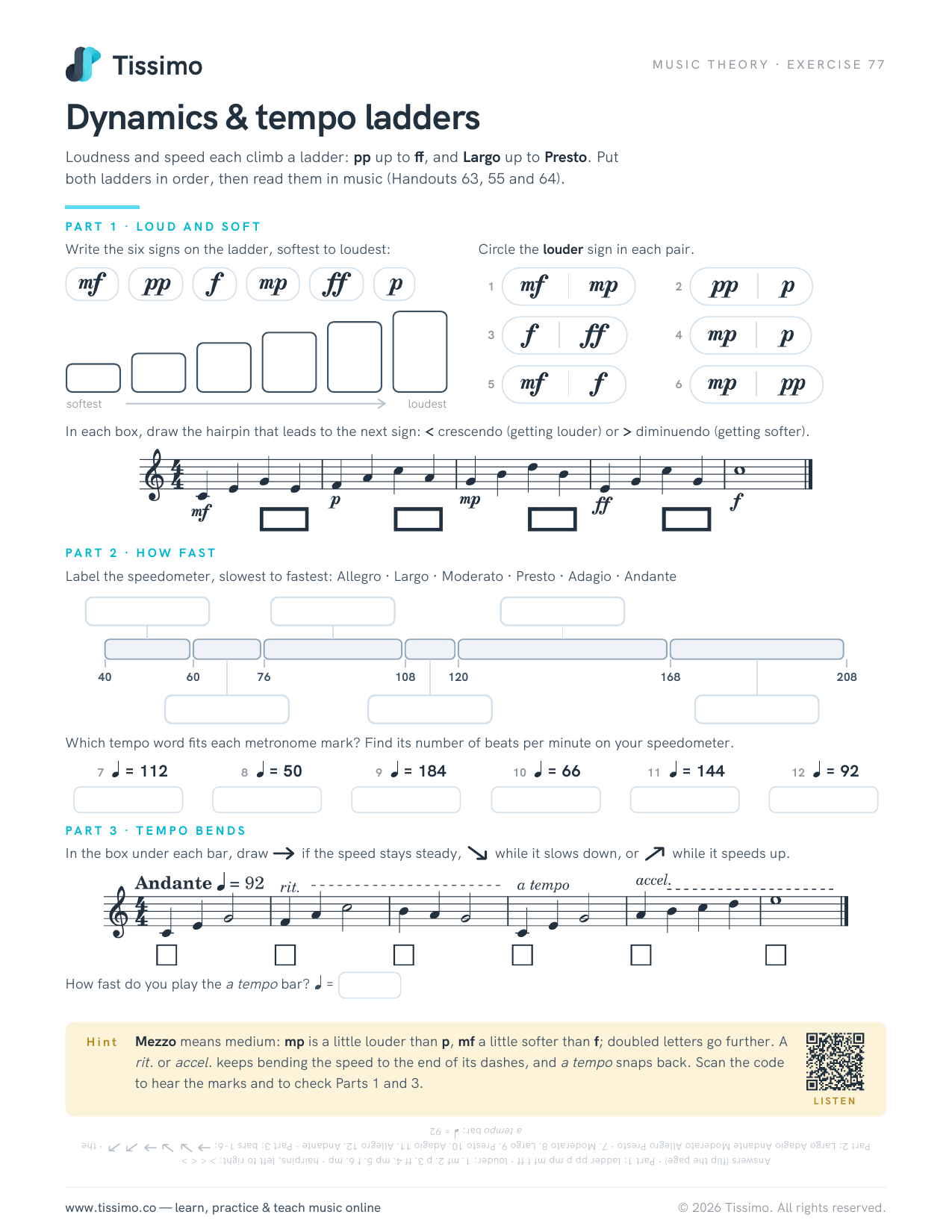 Dynamics & tempo laddersLoudness and speed each climb a ladder: pp up to ff, and Largo up to Presto. Put both ladders in order, then read them in music (Handouts 63, 55 and 64).
 Match the termsDraw a line from each term to its meaning. The colors tell you what kind of word it is — but each color has several meanings on the right, so read carefully.
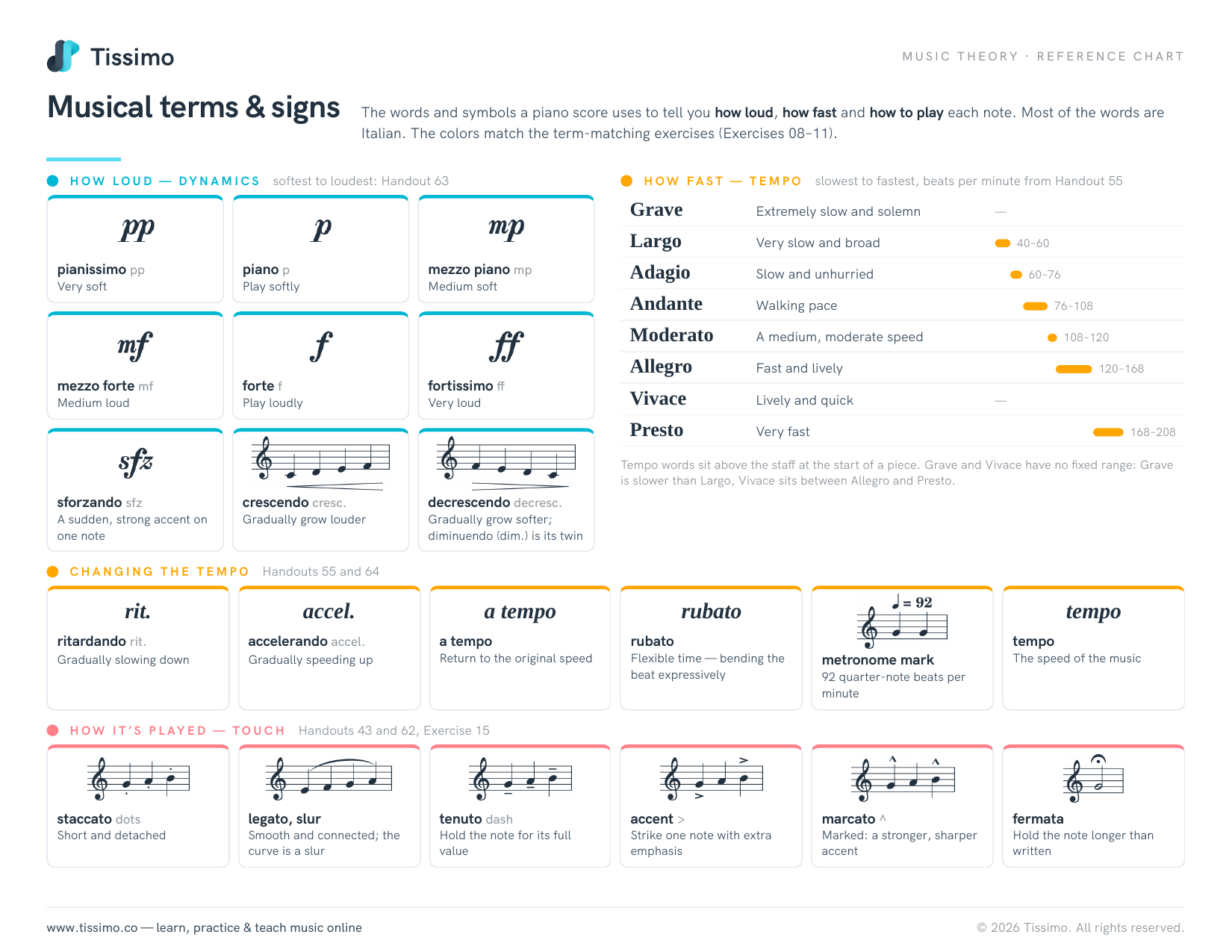 Musical terms & signsThe words and symbols a piano score uses to tell you how loud, how fast and how to play each note. Most of the words are Italian. The colors match the term-matching exercises (Exercises 08–11, 74 and 75).
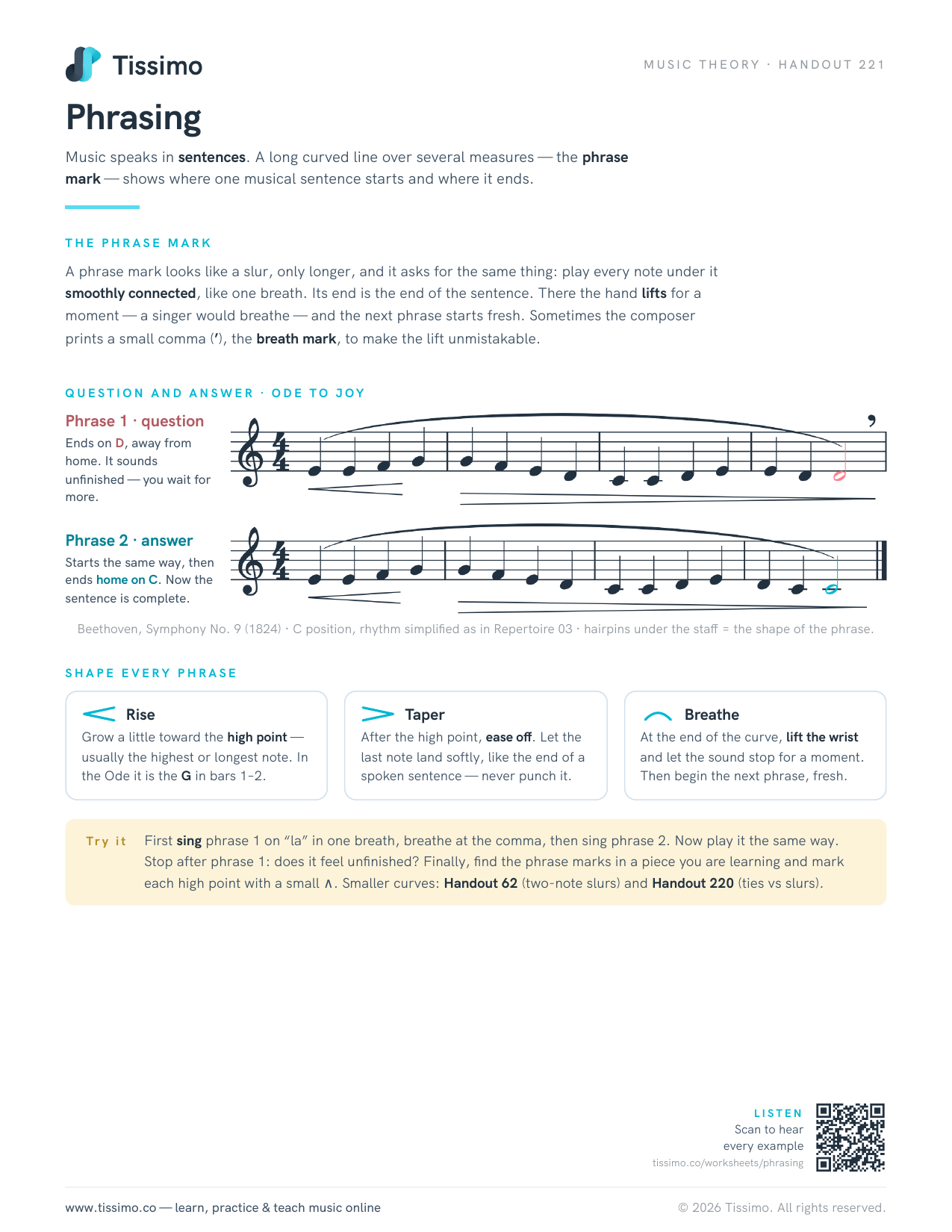 PhrasingMusic speaks in sentences. A long curved line over several measures — the phrase mark — shows where one musical sentence starts and where it ends.
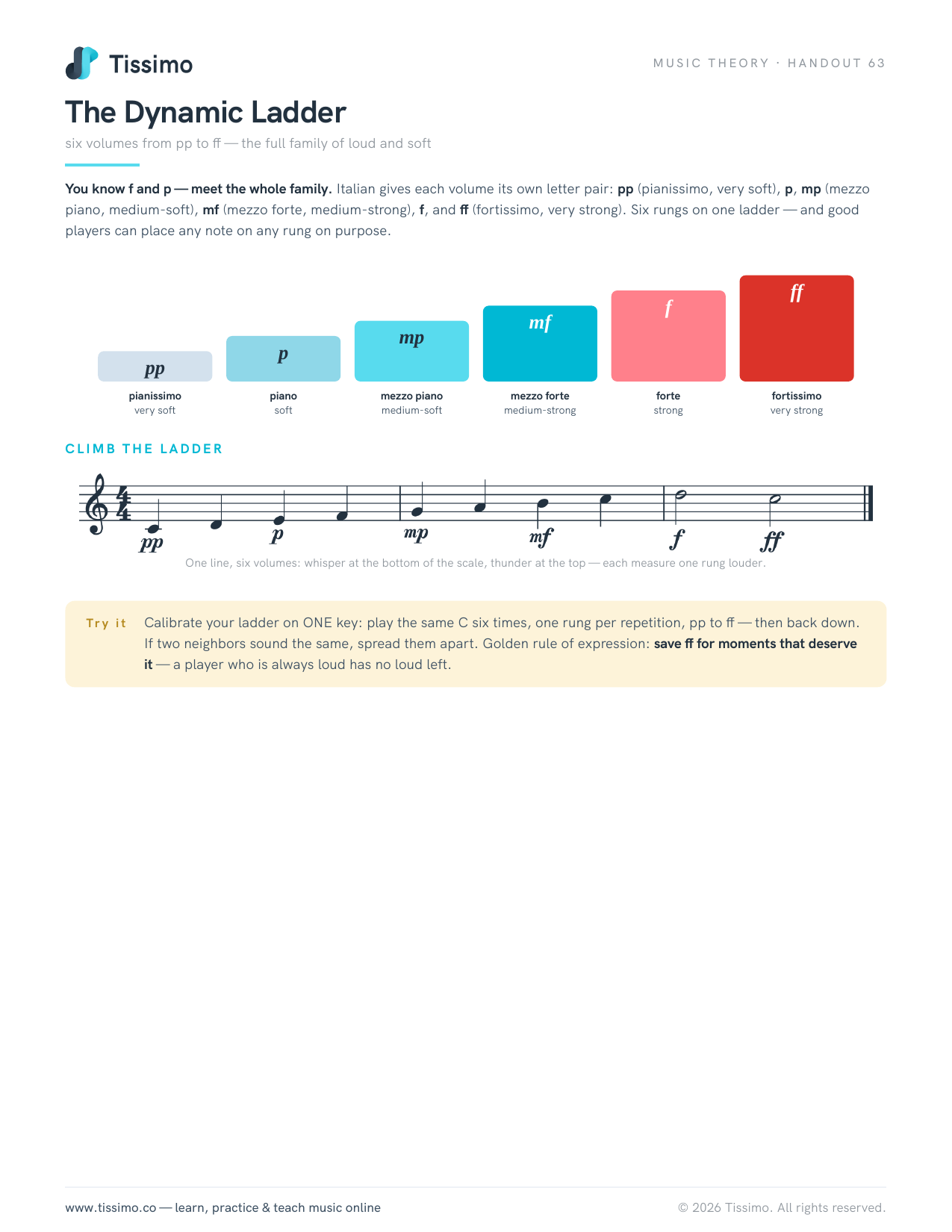 The Dynamic Laddersix volumes from pp to ff — the full family of loud and soft
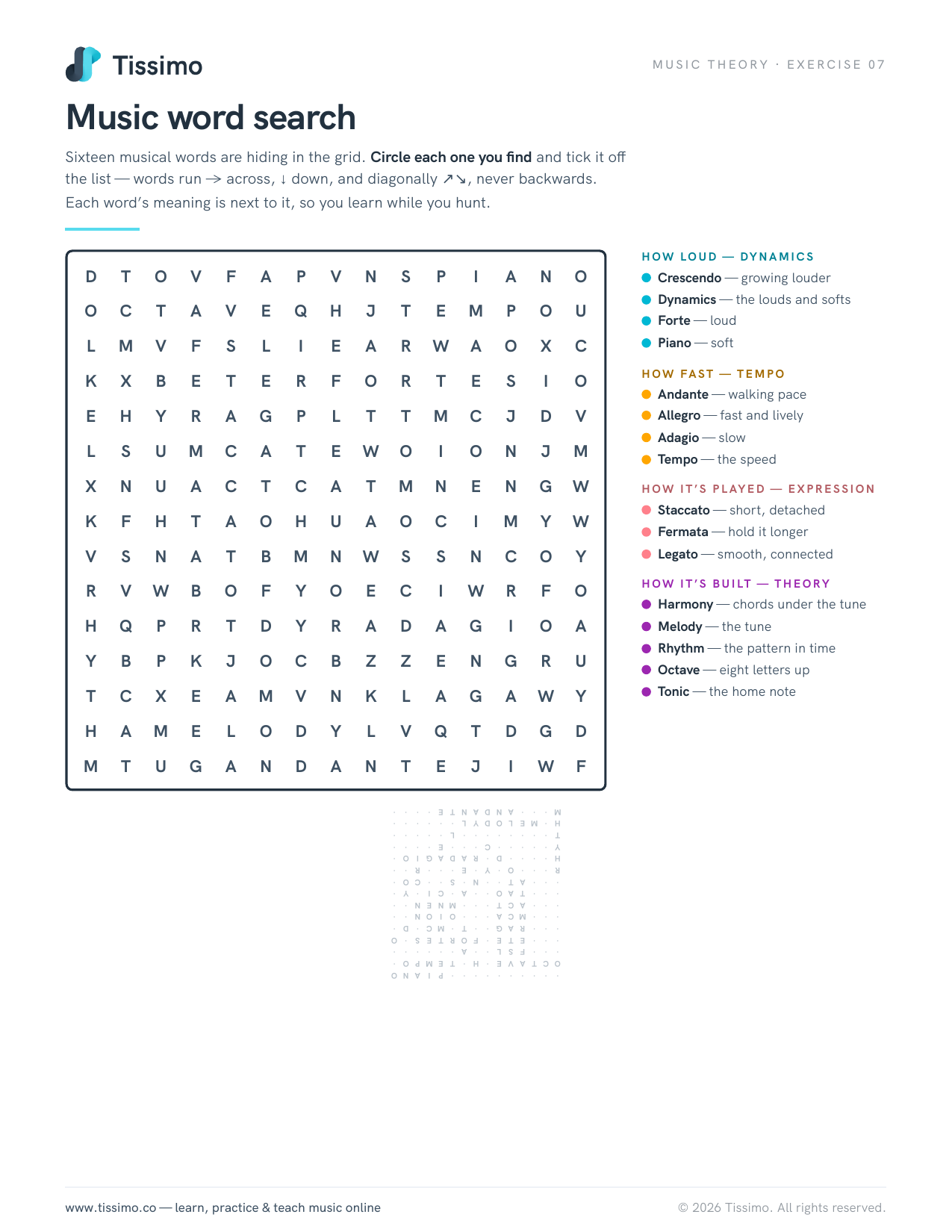 Music word searchSixteen musical words are hiding in the grid. Circle each one you find and tick it off the list — words run → across, ↓ down, and diagonally ↗↘, never backwards. Each word’s meaning is next to it, so you learn while you hunt.