Tempo Markings
Allargando
Pronounced ah-lar-GAHN-dohWritten as allarg.
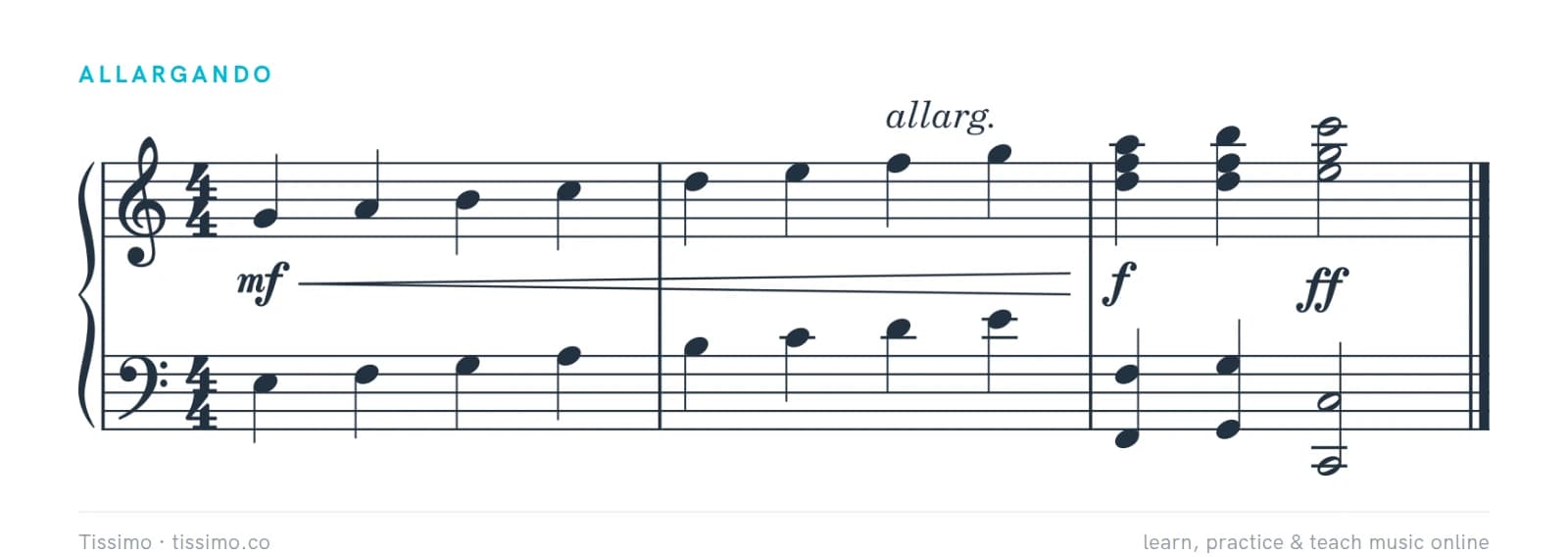
Allargando, written allarg., means broadening: slow down gradually while keeping the sound full, usually louder and weightier. It is typically used at a climax or a grand final cadence.
Allargando means "broadening" or "widening", from the Italian allargare, to widen. Written allarg., it asks you to slow down gradually and make the sound fuller at the same time, usually louder and weightier. It is the tempo marking of a grand arrival.
Allargando versus ritardando
A ritardando slows down and usually relaxes: the music winds down. An allargando slows down and grows: the music gets bigger. You will often find it with forte, fortissimo or a crescendo, at the climax of a piece or just before the final cadence. Many editions print a loud dynamic right beside it.
Playing allargando
- Slow down gradually, but usually less than you would at the end of a quiet piece. The goal is breadth, not a stop.
- Give each note and chord more weight and more time. Use the arm, and let chords ring.
- Do not let the volume sag while you slow. Keep the sound full, or let it grow with the hairpin.
- If A tempo follows, it usually comes after the climax, and the return should feel like a release of tension.
Allargando is common in Romantic music and in later orchestral, band and film scores, wherever a big moment needs room to land. Think of it as the opposite of hurrying to the finish: the music arrives with its full weight.
For the gradual slowing itself, start with Ritardando & Accelerando.
Common questions
Does allargando mean slow down or get louder?
Both, in a sense: it means broaden. The tempo slows gradually while the sound stays full or grows, so allargando usually comes with a loud dynamic or a crescendo.