Dynamics & Expression
Maestoso
Pronounced my-eh-STOH-soh
Maestoso means 'majestic': play in a stately, dignified way, usually at a moderate, unhurried tempo with full, weighty tone. It appears alone or with a tempo word, as in Allegro maestoso.
Maestoso means "majestic" or "stately". It asks for dignity and grandeur: a full, weighty tone, firm rhythm and an unhurried tempo that never feels rushed. On its own, Maestoso works as a tempo heading, usually moderate in speed. Attached to another word, it adds majesty: Allegro maestoso is fast but grand.
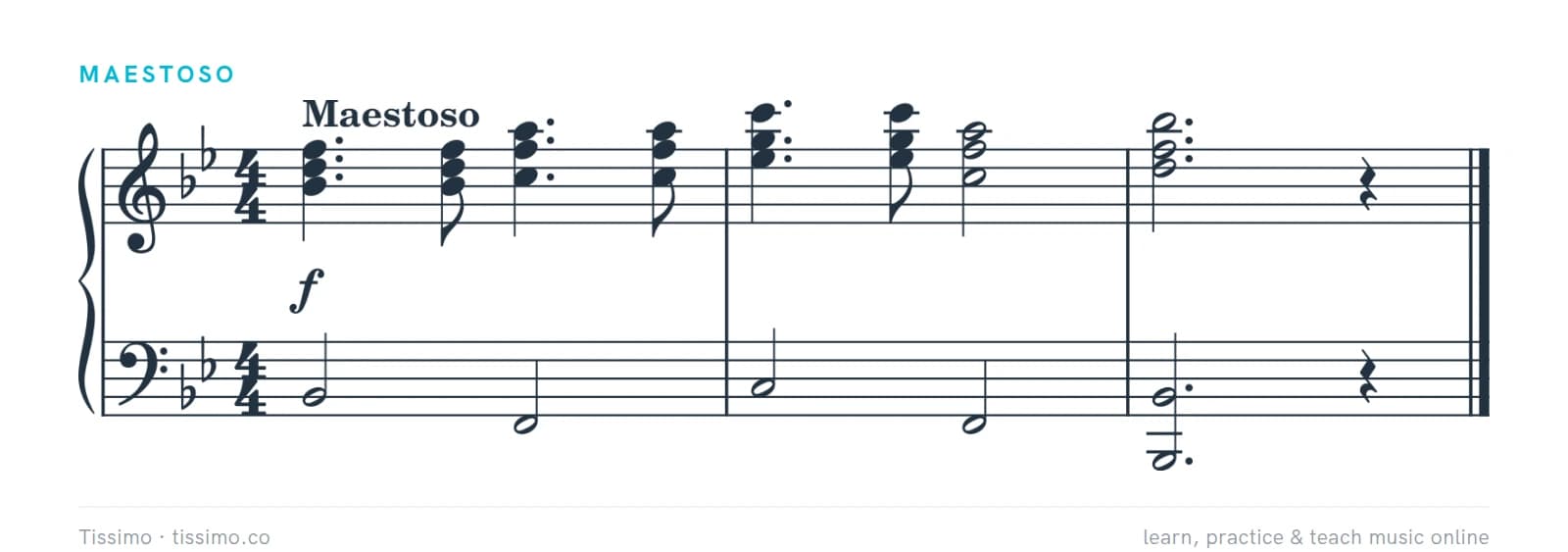
Maestoso in real music
- Beethoven's Ninth Symphony opens Allegro ma non troppo, un poco maestoso: fast, not too fast, a little majestic.
- The first movement of Chopin's Piano Concerto No. 1 is marked Allegro maestoso, and his Second Concerto opens Maestoso.
Maestoso music often uses dotted rhythms, full chords, a strong bass and broad phrases, like a procession or a ceremonial entrance.
Playing maestoso
- Weight and breadth. Let the arm sink into the chords. Give each beat its full length; majestic music does not hurry.
- Sharp dotted rhythms. Keep the short note of a dotted pair short and late, so the long notes feel proud rather than lazy.
- Grand but not harsh. Majesty comes from fullness and control, not from banging.
Similar words: pesante (heavy, weighty), grave (very slow and solemn), and allargando, which broadens the tempo toward a grand arrival.
Common questions
Is maestoso a tempo or an expression?
Both. On its own it usually implies a moderate, stately tempo; joined to a tempo word, as in Allegro maestoso, it describes the character while the other word sets the speed.