Chords & Harmony
Alberti Bass
Pronounced al-BEHR-tee
Alberti bass is a left-hand accompaniment that breaks each chord into the repeating pattern lowest–highest–middle–highest, such as C–G–E–G. It is a hallmark of Classical-era keyboard music.
Alberti bass is a left-hand accompaniment that breaks each chord into a repeating four-note pattern: lowest note, highest note, middle note, highest note. On a C major chord (C–E–G) that gives C–G–E–G, C–G–E–G, usually in even eighth or sixteenth notes. It is a kind of broken chord, and one of the most recognizable sounds of the Classical period.
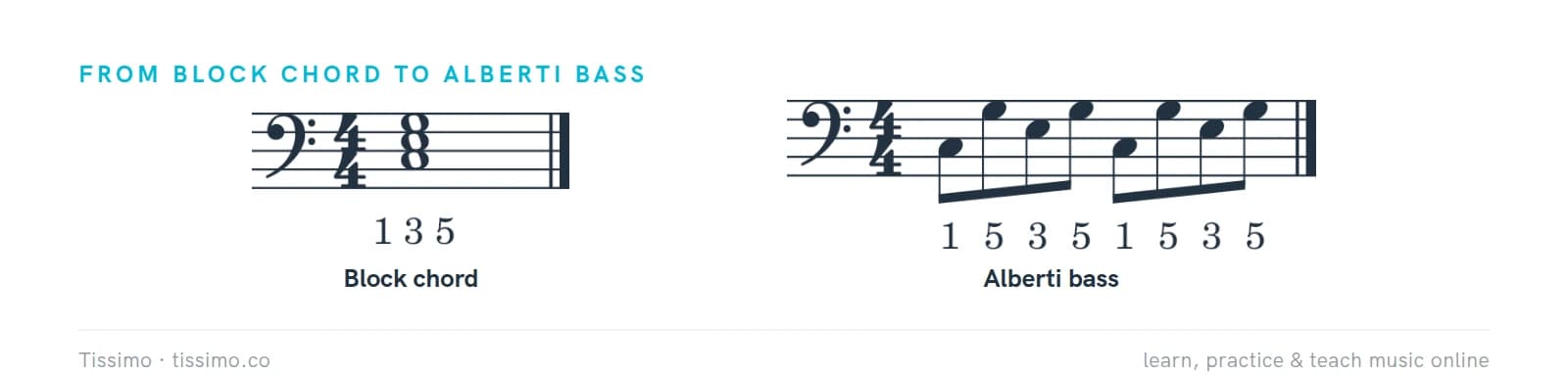
Where the name comes from
The pattern is named after Domenico Alberti, an Italian composer of the early 18th century who used it so often in his keyboard sonatas that it became linked with his name. He was far from its only user: Haydn, Mozart, Clementi and many others wrote Alberti basses. The opening of Mozart's Piano Sonata in C major, K. 545, is one of the best-known examples (Inside Mozart's Sonata in C, K. 545).
How it works with a melody
Alberti bass keeps the harmony moving and fills every beat, which frees the right hand to sing a simple melody above it. That texture, a clear tune over a chordal accompaniment, is called homophony. In the example below the left hand stays in one small area of the keyboard: the chords are in their closest positions (I, IV6/4, V6/5, I), so only one or two fingers move at each change.
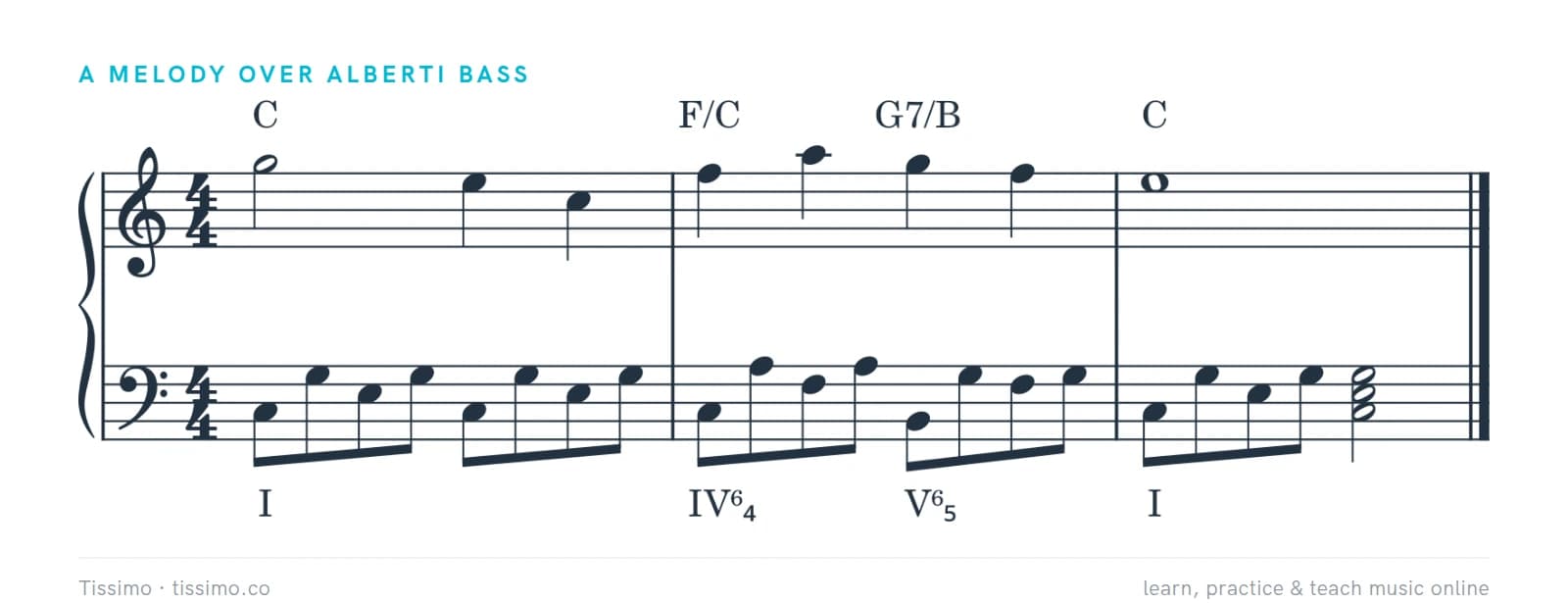
Playing it well
- Keep it quiet. The accompaniment sits under the melody; it should not compete with it.
- Lighten the repeated note. The top note (G in C–G–E–G) comes back twice in every group. Play it with a light thumb so that it doesn't hammer.
- Rotate, don't lift. Let the forearm rock gently between the little finger and the thumb instead of lifting each finger high.
- Learn the blocks first. Play each chord as a block chord until the changes are easy, then break it into the pattern.
A common left-hand fingering for C–G–E–G is 5–1–3–1: little finger on C, thumb on G, middle finger on E.
Practice with Alberti Bass and Accompaniment patterns.
Common questions
Why is it called Alberti bass?
It is named after Domenico Alberti, an Italian composer of the early 18th century who used the pattern constantly in his keyboard sonatas. Many other composers of the time used it too.
What fingering do you use for Alberti bass?
For C–G–E–G in the left hand, 5–1–3–1 is the usual choice: little finger on the bottom note, thumb on the top note, middle finger on the middle note.
Practice it: free worksheets
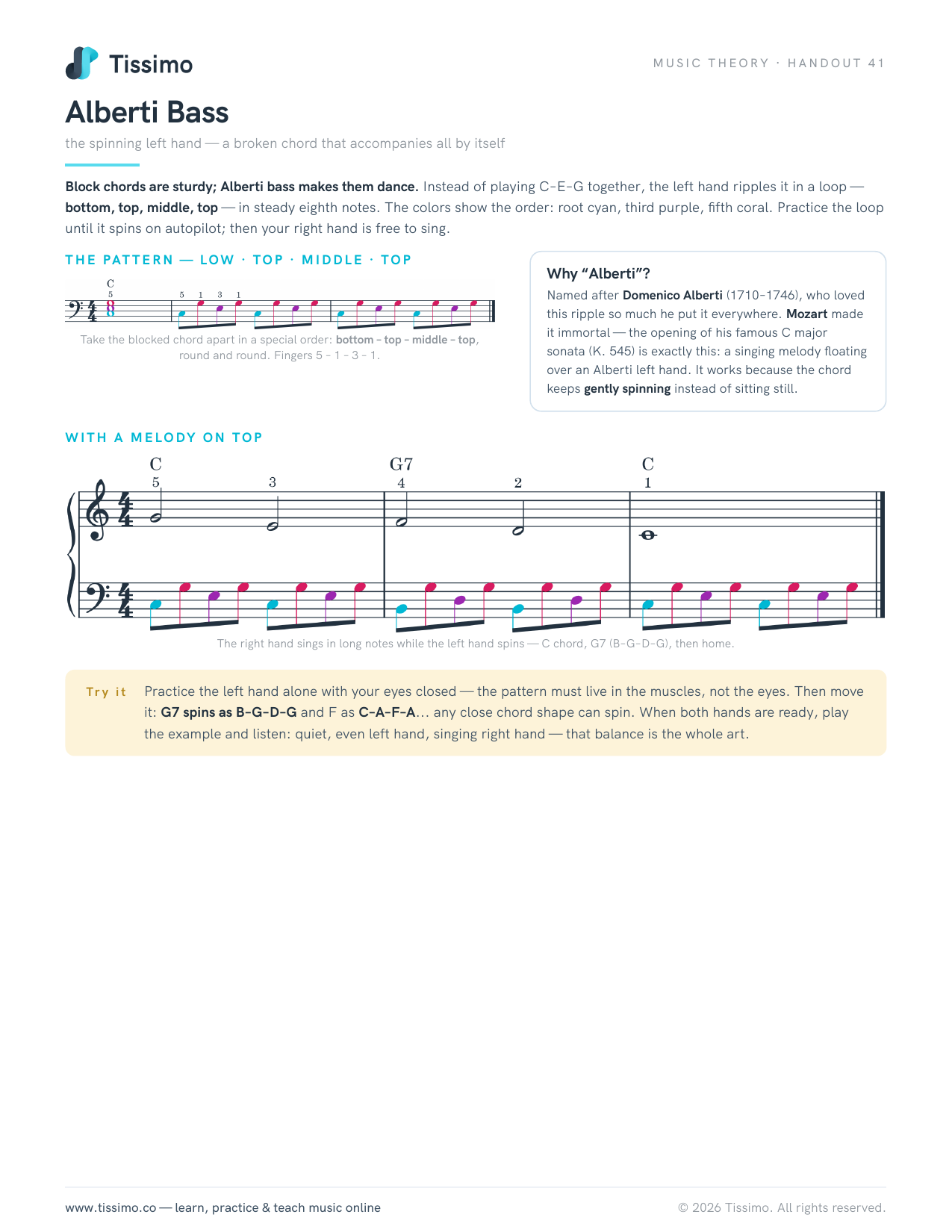 Alberti Bassthe spinning left hand — a broken chord that accompanies all by itself
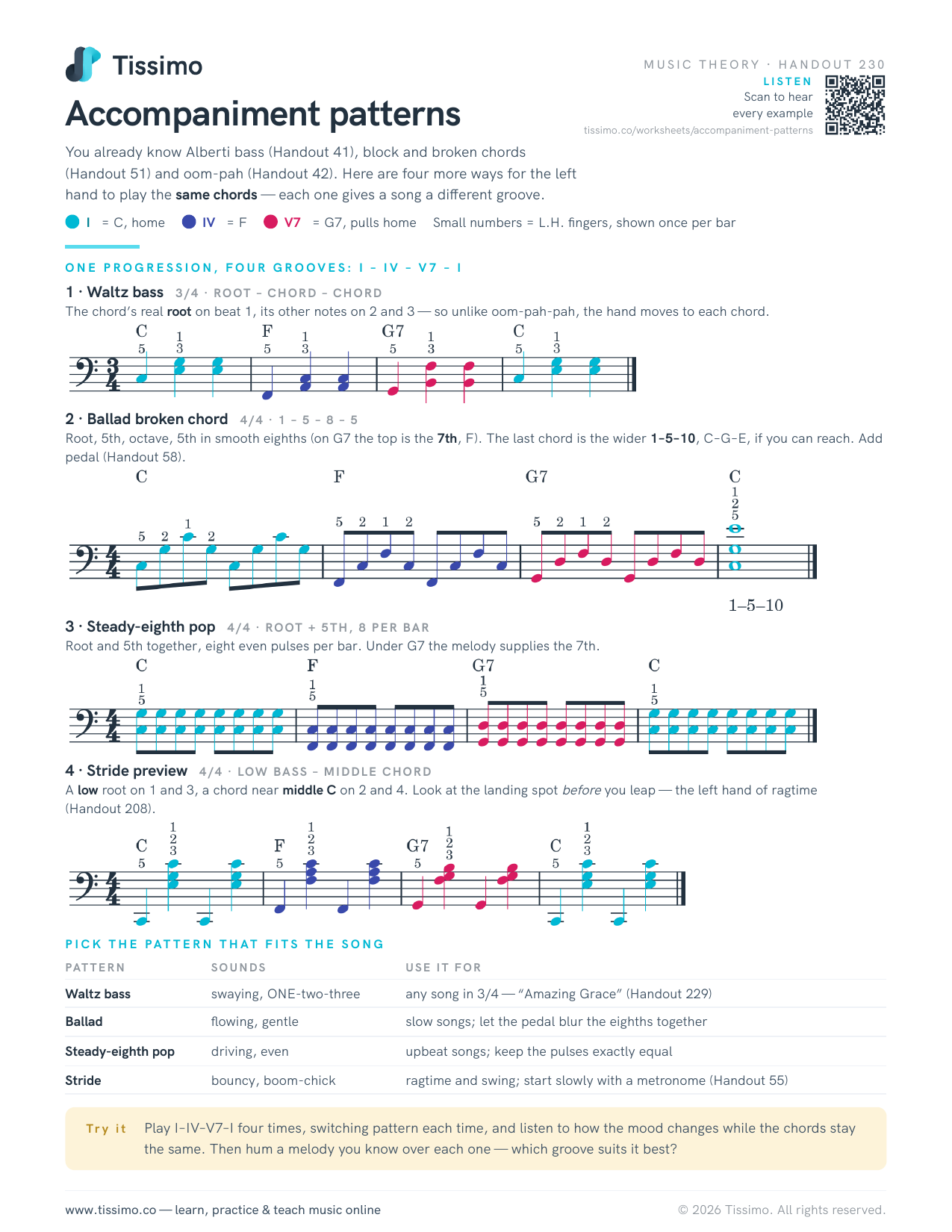 Accompaniment patternsYou already know Alberti bass (Handout 41), block and broken chords (Handout 51) and oom-pah (Handout 42). Here are four more ways for the left hand to play the same chords — each one gives a song a different groove.
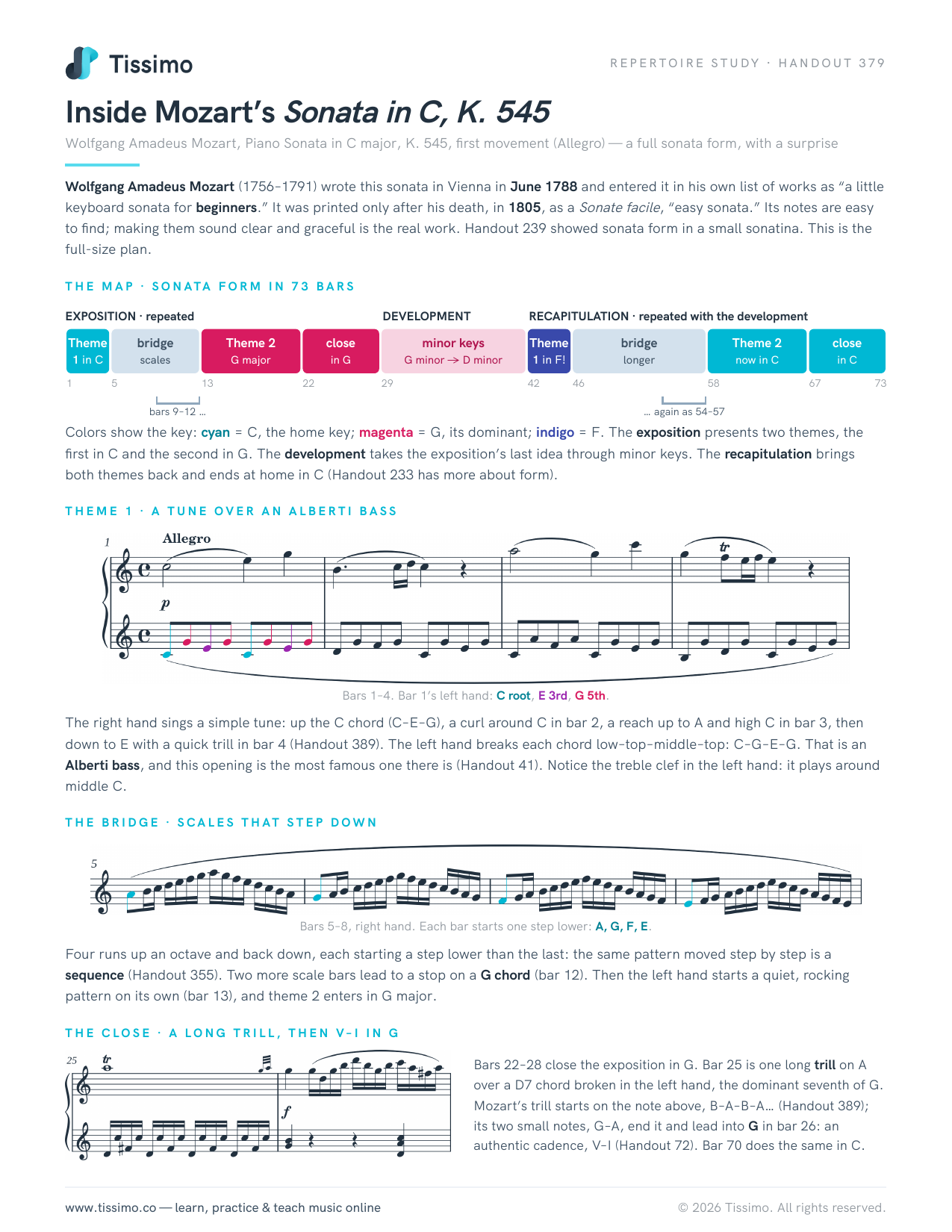 Inside Mozart’s Sonata in C, K. 545Wolfgang Amadeus Mozart, Piano Sonata in C major, K. 545, first movement (Allegro) — a full sonata form, with a surprise
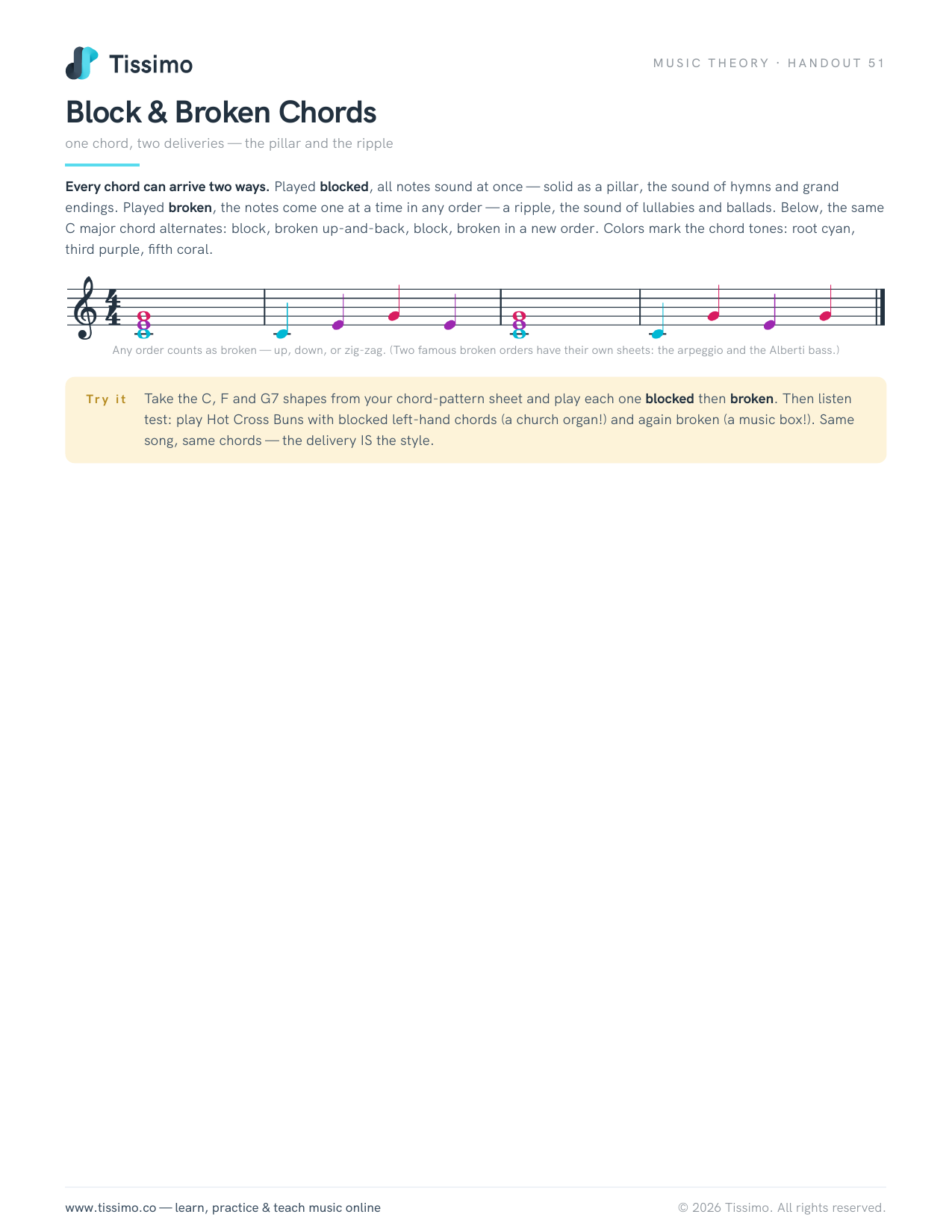 Block & Broken Chordsone chord, two deliveries — the pillar and the ripple
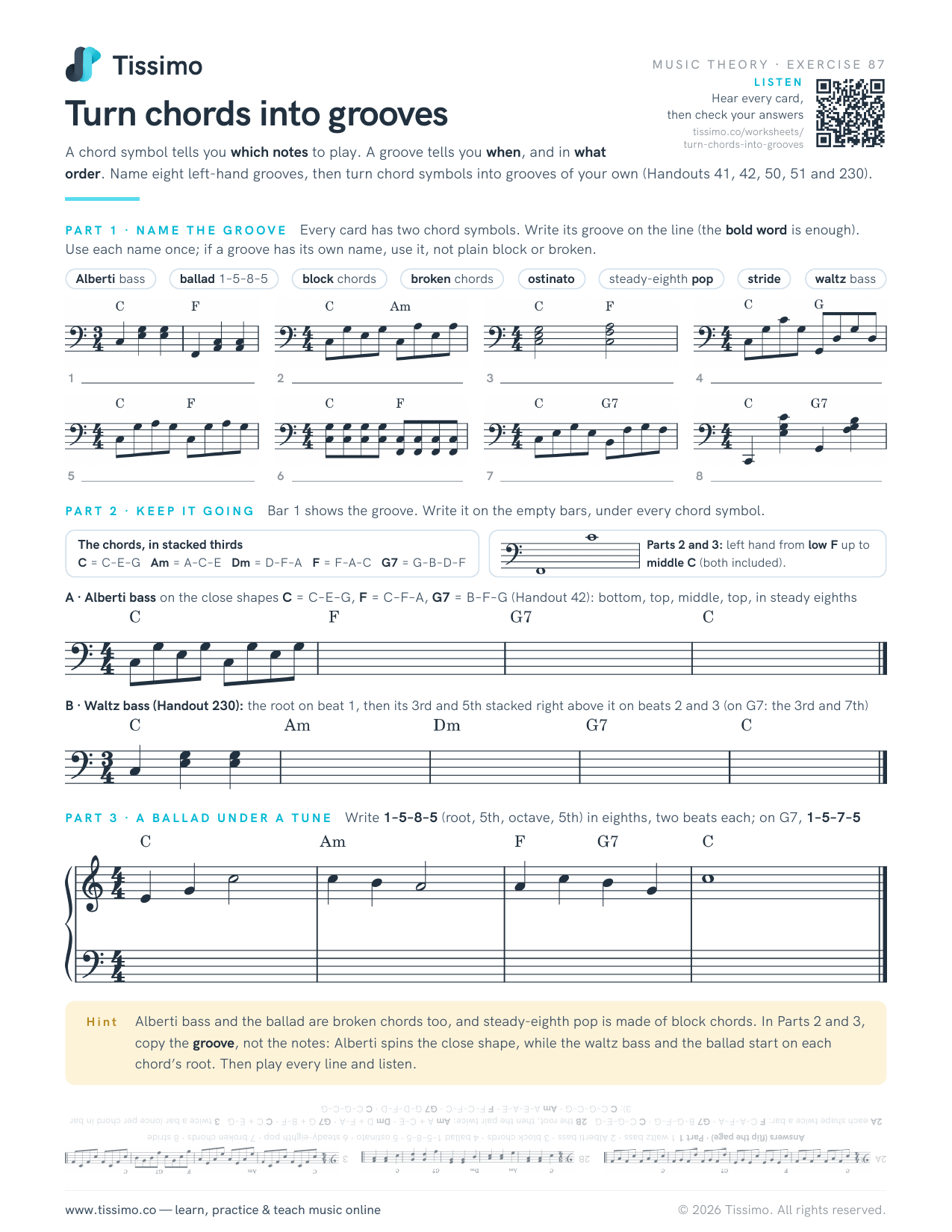 Turn chords into groovesA chord symbol tells you which notes to play. A groove tells you when, and in what order. Name eight left-hand grooves, then turn chord symbols into grooves of your own (Handouts 41, 42, 50, 51 and 230).