Chords & Harmony
Arpeggio
Pronounced ar-PEJ-ee-oh
An arpeggio is a chord played one note at a time, usually in order from the bottom up or the top down, such as C–E–G–C. Musicians practice them in every key, and composers use them in accompaniments and melodies.
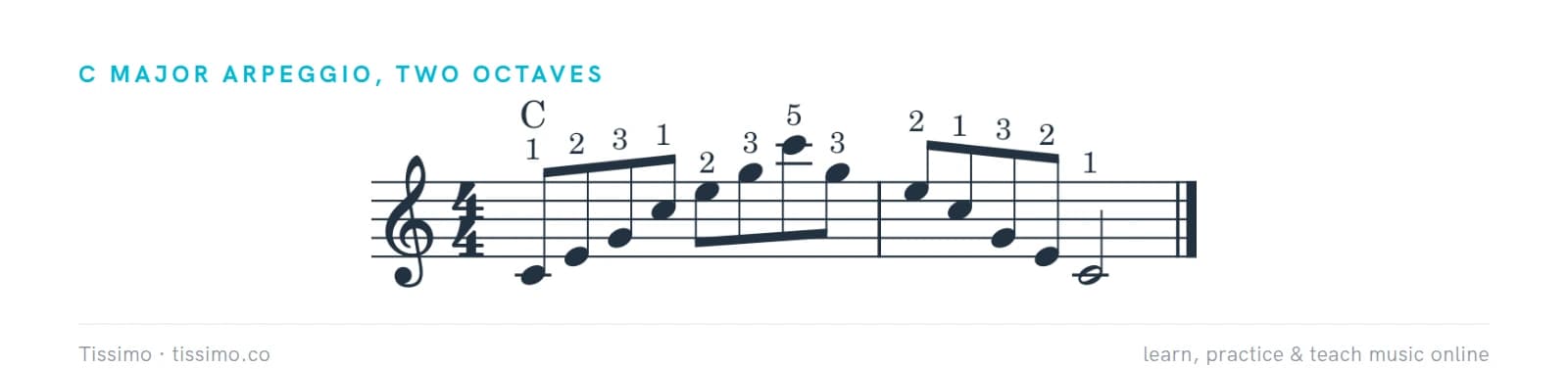
An arpeggio is a chord played one note at a time, usually in order from the bottom up or the top down. C–E–G–C is an arpeggio of C major; play it across two octaves and back and you have one of the classic piano exercises. The word comes from the Italian arpeggiare, "to play the harp", because harpists sound chords this way.
Arpeggio or broken chord?
Both mean playing a chord's notes separately. "Arpeggio" usually means going through the notes in order, up or down, often across several octaves. Broken chord is the wider term and includes patterns that jump around inside the chord, like the Alberti bass (C–G–E–G). Some exam syllabuses list "broken chords" and "arpeggios" as separate items, so check which one you are asked for.
How to practice them on the piano
- Learn the fingering first. For C major over two octaves, the right hand usually plays 1-2-3-1-2-3-5 going up, with the thumb passing under after G; the left hand plays 5-4-2-1-4-2-1.
- Practice the thumb under motion slowly, and keep the wrist level and loose as the hand travels along the keyboard.
- Play the chord as a block first, so your hand knows the shape before it moves.
- Start hands separately, then together, and aim for even notes; a metronome helps.
Arpeggios in music
Composers use arpeggios everywhere: flowing left-hand accompaniments, rippling harp and guitar parts, brilliant runs in concertos, and melodies that outline a chord. Bach's Prelude in C major from Book 1 of The Well-Tempered Clavier is built almost entirely from one arpeggiated pattern, one chord per bar; Analyze the Prelude in C shows how. Singers, string players and wind players practice arpeggios too, and synthesizers have an arpeggiator that turns a held chord into a repeating pattern.
Not to be confused with
A wavy vertical line in front of a chord tells you to roll it quickly from the bottom up. That is an arpeggiando (rolled chord): the same idea, but as a quick spread of one chord rather than a figure in rhythm.
Practice with Arpeggios: One Hand, Arpeggios in Every Key and Two-Octave Arpeggios in Every Key.
Common questions
What is the difference between a scale and an arpeggio?
A scale moves by step through each note of a key (C–D–E–F–G–A–B–C). An arpeggio skips, using only the notes of one chord (C–E–G–C).
Why do musicians practice arpeggios?
They train the hand to move across the instrument with even, controlled shifts, and they build the chord shapes that appear constantly in real music.
Practice it: free worksheets
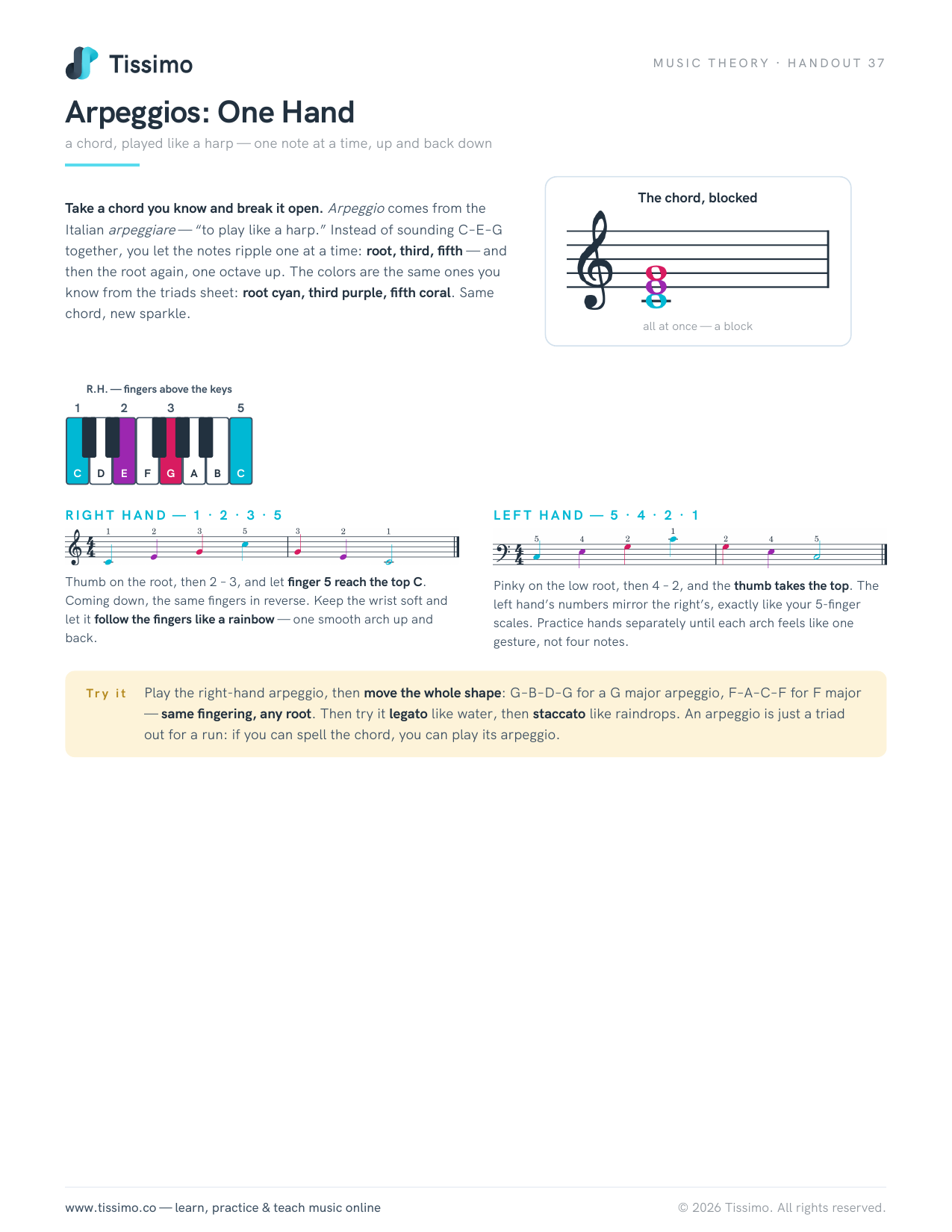 Arpeggios: One Handa chord, played like a harp — one note at a time, up and back down
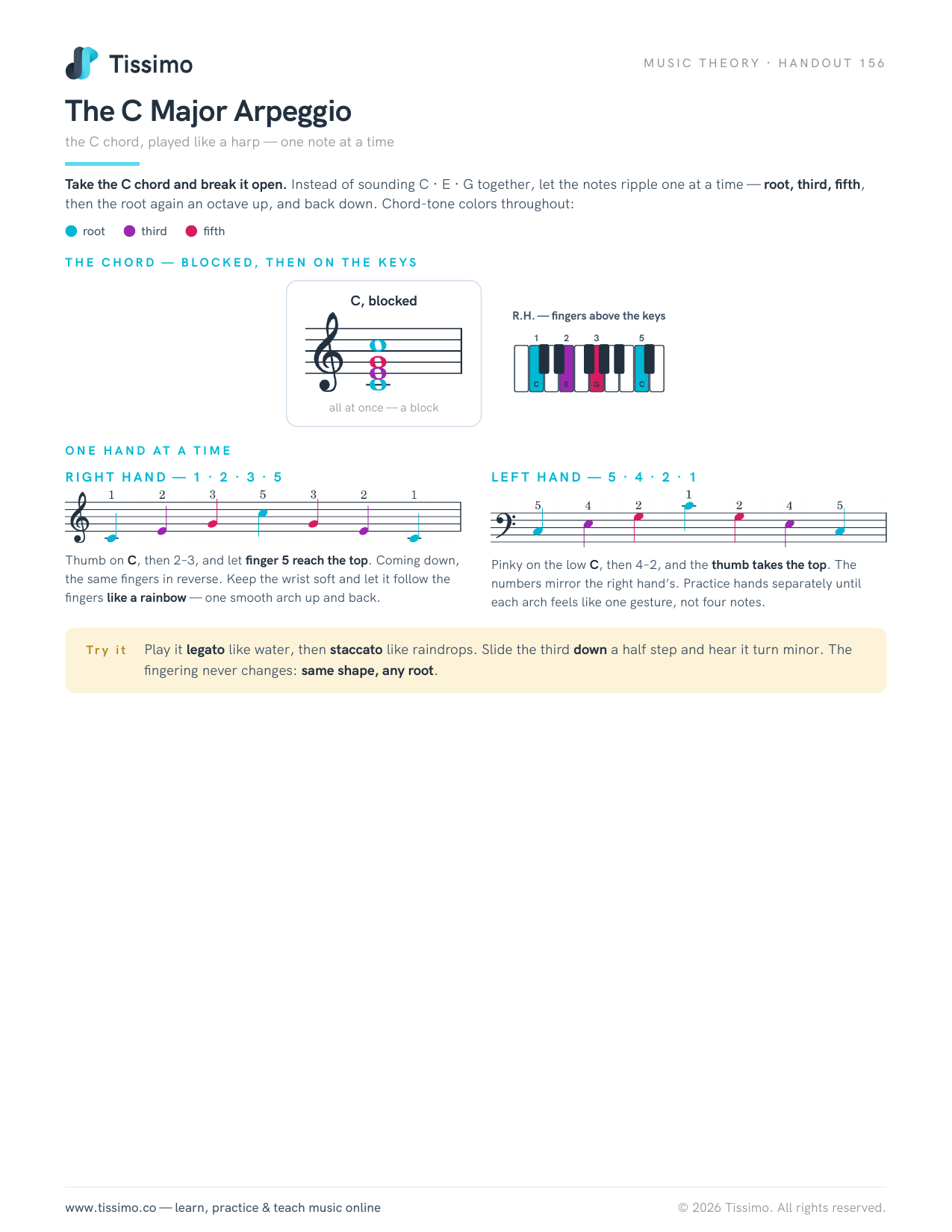 Arpeggios in Every KeyThe chord played like a harp — one note at a time, up and back down, in all 24 keys.
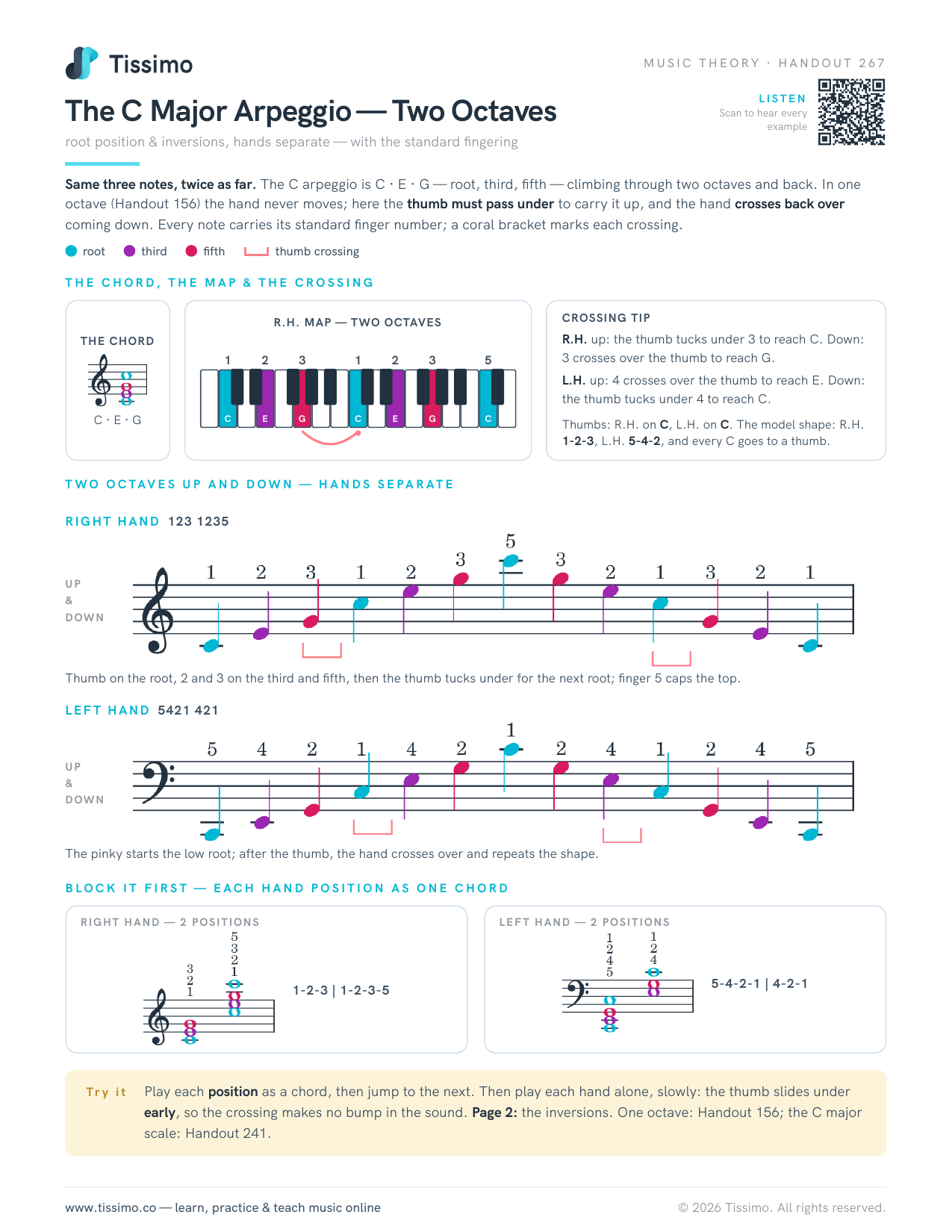 Two-Octave Arpeggios in Every KeyTwo octaves up and down with the thumb crossings marked and every note fingered, in all 24 keys.
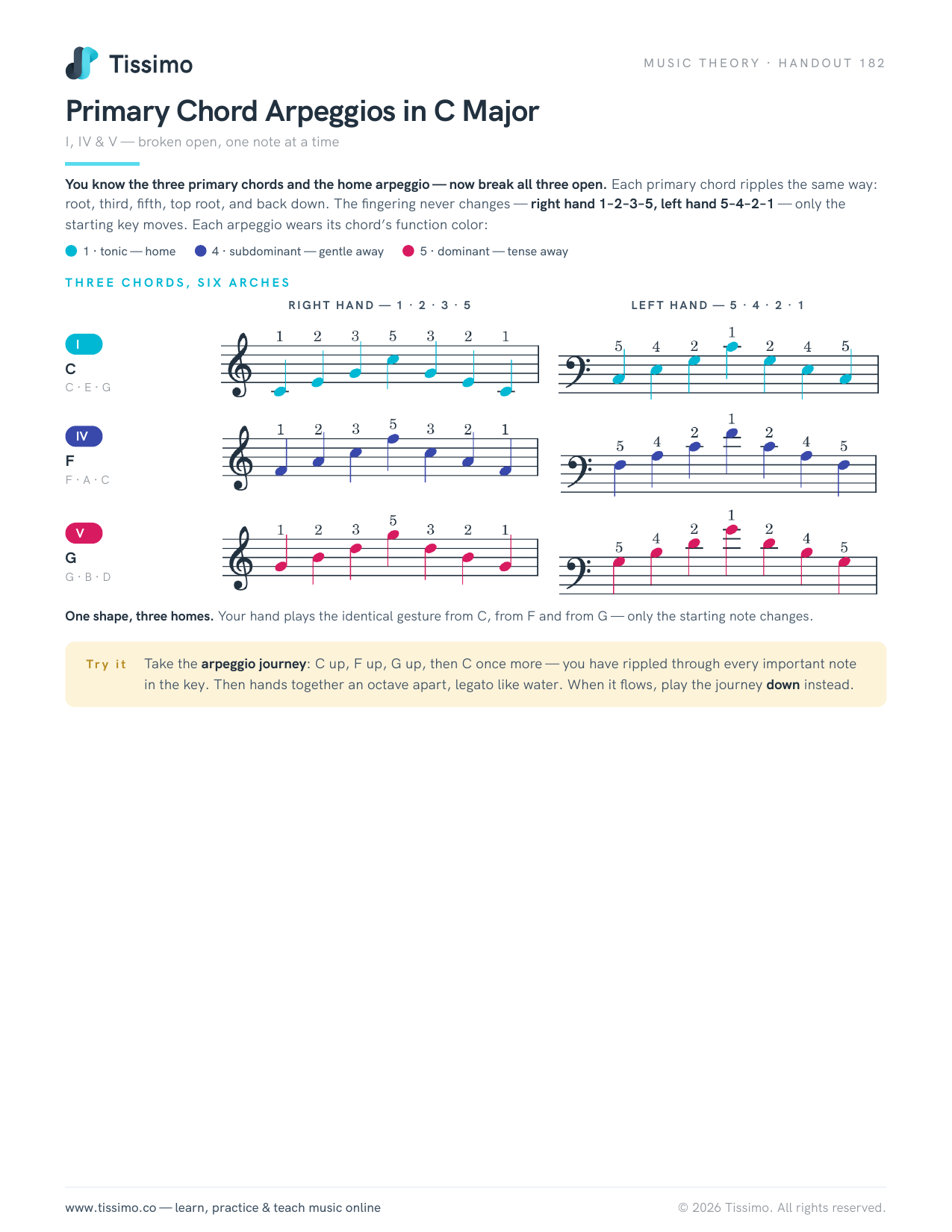 Primary Chord Arpeggios in Every KeyI, IV and V broken open, one note at a time, in all 24 keys.
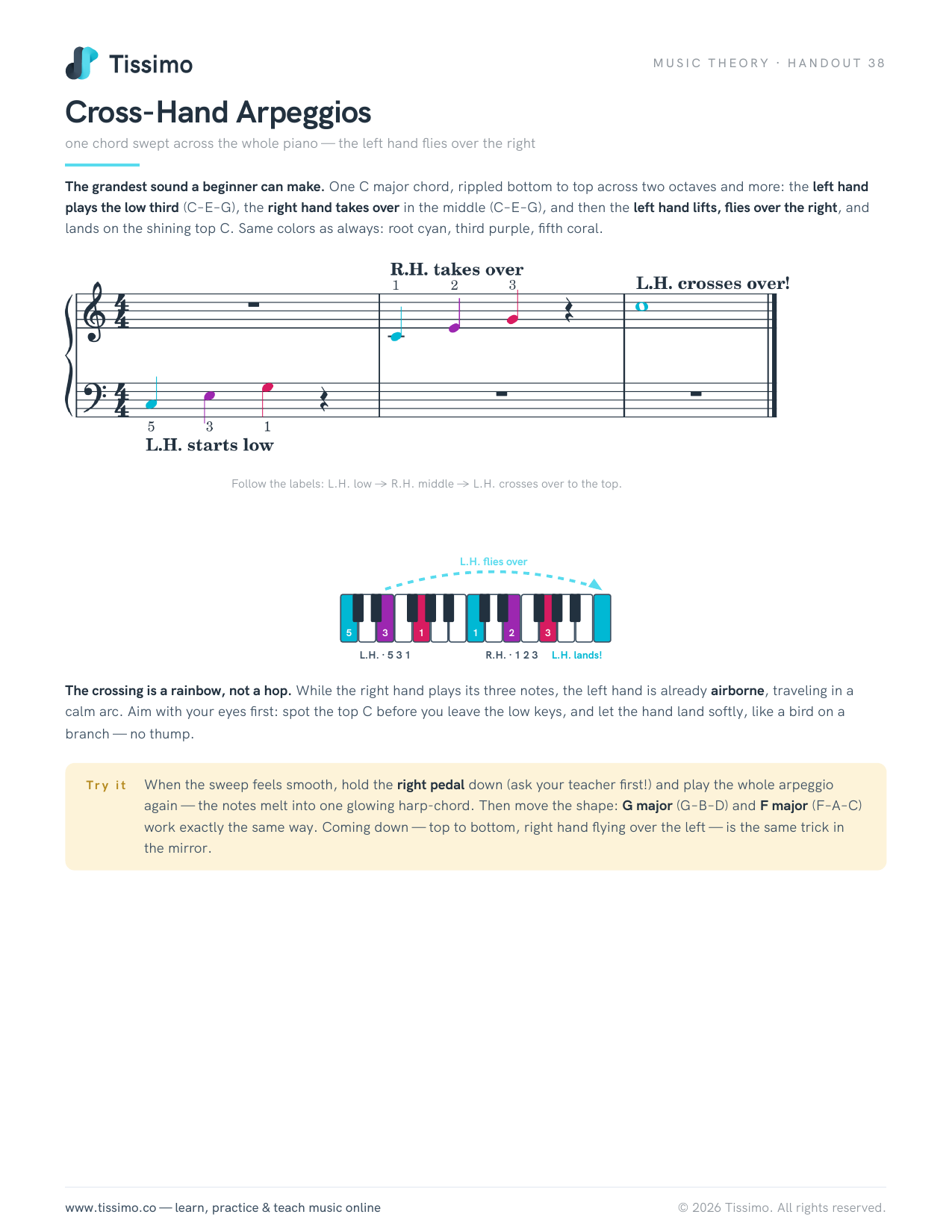 Cross-Hand Arpeggiosone chord swept across the whole piano — the left hand flies over the right
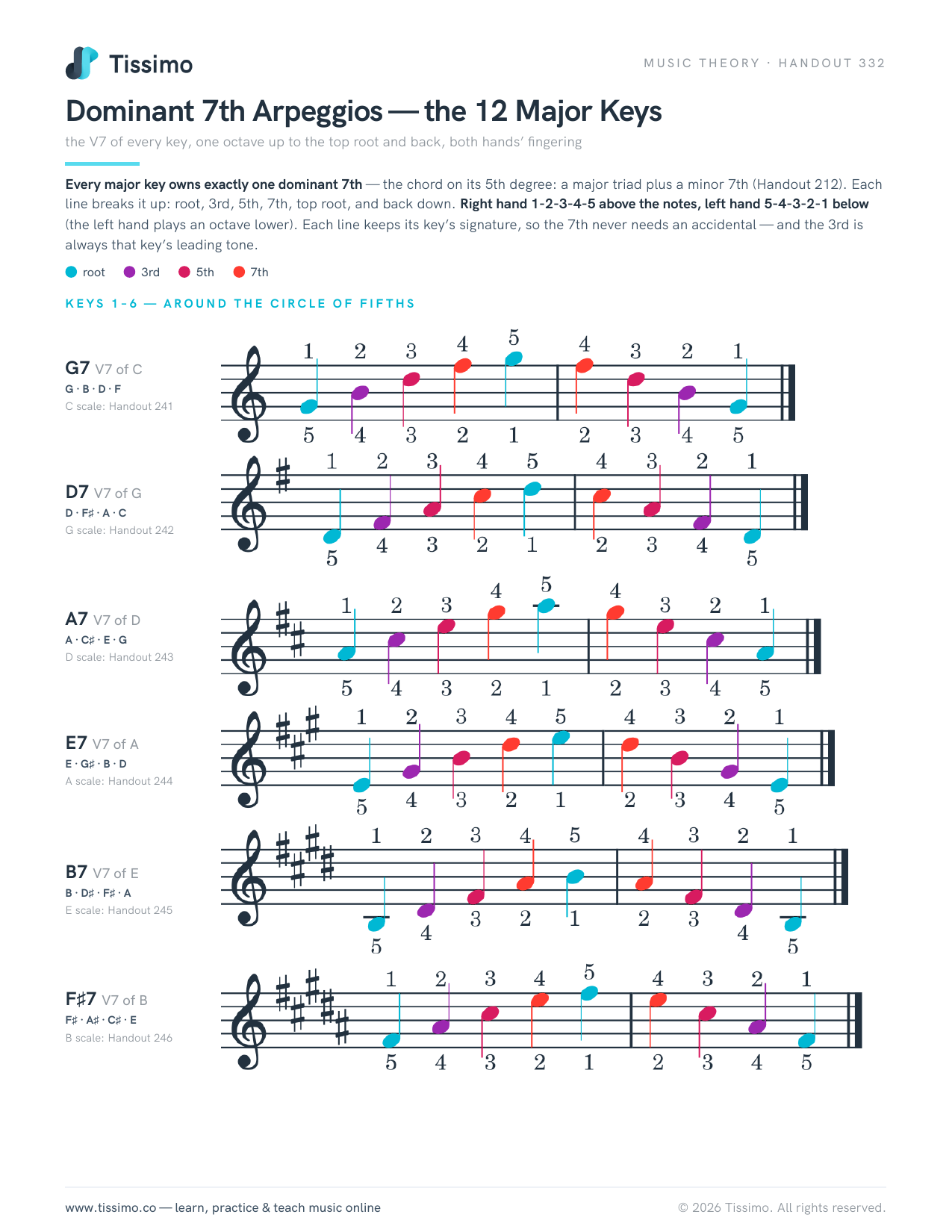 Dominant 7th Arpeggios — the 12 Major Keysthe V7 of every key, one octave up to the top root and back, both hands’ fingering