Technique & Performance
Arrangement
An arrangement is a new version of an existing piece of music, reworked for different instruments, voices or a different style, with fresh choices about harmony, texture, form and who plays what.
An arranger starts from an existing piece, often just a melody and chords, and decides how it will actually sound. A folk song becomes a piece for string quartet; a pop song is arranged for choir; a big-band arranger writes parts for saxophones, trumpets and trombones from a lead sheet. The melody stays recognizable, but almost everything around it can change.
What an arranger decides
- Instrumentation: which instruments or voices play, and a key that suits their ranges.
- Texture: melody with block chords, broken chords, a countermelody, or several independent lines (texture).
- Harmony: keeping the original chords, or reharmonizing with new ones.
- Form: adding an introduction, an ending or a new section, or repeating a verse in a new key (form).
- Rhythm and style: the same tune as a ballad, a waltz or a bossa nova.
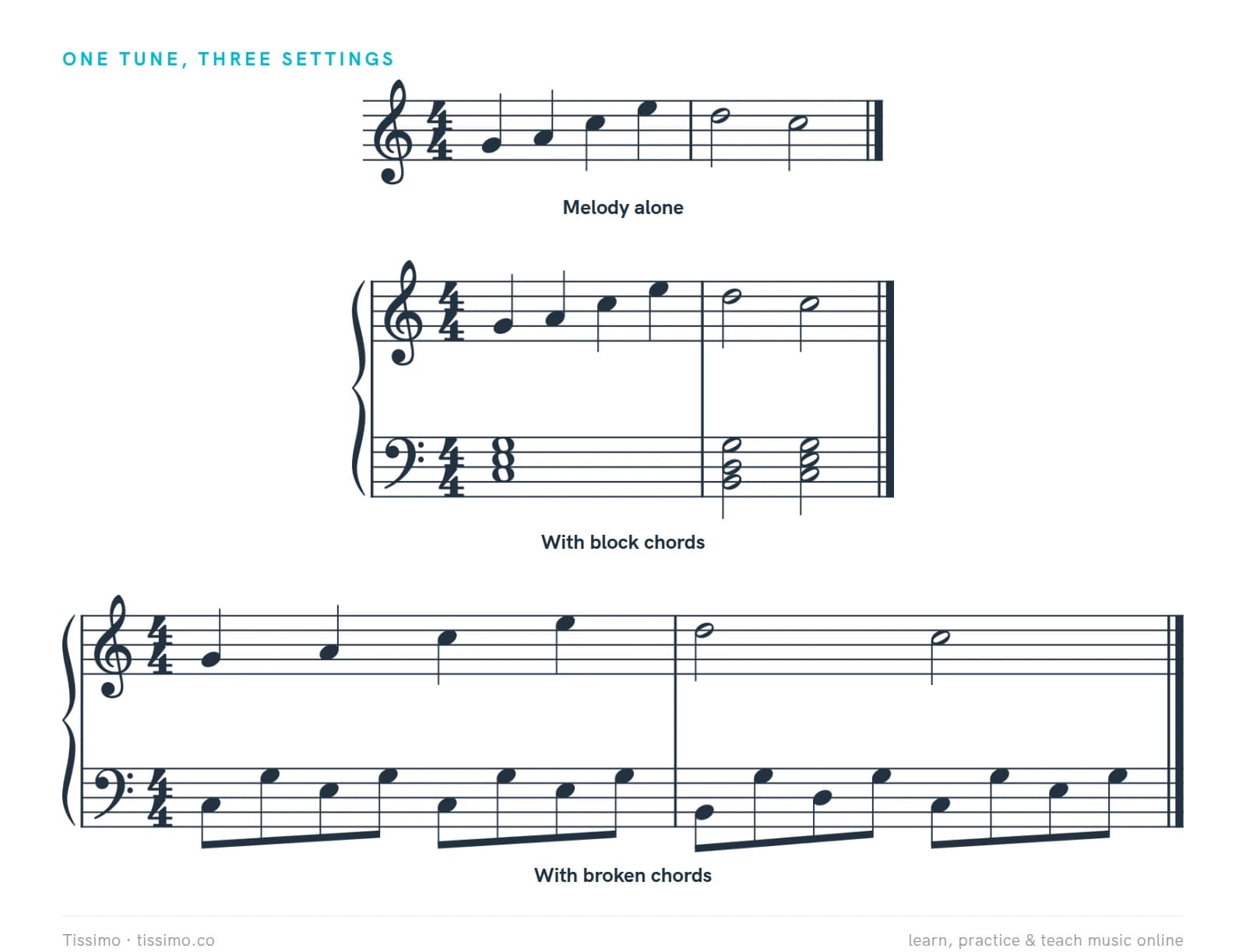
Arrangement and transcription
A transcription tries to keep the original music the same while moving it to a new instrument. An arrangement takes creative liberties. In practice the line between them is not sharp, and many published student "arrangements" are simplified versions of pieces, in easier keys and thinner textures.
Try arranging today
- Take a simple tune you know and its chords; I, IV and V are enough to start.
- Play the melody in your right hand with whole-note chords in the left.
- Change the left hand to broken chords, or an Alberti bass pattern.
- Add a two-bar introduction made from the last two bars of the tune.
- Play the tune once more an octave higher, or in a new key, as a final verse.
Accompaniment patterns, Turn chords into grooves and Realize a lead sheet give you left-hand ideas to use.
A note on copyright
Arranging a piece for your own practice is one thing. Publishing, selling or distributing an arrangement of a song that is still under copyright usually needs permission from the rights holder. Music old enough to be in the public domain can generally be arranged freely, though the rules differ from country to country.
Common questions
What is the difference between an arrangement and a composition?
A composition is the original piece; an arrangement is a new version of it. The arranger makes many creative choices, but the melody, and usually the basic harmony, come from the composer.
Do I need permission to arrange a song?
Arranging for your own private practice is generally not an issue. To publish, sell or distribute an arrangement of a song still under copyright, you usually need permission from the rights holder; public-domain music can generally be arranged freely.
Practice it: free worksheets
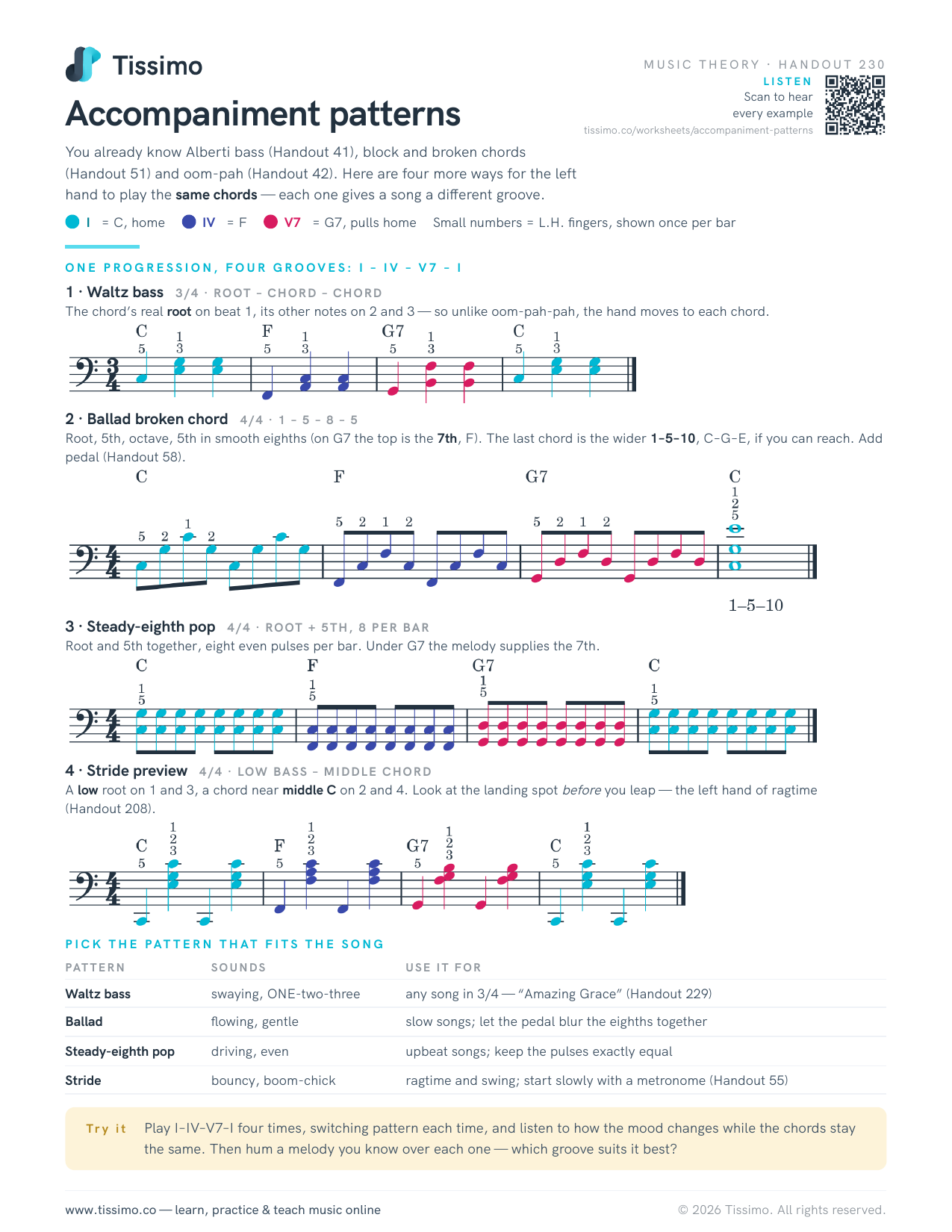 Accompaniment patternsYou already know Alberti bass (Handout 41), block and broken chords (Handout 51) and oom-pah (Handout 42). Here are four more ways for the left hand to play the same chords — each one gives a song a different groove.
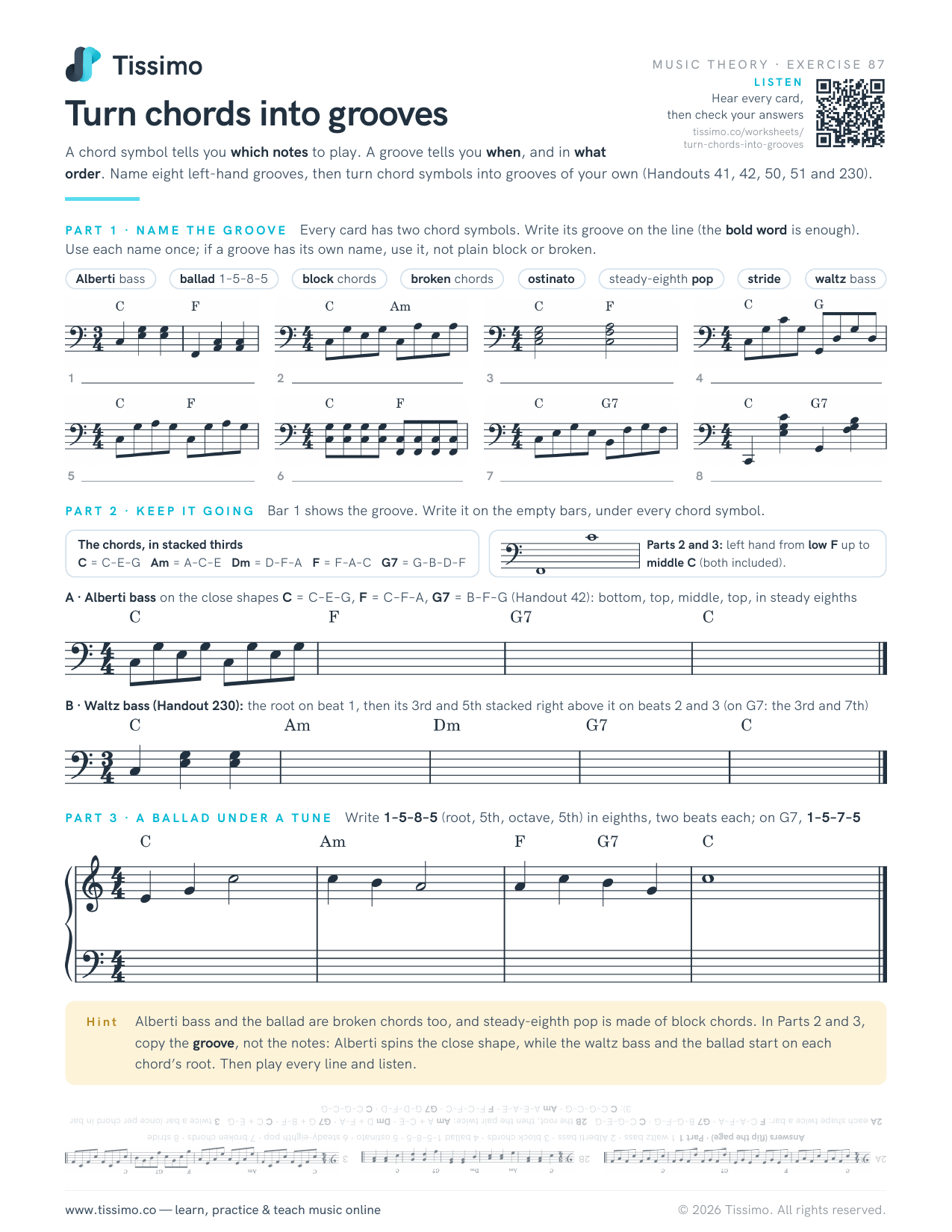 Turn chords into groovesA chord symbol tells you which notes to play. A groove tells you when, and in what order. Name eight left-hand grooves, then turn chord symbols into grooves of your own (Handouts 41, 42, 50, 51 and 230).
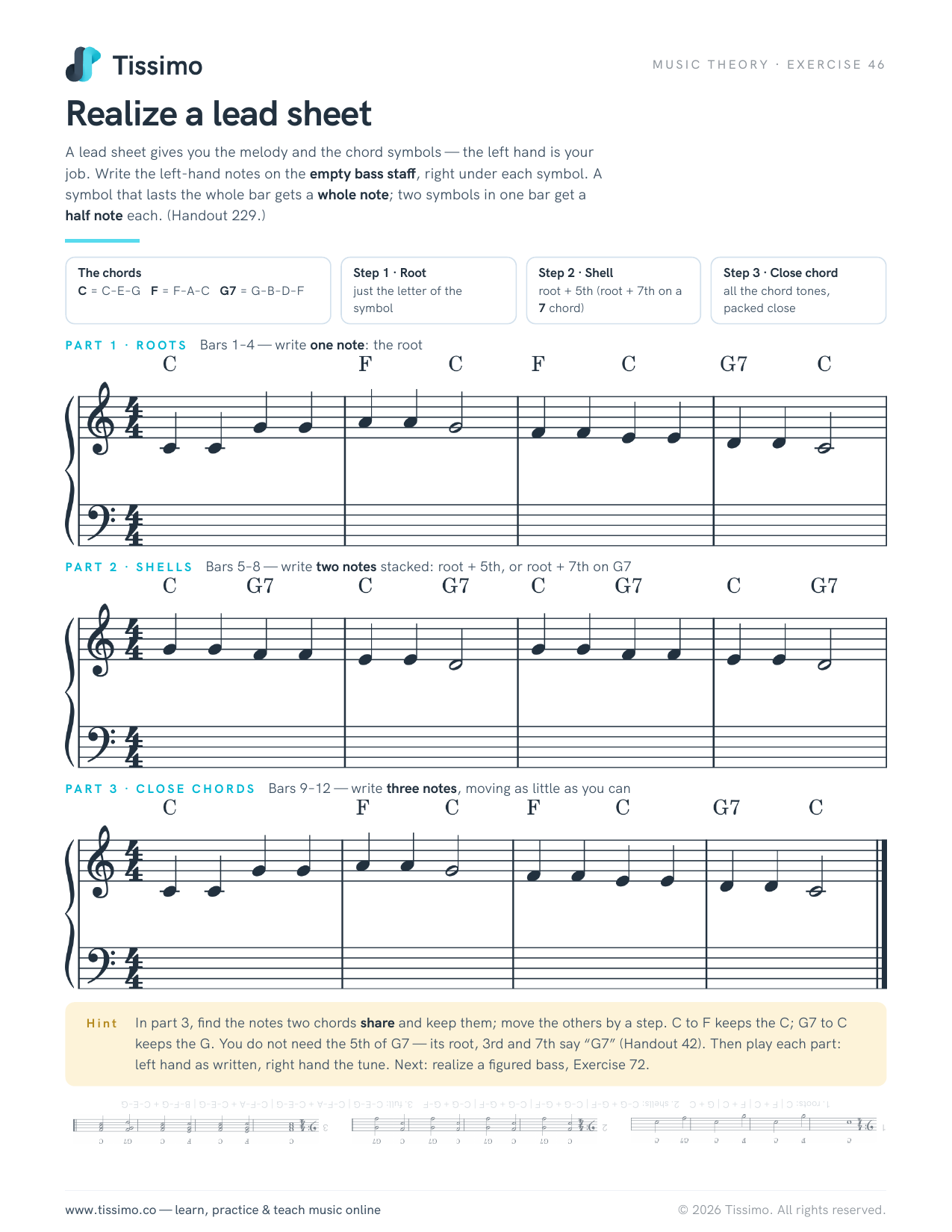 Realize a lead sheetA lead sheet gives you the melody and the chord symbols — the left hand is your job. Write the left-hand notes on the empty bass staff, right under each symbol. A symbol that lasts the whole bar gets a whole note; two symbols in one bar get a half note each. (Handout 229.)
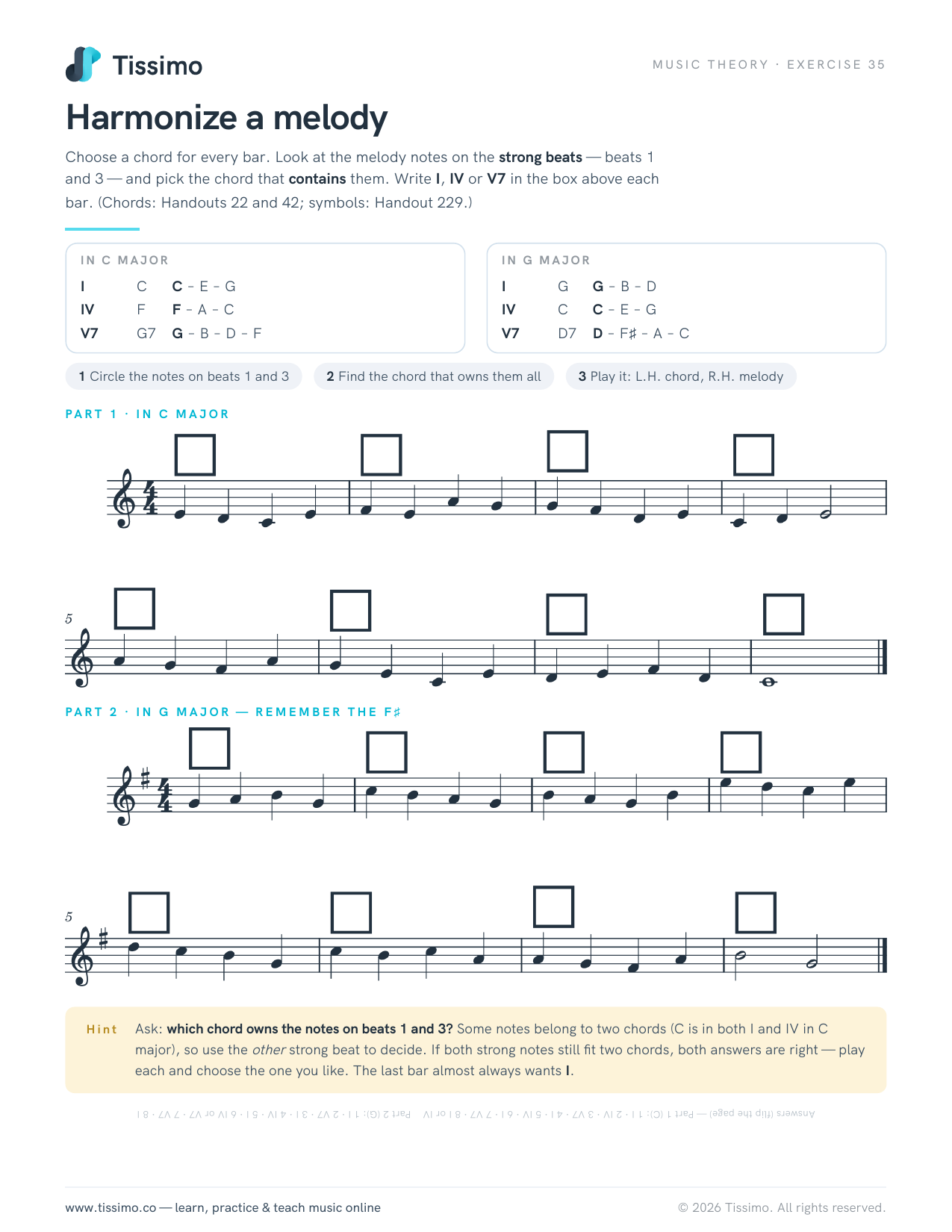 Harmonize a melodyChoose a chord for every bar. Look at the melody notes on the strong beats — beats 1 and 3 — and pick the chord that contains them. Write I, IV or V7 in the box above each bar. (Chords: Handouts 22 and 42; symbols: Handout 229; how to choose: Handout 358.) Next: Exercise 57 adds ii and vi.
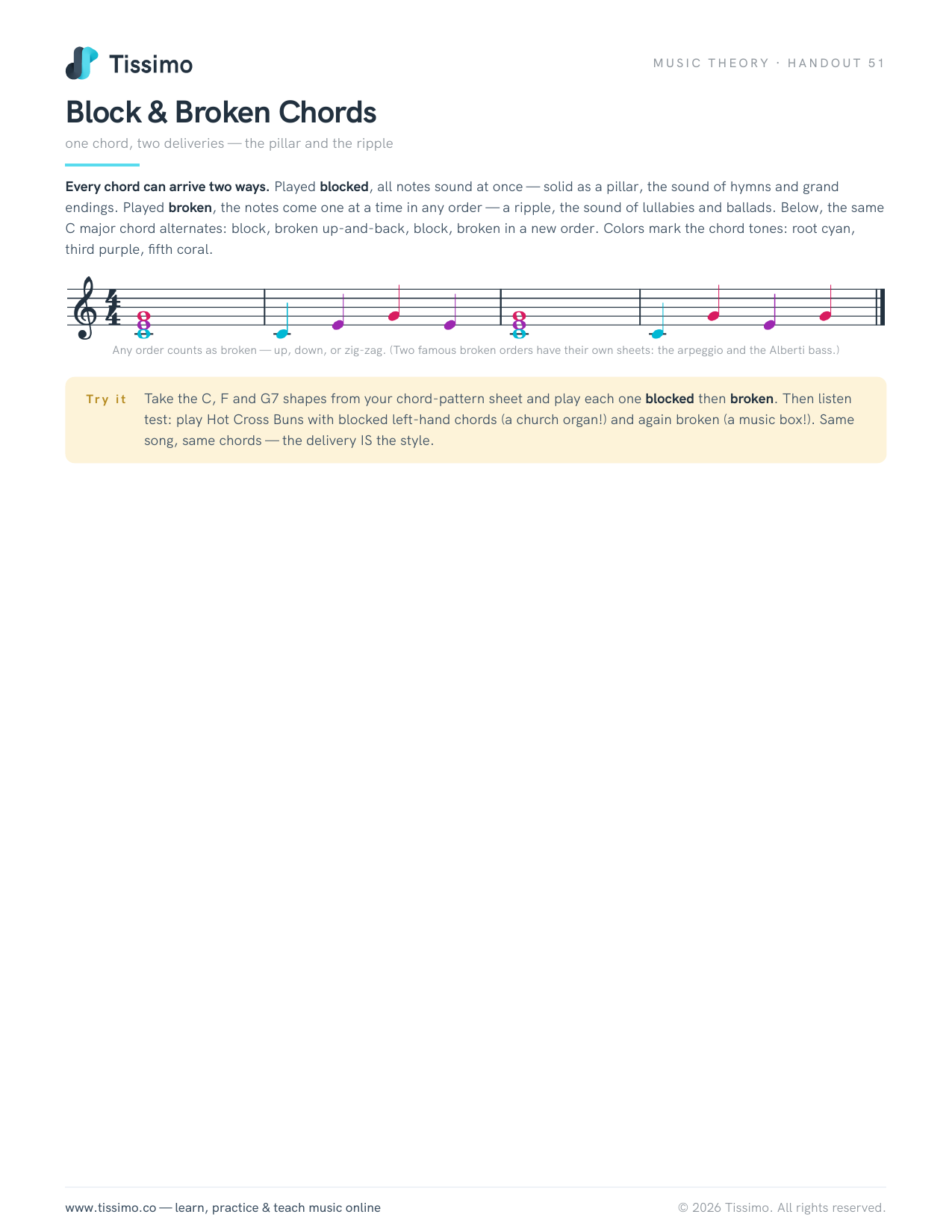 Block & Broken Chordsone chord, two deliveries — the pillar and the ripple