Technique & Performance
Soft Pedal (Una Corda)
Pronounced OO-nah KOR-dahWritten as u.c.
The soft pedal, or una corda, is the left pedal of a piano. It makes the sound quieter and more veiled; scores ask for it with the words una corda and cancel it with tre corde.
What the soft pedal does
Most notes on a piano have more than one string. The middle and upper notes have three strings each, tuned to the same pitch, and the lowest notes have two or one. On a grand piano, the left pedal slides the whole keyboard and its hammers slightly to the side, so each hammer strikes fewer of its strings and meets them with a softer, less-used part of its felt. The sound becomes quieter, and its color changes too: more veiled, less bright.
The Italian name, una corda, means "one string". On many early pianos the shift could move the hammers far enough to strike a single string. On a modern grand the hammer usually strikes two of the three.
On an upright piano the left pedal works differently. It moves the hammers closer to the strings, so they travel a shorter distance and strike more gently. That makes the sound softer, but the color changes much less than on a grand.
How it is written
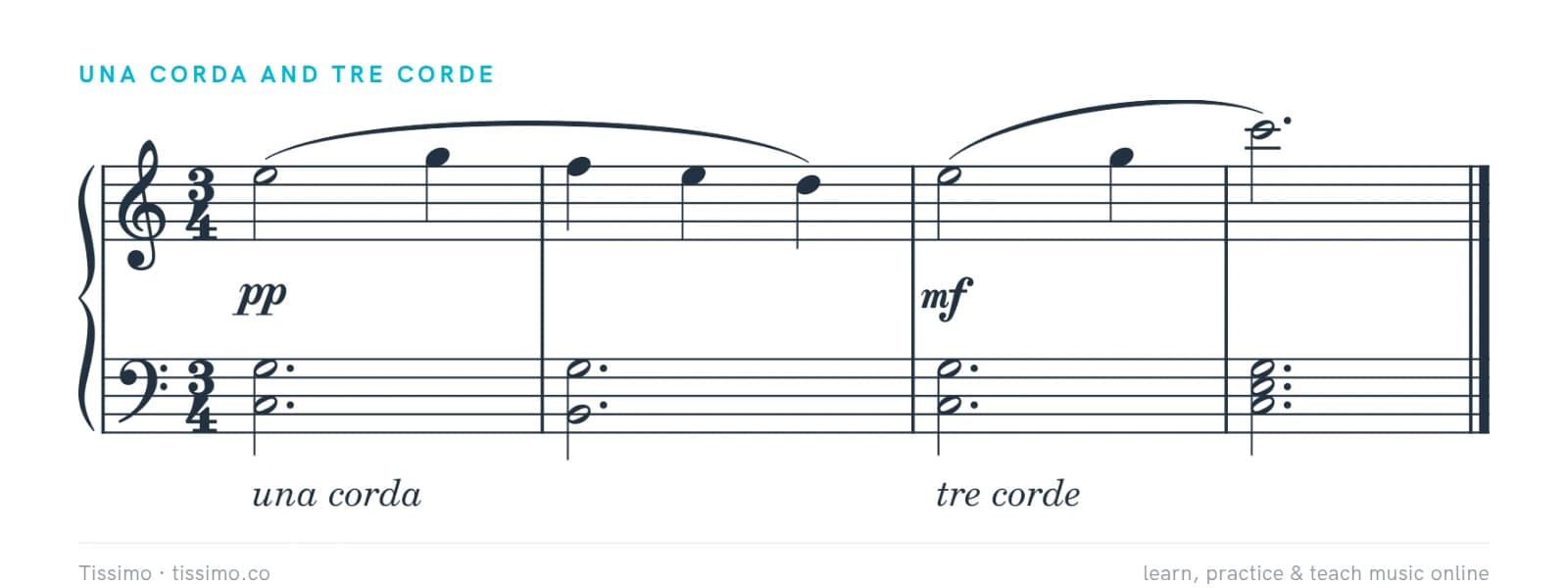
- una corda (sometimes u.c.): press the left pedal.
- tre corde ("three strings", t.c.) or tutte le corde ("all the strings"): release it.
How to use it
Treat the soft pedal as a color, not a volume knob. First learn the passage at the written dynamic with your fingers alone: a real pianissimo comes from slow, close key strokes, with or without the pedal. Then add una corda for the change of tone. Try one quiet phrase twice, without and with the pedal, and listen for the difference in color as well as in loudness.
You can combine it with the sustain pedal: left foot on the soft pedal, right foot on the damper pedal. Keep your left heel on the floor and press with the ball of the foot, just as with the right.
Composers ask for it most often in quiet, intimate passages, and sometimes for a sudden distant, muffled effect, close to what singers call sotto voce.
A common confusion
The soft pedal is not the same as a practice pedal (or mute pedal). That is the middle pedal on many uprights, which drops a strip of felt between the hammers and the strings to make the piano very quiet for practicing at home. It is a household convenience rather than a musical effect, and it is not marked in the music.
Common questions
Which pedal is una corda?
The left pedal. On a grand piano it shifts the hammers so they strike fewer strings; on an upright it moves the hammers closer to the strings.
Does the soft pedal just make the piano quieter?
It does make it a little quieter, but on a grand piano its main effect is a softer, more veiled color. Control the volume with your fingers and use una corda for the change of tone.