Technique & Performance
Sostenuto Pedal
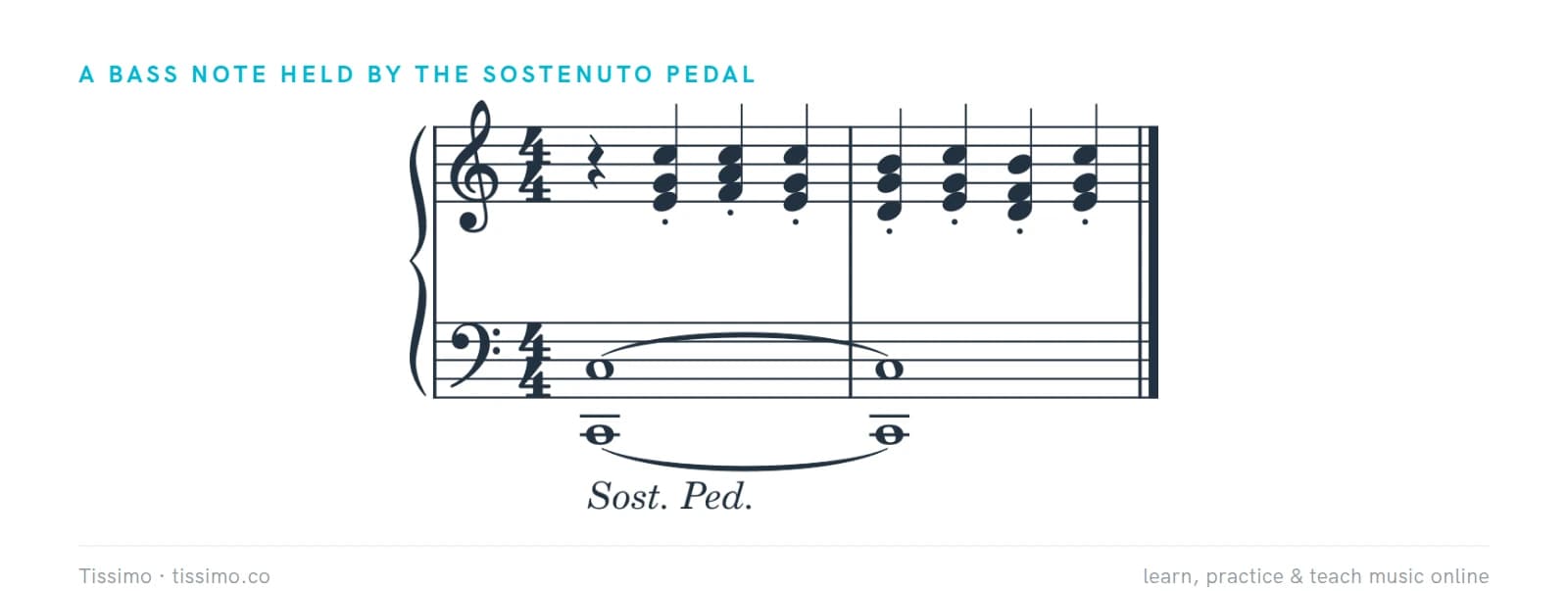
Pronounced soss-teh-NOO-tohWritten as Sost. Ped.
The sostenuto pedal, the middle pedal on most grand pianos, sustains only the notes whose keys are already down when you press it. Other, uncaptured notes stop when you release their keys, as usual.
Catching just a few notes
Press the sustain pedal and every note rings on. The sostenuto pedal is selective: it holds up the dampers only of the keys that are down at the moment you press it. Those notes keep sounding for as long as the pedal stays down. Notes whose dampers were not captured are damped normally when you let go of the keys. Replaying a captured note still leaves its damper raised.
That lets you hold a deep bass note while your hands play crisp, detached chords or a clear melody above it, something neither the hands nor the sustain pedal can manage alone.
How to use it
The order of events is everything:
- Play the note or chord you want to keep, and hold the keys down.
- Press the middle pedal while the keys are still down.
- Let go of the keys. The captured notes keep sounding.
- Play the rest of the music. New, uncaptured notes are not caught, even though the pedal is still down.
- Release the pedal to stop the captured notes.
If you press the pedal a moment too early, before the keys are down, nothing is caught. If other keys happen to be down when you press it, they are caught too. Catch This Note, Not the Next and Which Notes Were Already Down? practice exactly this timing.
You can use the sustain pedal on top of it. The right pedal can change freely for the upper notes while the middle pedal keeps the captured notes ringing underneath.
How it is written
Scores mark it in words, usually Sost. Ped. or S.P., sometimes with a line showing how long to hold it. Some music doesn't mark it at all, and pianists reach for it to solve a passage where a long note would otherwise be impossible to hold.
Don't confuse the pedal with the word sostenuto on its own above the music: that is an expression marking asking for a sustained, held-back way of playing, and it has nothing to do with the middle pedal.
Not every piano has one
Most modern grand pianos have a true sostenuto pedal. On many uprights the middle pedal is a practice (mute) pedal instead, and on some it sustains only the bass notes. Digital pianos vary. To find out, press a low C, catch it with the middle pedal, let go, and play some short notes, both higher up and in the bass: if only the C rings on, you have a sostenuto pedal.
Common questions
What does the middle pedal on a piano do?
On most grand pianos it is the sostenuto pedal, which sustains only the notes already held down when you press it. On many uprights it is a practice pedal that mutes the sound, and on some it sustains the bass notes only.
What is the difference between the sostenuto pedal and the sustain pedal?
The sustain pedal lifts every damper, so everything you play rings on. The sostenuto pedal holds up only the dampers of the keys that were down when you pressed it.
Practice it: free worksheets
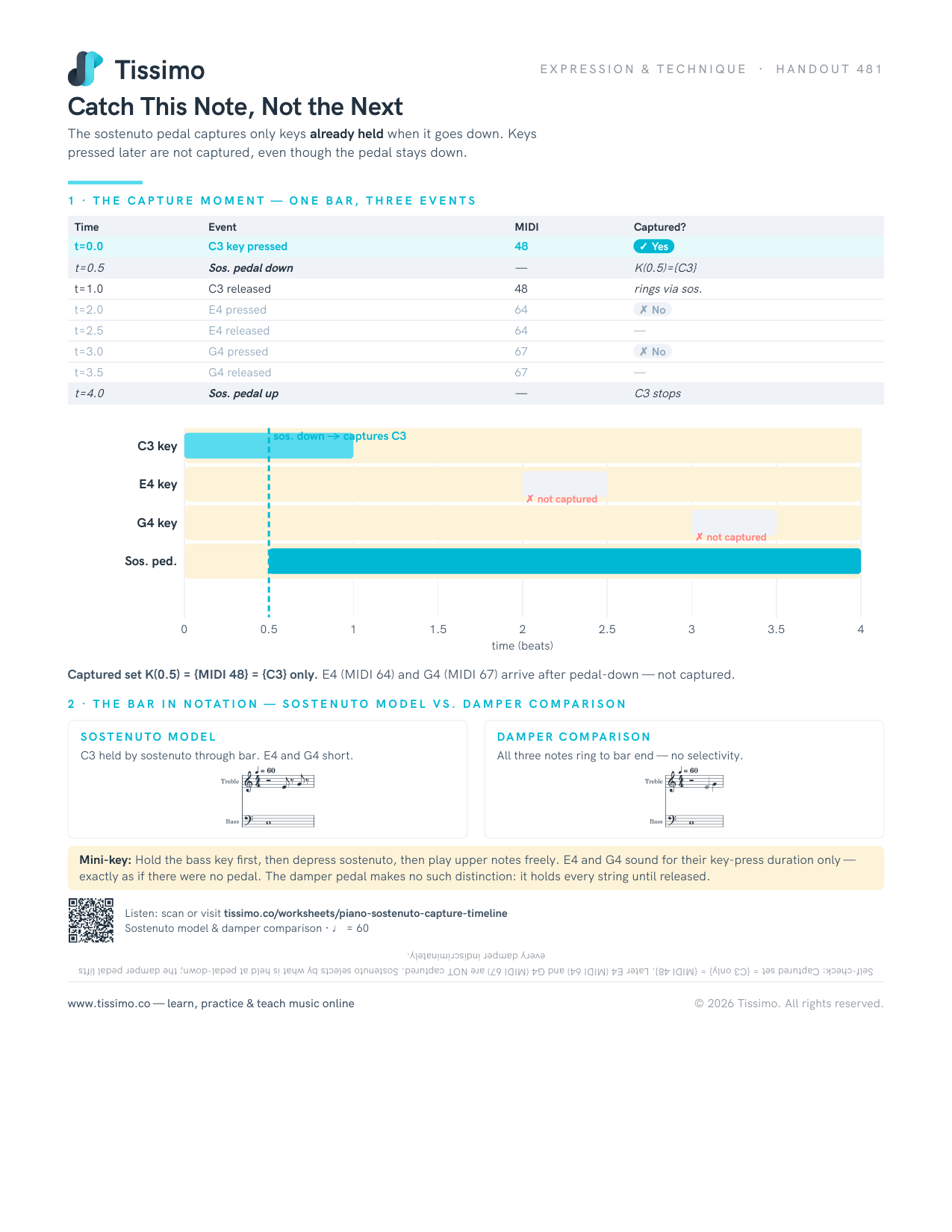 Catch This Note, Not the NextThe sostenuto pedal captures only keys already held when it goes down. Keys pressed later are not captured, even though the pedal stays down.
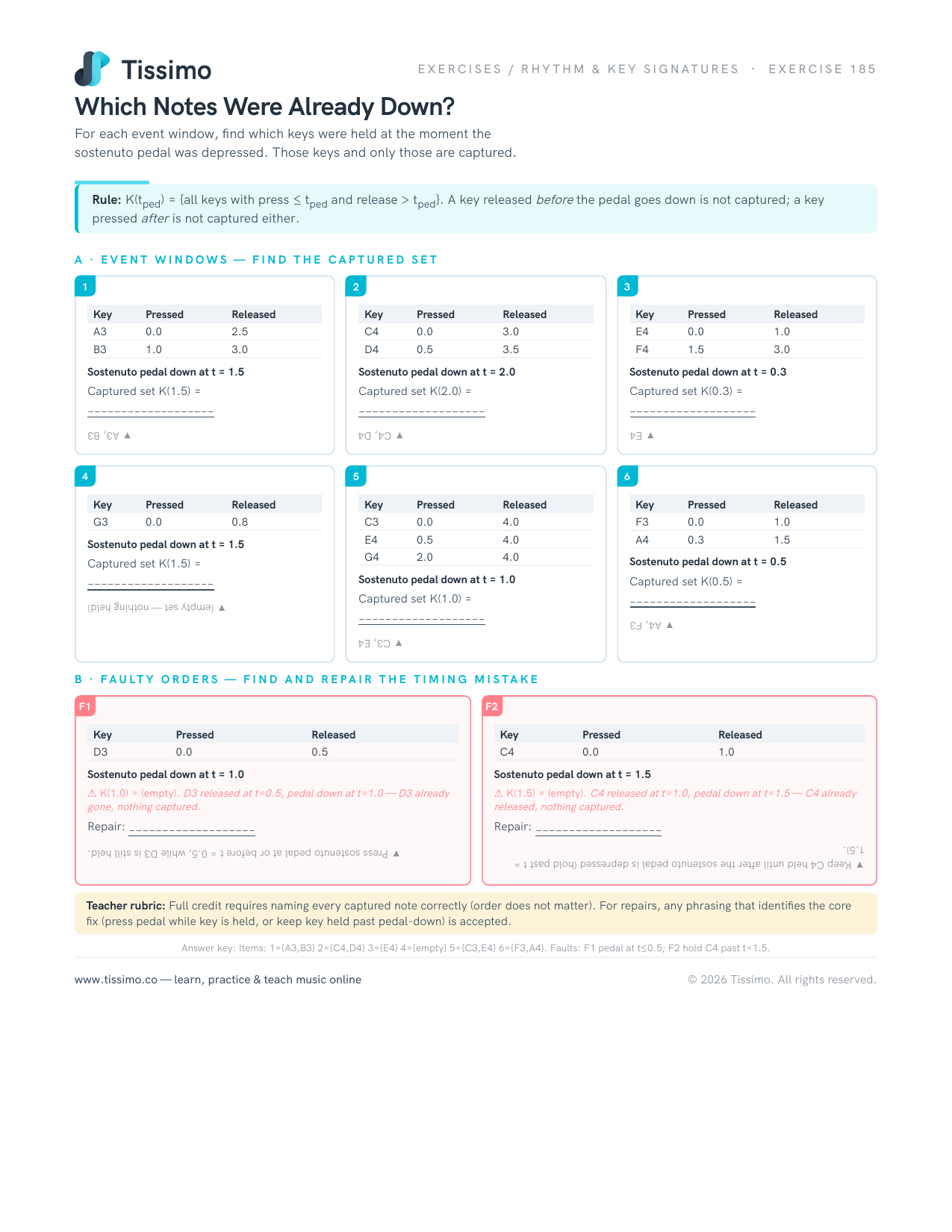 Which Notes Were Already Down?For each event window, find which keys were held at the moment the sostenuto pedal was depressed. Those keys and only those are captured.
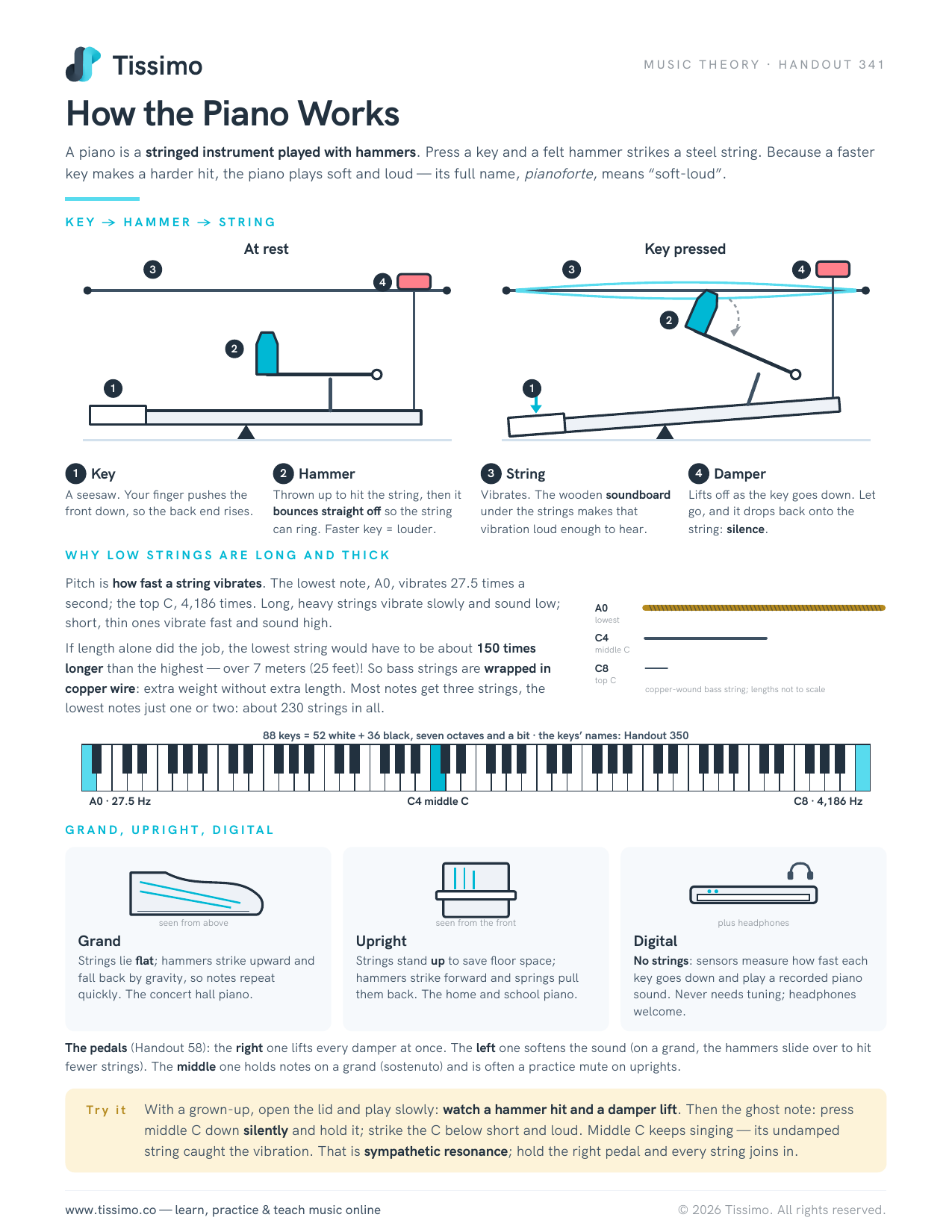 How the Piano WorksA piano is a stringed instrument played with hammers. Press a key and a felt hammer strikes a steel string. Because a faster key makes a harder hit, the piano plays soft and loud — its full name, pianoforte, means “soft-loud”.