Technique & Performance
Thumb Under (Finger Crossing)
Thumb under is the piano movement in which the thumb passes beneath the other fingers to reach the next note, or a finger crosses over the thumb, so that five fingers can play a scale or run of any length.
A hand has five fingers, but an octave of a scale has eight notes, and many runs go further. The thumb-under movement solves that. Going up the keyboard with the right hand, the thumb slides under the middle finger (or the ring finger) to take the next note. Coming back down, a finger crosses over the thumb. The left hand does the same in mirror image: thumb under going down, fingers over going up.
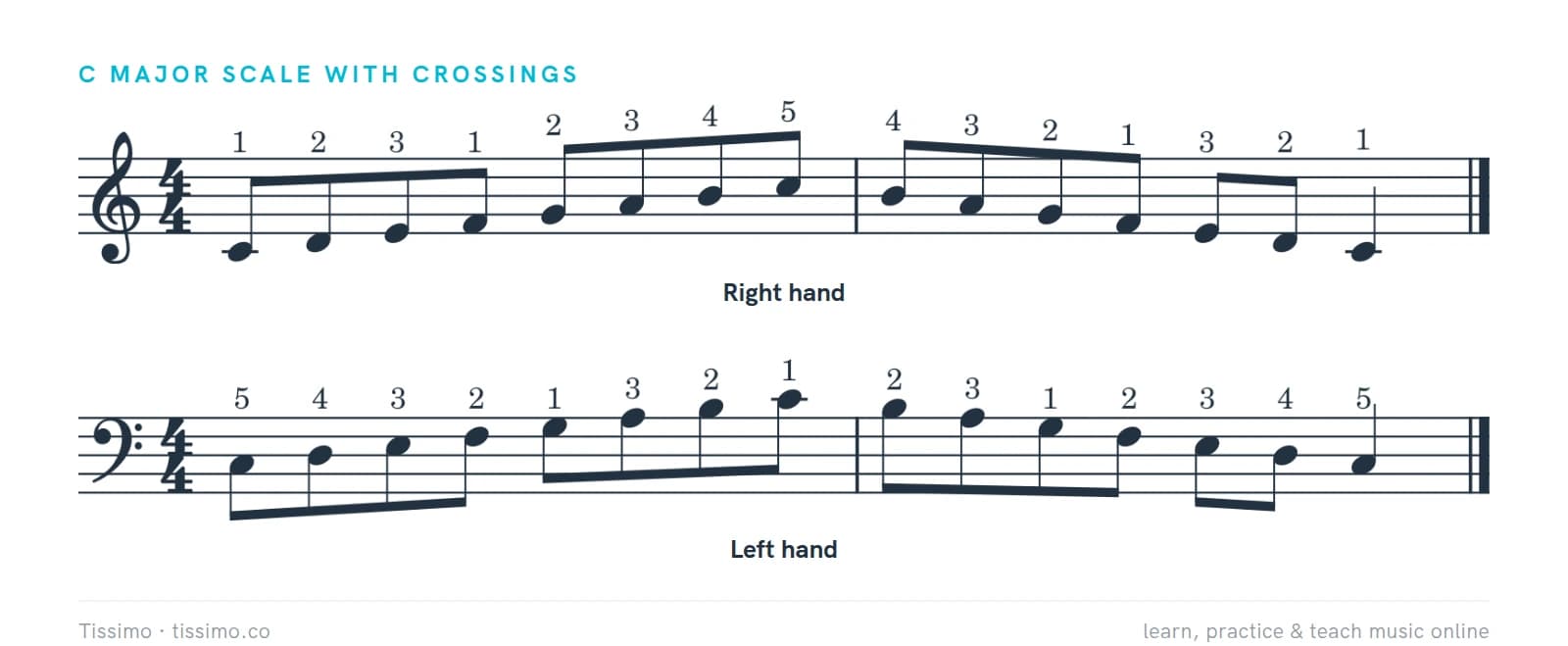
C major, one octave
Right hand going up: 1 2 3, thumb under to F, then 1 2 3 4 5. Coming down: 5 4 3 2 1, finger 3 crosses over to E, then 3 2 1.
Left hand going up: 5 4 3 2 1, finger 3 crosses over to A, then 3 2 1. Coming down: 1 2 3, thumb under to G, then 1 2 3 4 5.
How to make the crossing smooth
- Start the thumb moving early. As soon as finger 2 plays, let the thumb begin traveling under the hand toward its next key, so it arrives ahead of time.
- Keep the wrist level and quiet. The hand glides sideways and the elbow follows smoothly. A twist of the wrist or a jerk of the elbow makes the crossing note bump.
- Practice the crossing pair alone. Play E–F with fingers 3–1, slowly and legato, until the two notes sound as joined as any other pair. Then F–E with 1–3.
- Add a few notes on each side. D–E–F–G, then the whole scale, each hand separately before hands together.
- Listen for evenness. The note played by the thumb after a crossing often comes out too loud. Play it gently on purpose until it blends in.
Other keys
Every major and minor scale has its own fingering, but the idea is the same: groups of three and four fingers joined by the thumb. In standard scale fingerings the thumb almost always plays white keys, where it can reach under easily. Thumb-Under: the Full Scale walks through the movement slowly, and Scales in Every Key gives the standard fingering for all 24 major and minor keys.
The same movement appears in arpeggios, where the thumb passes under a wider gap, and in fast passages of almost any piece. It is the step that takes you beyond a five-finger position.
Common questions
What is the fingering for the C major scale?
Right hand: 1 2 3 1 2 3 4 5 going up, 5 4 3 2 1 3 2 1 coming down. Left hand: 5 4 3 2 1 3 2 1 going up, 1 2 3 1 2 3 4 5 coming down.
Why does my scale bump when the thumb goes under?
Usually the thumb starts moving too late, so the hand has to jump to place it. Start moving the thumb under as soon as the finger before it plays, keep the wrist level, and play the thumb's note gently.
Practice it: free worksheets
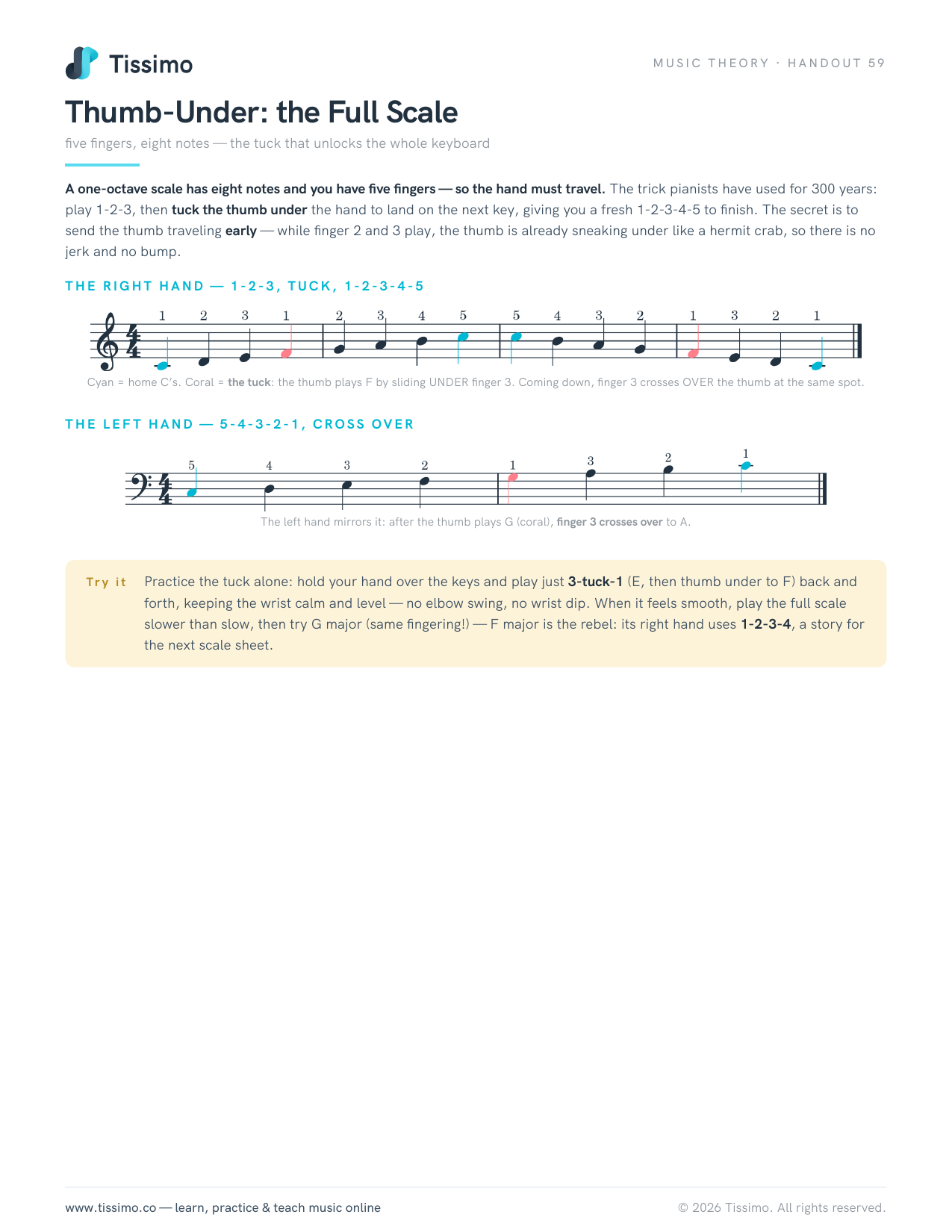 Thumb-Under: the Full Scalefive fingers, eight notes — the tuck that unlocks the whole keyboard
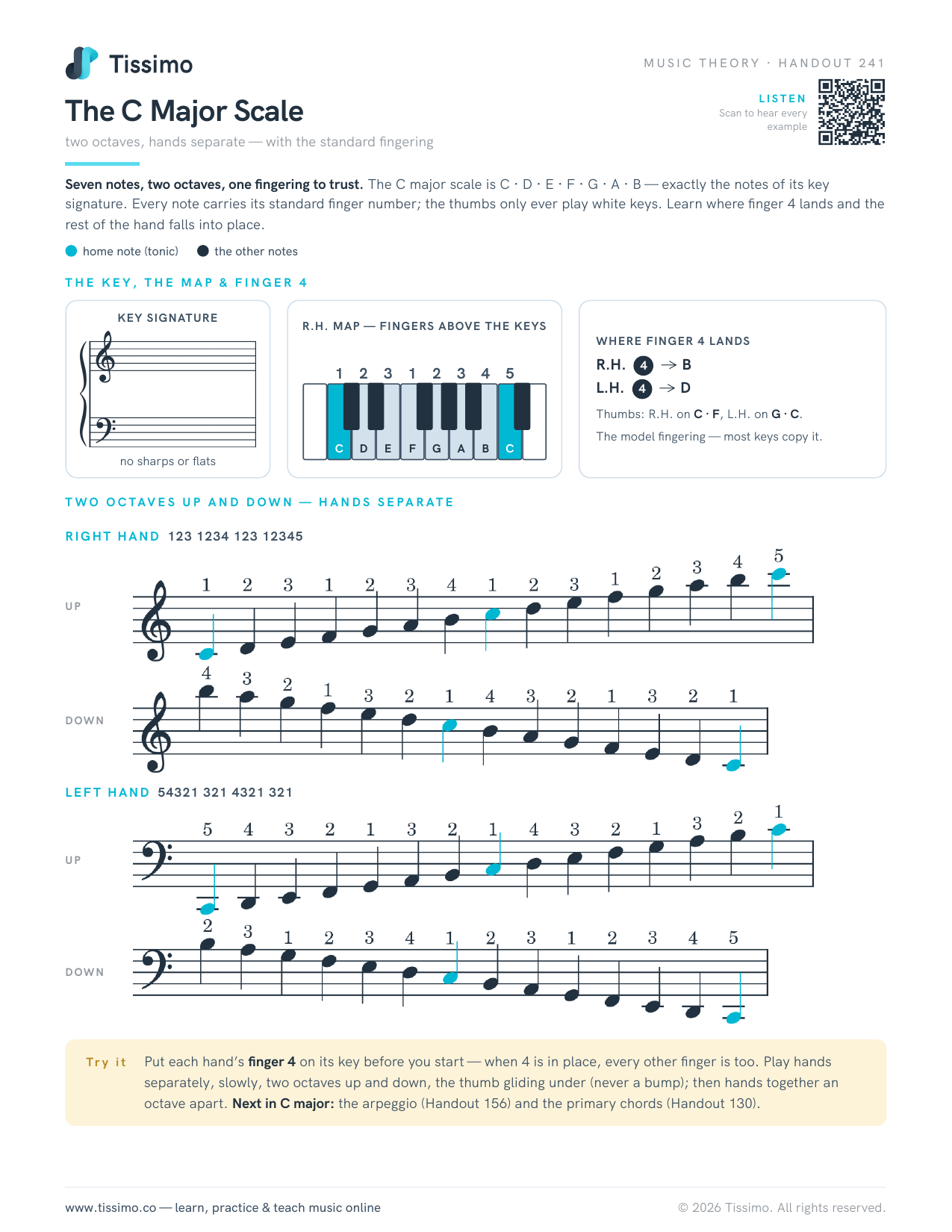 Scales in Every KeyTwo octaves up and down with the standard fingering on every note, in all 24 keys.
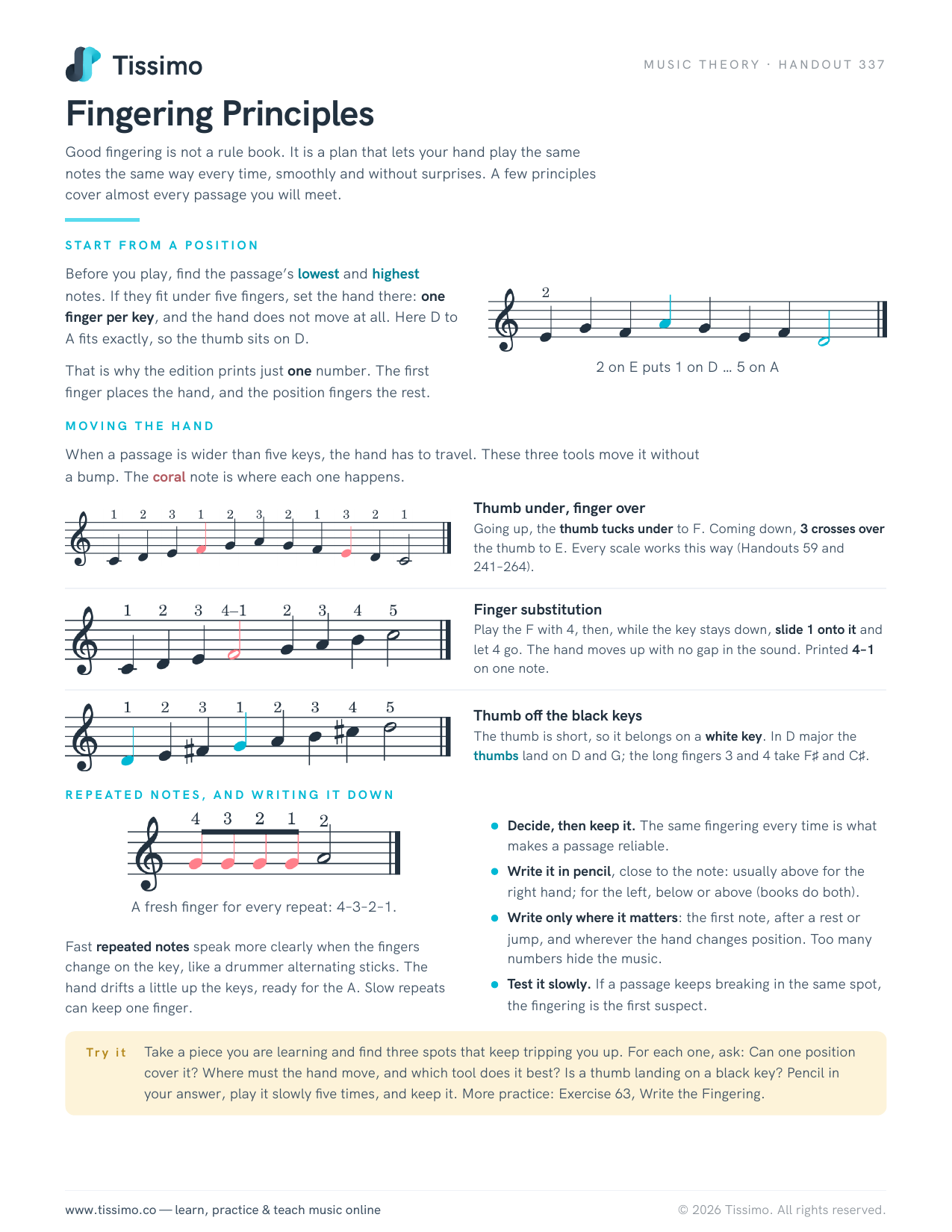 Fingering PrinciplesGood fingering is not a rule book. It is a plan that lets your hand play the same notes the same way every time, smoothly and without surprises. A few principles cover almost every passage you will meet.
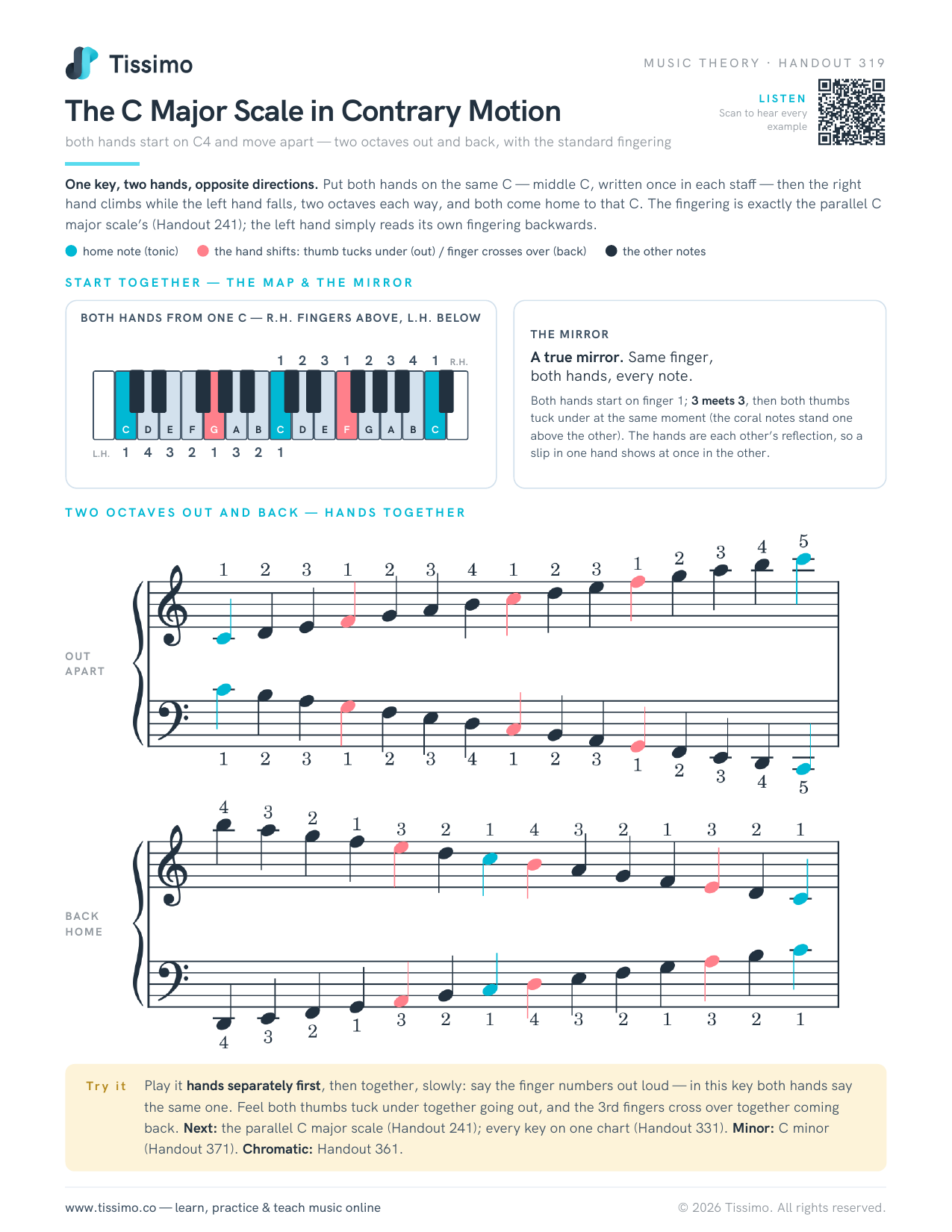 Contrary-Motion ScalesBoth hands start on one note and move apart two octaves and back, in all 12 major and 12 harmonic minor keys.