Form & Structure
Through-Composed
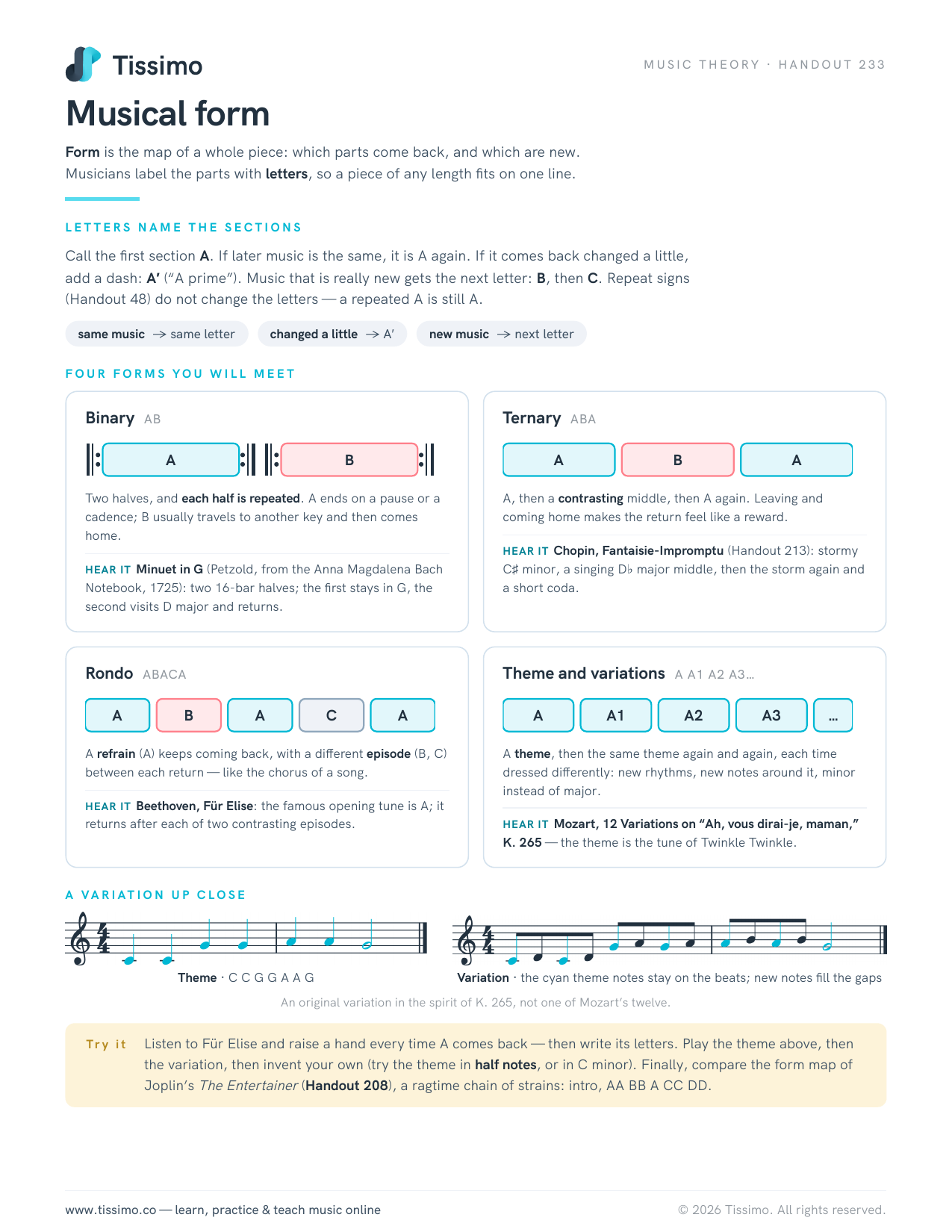
Through-composed music keeps moving on to new material instead of repeating earlier sections. In a through-composed song, the music changes to follow the text from beginning to end.
A through-composed piece does not return to earlier sections in any regular pattern. Each part of the text or the story gets its own music, so the letter outline keeps moving forward: A B C D… The German word for it is durchkomponiert.
The term is used most often for songs, where it is the opposite of strophic form. In a strophic song every verse is sung to the same tune. In a through-composed song the composer responds to the words line by line: new melody, new harmony and new accompaniment when the poem changes mood, scene or speaker.
A famous example
Schubert's "Erlkönig" ("The Erlking"), a setting of Goethe's ballad, is the classic through-composed song. One singer plays four characters (a narrator, a father, his frightened son and the supernatural Erlking), and the piano's galloping triplets drive the story forward. The music grows more desperate as the ride goes on instead of returning to an opening verse, and it ends with the narrator's stark announcement that the child is dead.
Through-composed does not mean "no unity"
Through-composed music still hangs together. Composers use:
- a recurring accompaniment figure or rhythm (the galloping piano in "Erlkönig"),
- a short motif that keeps returning in new forms,
- a plan of keys that builds toward a climax.
What is missing is large-scale sectional repetition: no verse comes back to the same music, and there is no recurring chorus.
Where you will find it
- Art songs (Lieder) that tell a story or follow a poem with changing moods.
- Opera and musical theater, especially scenes that follow dialogue and action. Many through-composed stretches of opera sit between the more closed forms of the aria.
- Program music and tone poems that follow a story (see program music).
- Film music, which usually follows the action on screen rather than a song form.
Strophic, modified strophic, through-composed
These three words make a scale. Strophic form repeats one tune for every verse; modified strophic form repeats it with one or more changed verses; through-composed form writes new music throughout. When you analyze a song, decide first whether any verse returns to earlier music; that tells you where on the scale it sits.
Common questions
What does through-composed mean in music?
It means the music keeps presenting new material instead of repeating sections. In a song, each part of the text gets its own music rather than every verse being sung to the same tune.
What is an example of a through-composed song?
Schubert's "Erlkönig" is the best-known example: its music changes continuously to follow the story of Goethe's ballad.