Rhythm & Meter
Thirty-Second Note
A thirty-second note has three flags, or three beams when grouped. It lasts half as long as a sixteenth note, so eight thirty-second notes fill one quarter-note beat.
A thirty-second note lasts half as long as a sixteenth note. It is drawn with three flags on its stem, or with three beams when it is grouped with other short notes. In British English it is called a demisemiquaver, literally "half of a half of a quaver".
How long is it?
- Two thirty-second notes = one sixteenth note.
- Four thirty-second notes = one eighth note.
- Eight thirty-second notes = one quarter note.
In 4/4 that means 32 of them would fill a bar, which is where the name comes from.
Where you meet them
Thirty-second notes are less common than the longer values, and they usually turn up in two situations:
- Slow movements. In an Adagio or a Largo, the beat is so slow that composers need very short values to write running figures and decorations. At a slow tempo, thirty-seconds may not sound fast at all.
- Ornaments and flourishes. Written-out turns, quick runs leading to a long note, and the short note after a double-dotted note are often thirty-seconds.

Reading and counting them
Do not try to give every thirty-second note its own syllable. Count in sixteenths ("1 e & a") and fit two thirty-seconds into each syllable, or find the beat each group belongs to and spread its notes evenly across it. Practice slowly with a metronome ticking eighth notes, and speed up only when the notes come out evenly.
Shorter still is the sixty-fourth note, with four flags or beams. It appears mostly in very slow music and in ornamental passages.
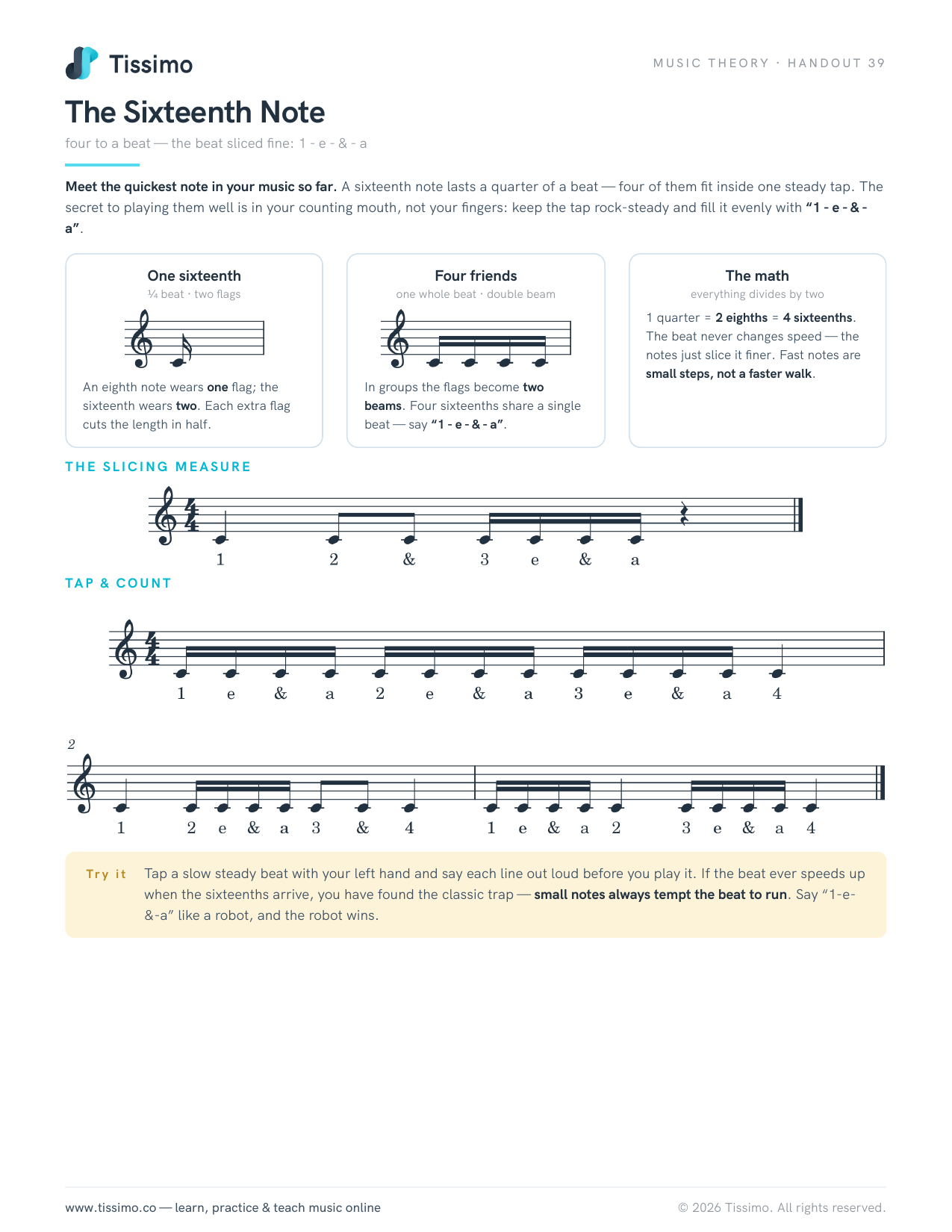
To build up to thirty-seconds, make sure sixteenths feel easy first: The Sixteenth Note is a good place to start.
Common questions
How many thirty-second notes are in a quarter note?
Eight. Two thirty-seconds make a sixteenth note, four make an eighth note, and eight make a quarter note.
Are thirty-second notes always fast?
No. Their real speed depends on the tempo. In a very slow movement, a run of thirty-second notes can move at a calm, singing pace.