Rhythm & Meter
Common Time
Written as C
Common time is another name for 4/4 time, with four quarter-note beats in every bar. It is often written as a large C in place of the two numbers.
Common time is the name for 4/4, the meter with four quarter-note beats in every bar. It is so widespread, from hymns and marches to a great many pop songs, that musicians often just call it "four-four". On the page it is frequently written as a large C in place of the two numbers. The C and 4/4 mean exactly the same thing, and you count them the same way.
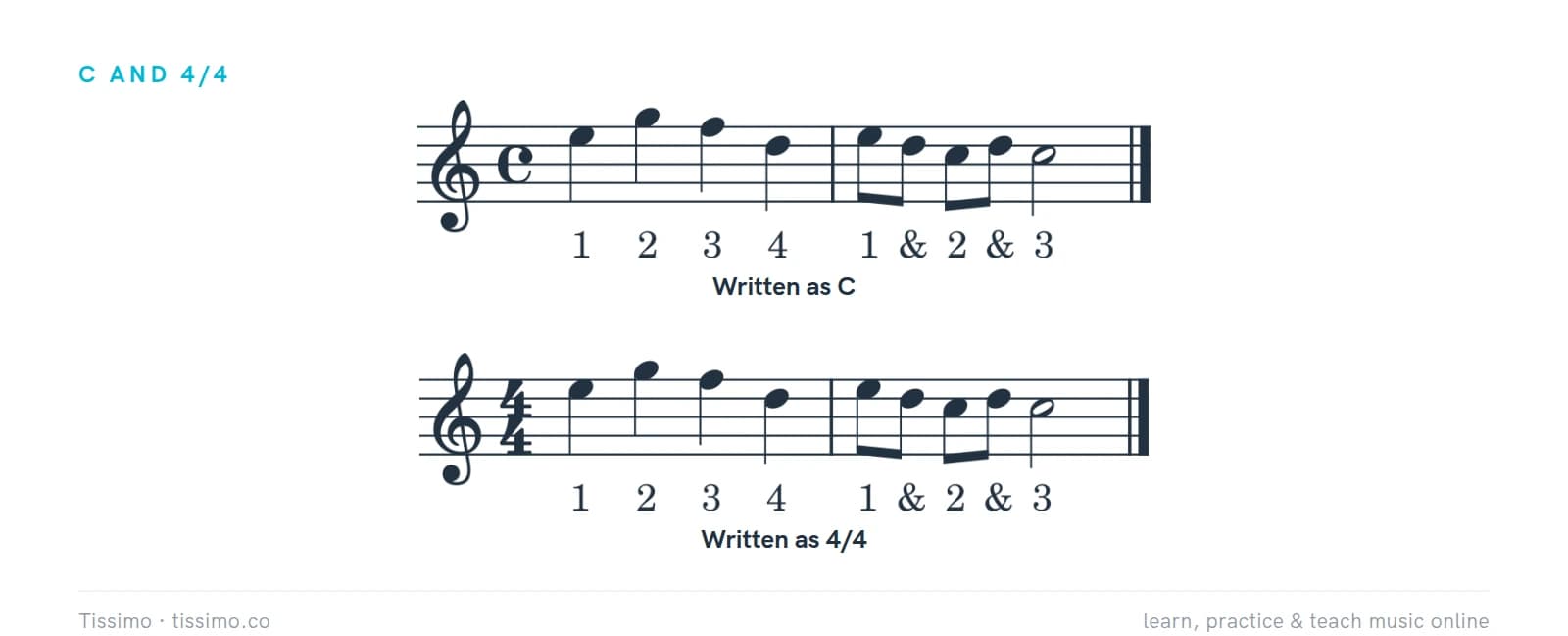
How to count common time
Count four beats per bar: "1, 2, 3, 4". Beat 1, the downbeat, is the strongest, beat 3 is a little lighter, and beats 2 and 4 are weak. When the beats divide into eighth notes, count "1 & 2 & 3 & 4 &". In much rock, pop and soul, the drummer turns the natural weighting around by hitting the snare drum on beats 2 and 4, the backbeat.
Where the C comes from
The C is often explained as standing for "common", but the sign is older than the name. In medieval and Renaissance notation (called mensural notation), a full circle marked a division of time into three, and a broken circle, which looks like a C, marked a division into two. The broken circle survived into modern notation as the sign for 4/4, and the name "common time" grew up around it.
Common time and cut time
Be careful not to confuse the C with the same letter crossed by a vertical line. That sign is cut time, or 2/2. A bar holds the same amount of music, but there are two half-note beats instead of four quarter-note beats, and the music usually moves faster.
Practice counting four-beat bars with Time Signatures I: Simple Time, and compare common time with cut time in Two Beats in a Bar: 2/4 & Cut Time.
Common questions
Is common time the same as 4/4?
Yes. The C sign and the numbers 4/4 mean the same meter: four quarter-note beats per bar.
Does the C in common time stand for common?
Not originally. The sign comes from older notation, in which a broken circle marked a division of time into two. The name "common time" came later and happens to fit the letter.
Practice it: free worksheets
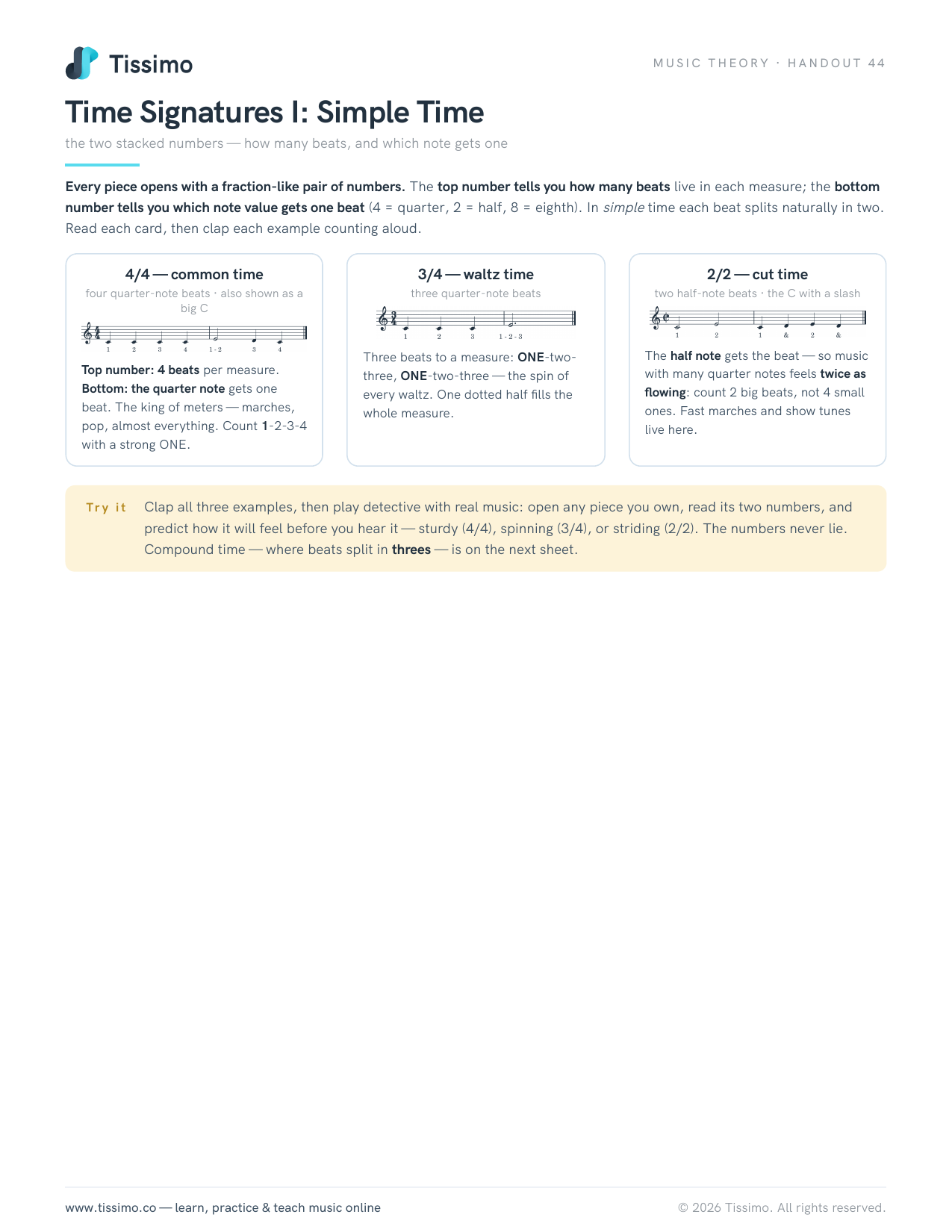 Time Signatures I: Simple Timethe two stacked numbers — how many beats, and which note gets one
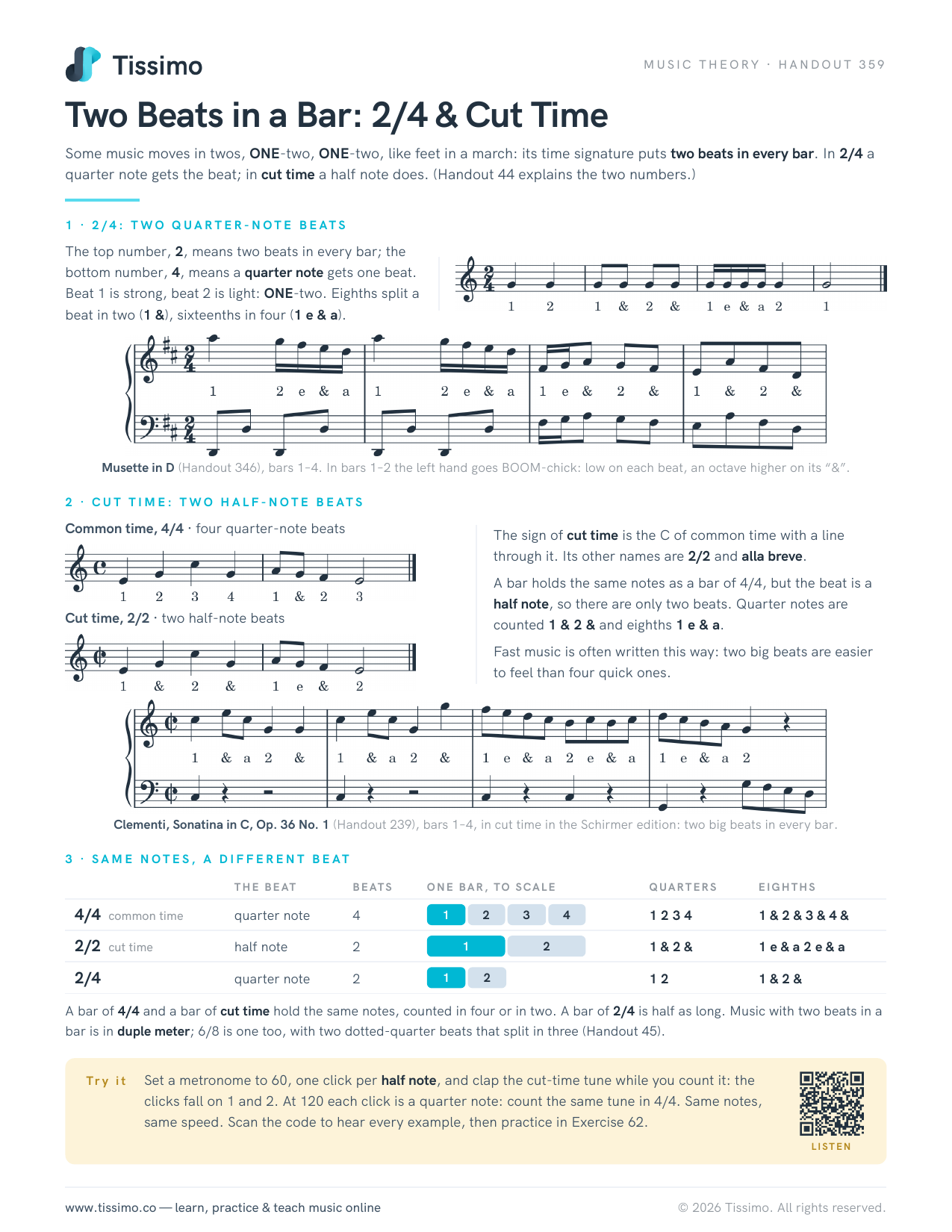 Two Beats in a Bar: 2/4 & Cut TimeSome music moves in twos, ONE-two, ONE-two, like feet in a march: its time signature puts two beats in every bar. In 2/4 a quarter note gets the beat; in cut time a half note does. (Handout 44 explains the two numbers.)