Rhythm & Meter
Quadruple Meter
Quadruple meter groups the beats in fours, with the main accent on beat 1 and a lighter one on beat 3. 4/4 (common time) is simple quadruple, and 12/8 is compound quadruple.
Quadruple meter groups the beats in fours. Beat 1, the downbeat, carries the main accent, beat 3 a lighter secondary one, and beats 2 and 4 are weak: STRONG-weak-medium-weak. 4/4, also called common time, is the best-known quadruple meter, and a great deal of popular music, hymns and classical music is written in it.
Simple and compound quadruple
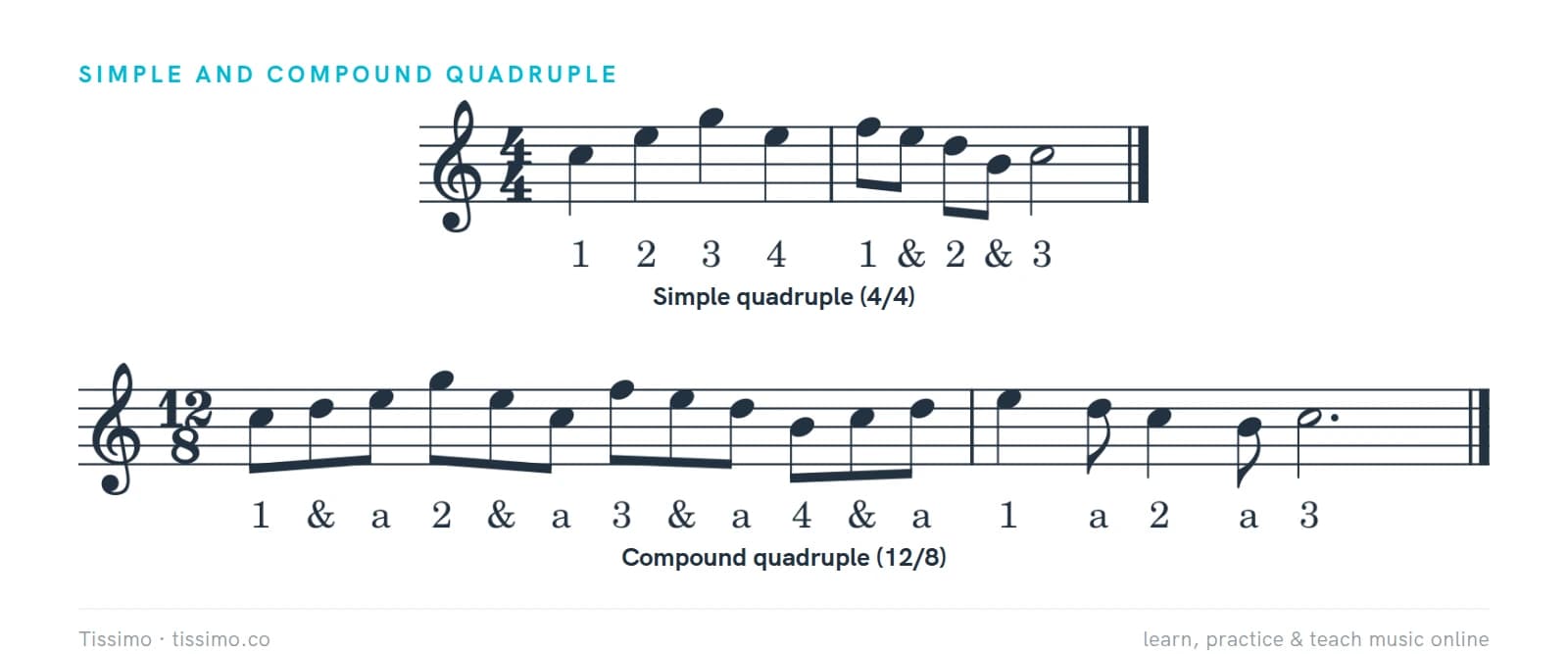
- Simple quadruple: four beats, each splitting into two. 4/4 is the usual signature; 4/2 and 4/8 are rarer.
- Compound quadruple: four beats, each splitting into three. 12/8 has four dotted-quarter beats of three eighth notes each. Slow blues and many soul and gospel ballads are often felt and written in 12/8.
Counting four
Count "1, 2, 3, 4", and for eighth notes "1 & 2 & 3 & 4 &". In 12/8, count the four big beats and their thirds: "1 & a 2 & a 3 & a 4 & a". A conductor beats quadruple meter down on 1, across to the left on 2, out to the right on 3, and up on 4.
Quadruple meter and the backbeat
In rock, pop, soul and much country music, the drums flip the natural weighting of 4/4. The bass drum plays on beats 1 and 3, and the snare drum hits hard on beats 2 and 4. That pattern is the backbeat, and it is a big part of why so much popular music in 4/4 seems to push forward.
Quadruple or duple?
A bar of 4/4 can sound like two bars of 2/4. The difference is mostly in the weight of beat 3: in quadruple meter it is clearly weaker than beat 1, while in duple meter every other beat is equally strong. Harmony helps too. In 4/4, chords often change once or twice a bar, on beats 1 and 3.
Practice reading four-beat bars with Time Signatures I: Simple Time, and four-beat compound bars with Write the Counts 4: Compound Time.
Common questions
Is 4/4 duple or quadruple meter?
Quadruple: it has four beats per bar. A fast 4/4 can feel like two big beats, which is why musicians sometimes say they "feel it in two", but the time signature still describes four quarter-note beats.
What is 12/8 time?
12/8 is compound quadruple meter: twelve eighth notes per bar, grouped in four sets of three. You count four dotted-quarter beats: 1 & a 2 & a 3 & a 4 & a.
Practice it: free worksheets
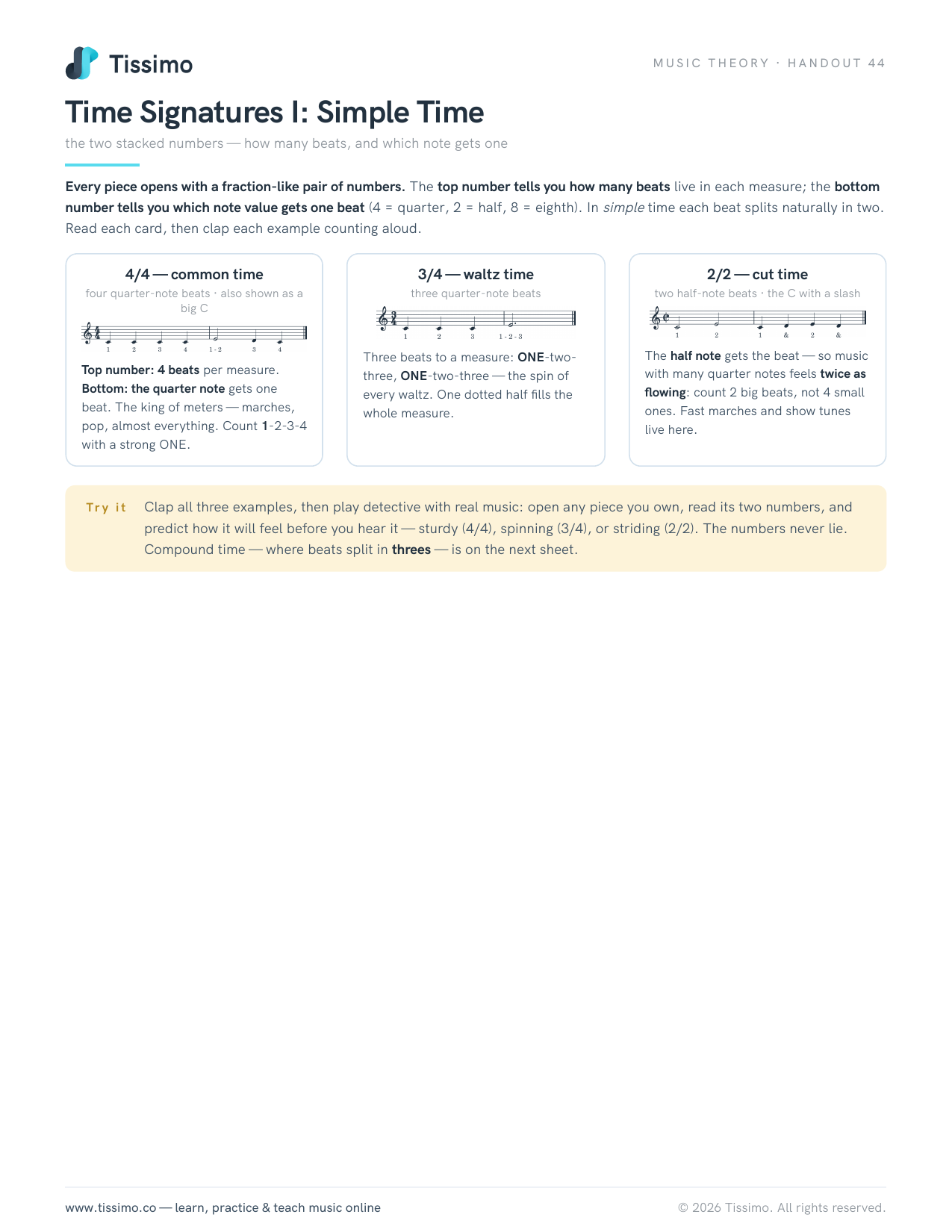 Time Signatures I: Simple Timethe two stacked numbers — how many beats, and which note gets one
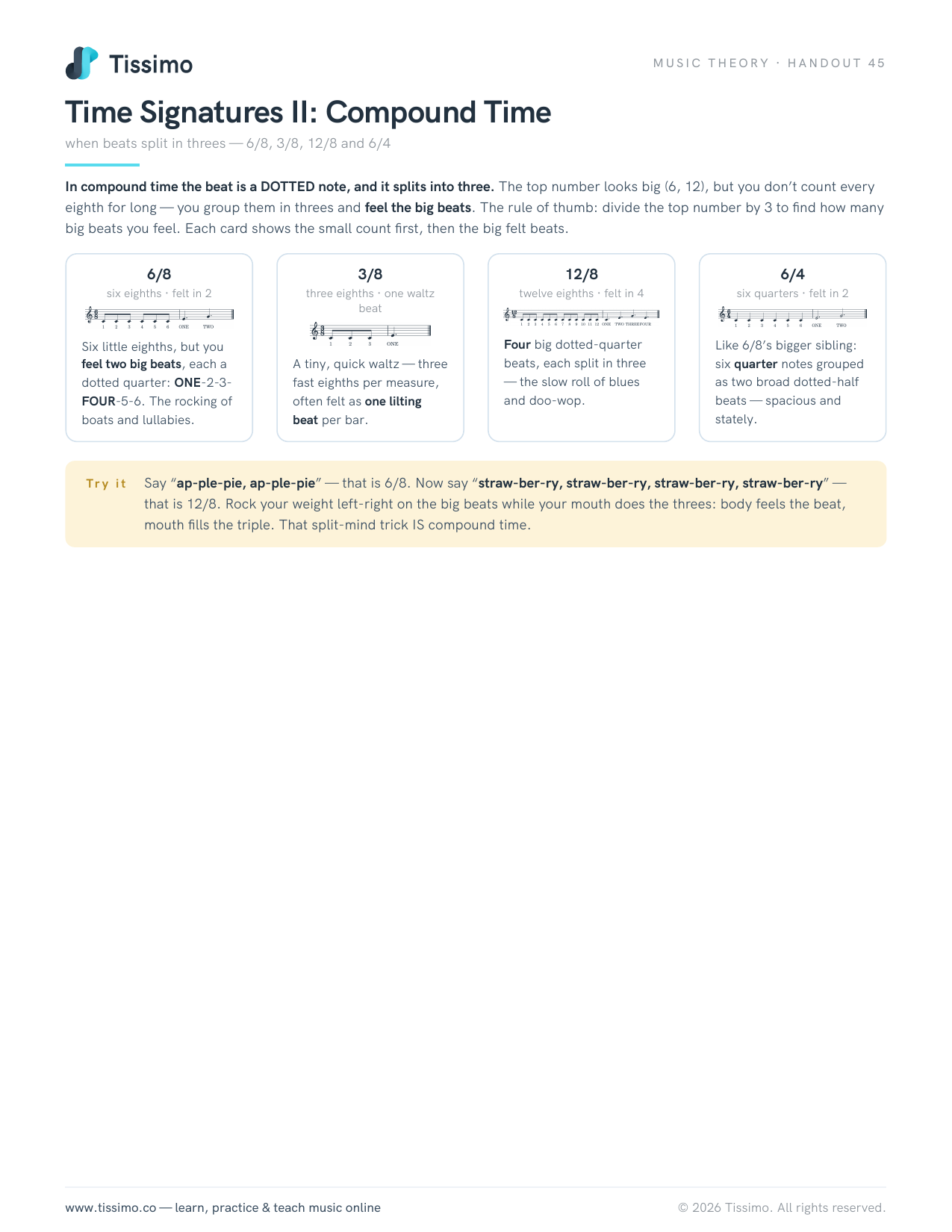 Time Signatures II: Compound Timewhen beats split in threes — 6/8, 9/8, 12/8 and 6/4
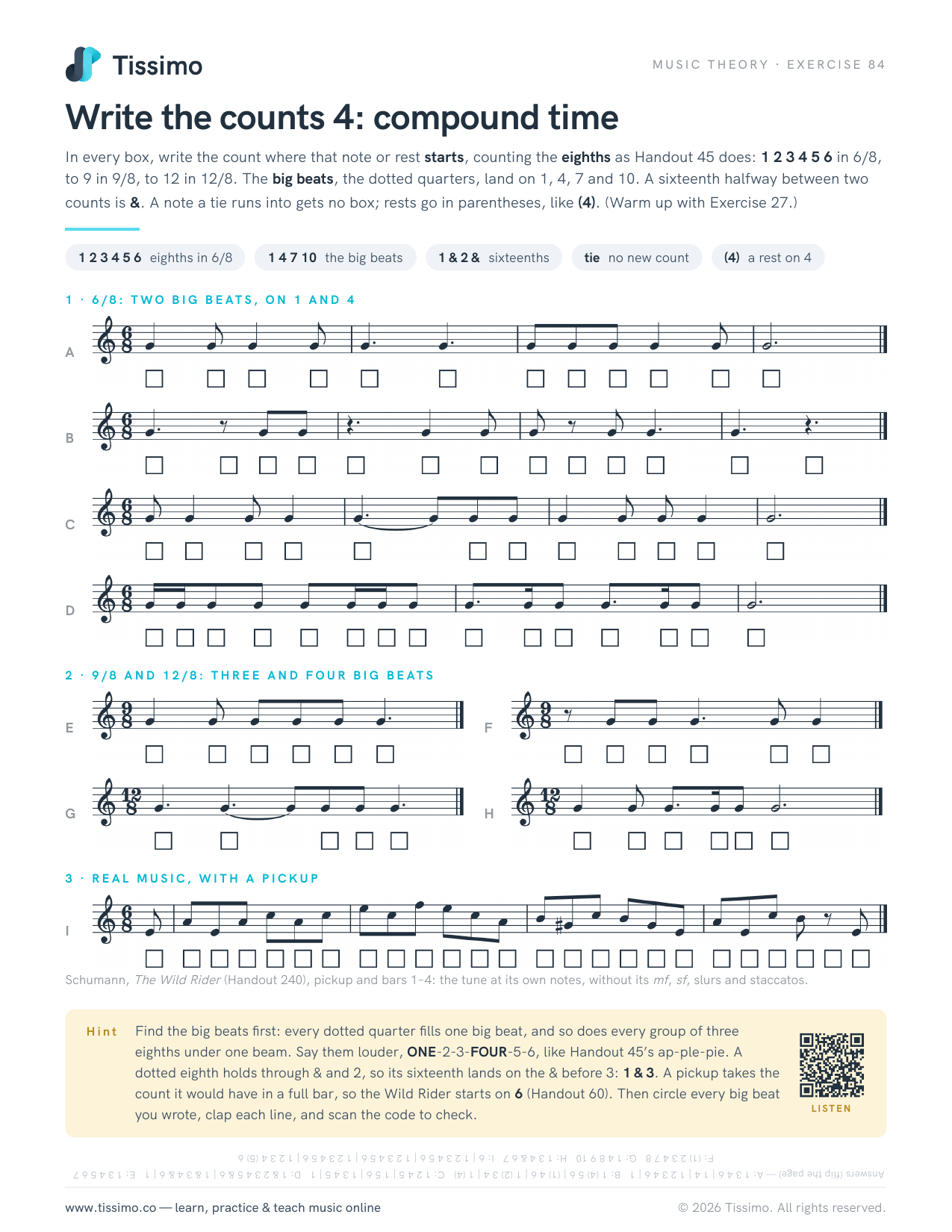 Write the counts 4: compound timeIn every box, write the count where that note or rest starts, counting the eighths as Handout 45 does: 1 2 3 4 5 6 in 6/8, to 9 in 9/8, to 12 in 12/8. The big beats, the dotted quarters, land on 1, 4, 7 and 10. A sixteenth halfway between two counts is &. A note a tie runs into gets no box; rests go in parentheses, like (4). (Warm up with Exercise 27.)