Styles, Genres & Eras
Program Music
Program music is instrumental music that tells a story, depicts a scene or illustrates a text, usually indicated by a title or a written program. Its opposite is absolute music.
Program music is instrumental music that refers to something outside itself: a story, a poem, a painting, a landscape, a character. The composer points the listener toward that subject with a title, a written description (the program) or headings in the score. Music with no such reference, such as a sonata or a fugue simply called by its form and key, is called absolute music.
How music can describe
- Imitation of sounds: birdsong, thunder, bells, running water.
- Motion and gesture: rising lines for climbing, galloping rhythms for horses.
- Mood and atmosphere: a slow, hushed opening for night; a brass fanfare for a hero.
- Recurring themes that stand for characters or ideas and change as the story unfolds, like Berlioz's idée fixe (a recurring melody representing the beloved) in his Symphonie fantastique.
Famous examples
- Vivaldi, The Four Seasons (published 1725): four violin concertos printed with sonnets describing each season.
- Beethoven, Symphony No. 6, "Pastoral," with movement titles such as "Scene by the brook." Beethoven noted that it was more an expression of feeling than painting.
- Berlioz, Symphonie fantastique (1830), a symphony with a detailed story about an artist's obsessive love.
- Liszt, who wrote a series of one-movement orchestral pieces he called symphonic poems and championed program music.
- Smetana, Vltava ("The Moldau"), following a river from its source to Prague.
- Mussorgsky, Pictures at an Exhibition, portraying paintings and the visitor walking between them.
- Saint-Saëns, Danse macabre; Dukas, The Sorcerer's Apprentice.
- Richard Strauss's tone poems, such as Don Juan and Till Eulenspiegel.
- Prokofiev, Peter and the Wolf, in which each character is played by a different instrument.
A 19th-century debate
Program music flourished in the Romantic era, and it sparked an argument: should music depict things, or is its highest form "pure" music about musical ideas alone? Liszt and Wagner were associated with the first view; the critic Eduard Hanslick, with Brahms often cited on his side, with the second. Today most musicians see the two as different, equally valid approaches.
Listening tip
Listen once without reading the program and note what you imagine. Then read it and listen again. Comparing the two is a good way to hear which details the composer chose to illustrate.
Common questions
What is the difference between program music and absolute music?
Program music refers to something outside the music, such as a story, scene or poem, usually through a title or written program. Absolute music is meant to be heard purely as music, without an outside subject.
What is a symphonic poem?
A one-movement orchestral piece based on a story, poem, painting or idea. Liszt introduced the name, and Smetana, Saint-Saëns, Sibelius and Richard Strauss wrote famous examples.
Practice it: free worksheets
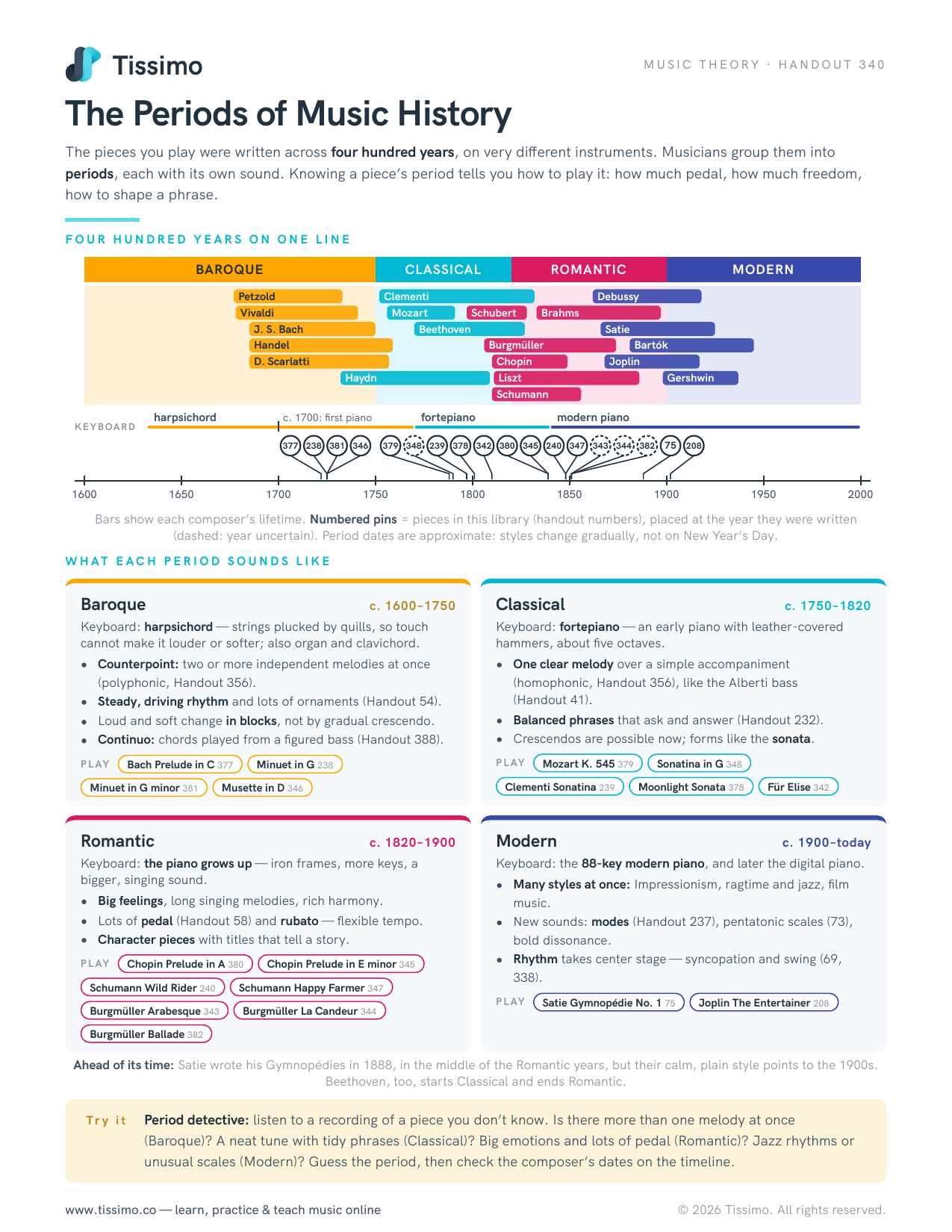 The Periods of Music HistoryThe pieces you play were written across four hundred years, on very different instruments. Musicians group them into periods, each with its own sound. Knowing a piece’s period tells you how to play it: how much pedal, how much freedom, how to shape a phrase.
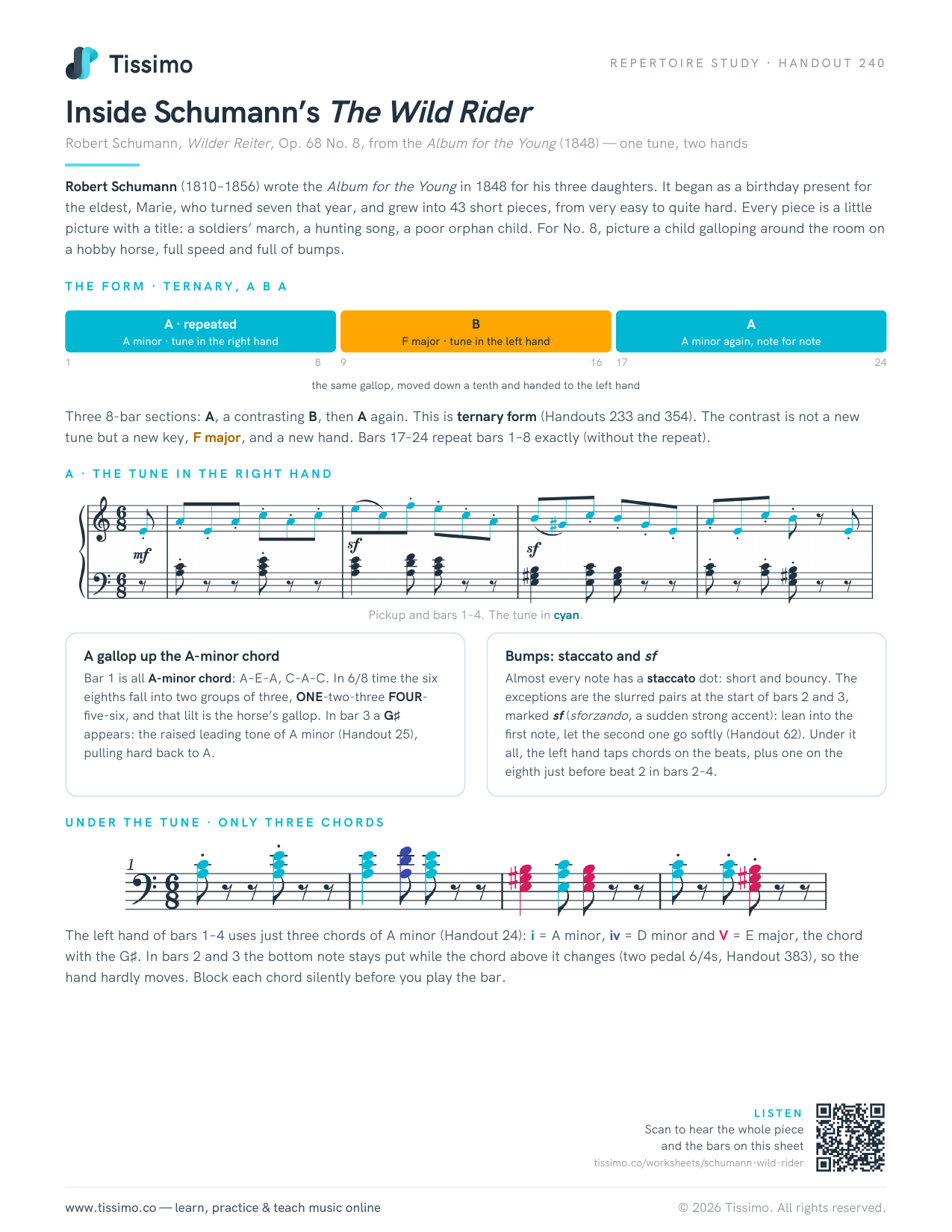 Inside Schumann’s The Wild RiderRobert Schumann, Wilder Reiter, Op. 68 No. 8, from the Album for the Young (1848) — one tune, two hands