Styles, Genres & Eras
Medieval Music
Medieval music is the music of Europe from roughly 500 to 1400: Gregorian chant, early polyphony such as organum, and the songs of troubadours and trouvères.
Medieval music covers almost a thousand years of European music, conventionally from about 500 to about 1400. Much of it is lost, because for centuries music was passed on by ear. What survives comes mostly from churches and monasteries, where it was gradually written down, and the period is also the time when Western music notation itself was invented.
Sacred music
- Gregorian chant: single-line, unaccompanied Latin song for the services of the Church, sung in free rhythm and built on the church modes. It is the foundation of the period.
- Organum: the earliest written polyphony. At first a second voice simply ran parallel to the chant, a fourth or fifth below; later the added voice became freer and more florid. In the late 12th and early 13th centuries, Léonin and Pérotin, associated with the cathedral of Notre-Dame in Paris, wrote elaborate organum in two, three and even four voices.
- The motet appeared in the 13th century, often with different texts sung at the same time in different voices.
- In the 14th century, the style known as the Ars nova ("new art") brought more complex rhythms. Guillaume de Machaut's Messe de Nostre Dame is one of the earliest complete polyphonic settings of the Mass by a single composer.
Hildegard of Bingen, a 12th-century German abbess, is one of the best-known medieval composers. Her chants are still sung and recorded.
Secular music
Poet-musicians sang about love, war and politics: the troubadours in southern France, the trouvères in northern France and the Minnesinger in German lands. Instruments included the vielle (an early fiddle), harp, lute, recorder, shawm, bagpipe, psaltery and the small portable organ.
Notation takes shape
Medieval musicians developed the tools later music depends on: neumes (signs above the text), then a staff of lines to fix pitches exactly. The 11th-century monk Guido of Arezzo is credited with improvements to the staff and with the syllables ut, re, mi, fa, sol, la, the ancestor of solfège. Rhythmic notation followed in the 13th and 14th centuries.
How it sounds to modern ears
Expect open sounds: perfect fourths, fifths and octaves are the main consonances, while thirds are treated as less stable. Melodies are modal rather than major or minor. Performers today reconstruct much of the sound, such as instrumentation, tempo and ornaments, from limited evidence, so recordings differ widely.
Common questions
When was the medieval period in music?
Roughly from 500 to 1400, though the dates are conventional. It is followed by the Renaissance, from about 1400 to 1600.
What instruments were used in medieval music?
Among others, the vielle (an early fiddle), harp, lute, recorder, shawm, bagpipe, psaltery, drums and small portable organs. Much sacred music was sung without instruments.
Practice it: free worksheets
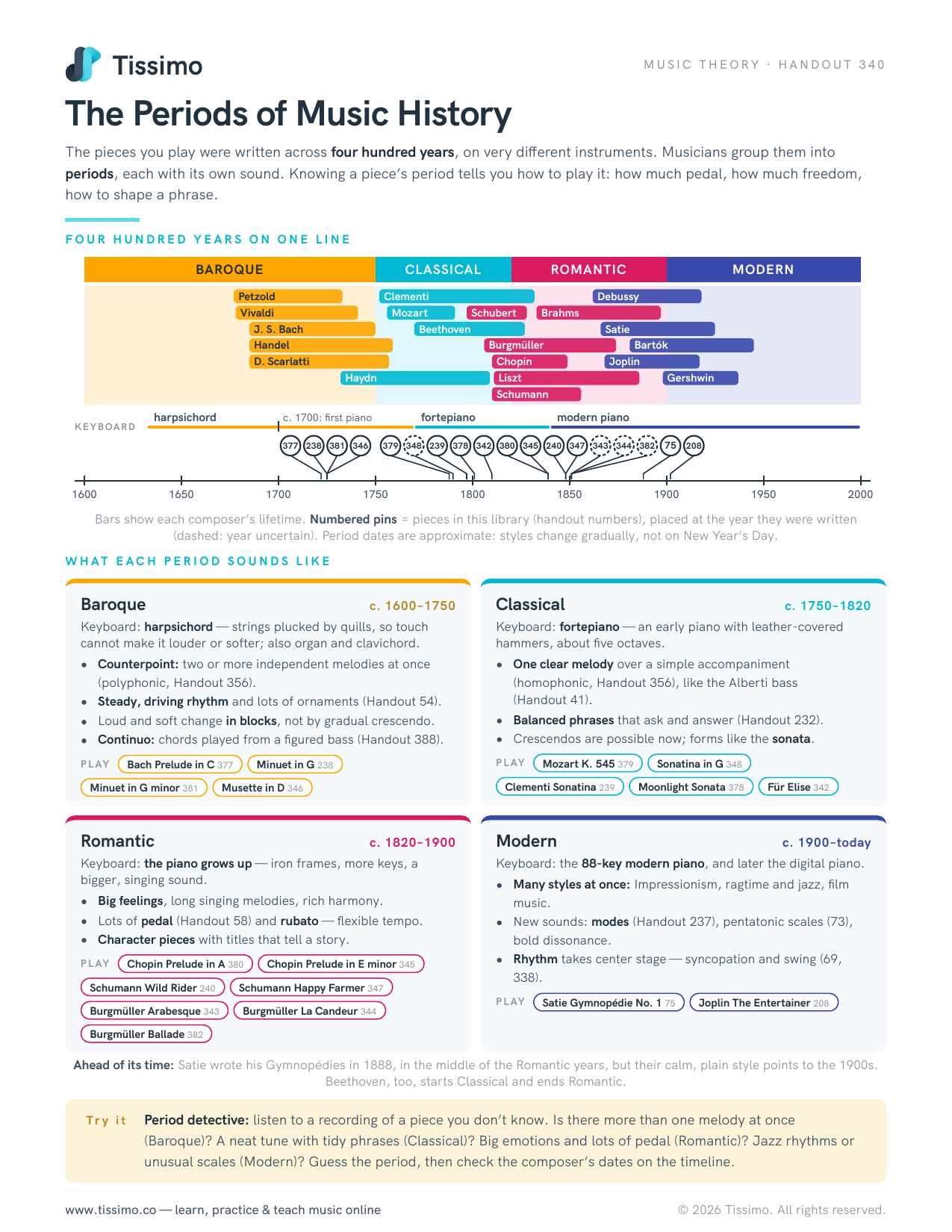 The Periods of Music HistoryThe pieces you play were written across four hundred years, on very different instruments. Musicians group them into periods, each with its own sound. Knowing a piece’s period tells you how to play it: how much pedal, how much freedom, how to shape a phrase.
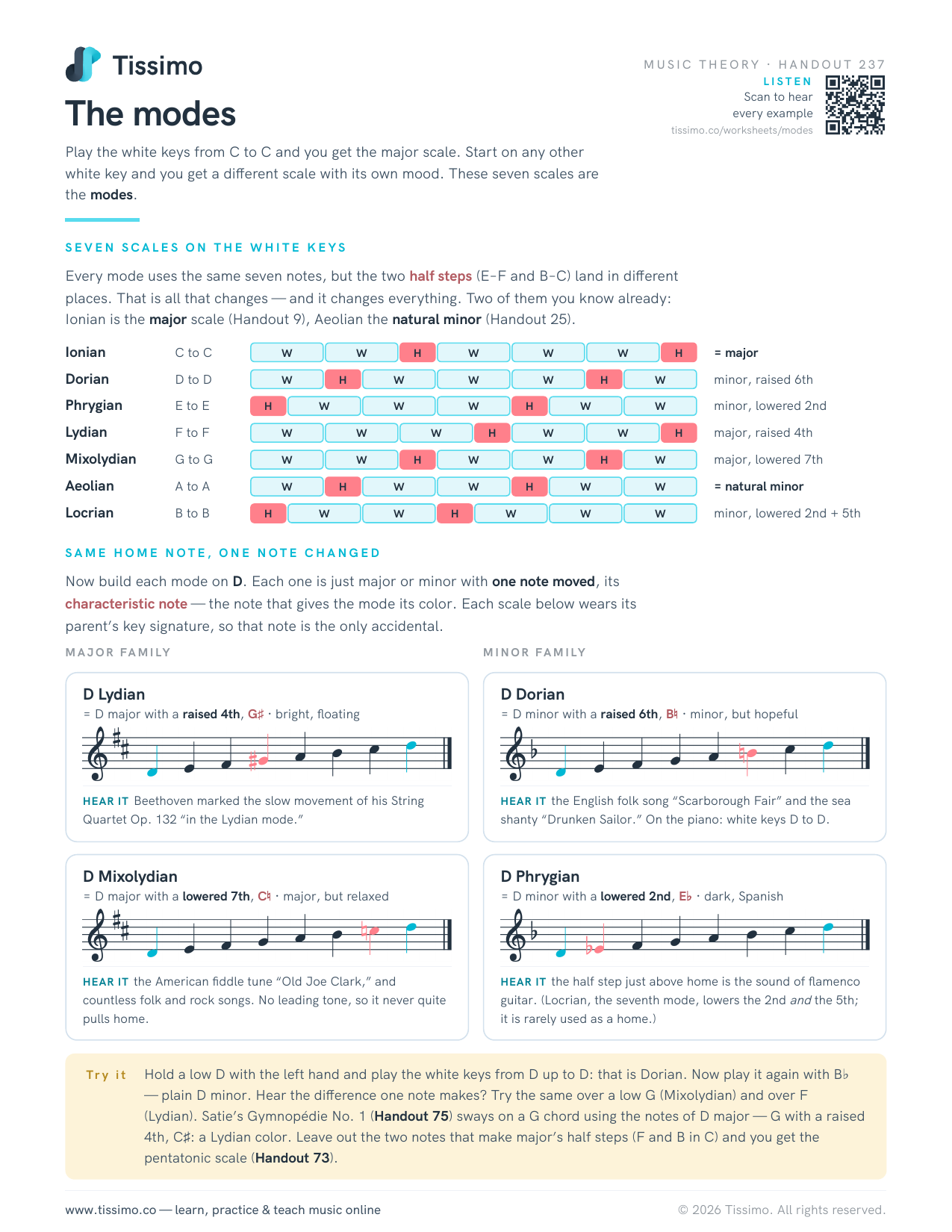 The modesPlay the white keys from C to C and you get the major scale. Start on any other white key and you get a different scale with its own mood. These seven scales are the modes.