Styles, Genres & Eras
Gregorian Chant
Gregorian chant is the traditional monophonic, unaccompanied song of the Roman Catholic liturgy, sung in Latin in free rhythm. It was central to Western music for centuries.
Gregorian chant is the plainchant of the Roman Catholic Church: a single melodic line, sung in Latin, usually without accompaniment and without a regular beat. Its rhythm follows the words. Its melodies are built on the church modes rather than on major and minor keys.
Where the name comes from
The chant is named after Pope Gregory I (who died in 604), and a medieval legend pictured him receiving the melodies from the Holy Spirit in the form of a dove. Historians, however, believe the repertory took the shape we know later, mainly in the Frankish kingdoms of the 8th and 9th centuries, when Roman chant was combined with local traditions and spread across Europe.
What it sounds like
- Monophonic: everyone sings the same line, in unison or in octaves.
- Free rhythm: no time signature; the natural stresses of the Latin text shape the flow.
- Narrow range and mostly stepwise motion, with occasional leaps.
- Modal melodies that often end on the mode's final note.
Chant melodies are described by how many notes they give each syllable: syllabic (one note per syllable), neumatic (a few notes per syllable) and melismatic, where one syllable stretches over many notes, as in the long "Alleluias" (see melisma).
How it is written
Chant is traditionally written in square notes, called neumes, on a four-line staff with a movable C or F clef. That notation descends from medieval sources. Modern editions sometimes transcribe it into standard notation with stemless noteheads.
Where it is sung
Chant was written for the Mass and for the Divine Office, the cycle of daily services sung in monasteries. In the 19th century, the Benedictine monks of Solesmes in France led a long effort to restore the chant from medieval manuscripts. After the Second Vatican Council (1962–65), most parishes switched to singing in their own languages, but the Council still named Gregorian chant as the music especially suited to the Roman liturgy, and monasteries, cathedral choirs and early-music ensembles continue to sing it.
Why it matters
For musicians, chant is the root of Western music. Medieval composers built the first polyphony on chant melodies, staff notation was developed largely to preserve it, and the syllables of solfège come from a chant hymn. Many later composers, from Renaissance masters to 20th-century composers, quoted or reworked chant melodies.
Common questions
Why is it called Gregorian chant?
It is named after Pope Gregory I (died 604), but historians think the repertory took its familiar form later, mainly in the Frankish lands in the 8th and 9th centuries.
Is Gregorian chant monophonic?
Yes. It is a single, unaccompanied melodic line sung in unison or octaves, without harmony or a regular beat.
Practice it: free worksheets
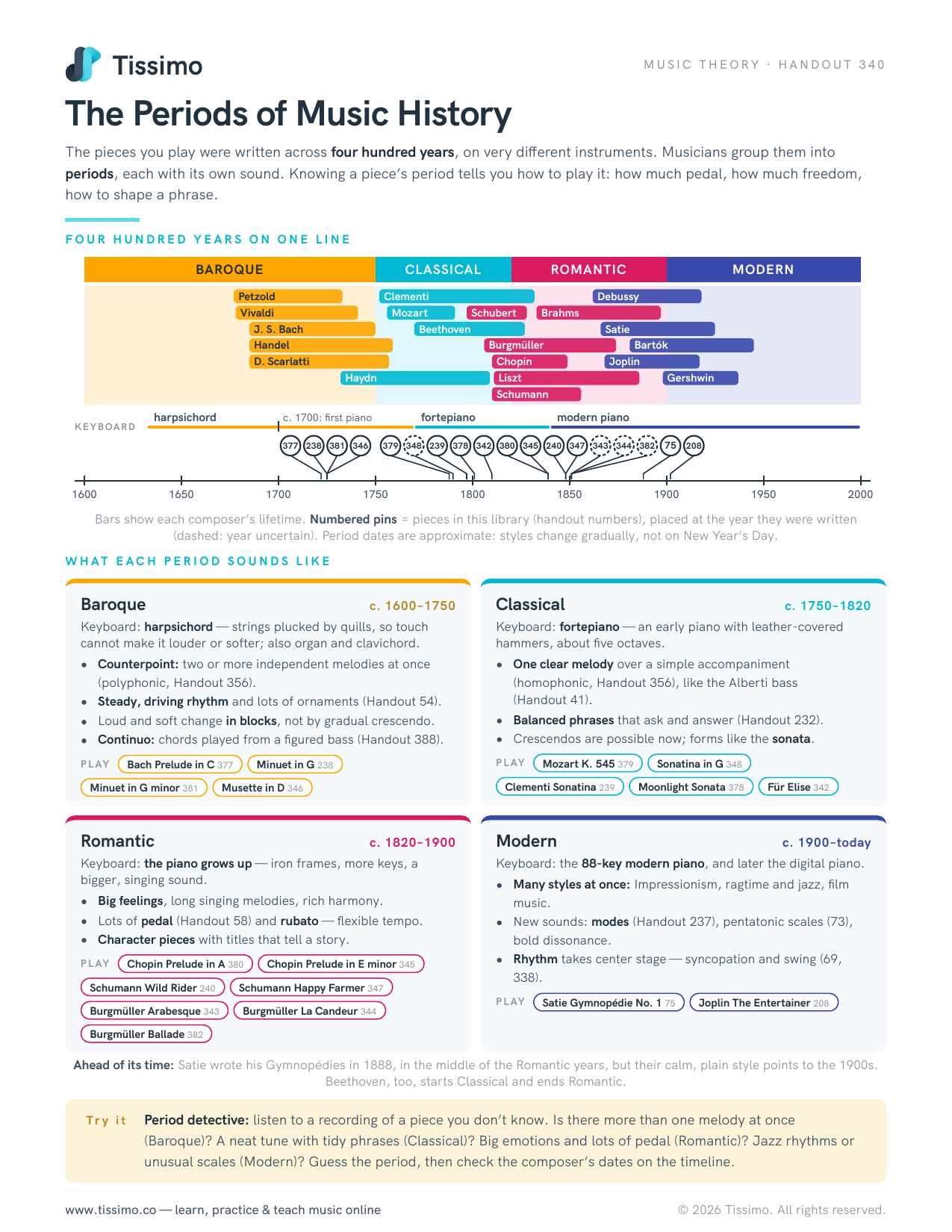 The Periods of Music HistoryThe pieces you play were written across four hundred years, on very different instruments. Musicians group them into periods, each with its own sound. Knowing a piece’s period tells you how to play it: how much pedal, how much freedom, how to shape a phrase.
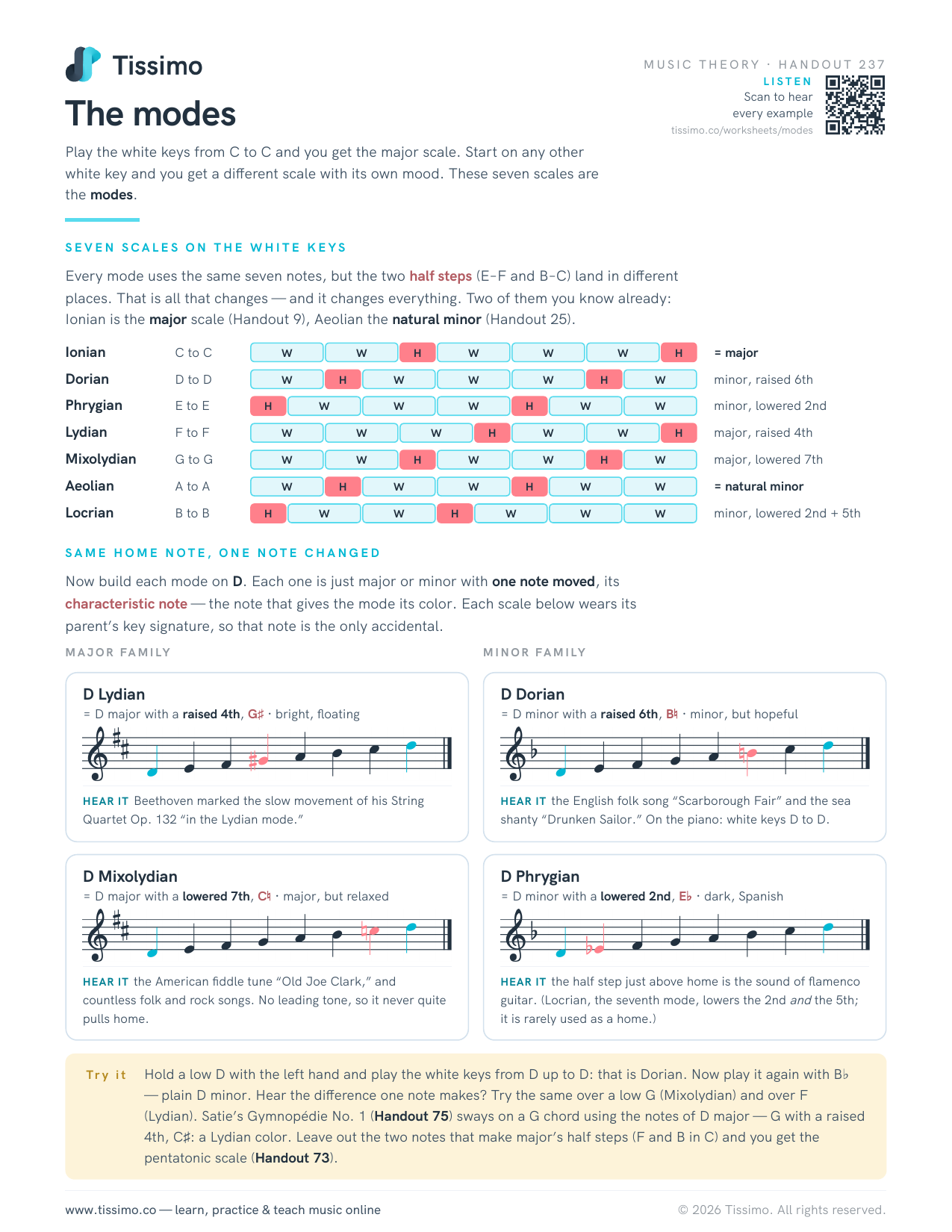 The modesPlay the white keys from C to C and you get the major scale. Start on any other white key and you get a different scale with its own mood. These seven scales are the modes.
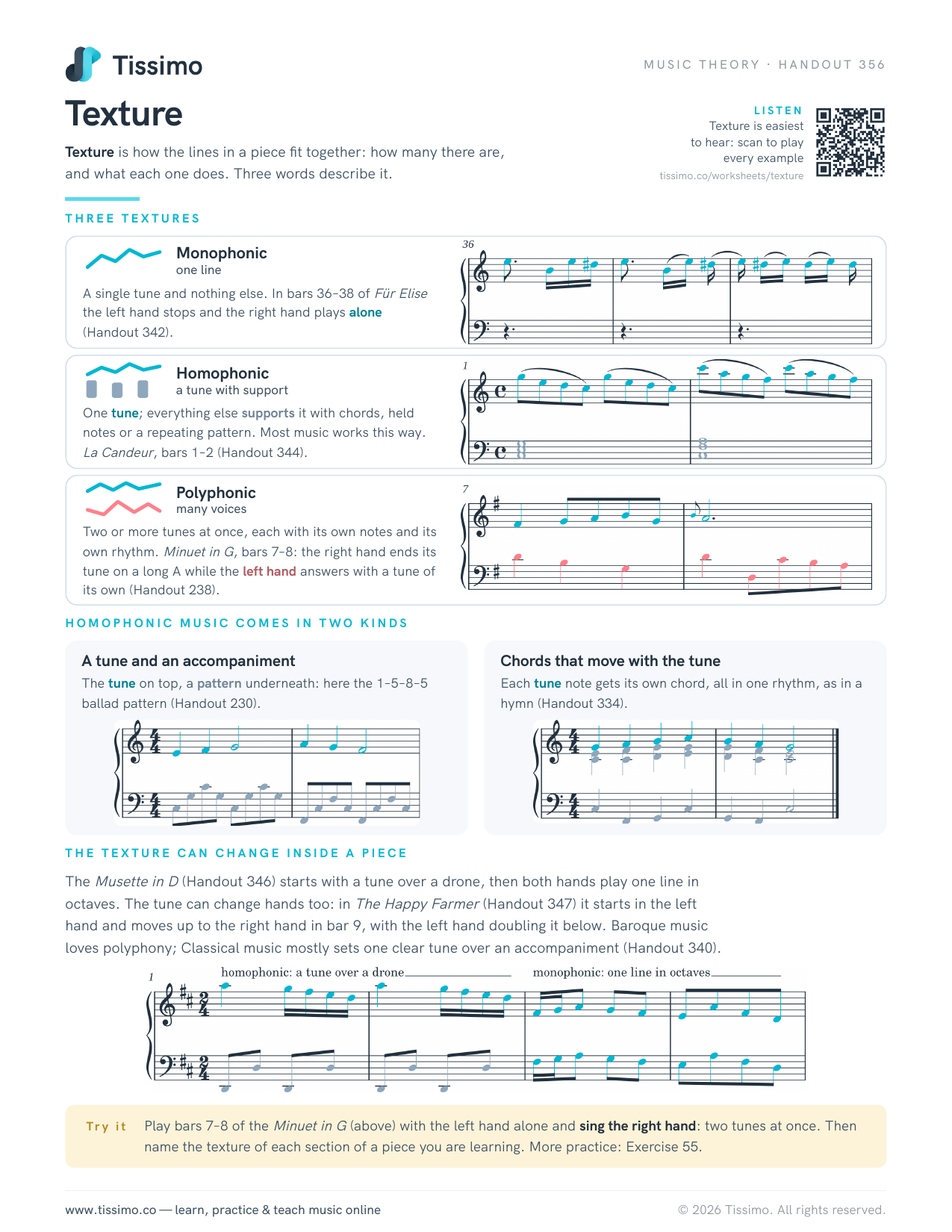 TextureTexture is how the lines in a piece fit together: how many there are, and what each one does. Three words describe it.