Styles, Genres & Eras
Renaissance Music
Renaissance music is European music from roughly 1400 to 1600, known for smooth, flowing vocal polyphony in which several equal voices imitate one another, as in the masses of Josquin and Palestrina.
The Renaissance in music runs roughly from 1400 to 1600, between the Medieval and Baroque periods. Its best-known sound is that of an unaccompanied choir weaving several independent lines into a smooth, glowing whole.
Characteristics
- Polyphony with equal voices. Four, five or six voices, each with its own melody, none of them simply an accompaniment.
- Imitation. Each voice enters in turn with the same short melodic idea, then continues freely.
- Smooth melodic lines, mostly stepwise, with carefully controlled dissonances.
- Fuller harmony. Thirds and sixths became central to the sound, alongside the open fifths and octaves of earlier music.
- Word painting. Especially in madrigals, the music illustrates the text: rising lines for "ascend," a sudden dissonance for "pain."
- Modal melodies and harmonies, gradually moving toward the major and minor keys of later centuries.
Sacred music
The main sacred genres were the Mass and the motet. Leading composers include Guillaume Du Fay and Johannes Ockeghem in the 15th century, Josquin des Prez around 1500, and later Giovanni Pierluigi da Palestrina, Orlande de Lassus, Tomás Luis de Victoria, Thomas Tallis and William Byrd. Palestrina's smooth style later became the model for teaching counterpoint. Tallis's Spem in alium is written for forty independent voices. The Protestant Reformation brought the Lutheran chorale, a hymn sung by the whole congregation.
Secular music
The madrigal, a setting of a poem for several solo voices, flourished first in Italy and then in England. French composers wrote chansons, and dance music for instruments was popular at court. Typical instruments included the lute, viols, recorders, cornetts, sackbuts (early trombones) and keyboard instruments such as the virginal.
Printed music
In 1501, the Venetian printer Ottaviano Petrucci published a collection of polyphonic songs printed from movable type. Printing made music cheaper and spread composers' works across Europe.
Listening and singing tips
Follow one voice at a time through a Renaissance motet, then try to hear how its entries line up with the others. If you sing in a choir, keep your line smooth and even, and listen across the ensemble: in this music, blend matters more than any single voice. The Texture worksheet explains polyphony, and Two Lines, One Note at a Time shows the basic rules of counterpoint.
Common questions
What are the characteristics of Renaissance music?
Smooth vocal polyphony in which equal voices imitate one another, consonant harmony rich in thirds and sixths, modal melodies, and word painting, especially in madrigals.
Who are the most important Renaissance composers?
Among them are Du Fay, Ockeghem, Josquin des Prez, Palestrina, Lassus, Victoria, Tallis and Byrd.
Practice it: free worksheets
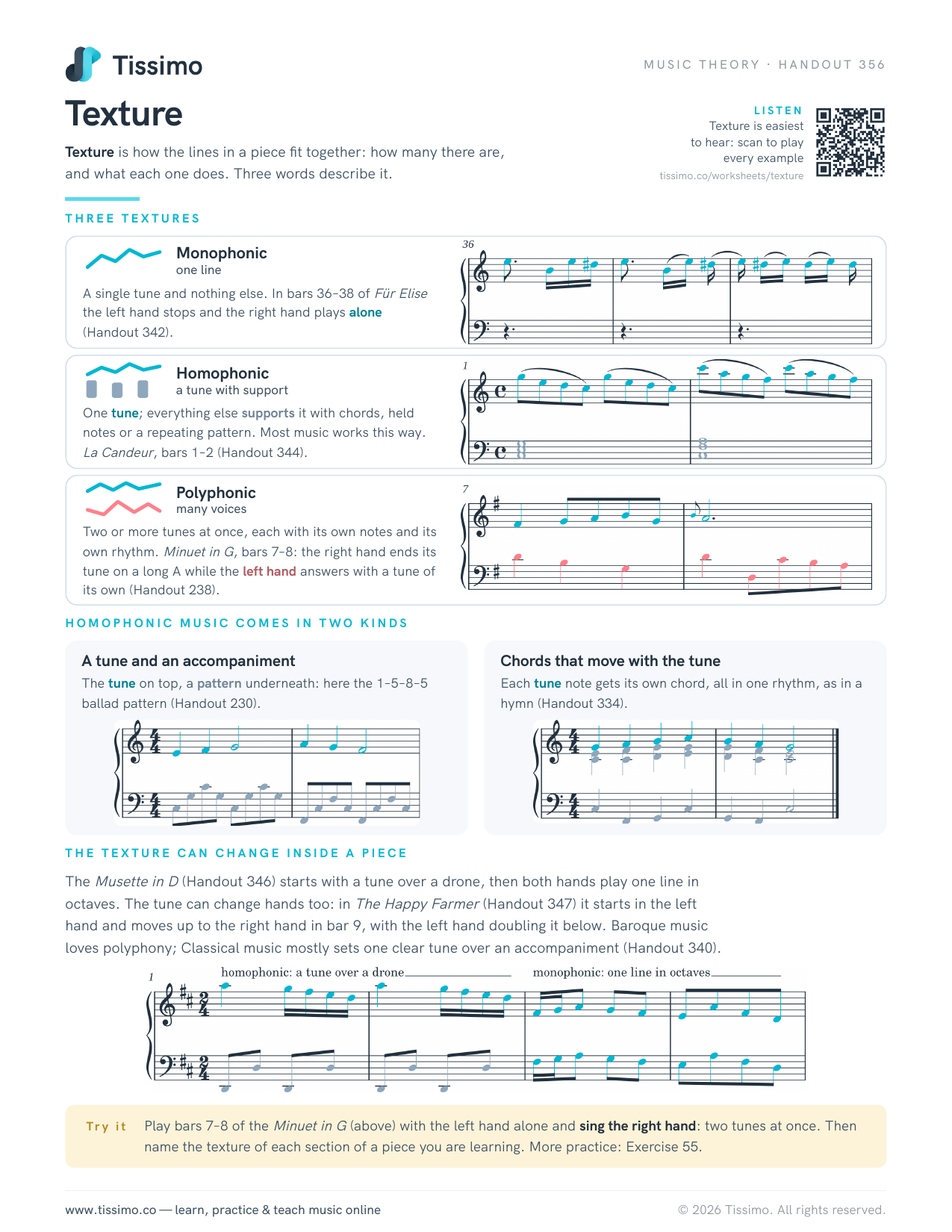 TextureTexture is how the lines in a piece fit together: how many there are, and what each one does. Three words describe it.
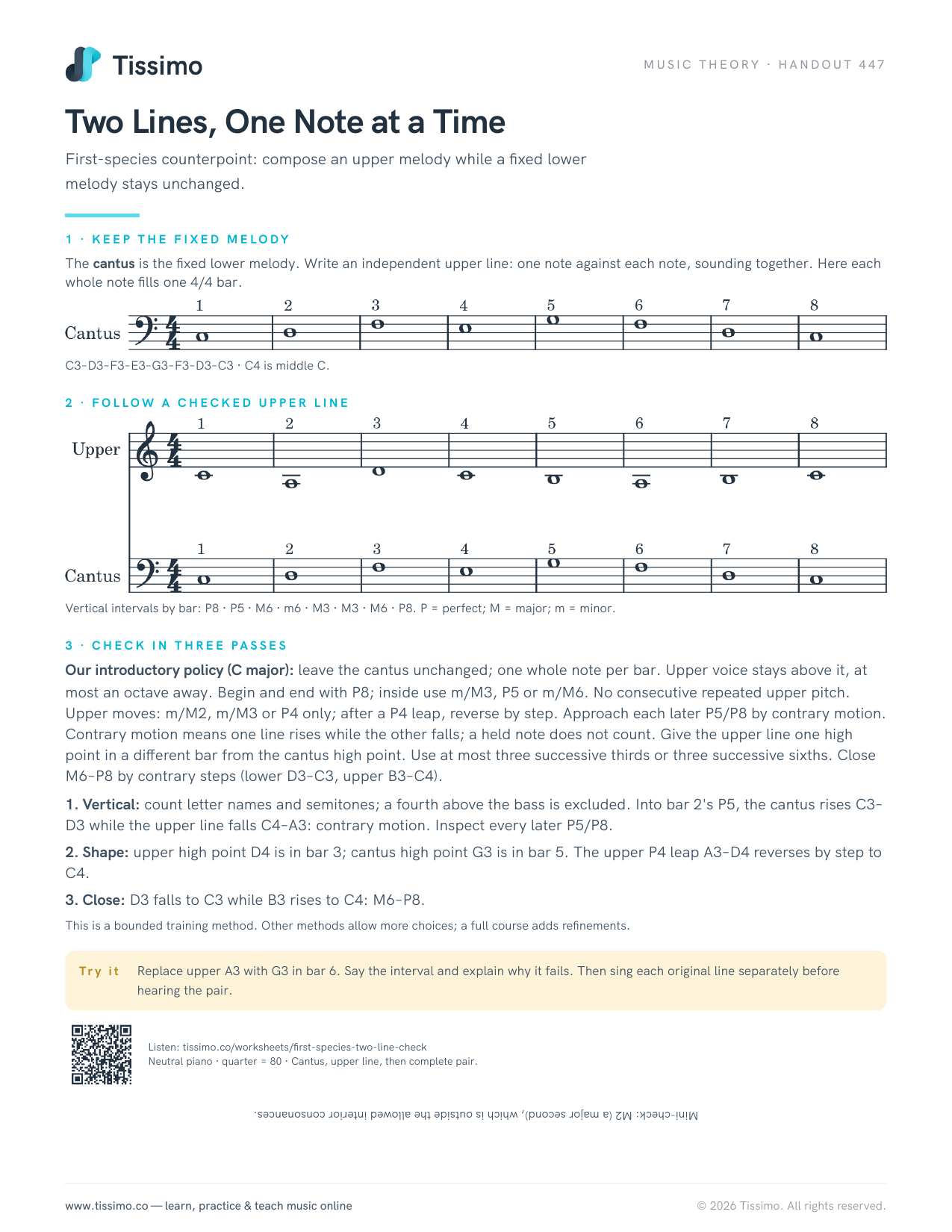 Two Lines, One Note at a TimeFirst-species counterpoint: compose an upper melody while a fixed lower melody stays unchanged.
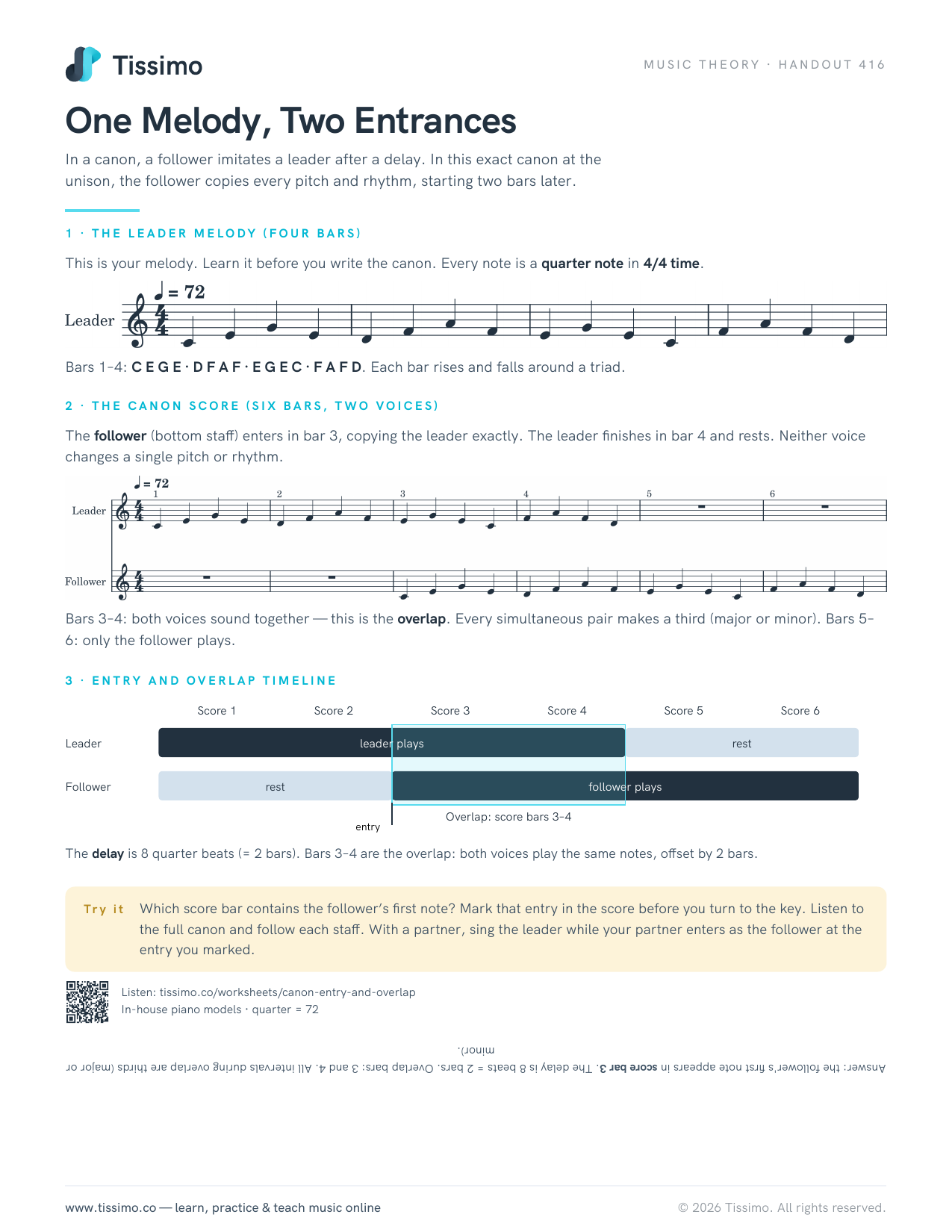 One Melody, Two EntrancesIn a canon, a follower imitates a leader after a delay. In this exact canon at the unison, the follower copies every pitch and rhythm, starting two bars later.
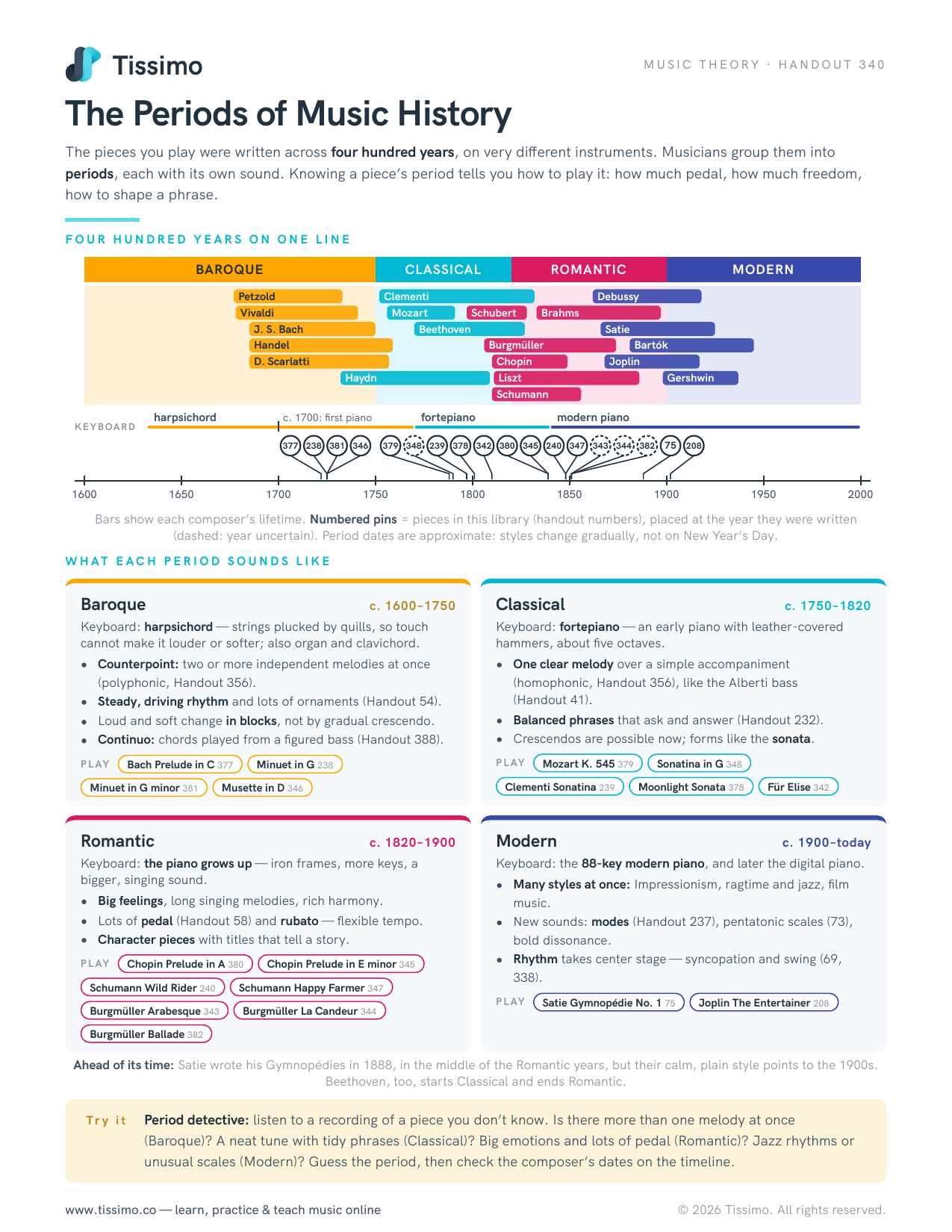 The Periods of Music HistoryThe pieces you play were written across four hundred years, on very different instruments. Musicians group them into periods, each with its own sound. Knowing a piece’s period tells you how to play it: how much pedal, how much freedom, how to shape a phrase.