Styles, Genres & Eras
Romantic Music
Romantic music is Western music from roughly 1820 to 1900, which put personal emotion, imagination and color first: long singing melodies, rich chromatic harmony, virtuosity and a larger orchestra.
The Romantic period runs roughly from 1820 to 1900, following the Classical period. Romantic composers valued feeling over balance and form: music became a way to express intense personal emotion, to tell stories, to describe nature and to evoke the supernatural. Beethoven, whose later works broke many Classical conventions, is often seen as the bridge into the era.
Characteristics
- Long, singing melodies, often modeled on opera.
- Rich, chromatic harmony: more dissonance, more seventh and ninth chords, and surprising modulations. Wagner's Tristan und Isolde pushed chromatic harmony to new limits.
- Extremes: from the tiny piano miniature to symphonies lasting over an hour, from ppp to fff, from the very slow to the very fast.
- A bigger orchestra, with more brass, more percussion and new instruments, used for color as much as for melody.
- Flexible tempo: rubato and frequent changes of speed.
- Virtuosity: performers such as the violinist Paganini and the pianist Liszt became celebrities.
Genres
- Character pieces for piano: nocturnes, preludes, études, ballades, mazurkas and songs without words.
- The art song (Lied) and the song cycle.
- Program music: symphonic poems and program symphonies that tell a story.
- Grand opera and music drama.
- Nationalist music inspired by folk songs and legends.
Composers
Franz Schubert, Felix Mendelssohn, Frédéric Chopin, Robert and Clara Schumann, Franz Liszt, Hector Berlioz, Richard Wagner, Giuseppe Verdi, Johannes Brahms, Pyotr Ilyich Tchaikovsky, Antonín Dvořák, Edvard Grieg and, at the end of the century, Gustav Mahler. Late Romantic styles continued well into the 20th century, in the music of Rachmaninoff, for example.
The piano grows up
The 19th-century piano gained an iron frame, heavier strings and a wider range, producing a bigger, more sustained sound. Romantic piano music relies on the sustain pedal to blend wide-spread accompaniments under a singing melody.
Playing Romantic music
Let the melody sing above the accompaniment, use the pedal to create color (changing it cleanly with the harmony), and shape phrases with rubato, but keep an underlying pulse. Try Chopin's Prelude in E Minor, Schumann's The Wild Rider and Burgmüller's Ballade, and compare the eras in The Periods of Music History.
Common questions
When was the Romantic period in music?
Roughly 1820 to 1900, after the Classical period. Late Romantic styles continued into the early 20th century.
What are the characteristics of Romantic music?
Expressive, song-like melodies, rich chromatic harmony, a larger orchestra, virtuoso display, flexible tempo (rubato), and an interest in stories, nature and national identity.
Practice it: free worksheets
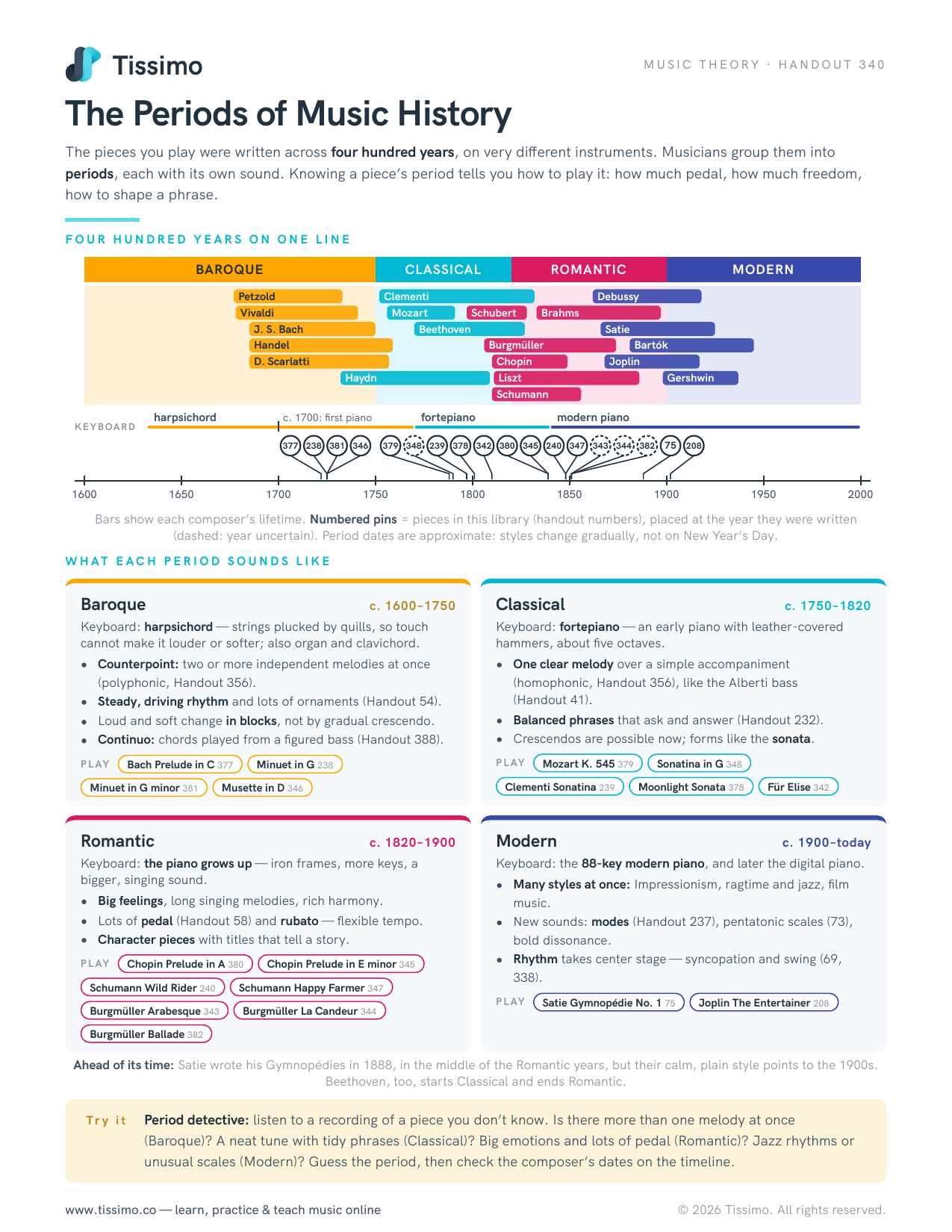 The Periods of Music HistoryThe pieces you play were written across four hundred years, on very different instruments. Musicians group them into periods, each with its own sound. Knowing a piece’s period tells you how to play it: how much pedal, how much freedom, how to shape a phrase.
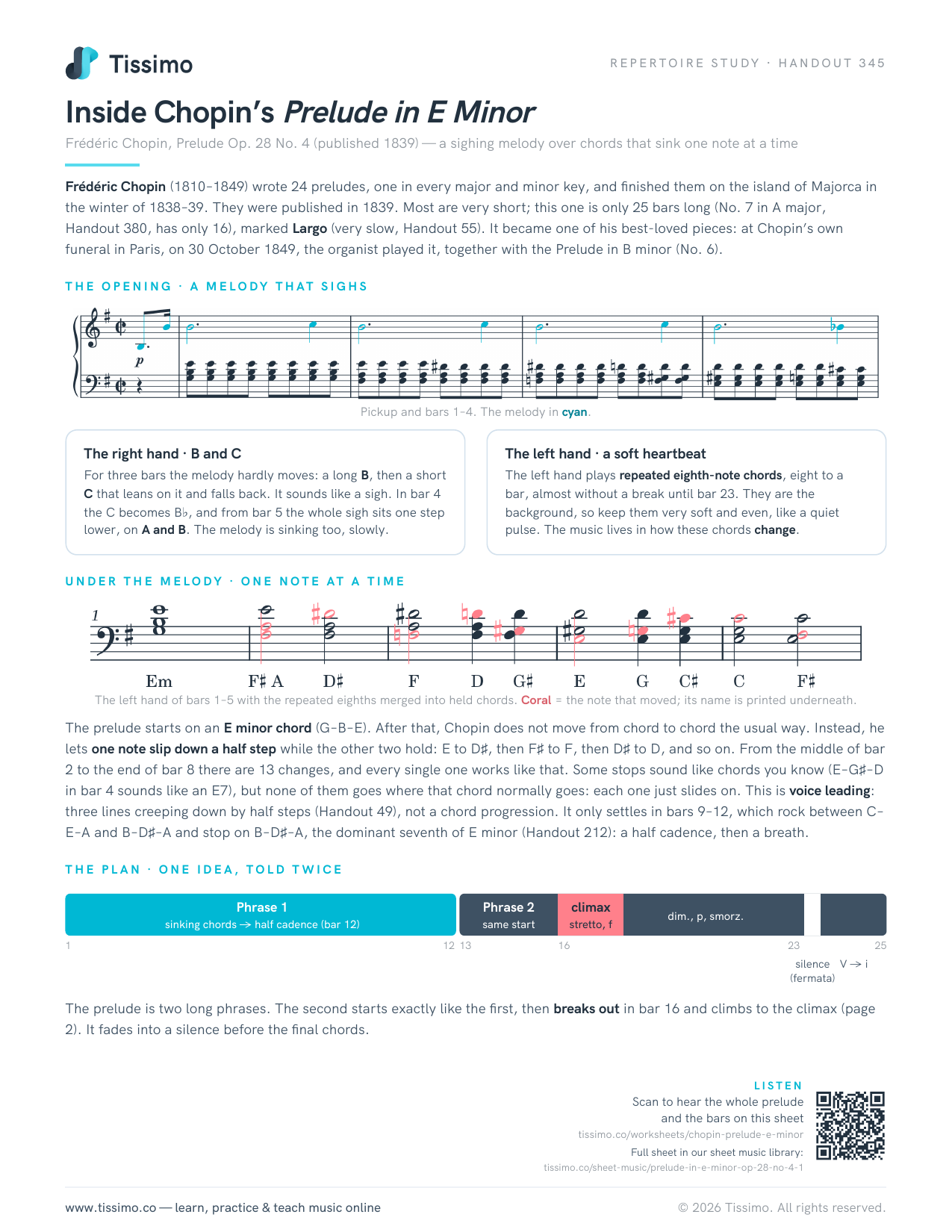 Inside Chopin’s Prelude in E MinorFrédéric Chopin, Prelude Op. 28 No. 4 (published 1839) — a sighing melody over chords that sink one note at a time
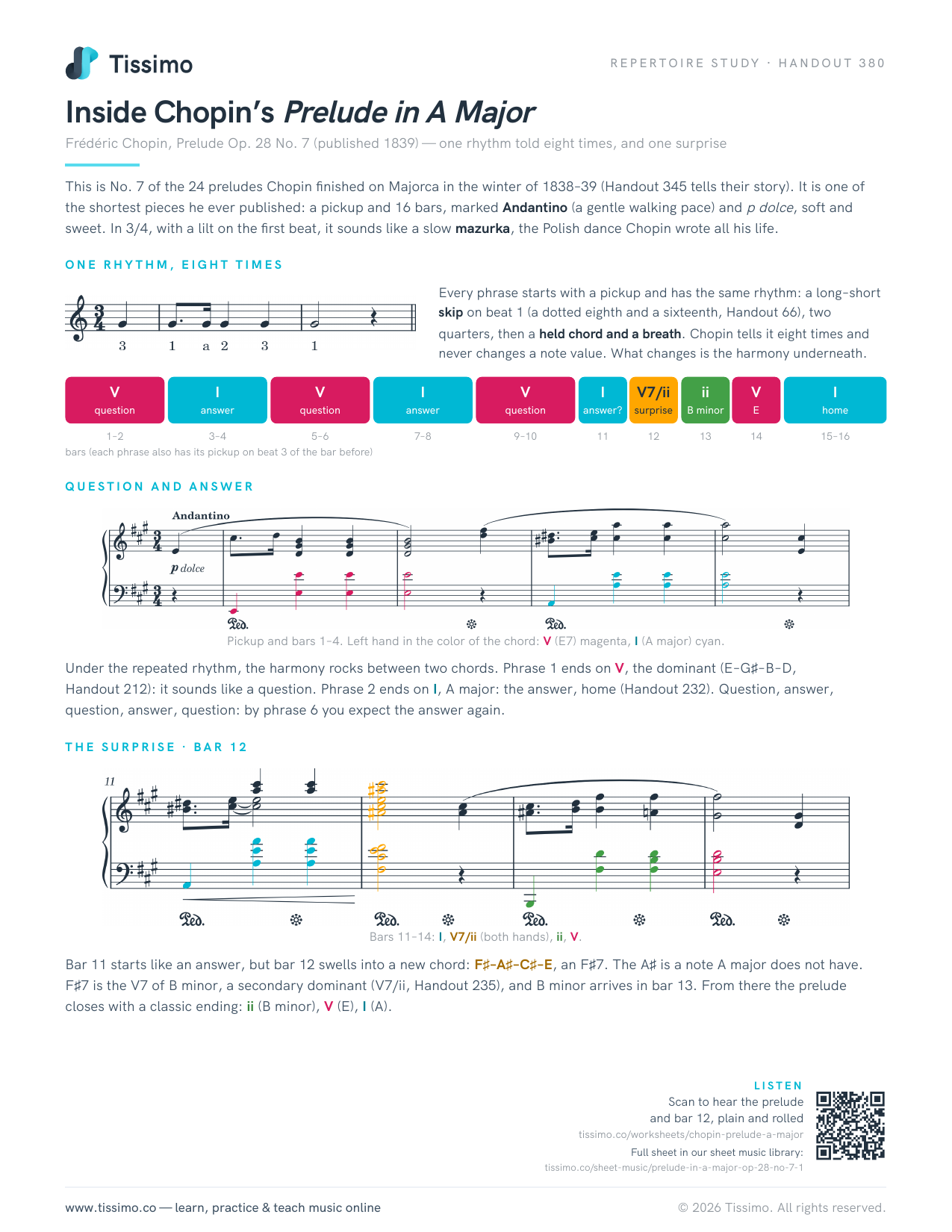 Inside Chopin’s Prelude in A MajorFrédéric Chopin, Prelude Op. 28 No. 7 (published 1839) — one rhythm told eight times, and one surprise
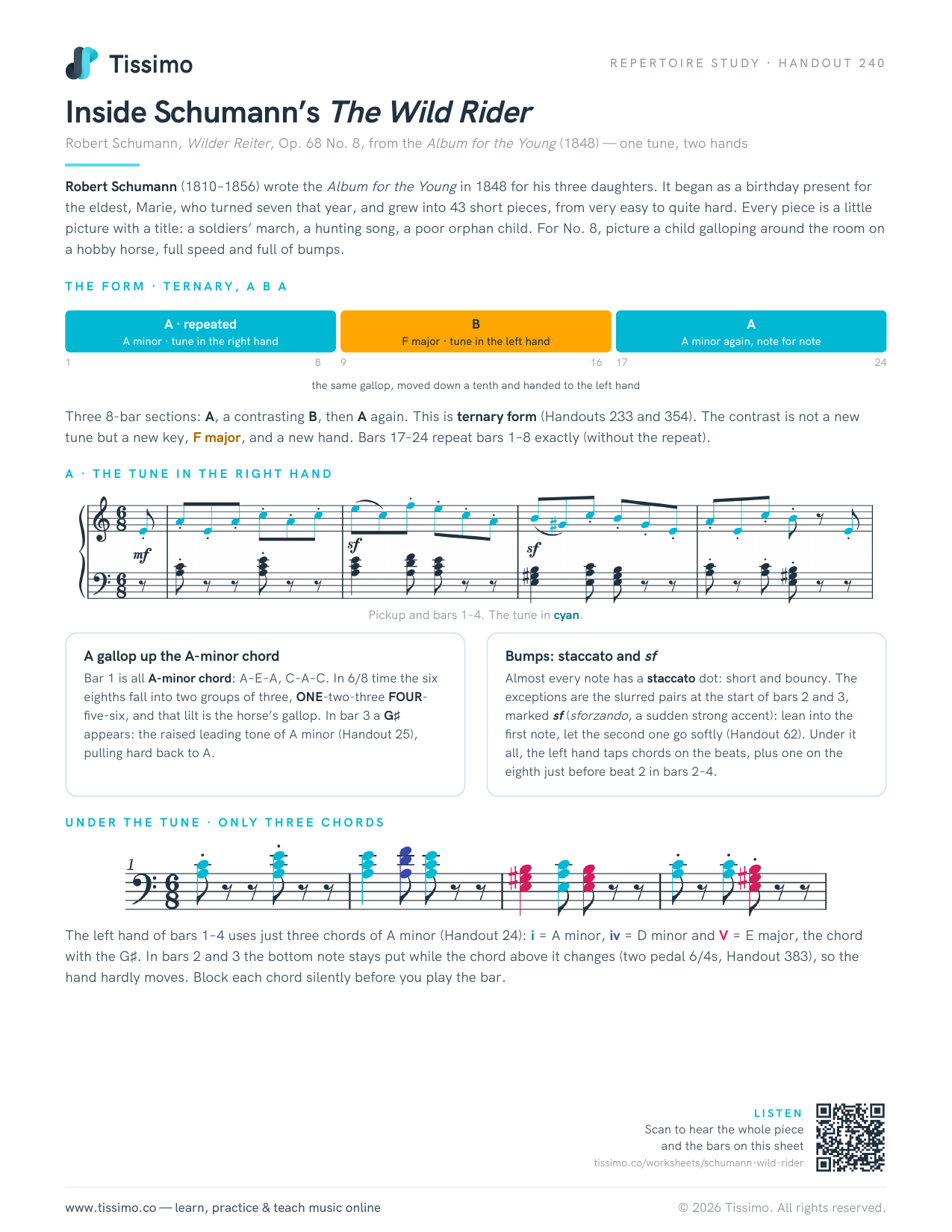 Inside Schumann’s The Wild RiderRobert Schumann, Wilder Reiter, Op. 68 No. 8, from the Album for the Young (1848) — one tune, two hands
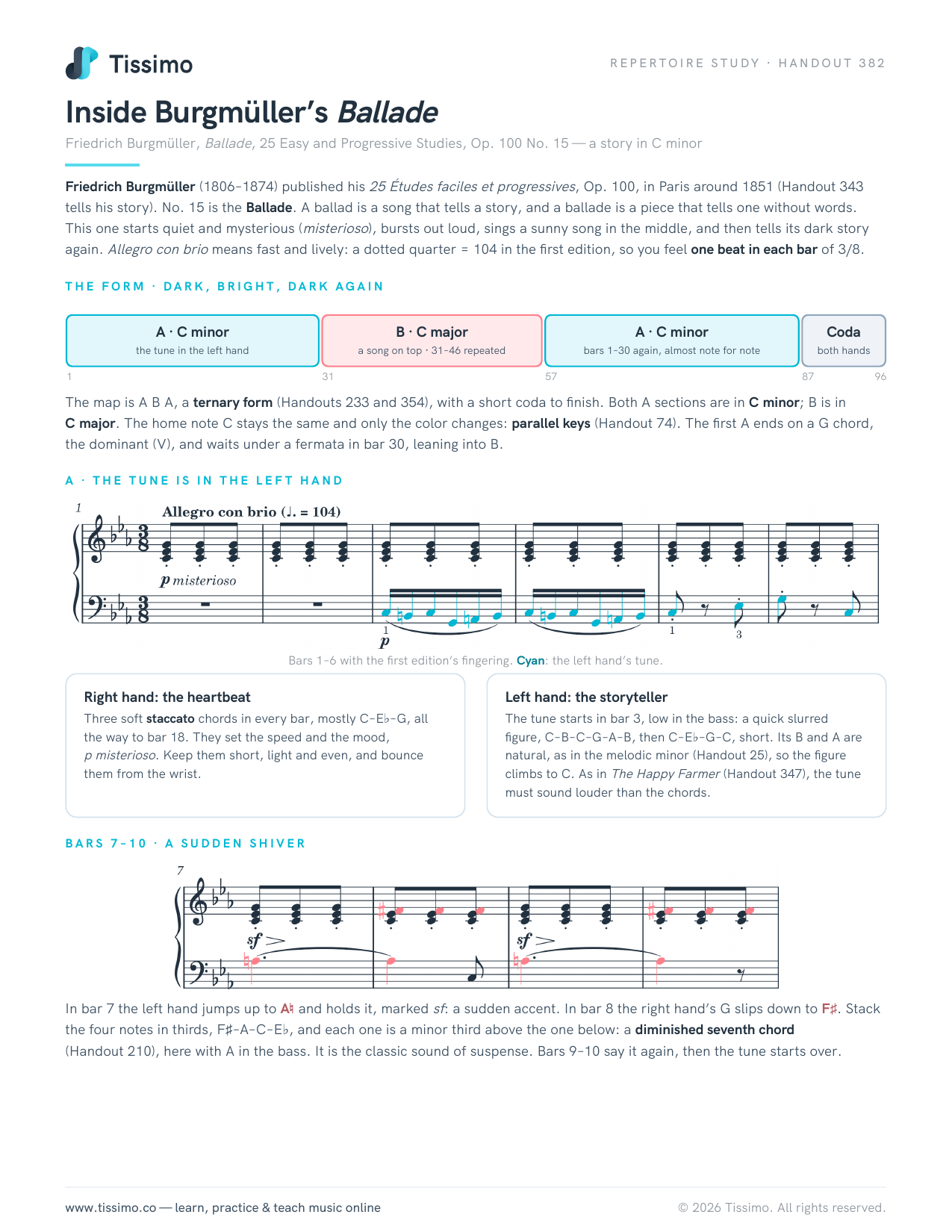 Inside Burgmüller’s BalladeFriedrich Burgmüller, Ballade, 25 Easy and Progressive Studies, Op. 100 No. 15 — a story in C minor
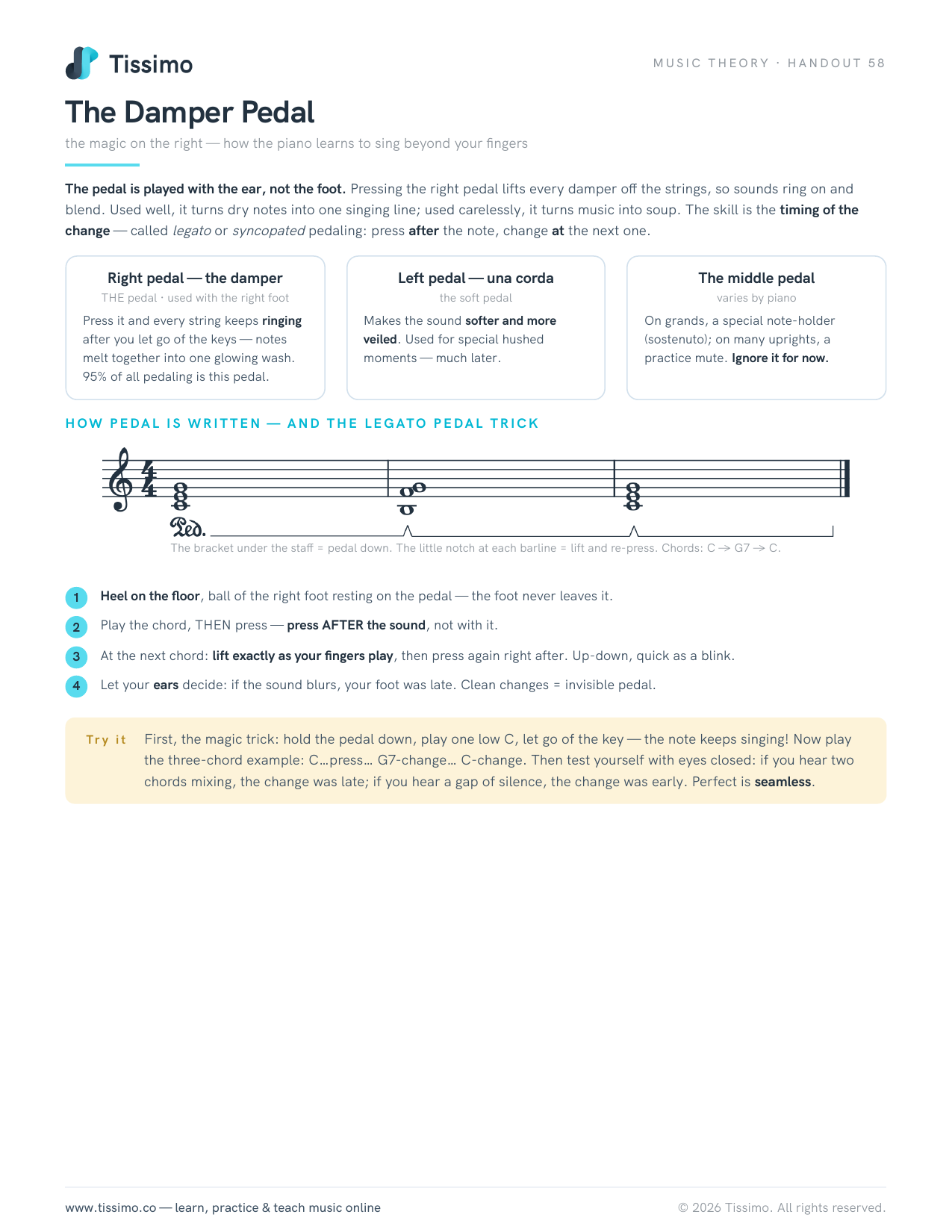 The Damper Pedalthe magic on the right — how the piano learns to sing beyond your fingers