Form & Structure
Étude
Pronounced AY-tood
An étude (French for "study") is a piece written to practice a particular technical skill, such as fast scales, broken chords or octaves. The best études are also fine music in their own right.
An étude is a piece with a job to do. Each one focuses on a particular technical problem and repeats it in many forms until it becomes easy: even scales, broken chords, repeated notes, octaves, finger independence, a singing tone over an accompaniment. The word is French for "study," and you will see both words in titles.
Exercise or étude?
A technical exercise is usually a short pattern repeated mechanically, often moved up step by step through every key. An étude is a complete piece: it has a melody, harmony, a form and an ending, but nearly every bar works on the same skill. That is why études are more musical to practice than drills and why teachers assign them alongside repertoire.
The teaching étude
The 19th century, when the piano became a fixture in middle-class homes, produced thousands of études for students:
- Carl Czerny wrote huge numbers of them, including The School of Velocity, Op. 299.
- Muzio Clementi's Gradus ad Parnassum collected studies of many kinds.
- Friedrich Burgmüller's 25 Easy and Progressive Studies, Op. 100, are among the most loved. Each has a descriptive title, such as "La Candeur" or "Arabesque," and works on one skill. See Burgmüller's Arabesque (light, quick fingers), La Candeur (a singing line) and Ballade.
Every instrument has its own étude books, for violin, flute, trumpet, guitar, drums and voice.
The concert étude
Chopin changed what an étude could be. His 24 Études, published as Op. 10 and Op. 25, each focus on one technical problem, yet they are concert pieces of real depth and are played in recitals worldwide. Others followed: Liszt's Transcendental Études, Rachmaninoff's Études-Tableaux, Debussy's twelve Études and, later in the 20th century, Ligeti's études. These are among the hardest pieces in the piano repertoire.
How to practice an étude
- Find the technical point. Ask your teacher, or look at the first two bars: the pattern there usually runs through the whole piece.
- Practice that pattern slowly and evenly, with the fingering written in, before playing the piece through.
- Raise the tempo gradually with a metronome. Evenness matters more than speed.
- Then play it as music, with dynamics and shape. A study played only mechanically has done half its job.
The How to practice worksheet gives a routine you can apply to any étude.
Common questions
What is the difference between an étude and an exercise?
An exercise is a short technical pattern, usually repeated mechanically. An étude is a complete piece of music that concentrates on one technical skill throughout.
Are études only for beginners?
No. There are études for every level, from Burgmüller's easy studies to Chopin's and Liszt's concert études, which are among the most demanding pieces in the piano repertoire.
Practice it: free worksheets
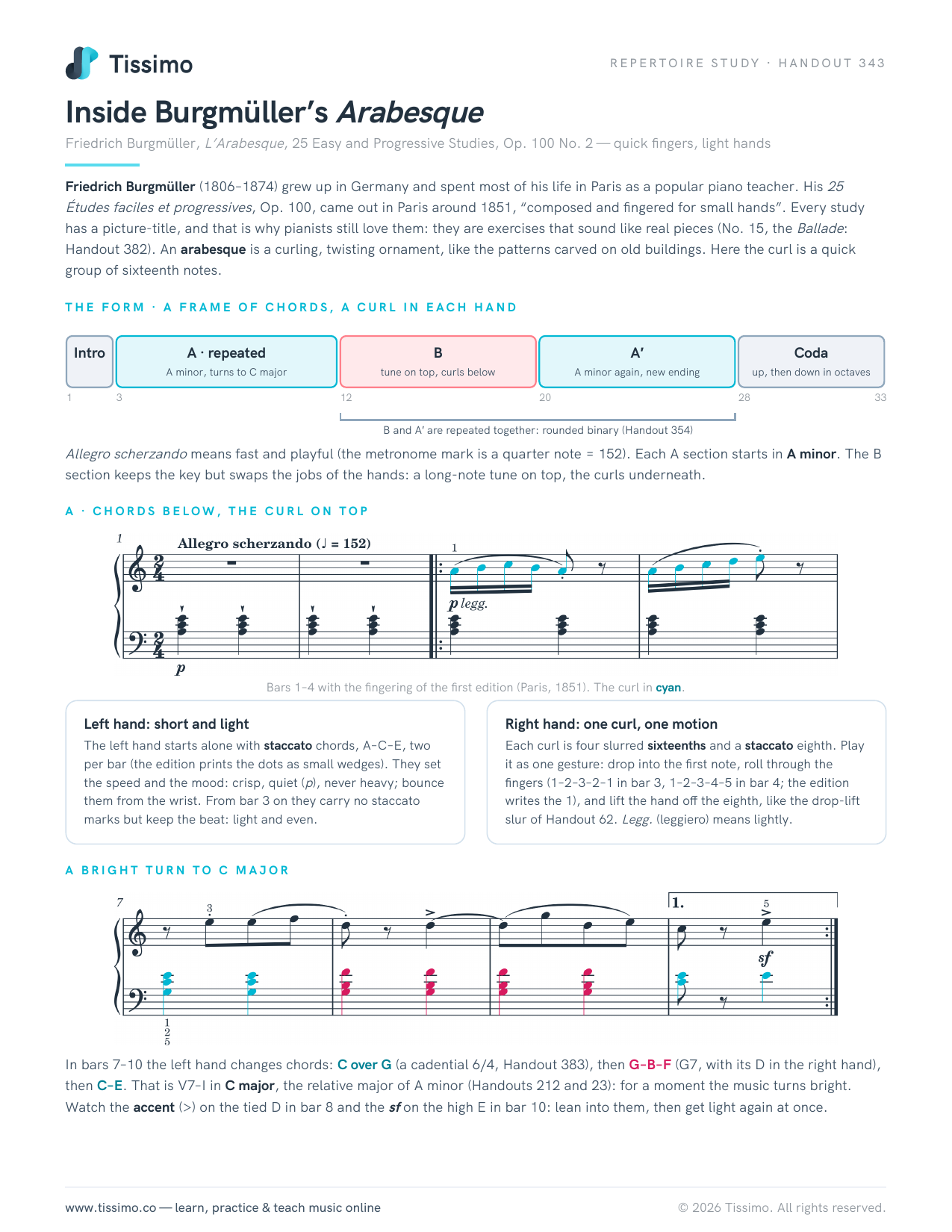 Inside Burgmüller’s ArabesqueFriedrich Burgmüller, L’Arabesque, 25 Easy and Progressive Studies, Op. 100 No. 2 — quick fingers, light hands
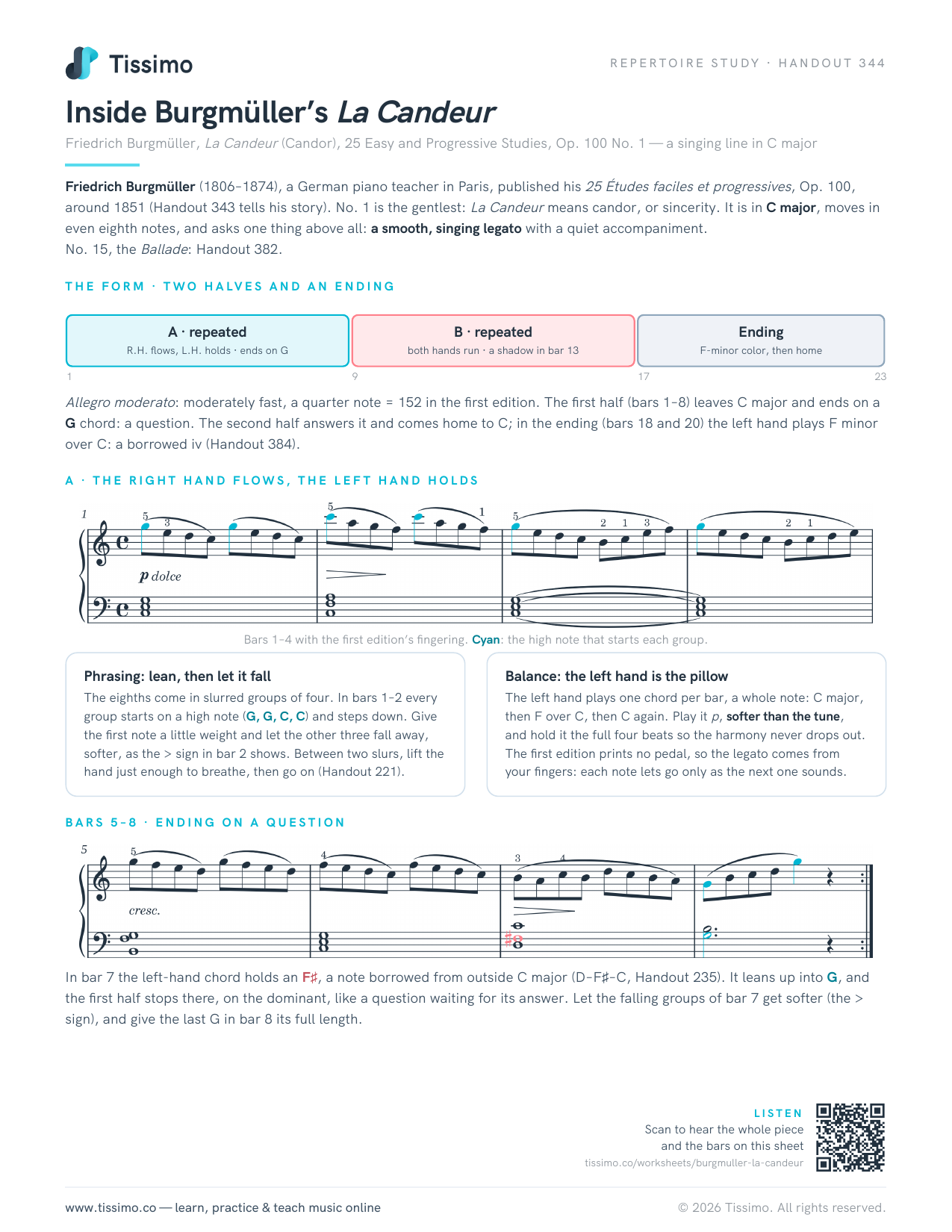 Inside Burgmüller’s La CandeurFriedrich Burgmüller, La Candeur (Candor), 25 Easy and Progressive Studies, Op. 100 No. 1 — a singing line in C major
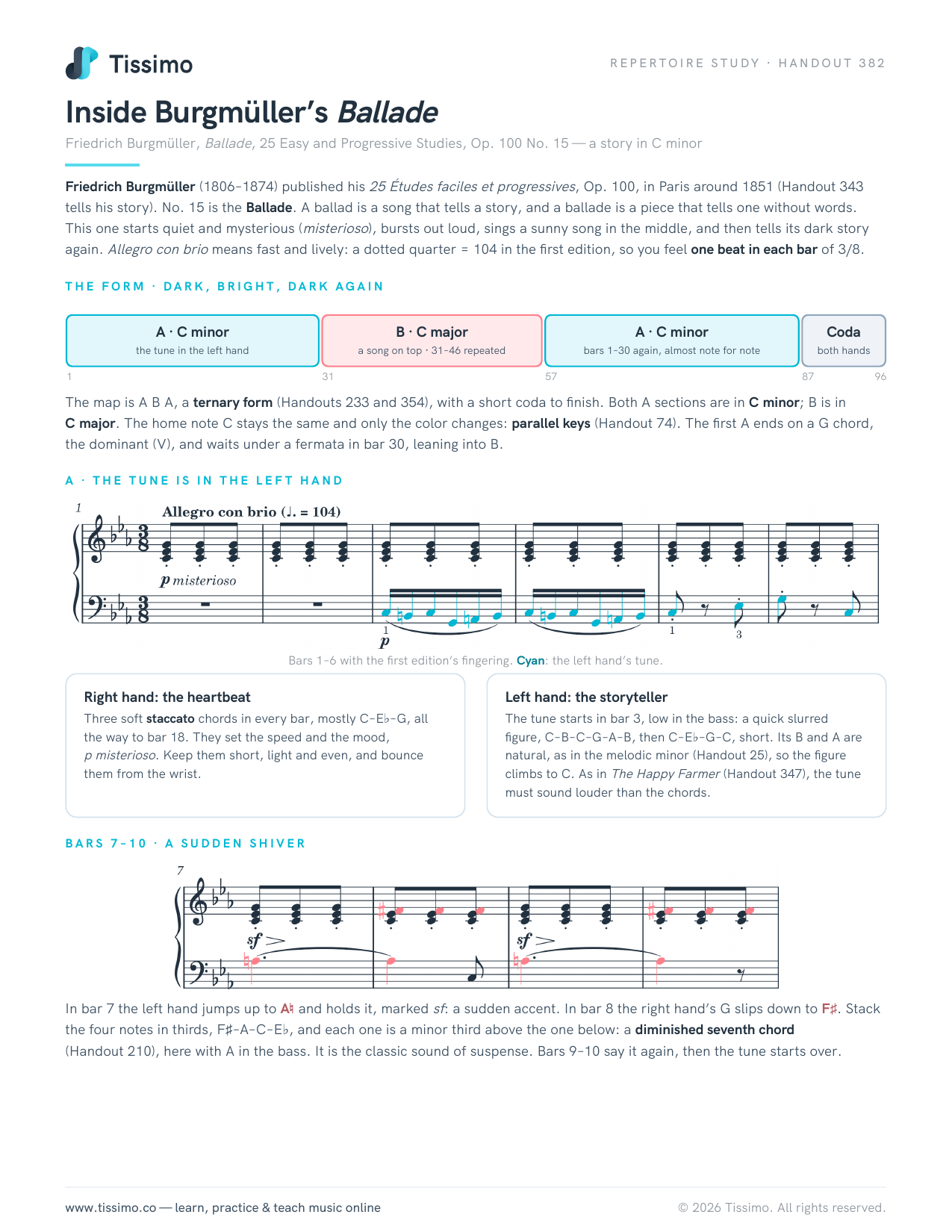 Inside Burgmüller’s BalladeFriedrich Burgmüller, Ballade, 25 Easy and Progressive Studies, Op. 100 No. 15 — a story in C minor
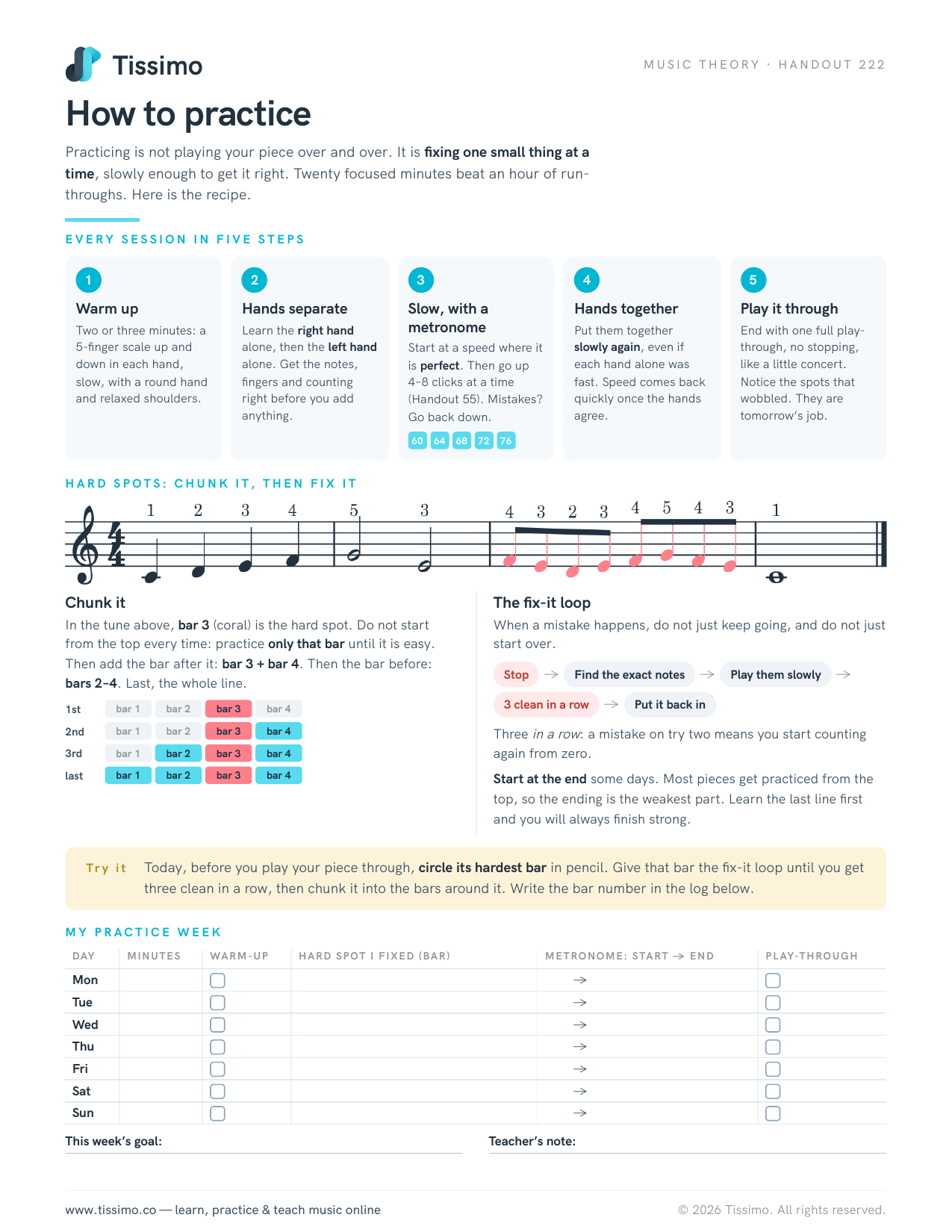 How to practicePracticing is not playing your piece over and over. It is fixing one small thing at a time, slowly enough to get it right. Aim for short, focused sessions, not hour-long run-throughs. Here is the recipe.
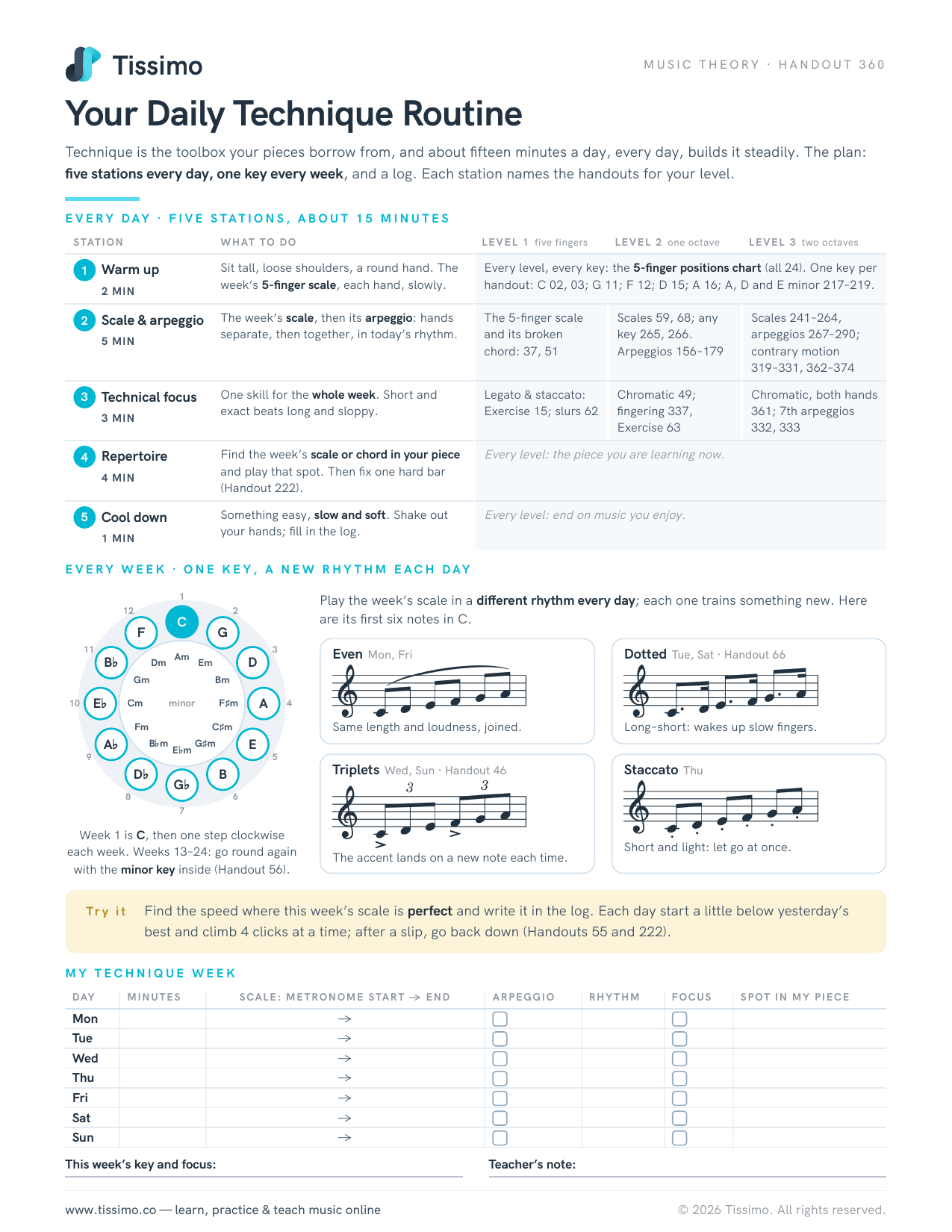 Your Daily Technique RoutineTechnique is the toolbox your pieces borrow from, and about fifteen minutes a day, every day, builds it steadily. The plan: five stations every day, one key every week, and a log. Each station names the handouts for your level.