Form & Structure
Prelude
Pronounced PREL-yood
A prelude is a piece that originally introduced another piece, such as a fugue, suite or opera. Since Chopin, it can also be a short independent piece built on a single idea or mood.
The word prelude means "something played before." It has two main uses.
A prelude that introduces
For centuries, a prelude was the opening of something larger:
- Prelude and fugue. In Bach's Well-Tempered Clavier, every fugue is paired with a prelude in the same key. There are 48 pairs in two books, one prelude and fugue in each major and minor key per book. The Prelude in C major that opens Book 1 is one of the most played keyboard pieces of all: one broken chord pattern per bar, almost from start to finish. See Inside Bach's Prelude in C.
- Prelude to a suite. Many Baroque suites open with a prelude, like the flowing first movement of Bach's Cello Suite No. 1.
- Prelude to an opera or act. Some opera composers, Wagner in particular, preferred a prelude (German Vorspiel) that flows straight into the first scene, instead of a self-contained overture.
Early preludes often grew out of improvisation: a keyboard player would warm up, test the instrument and establish the key before the main piece. Many preludes keep that feeling, running a single figuration pattern through a series of harmonies.
The independent prelude
Chopin's 24 Preludes, Op. 28 (published 1839), changed the meaning. They introduce nothing. Each is a complete miniature, some only a few bars long, built on one idea and one mood. Like Bach, Chopin wrote one in every key, ordered around the circle of fifths with each major key followed by its relative minor (C major, A minor, G major, E minor…). Two of them are studied in Chopin's Prelude in E Minor and Chopin's Prelude in A Major.
Others followed Chopin's lead: Scriabin's 24 Preludes, Op. 11, Rachmaninoff's preludes (including the famous one in C♯ minor) and Debussy's two books of Préludes, which print their poetic titles at the end of each piece rather than at the top, as if to let you hear the music first.
What preludes have in common
- They tend to be built on one idea: one figuration, one rhythm, one mood.
- They are often short, though Baroque organ preludes and some Romantic ones can be substantial.
- Many have a free, improvisatory character.
Common questions
What is the difference between a prelude and an overture?
Both can open a larger work. An overture is usually a self-contained orchestral piece with its own ending; a prelude is often shorter and may lead straight into what follows. Since Chopin, a prelude can also be an independent short piece.
Why are there 24 preludes in a set?
There are 24 major and minor keys. Following Bach's Well-Tempered Clavier, Chopin and later composers wrote one prelude in each key.
Practice it: free worksheets
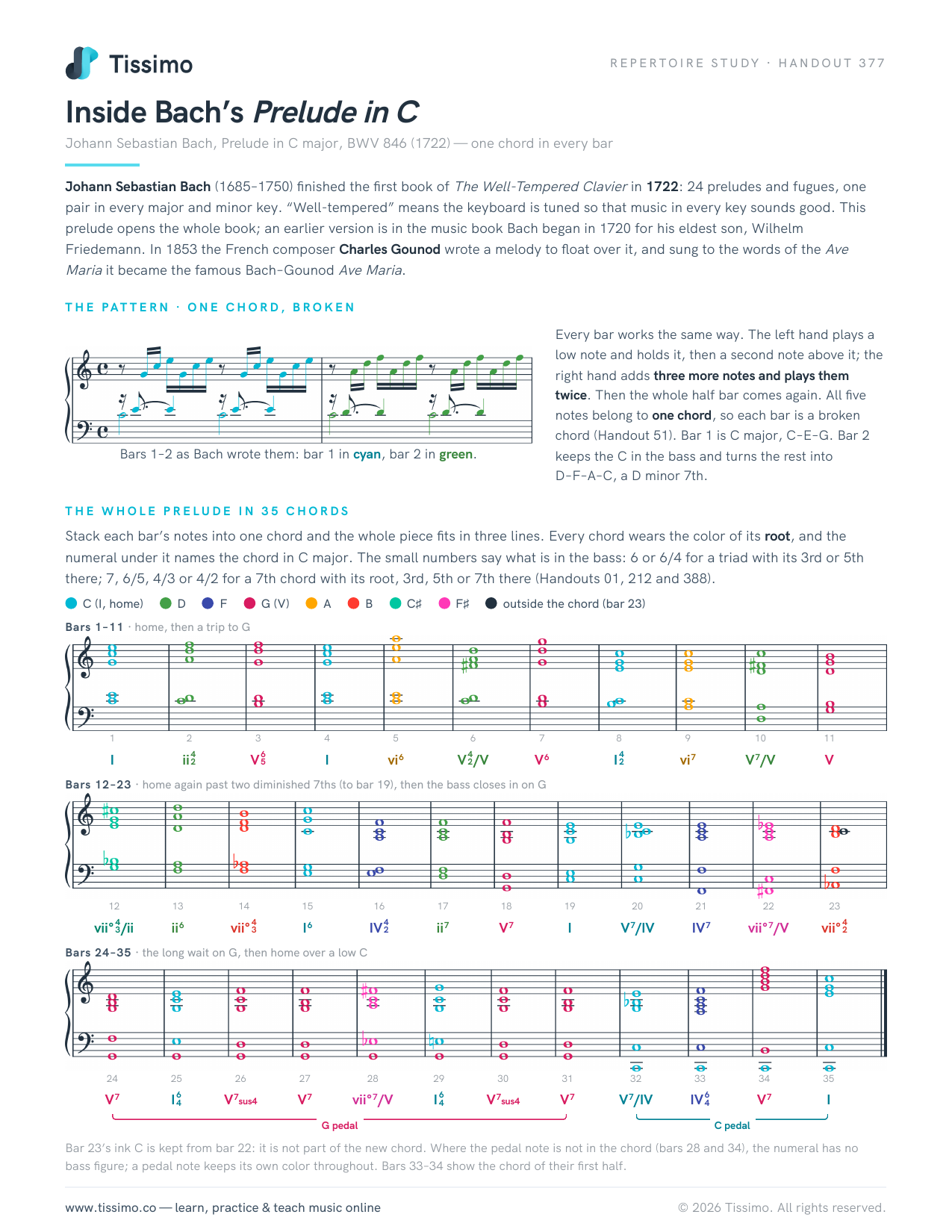 Inside Bach’s Prelude in CJohann Sebastian Bach, Prelude in C major, BWV 846 (1722) — one chord in every bar
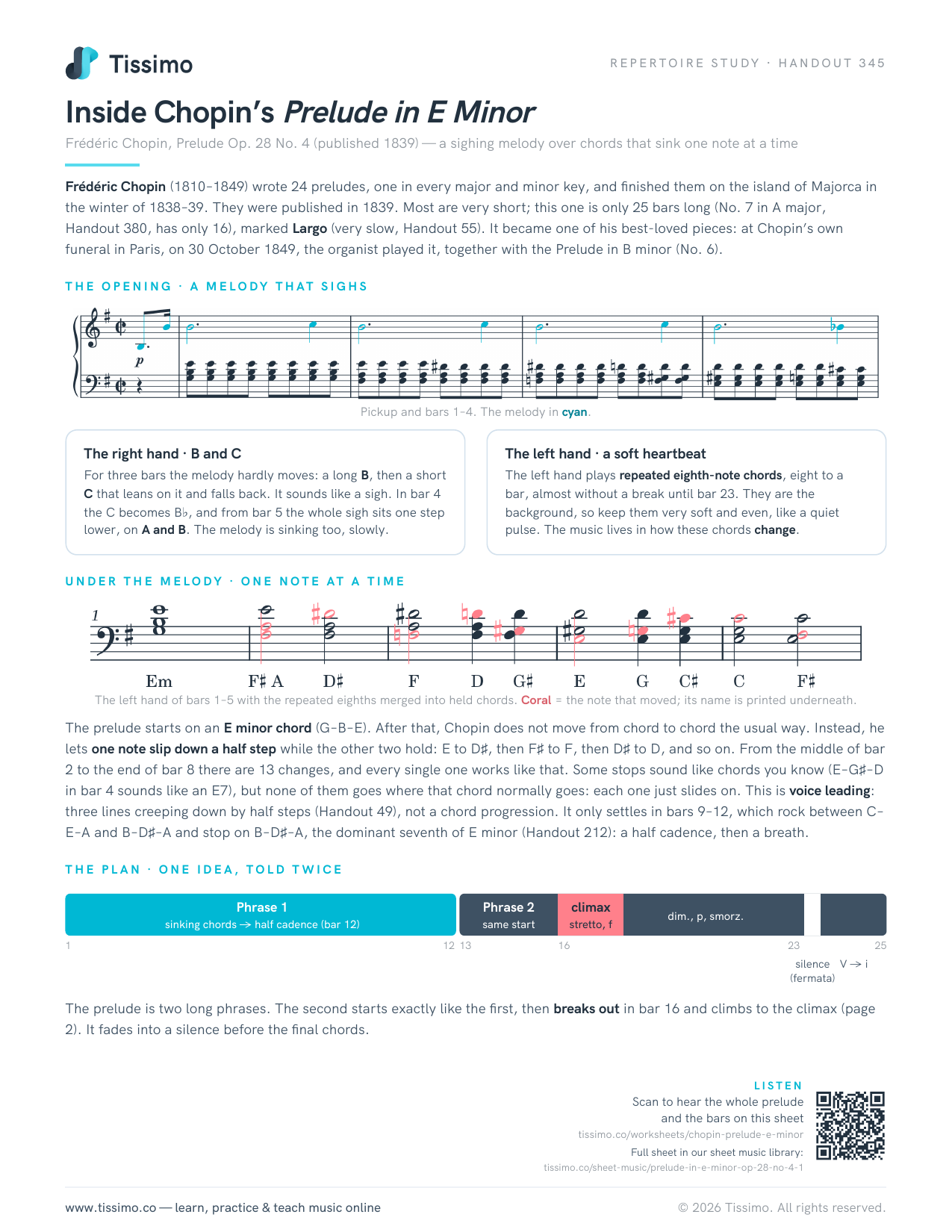 Inside Chopin’s Prelude in E MinorFrédéric Chopin, Prelude Op. 28 No. 4 (published 1839) — a sighing melody over chords that sink one note at a time
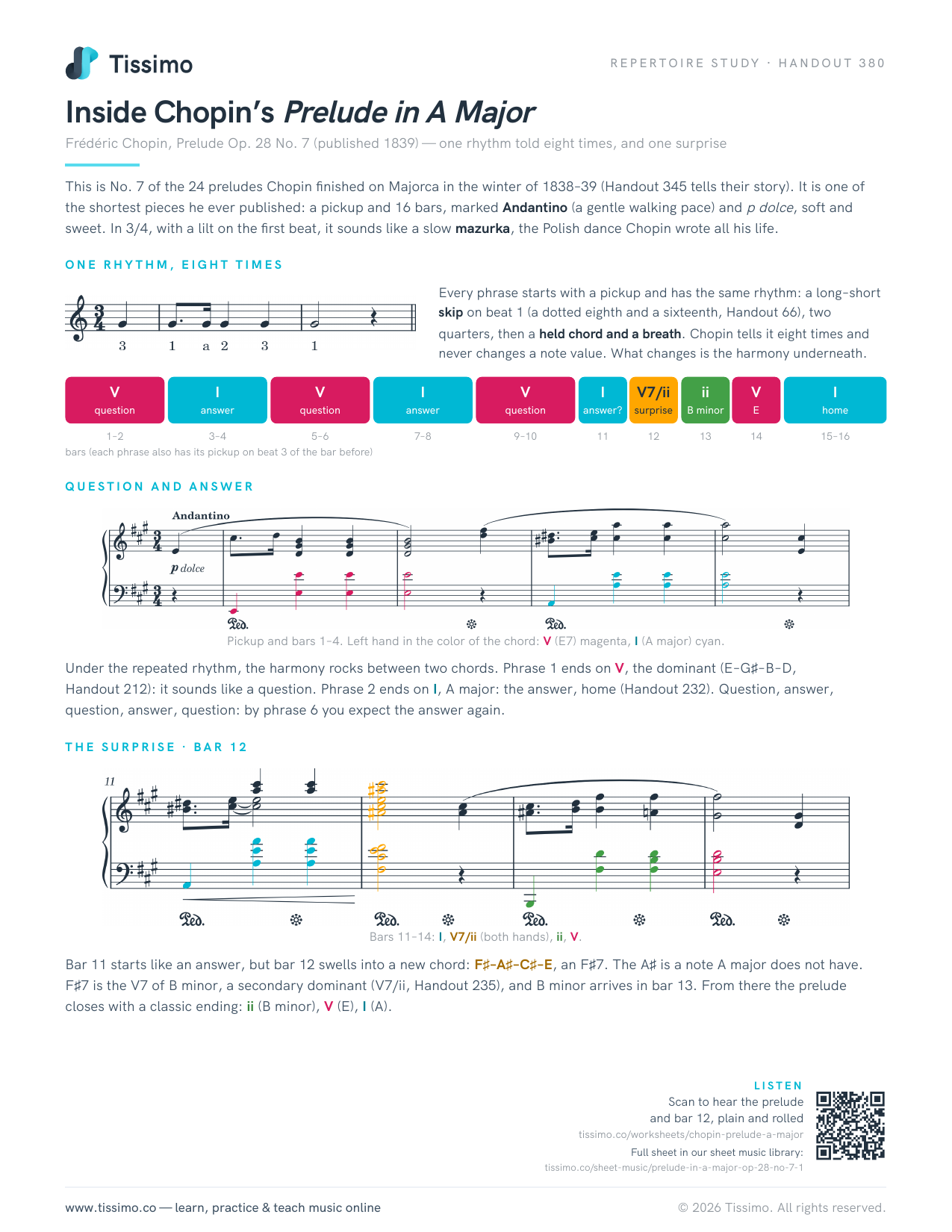 Inside Chopin’s Prelude in A MajorFrédéric Chopin, Prelude Op. 28 No. 7 (published 1839) — one rhythm told eight times, and one surprise
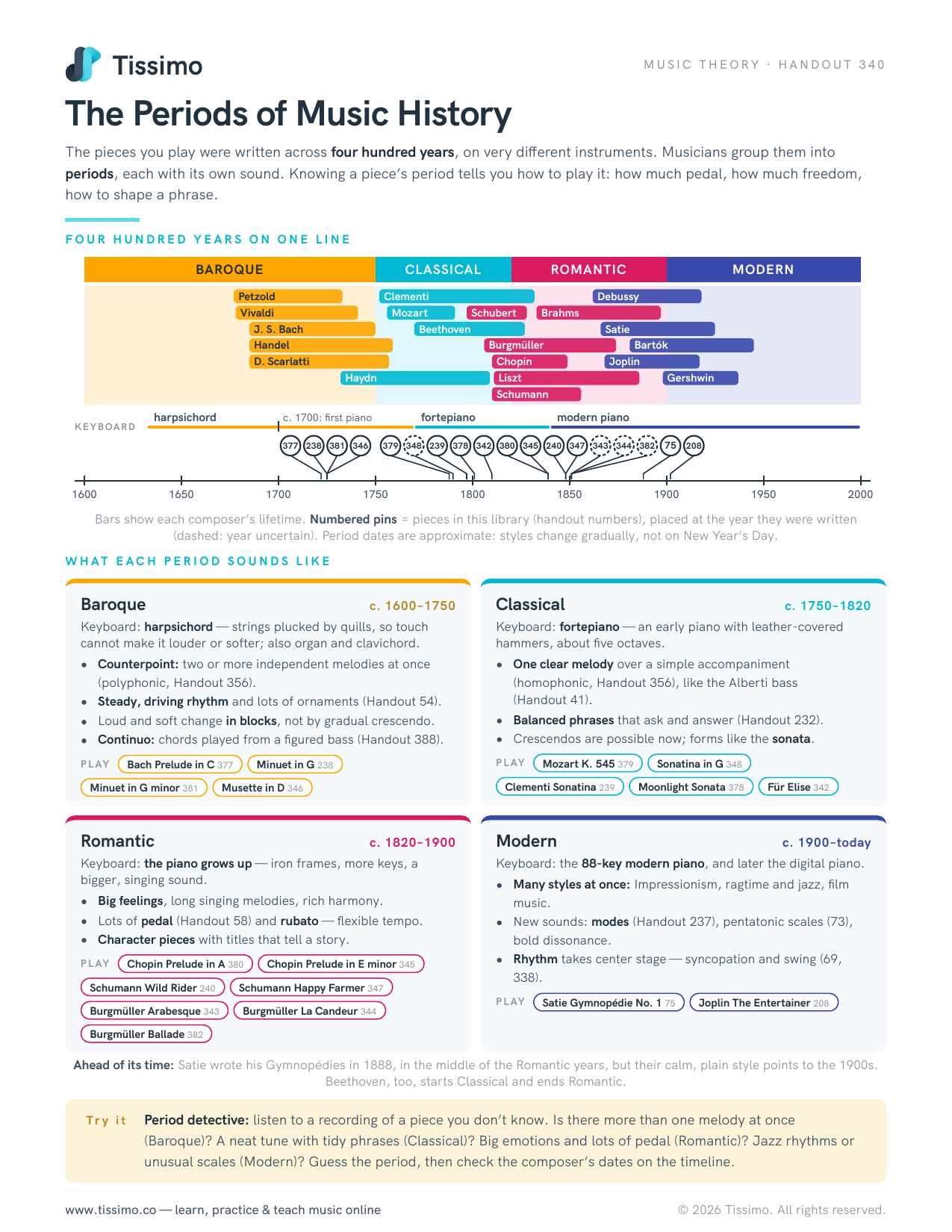 The Periods of Music HistoryThe pieces you play were written across four hundred years, on very different instruments. Musicians group them into periods, each with its own sound. Knowing a piece’s period tells you how to play it: how much pedal, how much freedom, how to shape a phrase.