Form & Structure
Binary Form
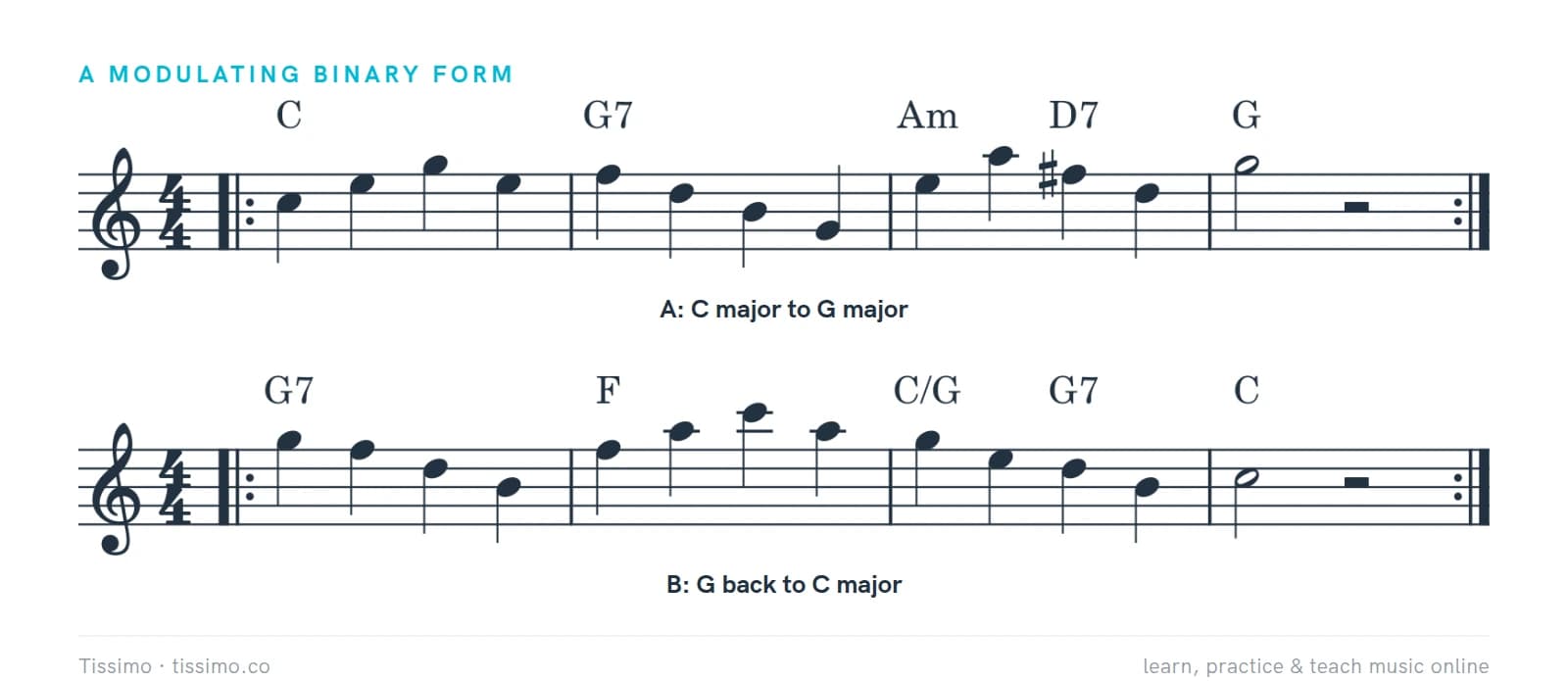
Binary form is a two-part musical form, AB, in which each half is usually repeated. The first half typically moves away from the home key and the second half finds its way back.
Binary form divides a piece into two halves, labeled A and B. In most binary pieces each half is repeated, so the layout on the page is:
- ||: A :|| ||: B :||
It is the standard plan for the short dances of the Baroque era, such as the movements of a suite, and for many minuets, marches and folk-style pieces since.
The key plan
What usually holds the two halves together is a plan of keys:
- A starts in the home key and, in a longer piece, often modulates. In a major key it usually ends in the dominant key (C major to G major); in a minor key it often ends in the relative major.
- B begins in that new key, may pass through other keys, and ends back in the home key.
Not every A section modulates. The Minuet in G from the 1725 notebook for Anna Magdalena Bach (now credited to Christian Petzold) keeps its first half in G major and travels to D major only in the second half. Theorists call a binary form whose A section ends with a full cadence in the home key sectional, and one whose A section ends anywhere else continuous.
Rounded and balanced binary
Two common variants:
- Rounded binary: near the end of B, the opening of A comes back in the home key. The layout is ||: A :||: B A′ :||. The return is usually shortened and sits inside the second repeat.
- Balanced binary: the closing bars of A come back at the end of B, moved into the home key, so both halves end with the same music.
Binary or ternary?
Rounded binary can look like ternary form (ABA). The usual test: in ternary form, the returning A is a complete, independent section, and B is a section in its own right with its own ending. In rounded binary, the return is part of the second half and is repeated together with B. The Binary, rounded binary & ternary worksheet gives three questions that settle it.
Where you will find it
- The dance movements of Baroque suites (allemande, courante, sarabande, gigue and many others).
- Domenico Scarlatti's keyboard sonatas, hundreds of them, nearly all in binary form.
- Easy pieces such as the Minuet in G and the Minuet in G minor from the same notebook.
- Binary form is also the ancestor of sonata form, which grew out of large rounded binary movements in the 1700s.
Common questions
What is the difference between binary and ternary form?
Binary form has two halves (AB), usually each repeated, and the opening tune does not come back as a complete section. Ternary form (ABA) has three sections: after a contrasting B, the whole of A returns.
What is rounded binary form?
A binary form in which the opening music of A returns, usually shortened and in the home key, near the end of the second half: ||: A :||: B A′ :||.
Practice it: free worksheets
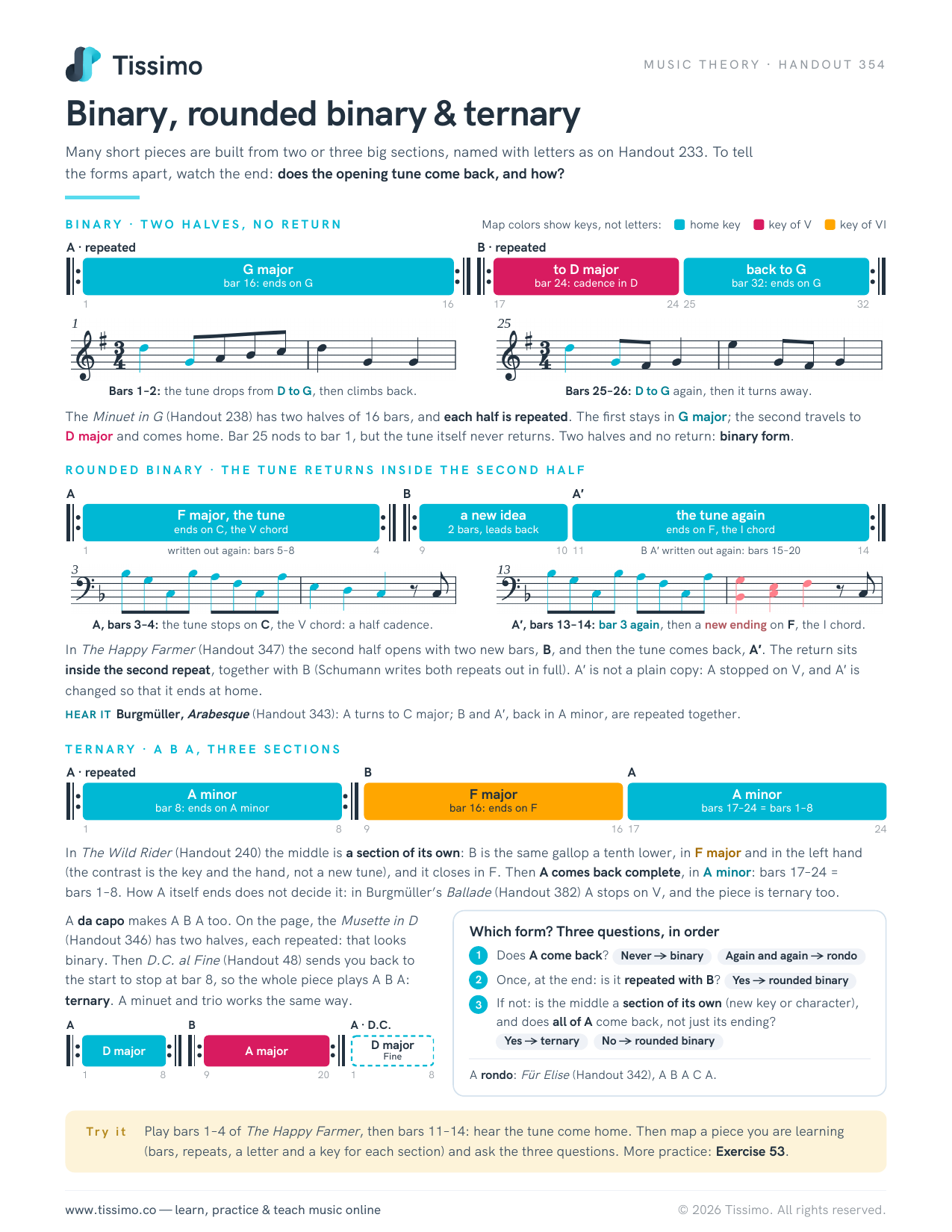 Binary, rounded binary & ternaryMany short pieces are built from two or three big sections, named with letters as on Handout 233. To tell the forms apart, watch the end: does the opening tune come back, and how?
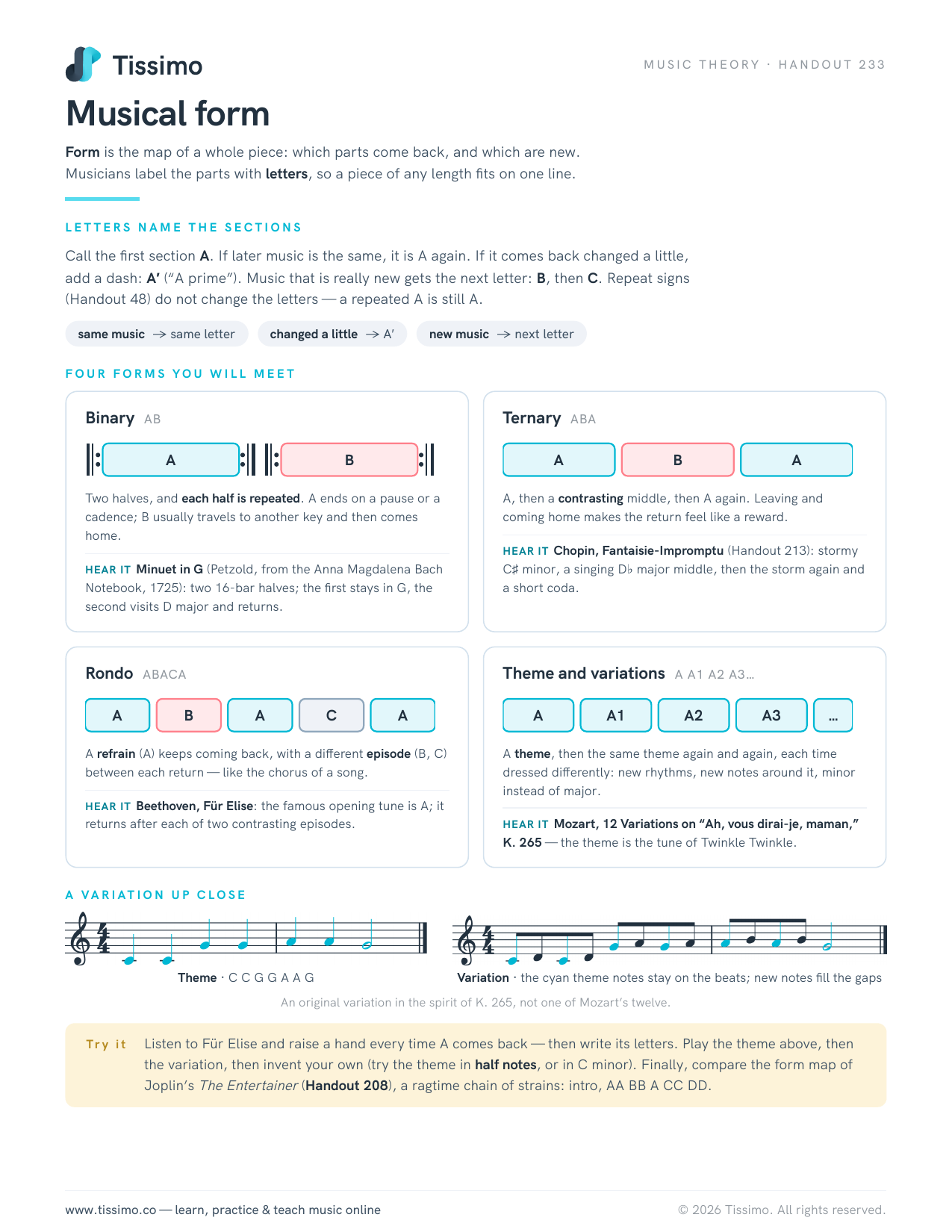 Musical formForm is the map of a whole piece: which parts come back, and which are new. Musicians label the parts with letters, so a piece of any length fits on one line.
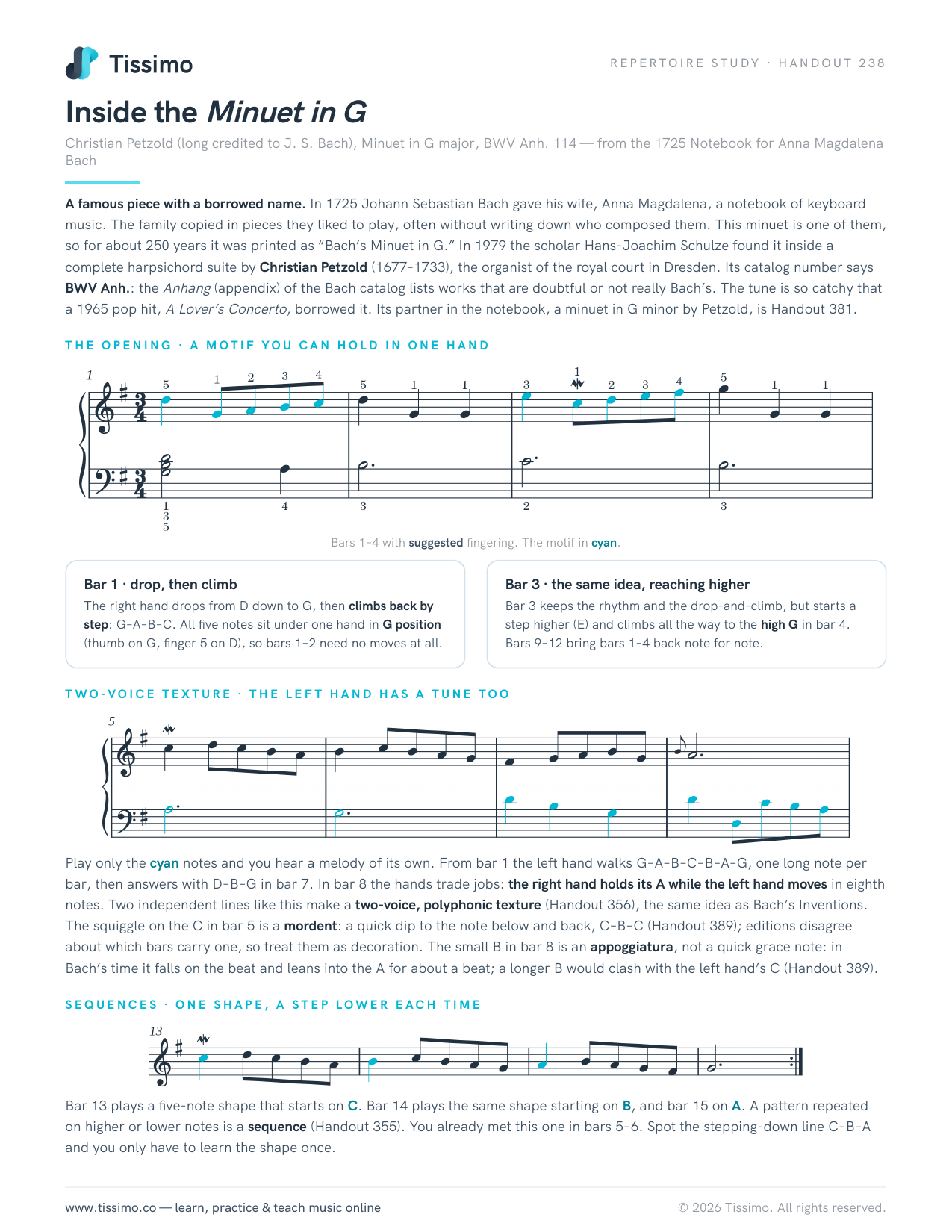 Inside the Minuet in GChristian Petzold (long credited to J. S. Bach), Minuet in G major, BWV Anh. 114 — from the 1725 Notebook for Anna Magdalena Bach
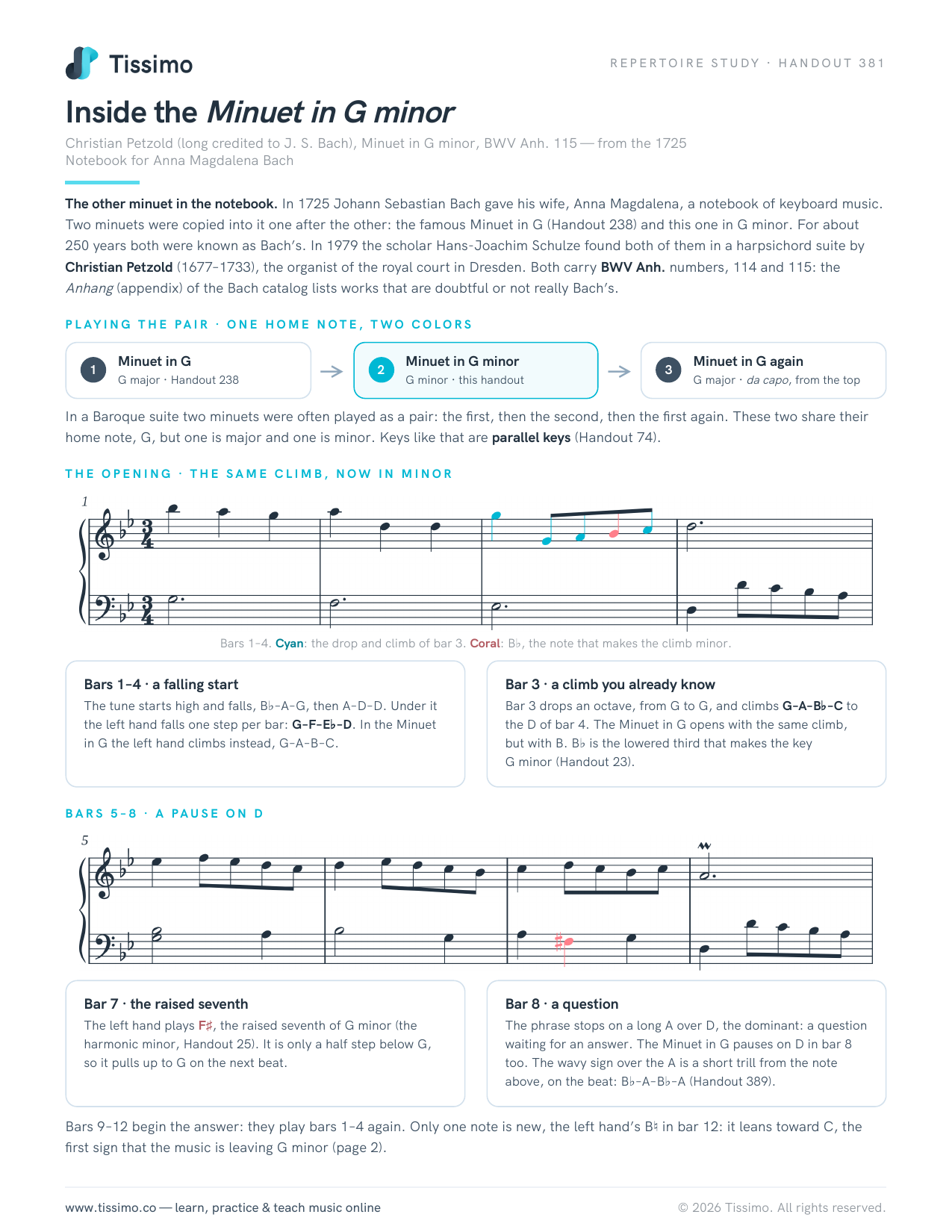 Inside the Minuet in G minorChristian Petzold (long credited to J. S. Bach), Minuet in G minor, BWV Anh. 115 — from the 1725 Notebook for Anna Magdalena Bach