Styles, Genres & Eras
Bebop
Bebop is a style of jazz that developed in the early to mid-1940s, built on fast tempos, complex harmony and long, intricate improvised lines. Charlie Parker and Dizzy Gillespie were its leading figures.
Bebop, or bop, transformed jazz in the 1940s. Young musicians, many of them playing in late-night jam sessions in New York clubs such as Minton's Playhouse, turned jazz from dance music into a demanding art music for listening. Its leading figures were the alto saxophonist Charlie Parker and the trumpeter Dizzy Gillespie, with the pianists Thelonious Monk and Bud Powell and the drummers Kenny Clarke and Max Roach.
What bebop sounds like
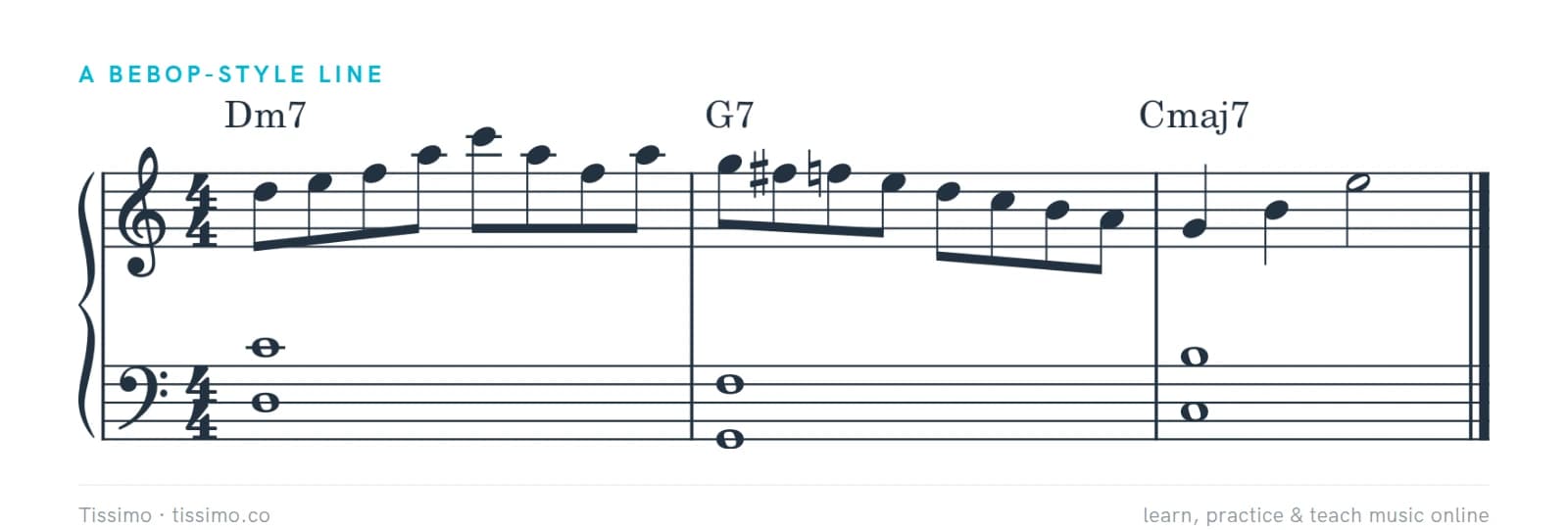
- Fast tempos and long phrases of eighth notes, swung lightly.
- Complex harmony: extended and altered chords, quick chord changes, and substitutions such as the tritone substitution.
- Chromatic lines: passing tones and approach notes that weave around the chord tones.
- Angular melodies with surprising accents and phrases that start and end in unexpected places.
- Small groups: typically saxophone and/or trumpet with piano, bass and drums.
- A new rhythm section role: the drummer keeps time on the ride cymbal and adds sharp accents ("bombs") on the bass drum and snare, while the bass walks steady quarter notes and the pianist comps in short, syncopated chords.
Contrafacts
Bebop musicians often wrote new, complex melodies over the chord progressions of existing songs. These are called contrafacts. The chords of Gershwin's "I Got Rhythm," known as rhythm changes, and of the 12-bar blues were favorite foundations. Charlie Parker's "Ko-Ko," for example, is built on the chords of the song "Cherokee."
The bebop scale
Teachers often describe bebop lines with bebop scales: seven-note scales with one extra chromatic passing tone, placed so that chord tones fall on the beats when the line runs in eighth notes. The best-known, the bebop dominant scale, adds the major seventh to the Mixolydian mode (in G: G F♯ F E D C B A).
After bebop
Bebop's language underlies most later jazz. Hard bop in the 1950s added blues and gospel feeling; cool jazz relaxed it; and bebop vocabulary remains the basis of jazz improvisation teaching today.
Learning bebop
Start slowly. Learn a few bebop heads from recordings, practice the ii–V–I in every key (The ii–V–I in Every Key), and play lines that land chord tones on the beats. Listening and transcribing solos is the traditional way to learn the style.
Common questions
Who invented bebop?
No single person. It grew out of 1940s jam sessions in New York, with Charlie Parker, Dizzy Gillespie, Thelonious Monk, Kenny Clarke and others as its key figures.
How is bebop different from swing?
Swing-era jazz was big-band dance music with arranged sections. Bebop was played by small groups for listening, at faster tempos, with more complex harmony and long improvised solos.
Practice it: free worksheets
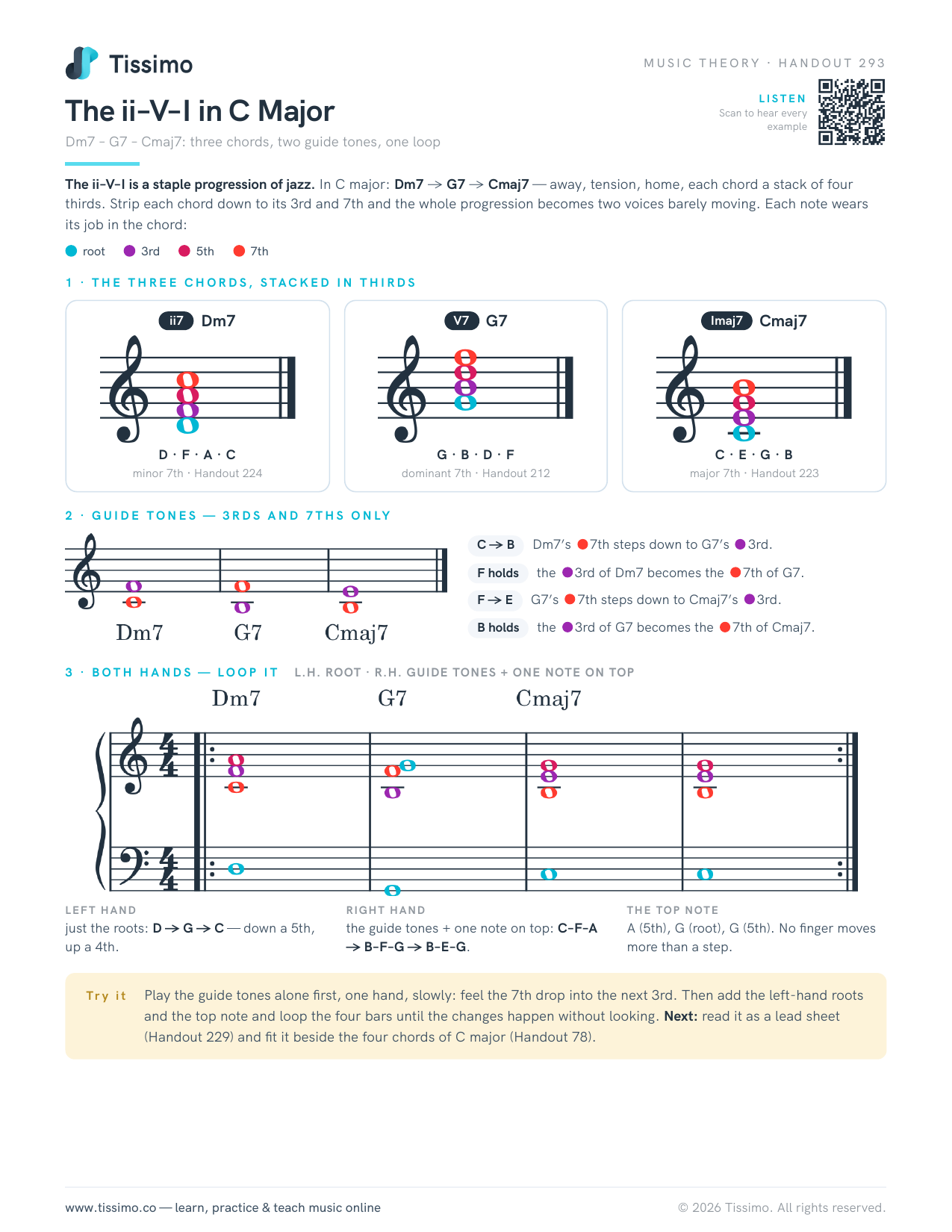 The ii–V–I in Every KeyThe most-played progression in jazz: three chords, two guide tones, one loop, in all 24 keys.
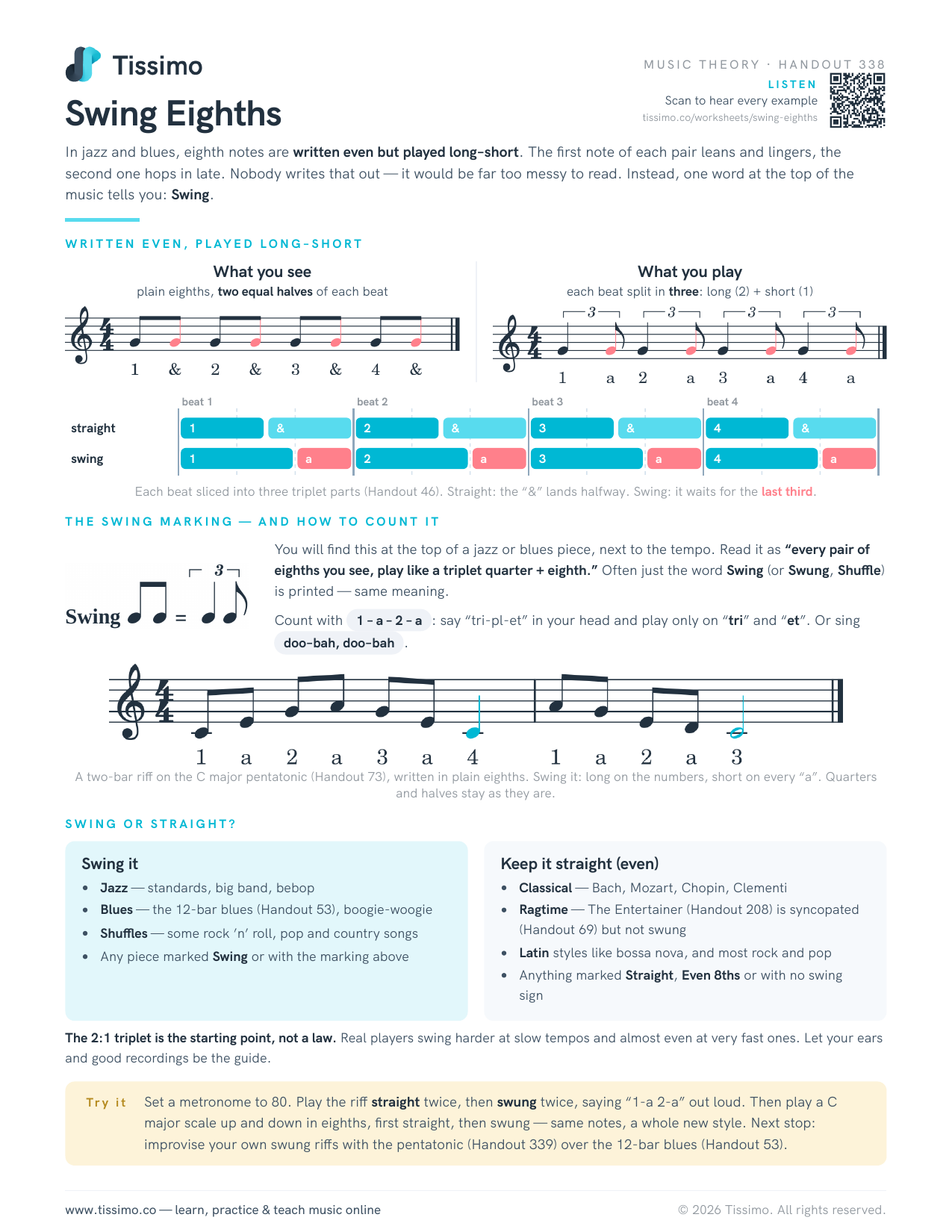 Swing EighthsIn jazz and blues, eighth notes are written even but played long–short. The first note of each pair leans and lingers, the second one hops in late. Nobody writes that out — it would be far too messy to read. Instead, one word at the top of the music tells you: Swing.
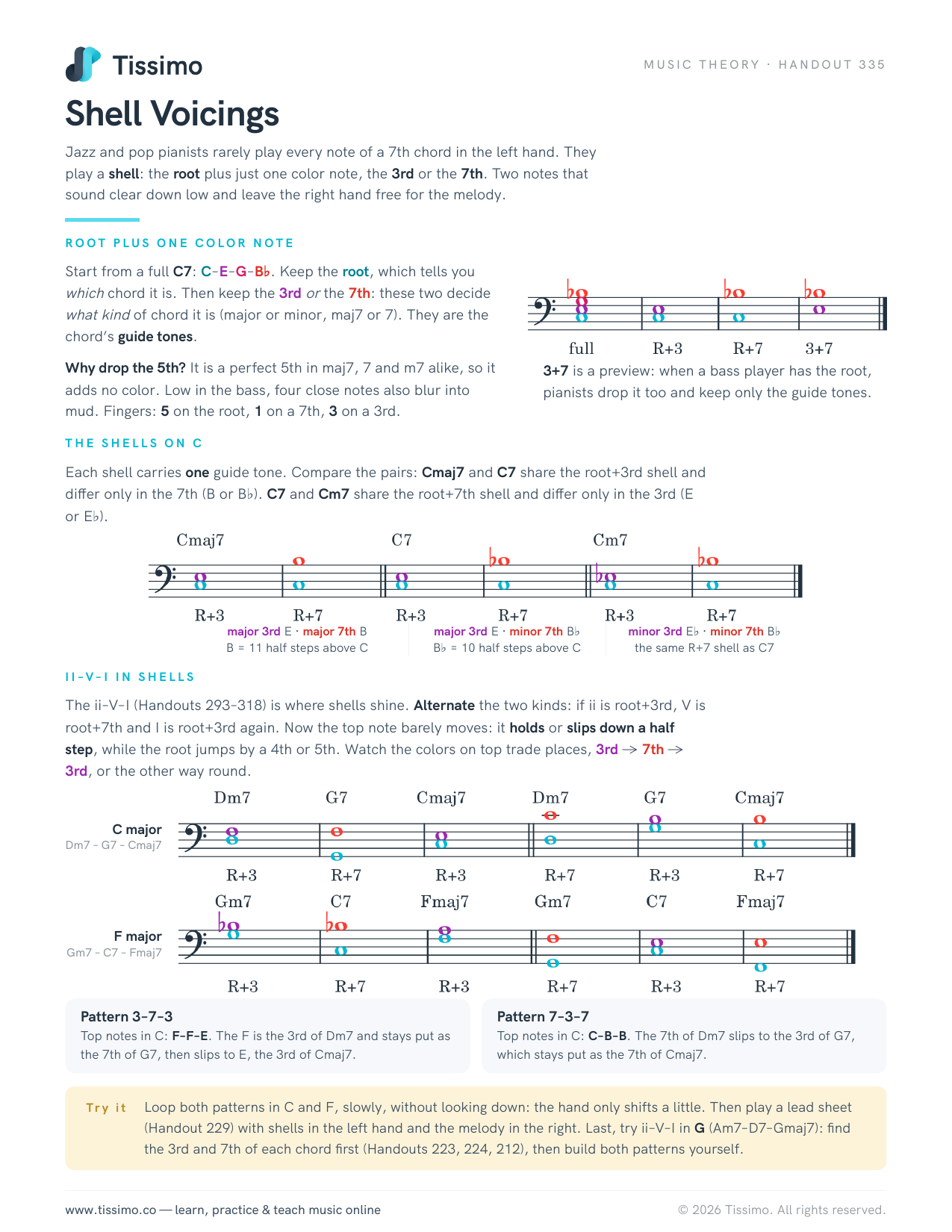 Shell VoicingsJazz and pop pianists rarely play every note of a 7th chord in the left hand. They play a shell: the root plus just one color note, the 3rd or the 7th. Two notes that sound clear down low and leave the right hand free for the melody.
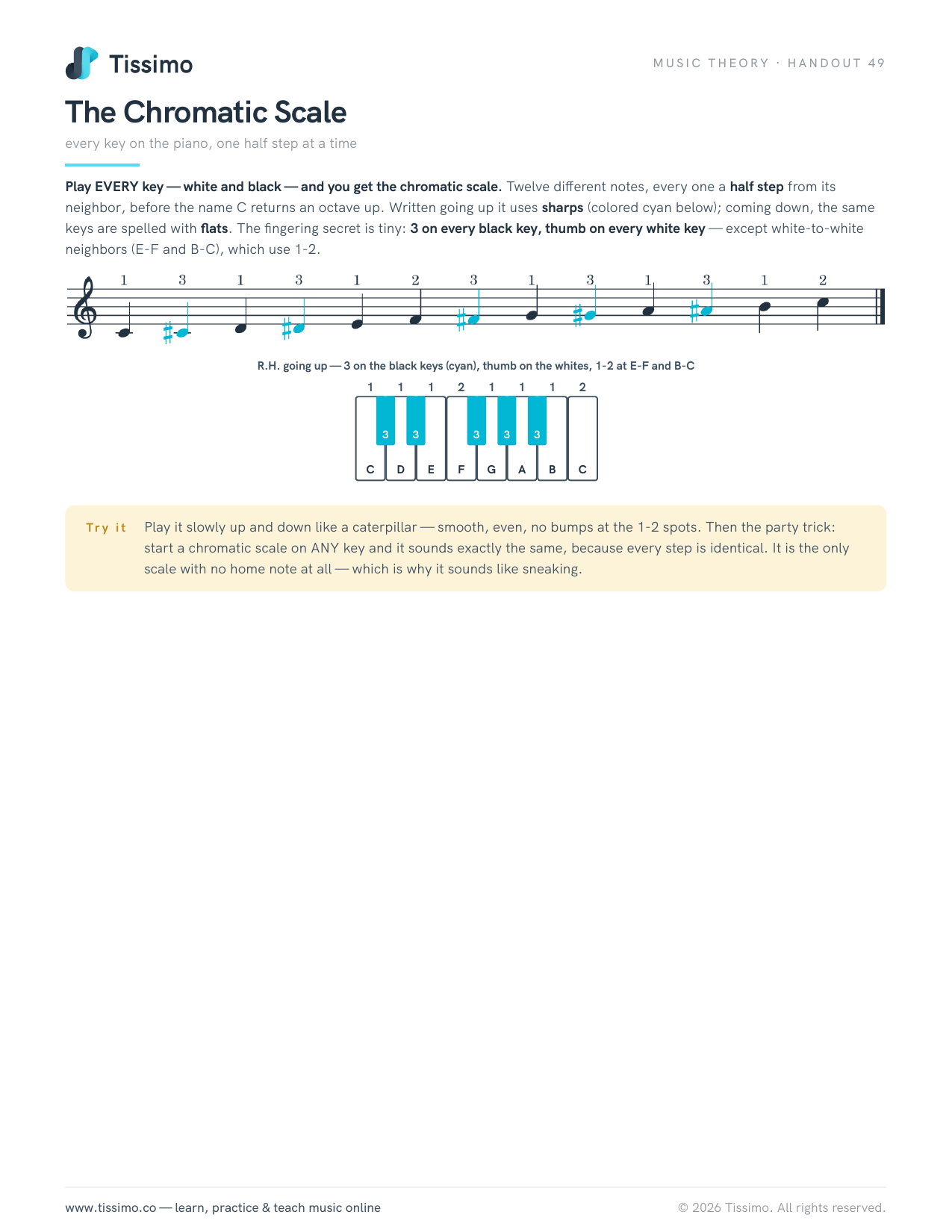 The Chromatic Scaleevery key on the piano, one half step at a time