Rhythm & Meter
Swing
Swing is a way of playing pairs of eighth notes unevenly, long then short, which gives music a lilting, forward-moving feel. It is usually written as even eighths with the word Swing, and it is the basic feel of much jazz.
In swing, eighth notes that look even on the page are played unevenly: the first of each pair is longer, and the second is shorter and a little later. That long-short pattern gives the music its lilt and its forward motion. Swing is the basic rhythmic feel of much jazz, and it is common in blues, boogie-woogie and Western swing. (Swing is also the name of the big-band jazz style and era that took its name from the feel.)
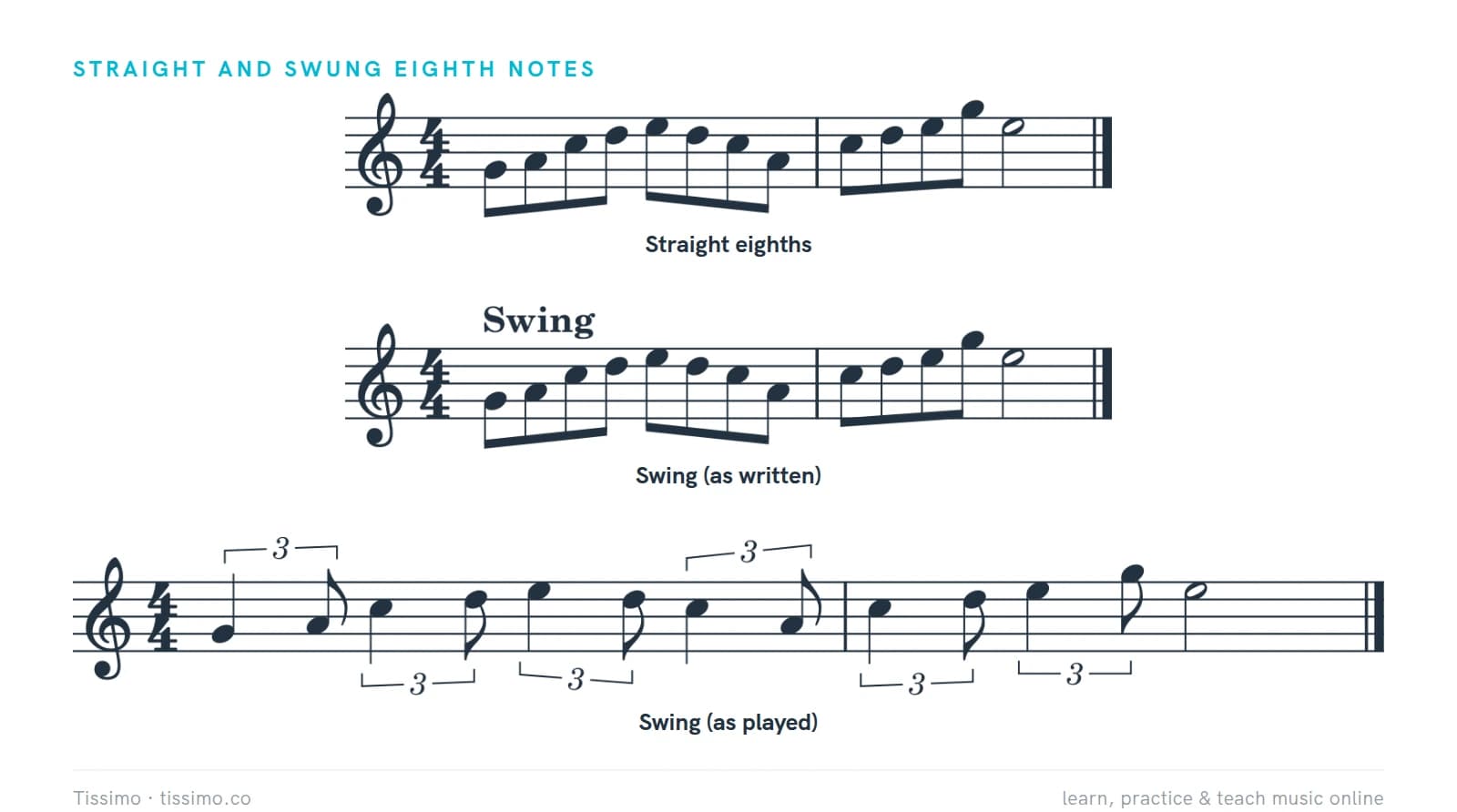
How swing is written
Writing every swung pair out exactly would make the music hard to read, so it is normally written as plain eighth notes with an instruction at the top: "Swing", "Swing 8ths", "Medium swing", or a small equation showing two eighth notes equal to a triplet quarter note and eighth note. Jazz musicians often assume swing unless the music says "Straight 8ths" or names a straight style such as Latin or rock.
How swing sounds
The usual starting point is the triplet. Think of each beat as "1-trip-let", play the first note of the pair on "1" and the second on "let", and leave "trip" silent. That gives a 2:1 long-short ratio. Real swing is more flexible: at fast tempos, swung eighths tend to get closer to even, and at slow and medium tempos they can be more uneven. Players also tend to lean lightly on the second eighth of each pair, and the drummer's hi-hat usually marks beats 2 and 4.
Do not confuse swing with a dotted-eighth-and-sixteenth rhythm. That pattern is a sharper 3:1, and played literally it sounds stiff and jumpy rather than relaxed. Some older arrangements did write swing that way, so let the style guide you.
Practicing swing
- Count triplets aloud: "1-trip-let 2-trip-let".
- Clap on "1" and "let" only, keeping "trip" silent.
- Play a scale in eighth notes with that feel, slowly, with a metronome clicking on 2 and 4.
- Listen to recordings and copy the feel; swing is learned by ear more than by reading.
Hear the difference and test yourself with Swing Eighths and Ear Training: Swing or Straight?. The related shuffle uses the same long-short division in a heavier, more insistent groove.
Common questions
How do you count swing eighths?
Count triplets, "1-trip-let 2-trip-let", and play only on "1" and "let". The first note of each pair takes about two-thirds of the beat and the second about one-third. Then relax the feel to suit the tempo.
What is the difference between swing and shuffle?
Both play eighth notes long-short. Swing is the lighter, more flexible feel of jazz; a shuffle states the long-short pattern constantly and heavily, often in the drums, bass and guitar or piano at once, as in blues and early rock and roll.
Practice it: free worksheets
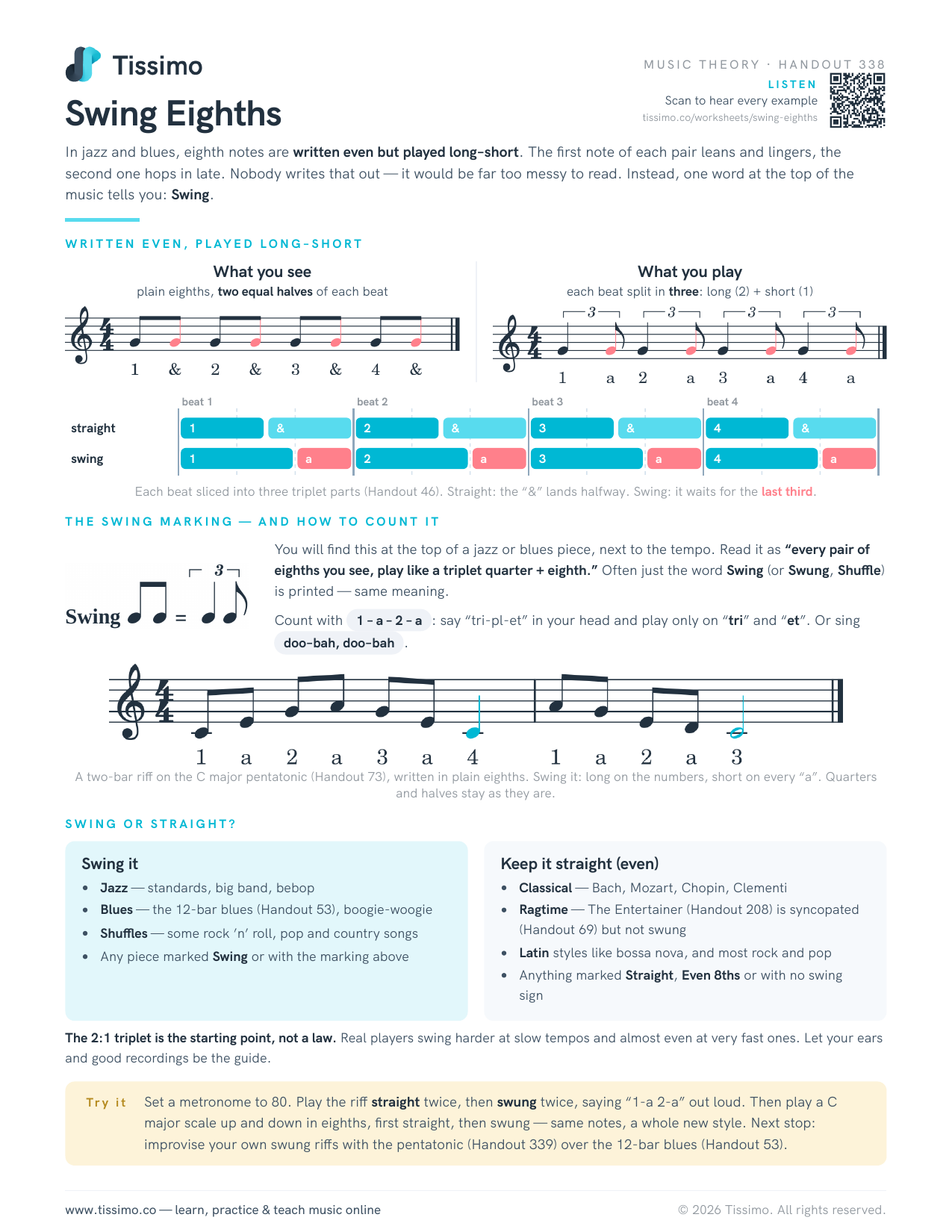 Swing EighthsIn jazz and blues, eighth notes are written even but played long–short. The first note of each pair leans and lingers, the second one hops in late. Nobody writes that out — it would be far too messy to read. Instead, one word at the top of the music tells you: Swing.
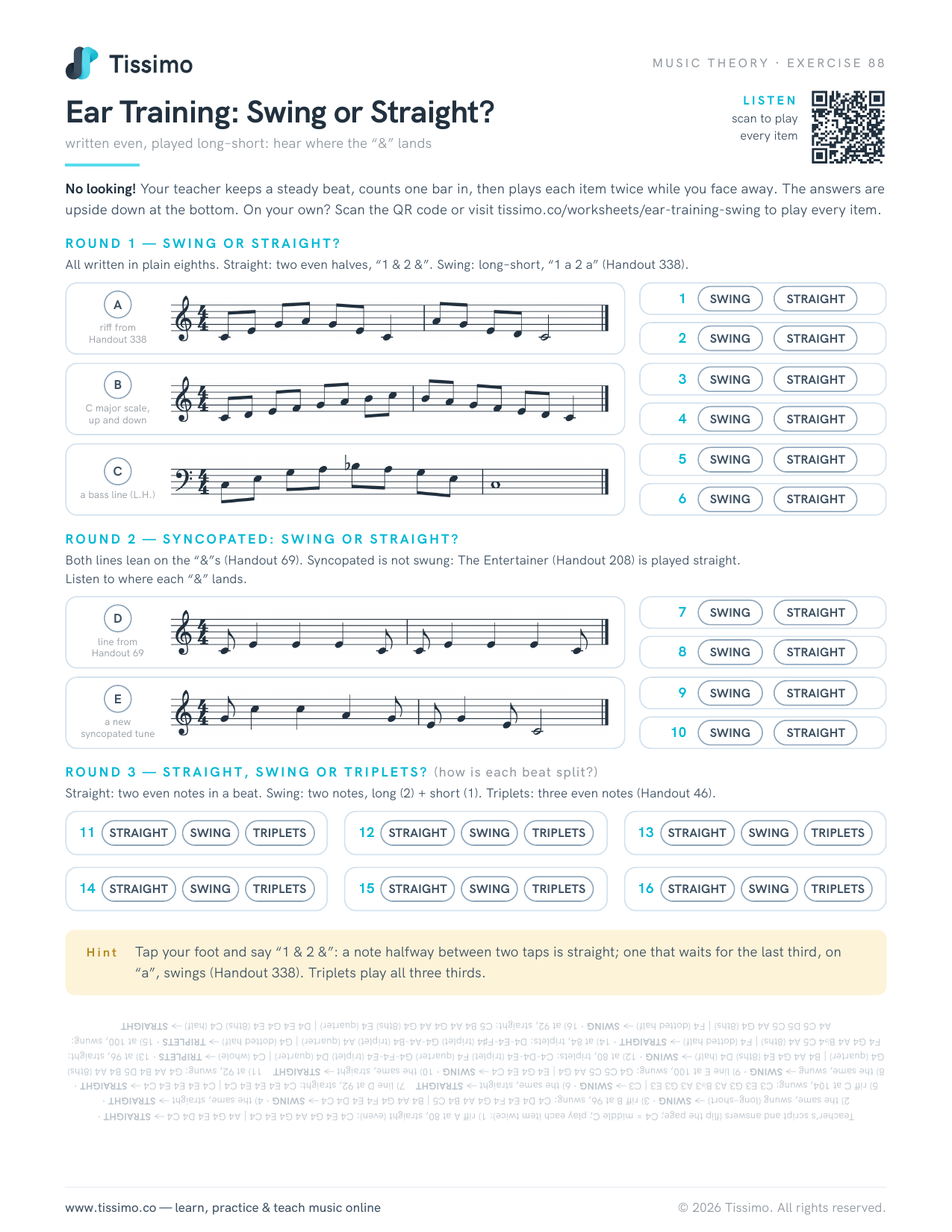 Ear Training: Swing or Straight?written even, played long–short: hear where the “&” lands