Sound & Acoustics
Sympathetic Vibration
Sympathetic vibration is when an object starts vibrating on its own because a nearby sound contains its natural frequency. An undamped piano string, for example, rings when another note supplies its pitch.
Sympathetic vibration happens when one vibrating object transfers energy to another, through the air or a shared structure such as a bridge and soundboard. The response is strongest near one of the receiving object's natural frequencies, which may match a fundamental or overtone in the source. It is a case of resonance.
Try it on a piano
You can hear sympathetic vibration clearly on any acoustic piano:
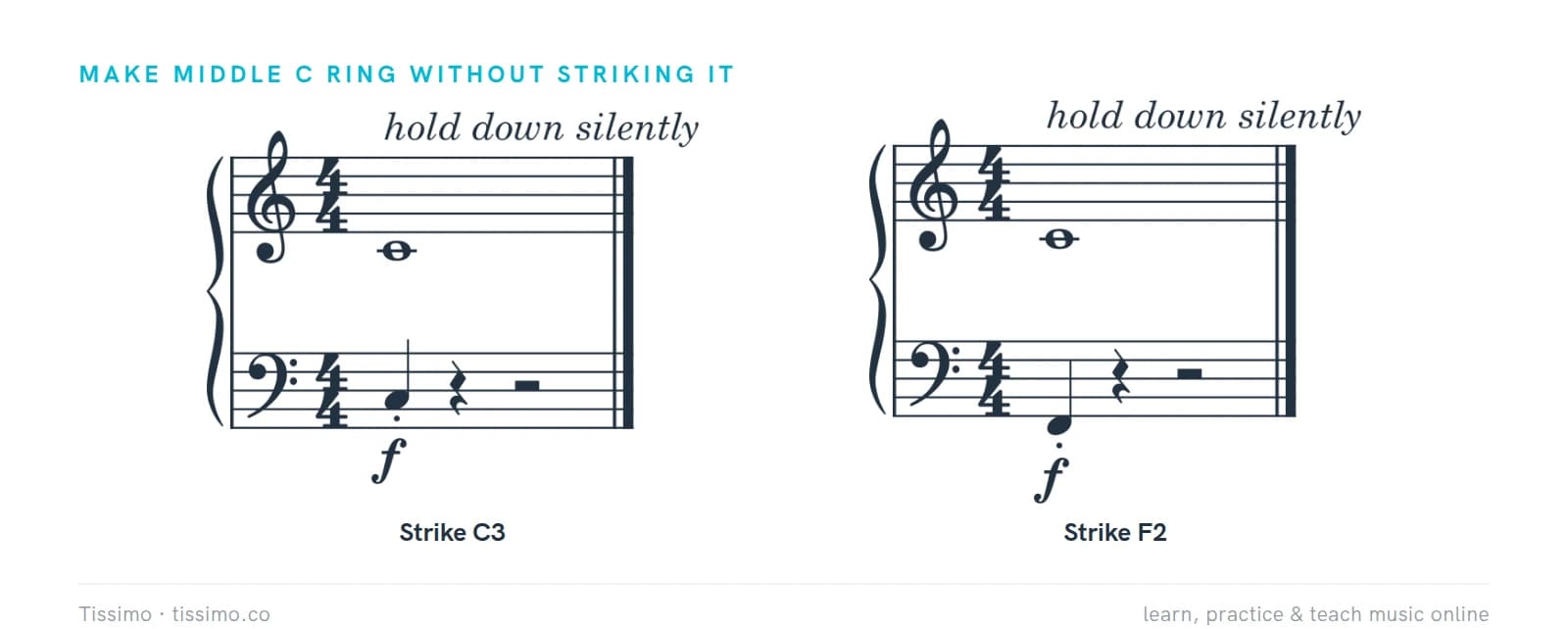
- Press middle C (C4) down so slowly that it makes no sound. This lifts its damper and leaves the string free.
- With your other hand, strike the C an octave lower (C3) loudly and short, so that it stops at once.
- Listen: middle C keeps ringing, though you never struck it.
The 2nd harmonic of the C3 string vibrates at the same frequency as middle C's fundamental, about 261.6 Hz, and the free string picks it up. Now strike F2 instead: its 3rd harmonic, about 261.9 Hz, is almost exactly middle C, so middle C answers again.
With the sustain pedal down, every damper lifts and all the strings can respond. That is why a pedaled piano has a halo of ringing sound around the notes you actually play.
Instruments built around it
Some instruments carry extra strings that are never played directly but ring in sympathy with the played ones:
- The sitar of North Indian classical music has a set of thin sympathetic strings beneath the main ones, tuned to the notes of the raga being played.
- The Norwegian Hardanger fiddle has four or five sympathetic strings running under its fingerboard.
- The Baroque viola d'amore has a similar set, which gives it a silvery glow.
Some pianos made by Blüthner add an extra "aliquot" string to each note in the treble that is never struck and vibrates only in sympathy.
When it is a nuisance
Sympathetic vibration also explains a snare drum that buzzes whenever the bass plays a certain note, a guitar's open strings ringing when they should be silent, and a lampshade that rattles on one particular pitch. Guitarists rest the side of the hand on unused strings for exactly this reason.
Read more about strings and dampers in How the Piano Works.
Common questions
Why does my piano ring when I play other notes?
Undamped strings respond to frequencies they share with the notes you play. With the sustain pedal down, or with keys held down silently, those strings pick up energy and ring in sympathy. It is normal and part of the piano's sound.
Which instruments have sympathetic strings?
The best known are the sitar, the Hardanger fiddle and the viola d'amore. Their extra strings are not played directly; they ring in sympathy with the played strings and add resonance.