Form & Structure
Symphony
Pronounced SIM-fuh-nee
A symphony is a large work for orchestra, usually in four movements. It became the central orchestral form of the Classical era through Haydn, Mozart and Beethoven.
A symphony is an extended piece for full orchestra, normally in several movements. It is the orchestra's equivalent of the sonata: the same multi-movement plan, written on a large scale for many players.
The word is also used, confusingly, as a short name for a symphony orchestra ("the city symphony").
The four-movement plan
The Classical symphony settled into a plan that many later composers kept:
- First movement: fast, usually in sonata form, sometimes with a slow introduction.
- Second movement: slow and lyrical, often in a related key.
- Third movement: a minuet and trio or, from Beethoven onward, a scherzo.
- Finale: fast, often a rondo or sonata form.
Composers often swapped the middle two movements, and many symphonies break the pattern altogether.
A short history
- Origins: the symphony grew partly out of the Italian opera sinfonia, a three-part instrumental opening (fast–slow–fast), in the early and middle 18th century.
- Classical era (roughly 1750–1820): Haydn wrote over one hundred symphonies (104 are numbered), and is often called the "father of the symphony," though he did not invent it. Mozart wrote about forty, including his last three in 1788.
- Beethoven wrote nine, expanding the form in length and drama. His Ninth adds vocal soloists and a choir in the finale, setting Schiller's "Ode to Joy."
- Romantic era: Schubert, Brahms (four), Tchaikovsky (six), Dvořák (nine, ending with "From the New World") and Mahler, whose symphonies can last well over an hour. Berlioz's Symphonie fantastique follows a story, making it program music.
- 20th century and later: composers such as Sibelius, Prokofiev and Shostakovich (fifteen symphonies) kept the form alive, and composers still write symphonies today.
Symphony and symphonic poem
A symphonic poem (or tone poem) is a one-movement orchestral piece that tells a story or paints a scene. It is related to the symphony through its orchestra, not its plan.
How to listen to a symphony
Read the movement list first and note each tempo. During the first movement, listen for the two main themes and for the moment the first theme returns (the recapitulation). In the third movement, notice the contrasting trio in the middle and the return of the opening dance. Knowing the plan makes a forty-minute work feel like four connected stories.
Common questions
How many movements are in a symphony?
Usually four: a fast first movement, a slow movement, a minuet or scherzo, and a fast finale. Some symphonies have three, five or even one movement.
What is the difference between a symphony and a concerto?
A symphony usually centers on the orchestra, but some include voices, such as Beethoven's Ninth. A concerto typically highlights one or more instrumental soloists with the orchestra and usually has three movements.
Practice it: free worksheets
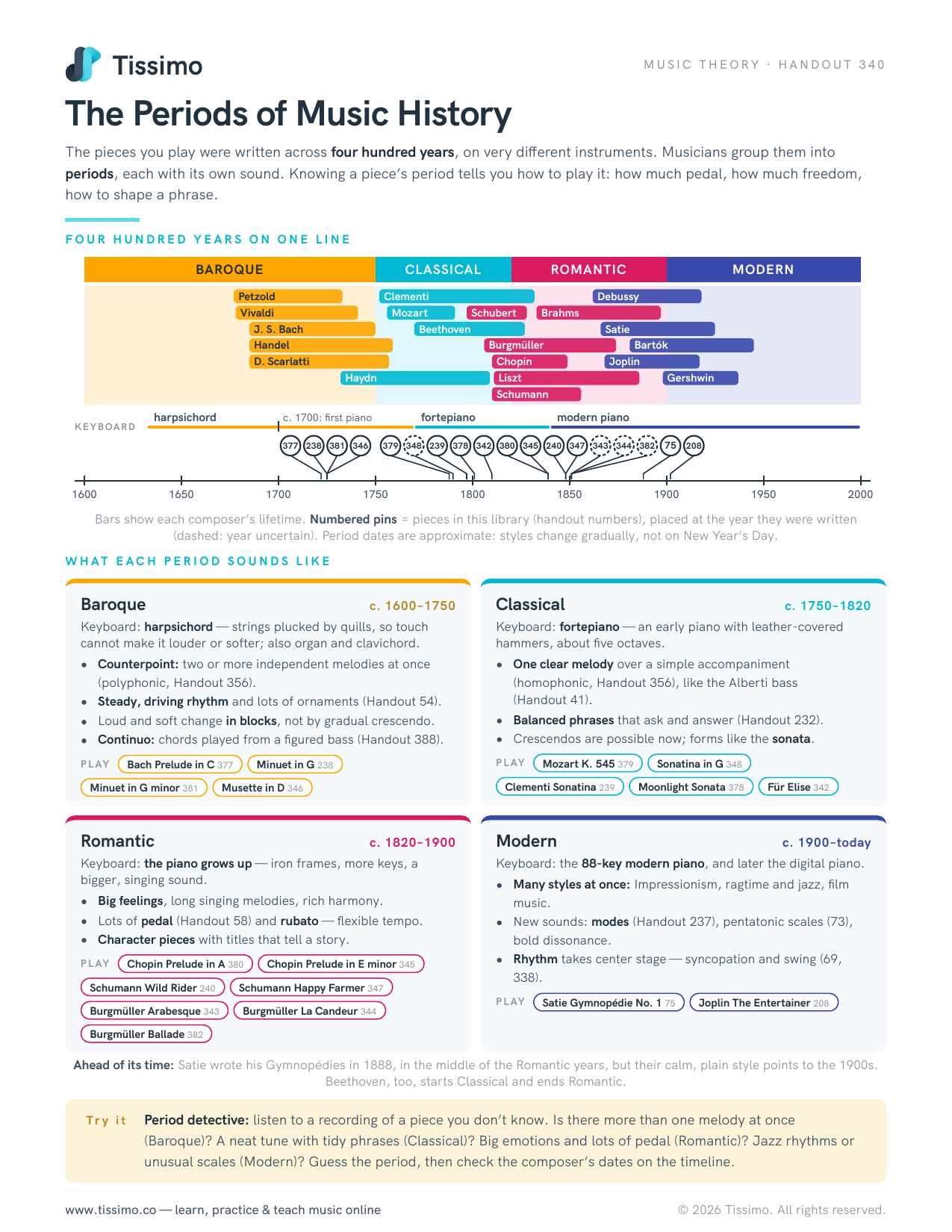 The Periods of Music HistoryThe pieces you play were written across four hundred years, on very different instruments. Musicians group them into periods, each with its own sound. Knowing a piece’s period tells you how to play it: how much pedal, how much freedom, how to shape a phrase.
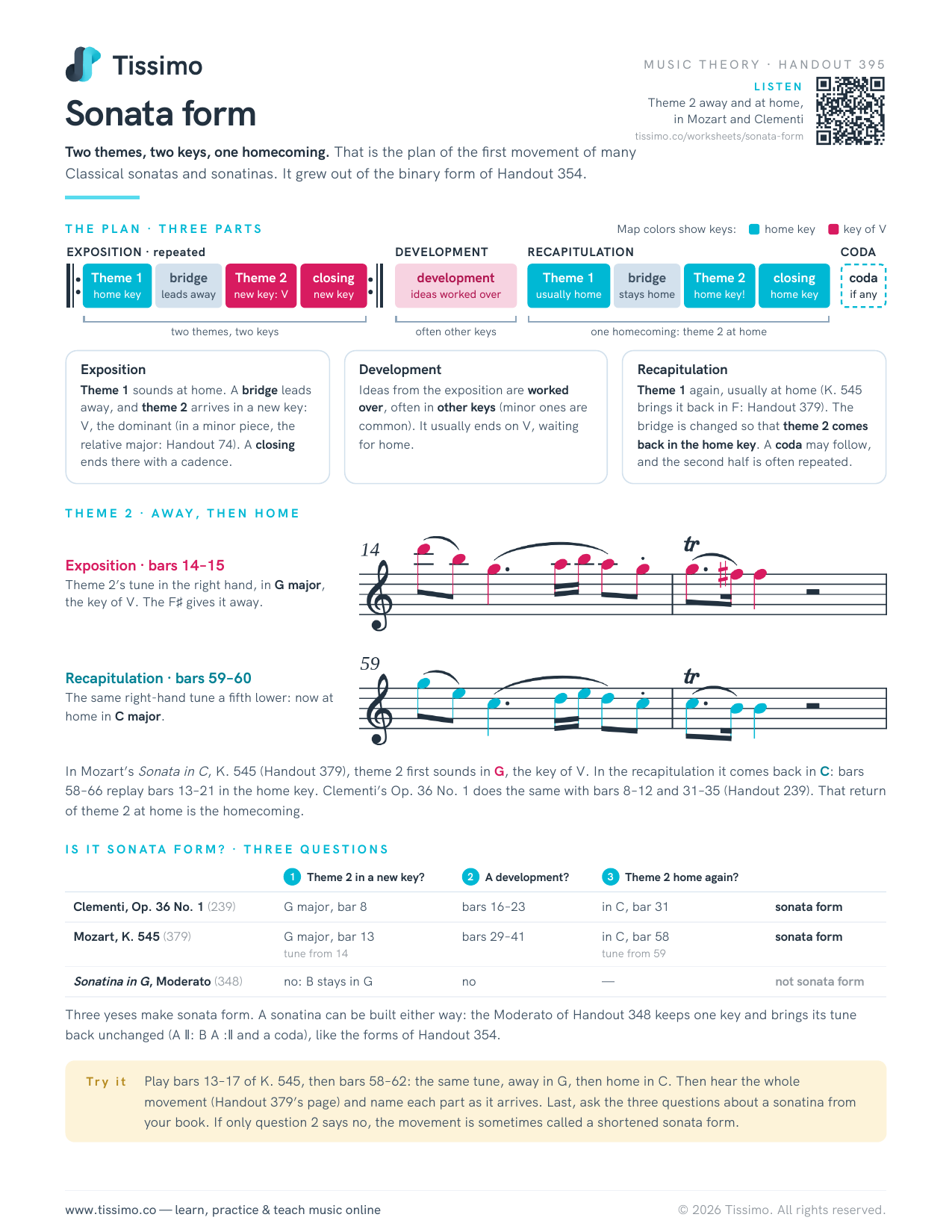 Sonata formTwo themes, two keys, one homecoming. That is the plan of the first movement of many Classical sonatas and sonatinas. It grew out of the binary form of Handout 354.