Form & Structure
Scherzo
Pronounced SKAIR-tsoh
A scherzo is a fast, lively movement, usually in 3/4 time felt in one beat per bar, that replaced the minuet in many symphonies, sonatas and string quartets from Beethoven onward.
Scherzo is Italian for "joke," and many scherzos live up to the name with sudden accents, surprising silences and witty rhythmic games. Musically, a scherzo is a fast movement in triple meter, so fast that you feel one beat per bar rather than three.
From minuet to scherzo
In the Classical symphony, sonata and string quartet, the third movement (sometimes the second) was usually a minuet. Haydn already used the title scherzo in some of his string quartets, and Beethoven made the scherzo standard, replacing the courtly minuet with something faster, rougher and more dramatic. The second movement of his Ninth Symphony is a famous, driving example.
The form
Most scherzos keep the minuet's shape:
- Scherzo (A): usually a rounded binary form with repeats.
- Trio (B): a contrasting middle section, often calmer, in a different key or texture.
- Scherzo again (A), often without repeats, sometimes followed by a coda.
That makes the whole movement a ternary ABA. Beethoven sometimes extended it to A B A B A, playing the trio twice.
How to feel it
Because the tempo is fast, counting "1-2-3" in every bar quickly becomes frantic. Count one big beat per bar instead and group the bars in fours. Accents on weak beats and sudden pauses are often the point, so keep them sharp.
The independent scherzo
In the Romantic era the scherzo also became a stand-alone piece. Chopin's four Scherzos for piano are large, dramatic works, far from jokes, though they keep the fast triple meter and the contrasting middle section. Mendelssohn's Scherzo from his music for A Midsummer Night's Dream is a light, quick orchestral example closer to the playful meaning of the word.
Related words
The performance direction scherzando ("playfully") asks for a light, joking character in any piece; see scherzando.
Common questions
What is the difference between a minuet and a scherzo?
Both are in triple meter and usually have a contrasting trio, but a scherzo is much faster, felt in one beat per bar, and often more energetic or humorous. Beethoven replaced the minuet with the scherzo in many of his works.
What does scherzo mean?
It is Italian for "joke." In music it names a fast, lively movement in triple time, often with playful accents and surprises.
Practice it: free worksheets
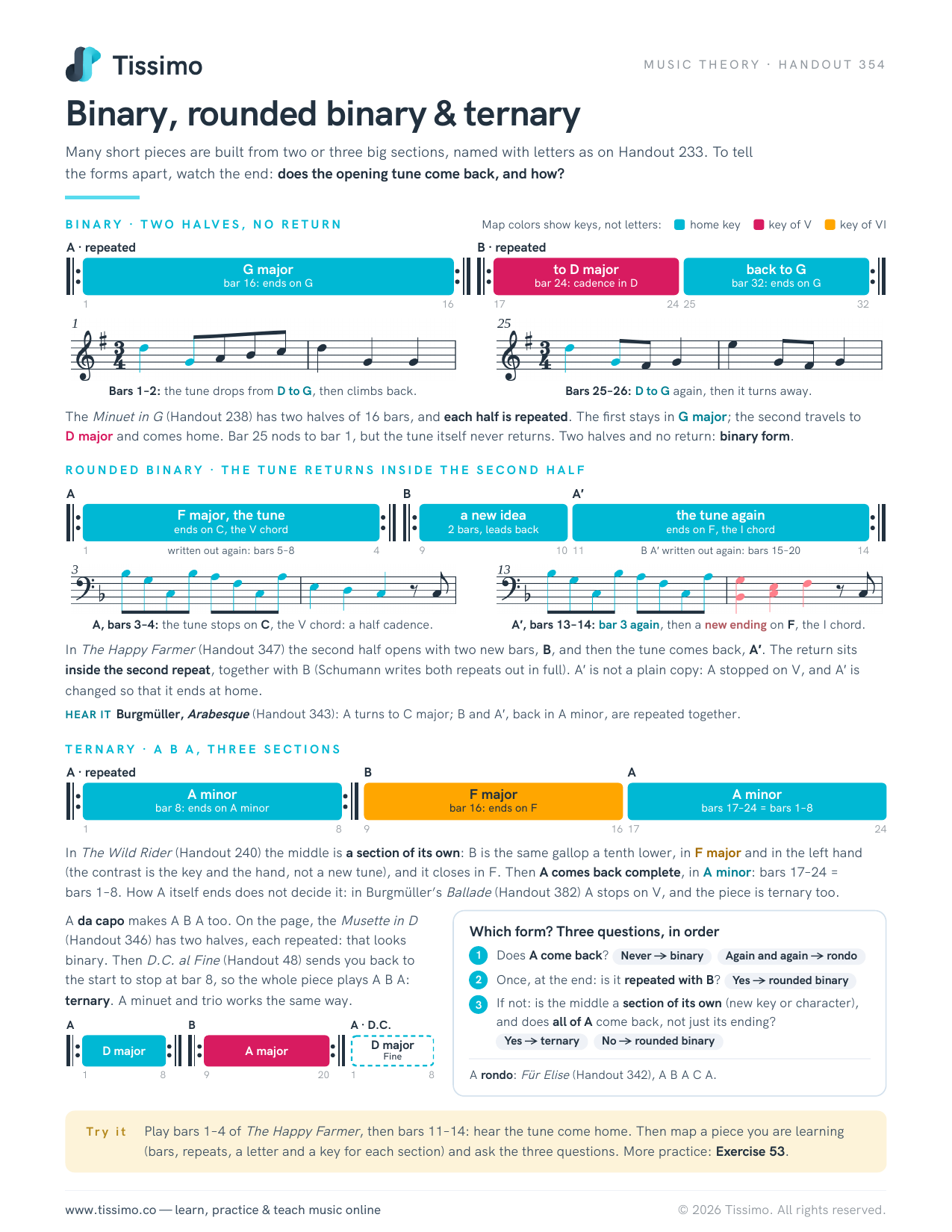 Binary, rounded binary & ternaryMany short pieces are built from two or three big sections, named with letters as on Handout 233. To tell the forms apart, watch the end: does the opening tune come back, and how?
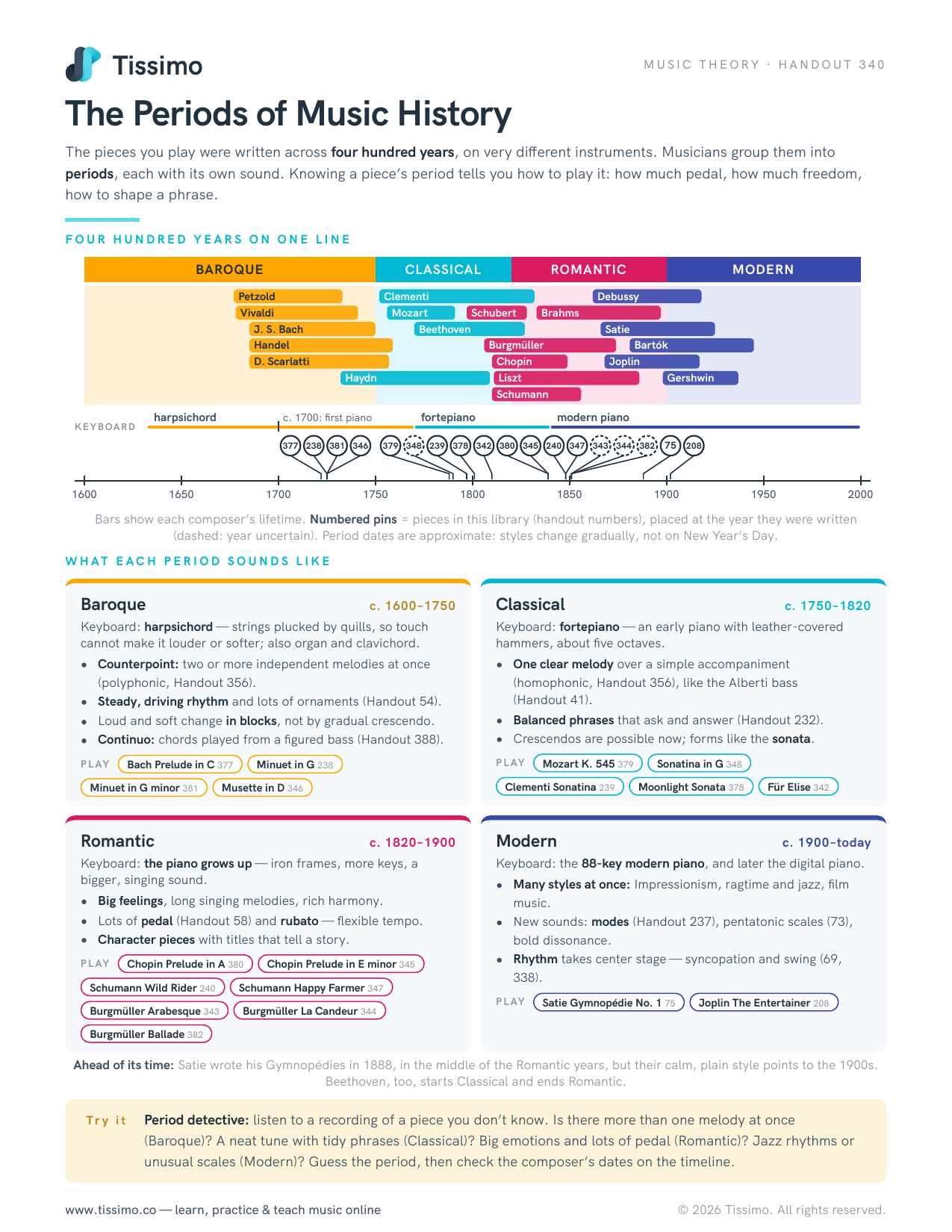 The Periods of Music HistoryThe pieces you play were written across four hundred years, on very different instruments. Musicians group them into periods, each with its own sound. Knowing a piece’s period tells you how to play it: how much pedal, how much freedom, how to shape a phrase.