Form & Structure
Sonata
Pronounced suh-NAH-tuh
A sonata is an instrumental work for a soloist or a small group, usually in two to four movements. Most sonatas are for solo piano or for one instrument with piano.
A sonata is a piece to be played rather than sung: the word comes from the Italian sonare, "to sound," in contrast to the cantata, a piece to be sung. Over four centuries the word has meant several things, but today it usually means a multi-movement work for solo piano or for one instrument with piano, such as a violin sonata or a cello sonata.
Don't confuse the sonata (a whole work) with sonata form (the plan of a single movement, usually the first).
The Classical sonata
From roughly 1750 to 1820, Haydn, Mozart, Beethoven and Clementi gave the sonata the shape most people know. A typical layout:
- Fast first movement, usually in sonata form.
- Slow movement, lyrical, often in a related key, in ternary or variation form.
- Dance movement (optional): a minuet or, from Beethoven on, a scherzo.
- Fast finale, often a rondo or another sonata-form movement.
Many sonatas, including most of Mozart's piano sonatas, have only three movements (fast–slow–fast). Beethoven wrote 32 piano sonatas that stretched every part of this plan; his "Moonlight" Sonata, for example, starts with its slow movement.
Sonatina
A sonatina ("little sonata") follows the same plan in miniature: shorter movements, simpler textures, and a first movement in a compact sonata form. Clementi's Op. 36 sonatinas are classic teaching pieces. See Clementi's Sonatina in C and the Sonatina in G attributed to Beethoven.
Before and after the Classical sonata
- Baroque: the trio sonata for two melody instruments and continuo, and the solo sonata for one instrument and continuo, often in four movements alternating slow and fast. Domenico Scarlatti wrote hundreds of one-movement keyboard sonatas in binary form.
- Romantic and later: sonatas grew larger and freer. Liszt's Sonata in B minor runs as one continuous movement. Composers kept writing sonatas for nearly every instrument, including flute, clarinet, saxophone and trumpet.
Your first sonata
Many students meet the sonata through sonatinas, then move on to Mozart's Sonata in C, K. 545, which Mozart himself described as being for beginners. The Mozart K. 545 study walks through its first movement.
Common questions
What is the difference between a sonata and a sonatina?
A sonatina is a small sonata: shorter, technically simpler movements, usually with a compact sonata-form first movement. Clementi's Op. 36 sonatinas are famous examples.
How many movements does a sonata have?
Most have three (fast–slow–fast) or four (adding a minuet or scherzo), but sonatas with one, two or five movements exist too.
Practice it: free worksheets
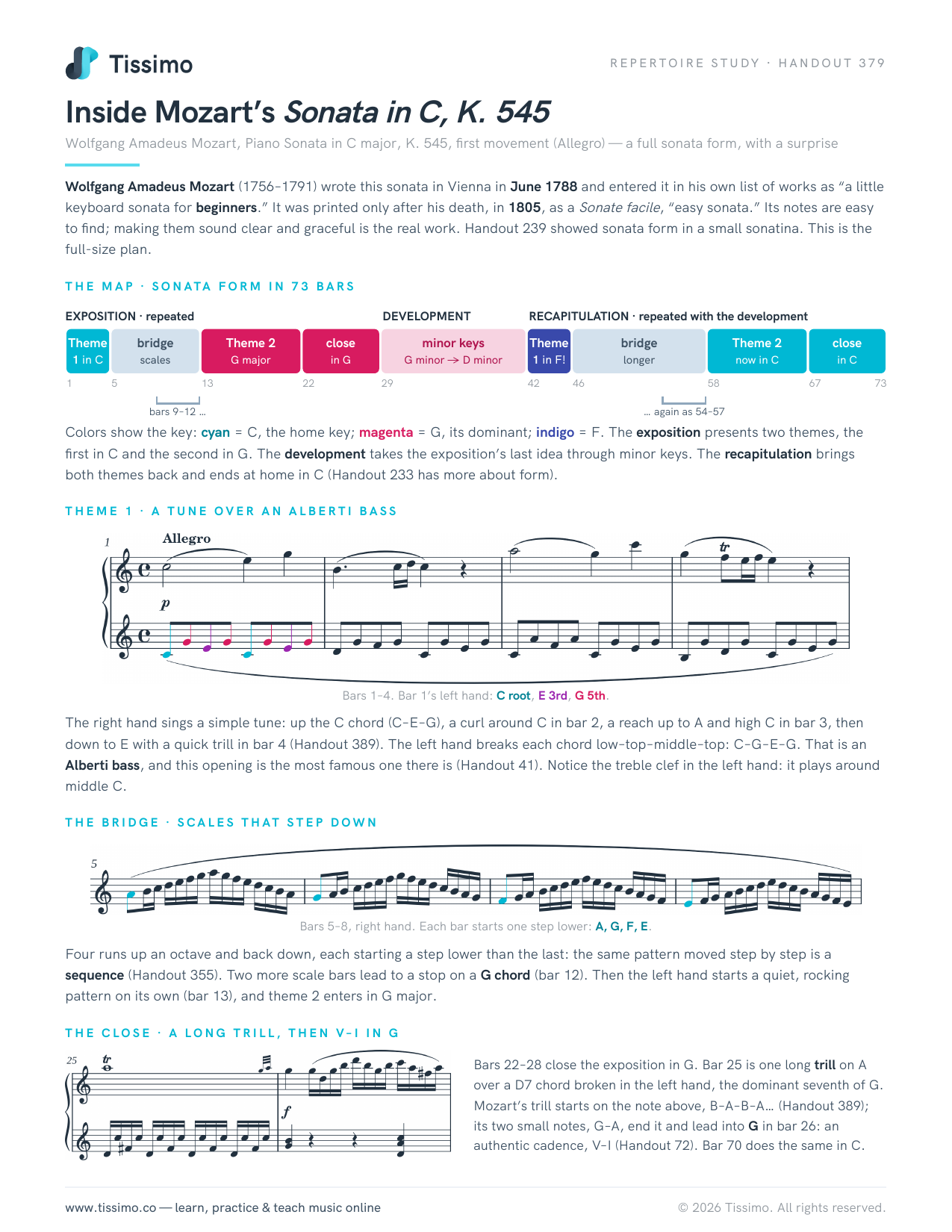 Inside Mozart’s Sonata in C, K. 545Wolfgang Amadeus Mozart, Piano Sonata in C major, K. 545, first movement (Allegro) — a full sonata form, with a surprise
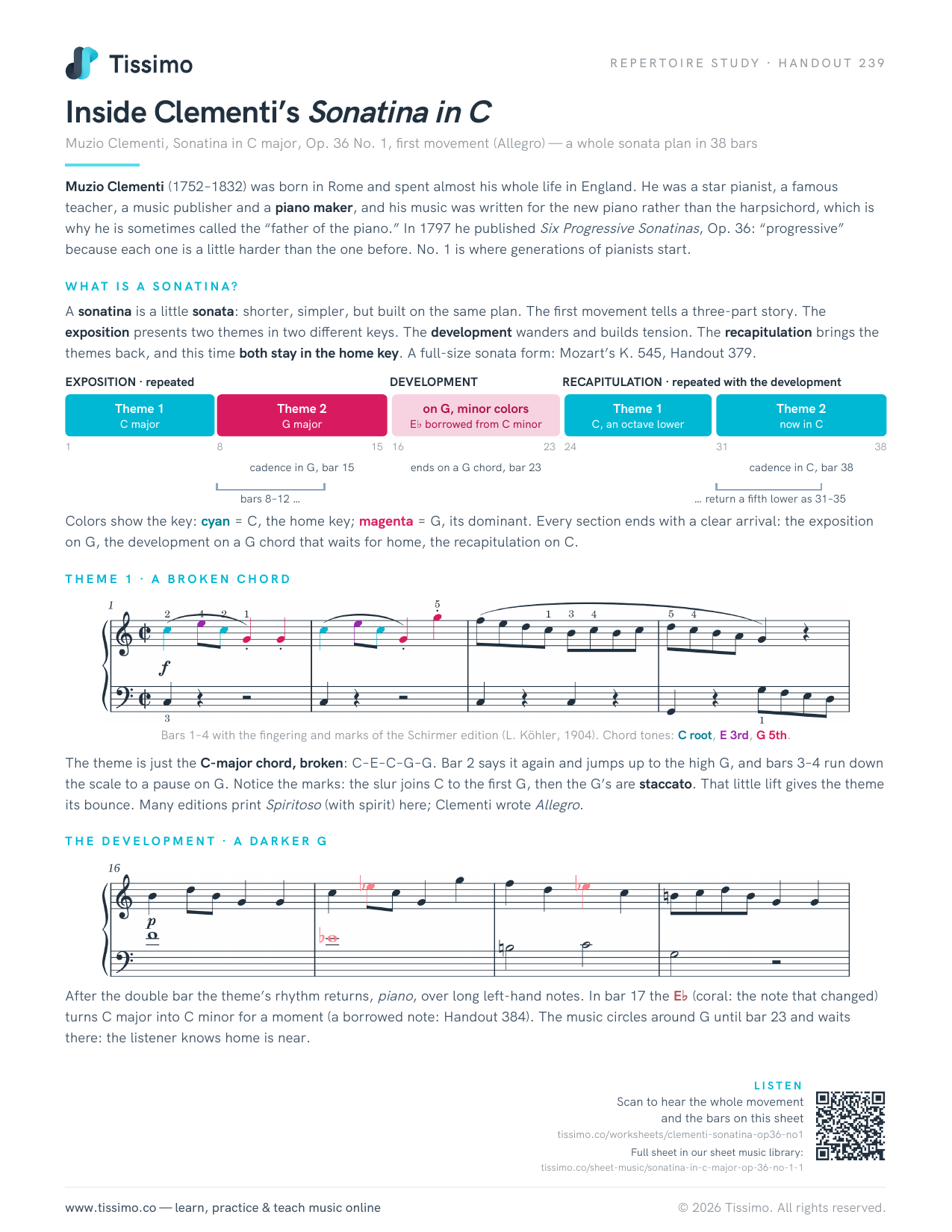 Inside Clementi’s Sonatina in CMuzio Clementi, Sonatina in C major, Op. 36 No. 1, first movement (Allegro) — a whole sonata plan in 38 bars
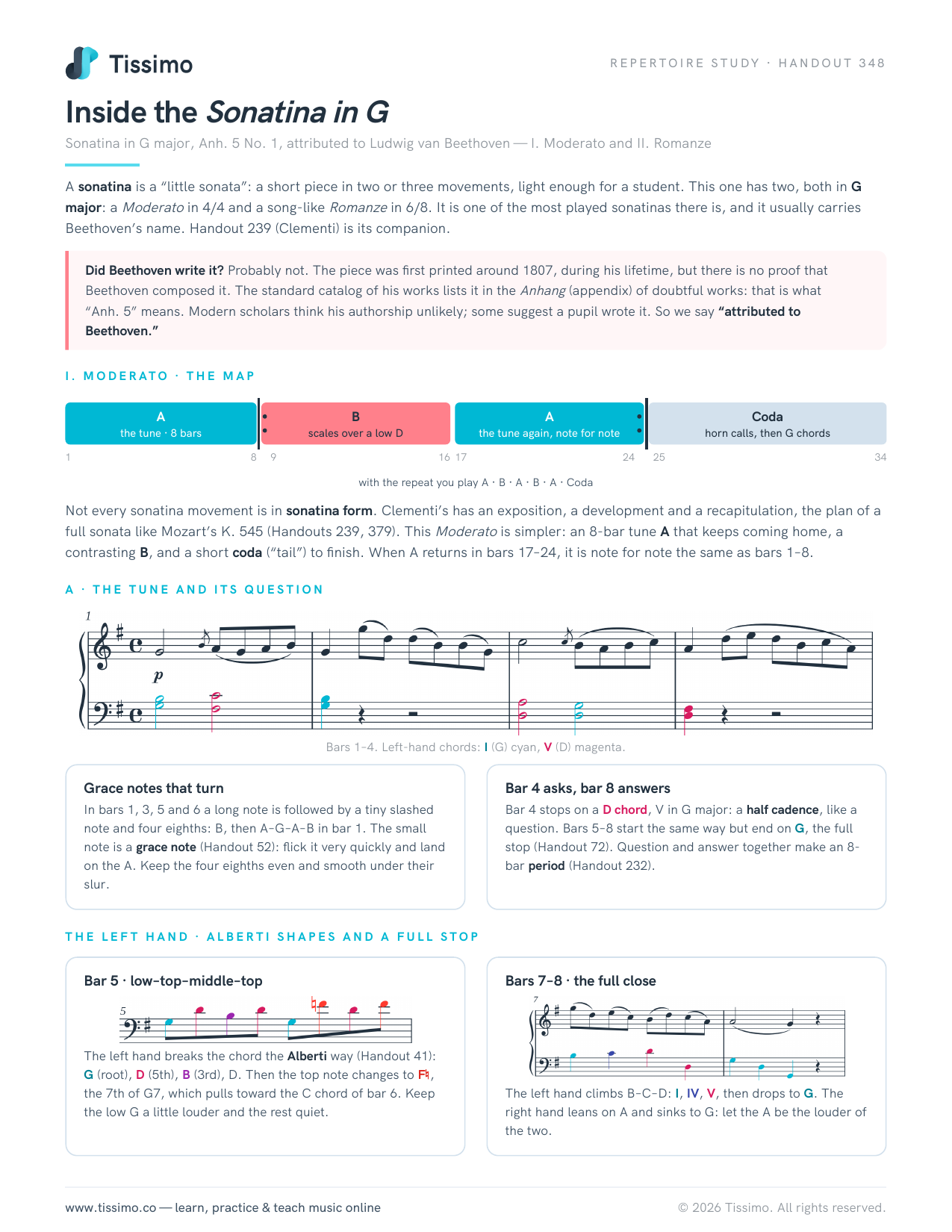 Inside the Sonatina in GSonatina in G major, Anh. 5 No. 1, attributed to Ludwig van Beethoven — I. Moderato and II. Romanze
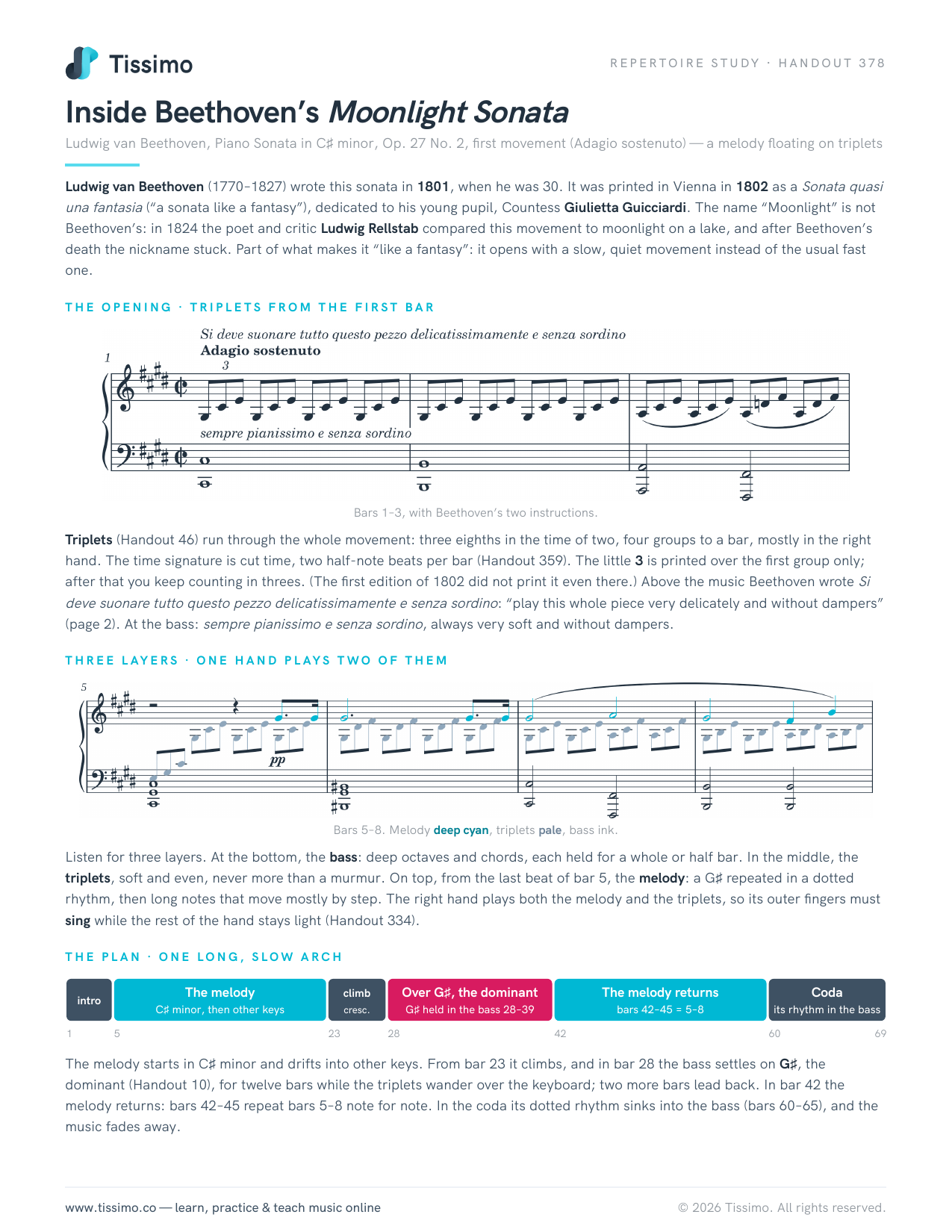 Inside Beethoven’s Moonlight SonataLudwig van Beethoven, Piano Sonata in C♯ minor, Op. 27 No. 2, first movement (Adagio sostenuto) — a melody floating on triplets
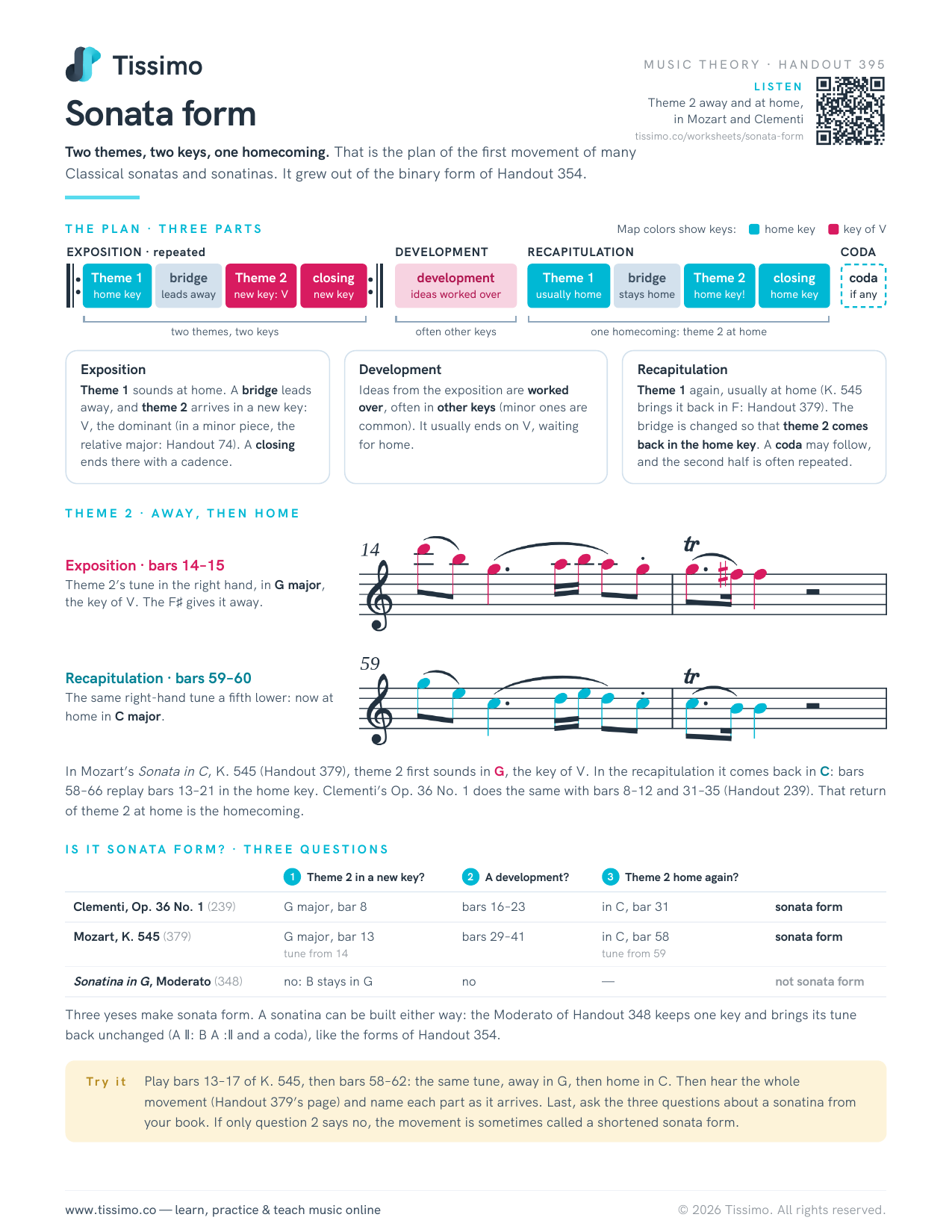 Sonata formTwo themes, two keys, one homecoming. That is the plan of the first movement of many Classical sonatas and sonatinas. It grew out of the binary form of Handout 354.