Form & Structure
Movement
A movement is a self-contained section of a larger work such as a symphony, sonata, concerto or suite, with its own tempo, character and form, usually separated from the next movement by a short pause.
Many large works are divided into movements: complete sections that can almost stand on their own, each with a beginning, a middle and an ending. A symphony typically has four, a concerto three, a sonata two to four, and a suite or a set of songs can have many more.
How movements are named
Most movements are known by their tempo marking. "The Andante of Mozart's sonata" means the slow movement marked andante. Others are named after a dance or form (minuet, scherzo, rondo, gigue), and some have descriptive titles. In programs you will see them listed with Roman numerals:
- I. Allegro
- II. Andante
- III. Menuetto
- IV. Presto
Why works have movements
Contrast. A sequence of movements lets a composer place a fast, dramatic opening, a slow lyrical middle, a dance and a lively finale side by side. Movements usually differ in tempo, meter, character and often key, but belong together: the outer movements are normally in the home key, and the inner ones often move to a closely related key.
Each movement has its own form
The word movement tells you nothing about the form inside it. A Classical first movement is very often in sonata form; a slow movement may be in ternary form or variations; a minuet uses ternary form (minuet, trio, minuet); a finale is often a rondo.
Pauses between movements
Between movements, performers usually pause briefly to tune or reset. In concerts today, audiences usually hold their applause until the end of the whole work, although that custom is relatively recent: audiences of the 18th and 19th centuries often applauded between movements. A composer can also link movements without a break, marked attacca ("attack," go straight on).
Movement or piece?
When a teacher assigns "the first movement of the Moonlight Sonata," you are learning one part of a three-movement work. Beethoven's Piano Sonata Op. 27 No. 2 has a slow first movement, a short second movement in the style of a minuet, and a stormy, fast finale. The Moonlight Sonata study looks inside the first.
Common questions
What is a movement in music?
A complete, self-contained section of a larger work such as a symphony, concerto or sonata. Each movement has its own tempo, character and form.
Why don't people clap between movements?
Modern concert custom treats the whole multi-movement work as one piece, so applause usually waits until the end. Earlier audiences often clapped between movements.
Practice it: free worksheets
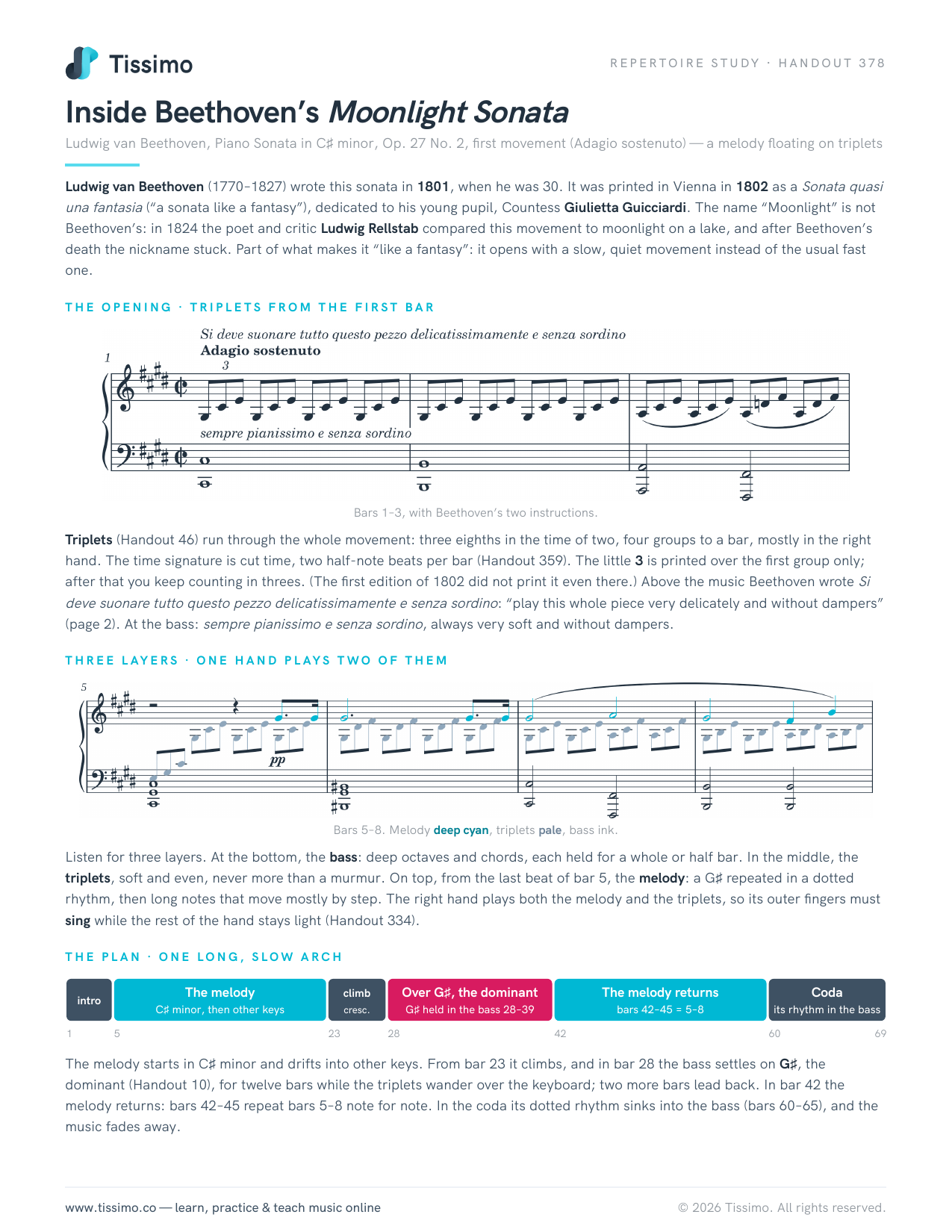 Inside Beethoven’s Moonlight SonataLudwig van Beethoven, Piano Sonata in C♯ minor, Op. 27 No. 2, first movement (Adagio sostenuto) — a melody floating on triplets
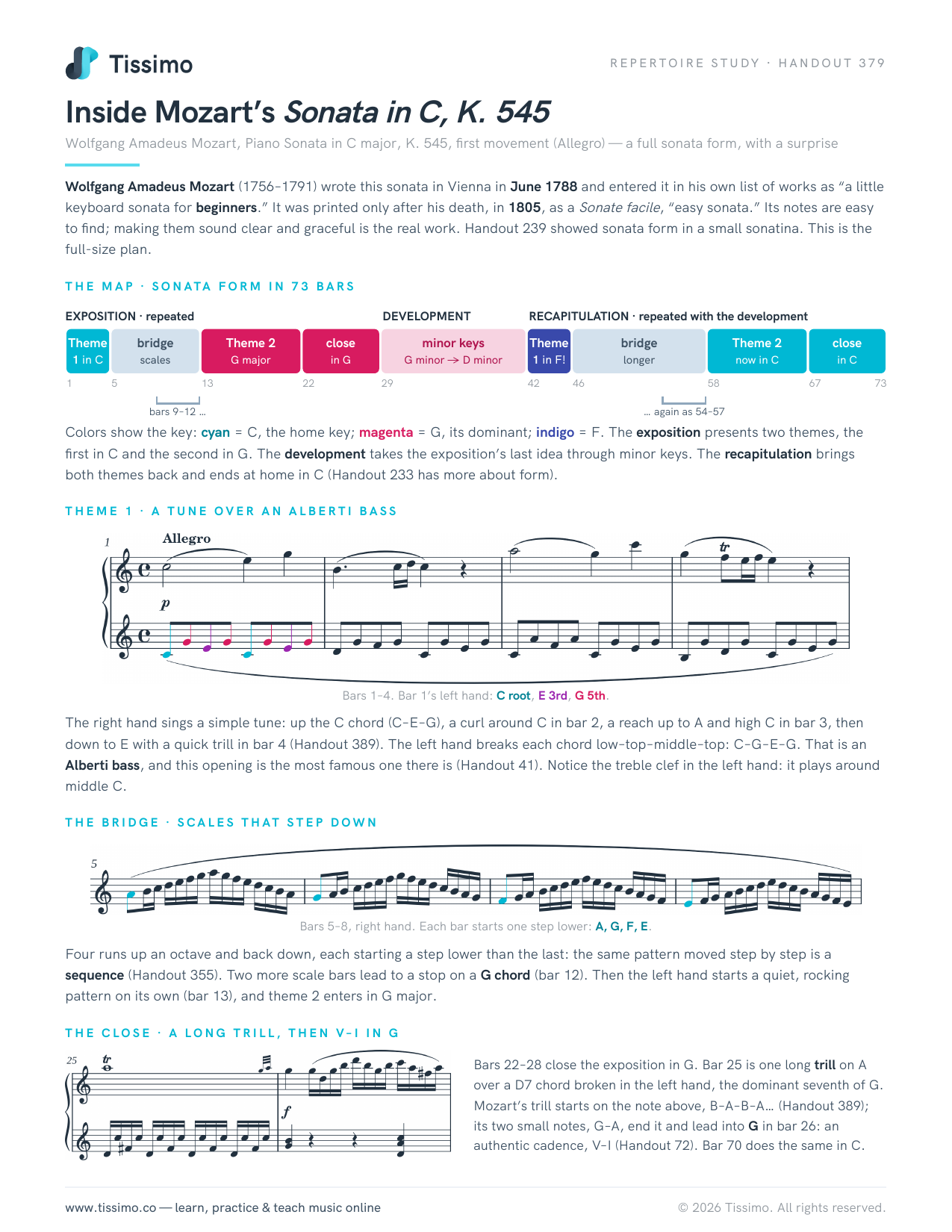 Inside Mozart’s Sonata in C, K. 545Wolfgang Amadeus Mozart, Piano Sonata in C major, K. 545, first movement (Allegro) — a full sonata form, with a surprise
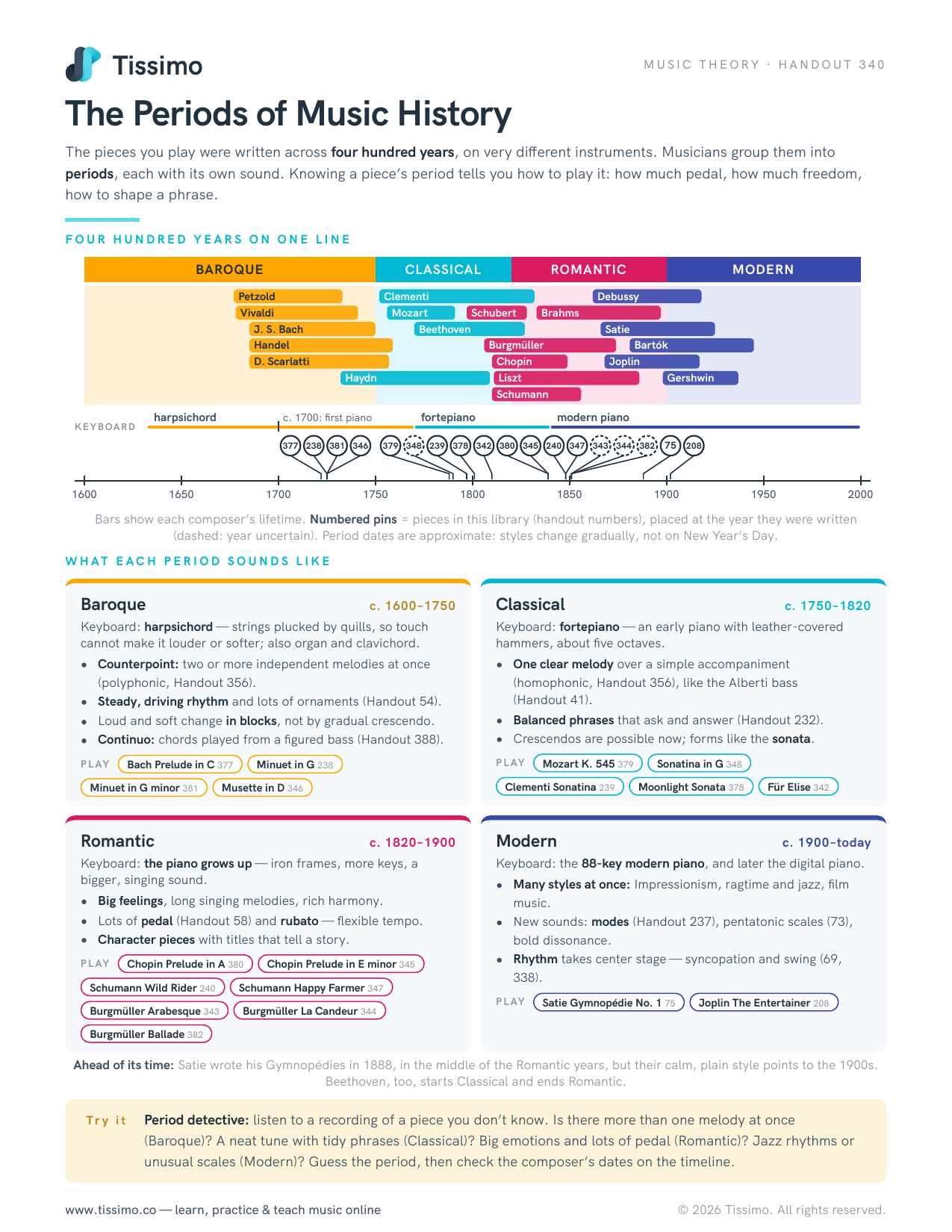 The Periods of Music HistoryThe pieces you play were written across four hundred years, on very different instruments. Musicians group them into periods, each with its own sound. Knowing a piece’s period tells you how to play it: how much pedal, how much freedom, how to shape a phrase.