Form & Structure
Suite
Pronounced SWEET
A suite is a set of instrumental pieces played in sequence. In the Baroque era it meant a series of stylized dances in the same key; later it also meant a set of movements drawn from a ballet, opera or film score.
A suite is a collection of pieces meant to be played one after another. The word is French for "sequence," and it has had two main meanings.
The Baroque dance suite
From the 1600s to the mid-1700s, a suite was a set of stylized dances, all in the same key, for keyboard, a solo instrument or an ensemble. By Bach's time a common core was four dances, usually in this order:
- Allemande: moderate, in four, with flowing sixteenth notes.
- Courante (or Italian corrente): a running dance in triple time.
- Sarabande: slow and stately, in triple time, often with weight on the second beat.
- Gigue: fast, usually in compound meter such as 6/8 or 12/8, often with imitative entries.
Composers often added a prelude at the start and optional dances, such as a minuet, bourrée, gavotte or passepied, usually between the sarabande and the gigue. Most of these dances are in binary form, each half repeated.
Well-known Baroque suites include Bach's six Cello Suites, his French Suites, English Suites and Partitas for keyboard, and Handel's Water Music. Other names for the same idea are partita and, in François Couperin's harpsichord books, ordre.
Suites from larger works
From the 19th century onward, suite also came to mean a concert set of movements taken from a longer stage or screen work. Tchaikovsky's Nutcracker Suite gathers numbers from his ballet, and Grieg made two Peer Gynt suites from his music for Ibsen's play. Film composers often publish suites of their scores for concert use.
Independent suites
Some composers use suite for any set of related pieces: Holst's The Planets is a suite of seven orchestral movements, each portraying a planet, and Debussy's Suite bergamasque for piano contains the famous "Clair de lune."
Playing dances from suites
Many students meet Baroque dances one at a time. Before you play one, find out what kind of dance it is: its typical tempo, meter and which beats are strong shape how it should feel. A minuet is not a gigue, even if both are in triple meter. The Minuet in G study shows how one such dance is built.
Common questions
What are the four dances of a Baroque suite?
The usual core is the allemande, courante, sarabande and gigue, in that order, often with a prelude at the start and optional dances such as minuets or gavottes before the gigue.
What is the difference between a suite and a sonata?
A Baroque suite is a sequence of dances in one key, mostly in binary form. A Classical sonata has contrasting movements in different tempos and forms, typically with a sonata-form first movement.
Practice it: free worksheets
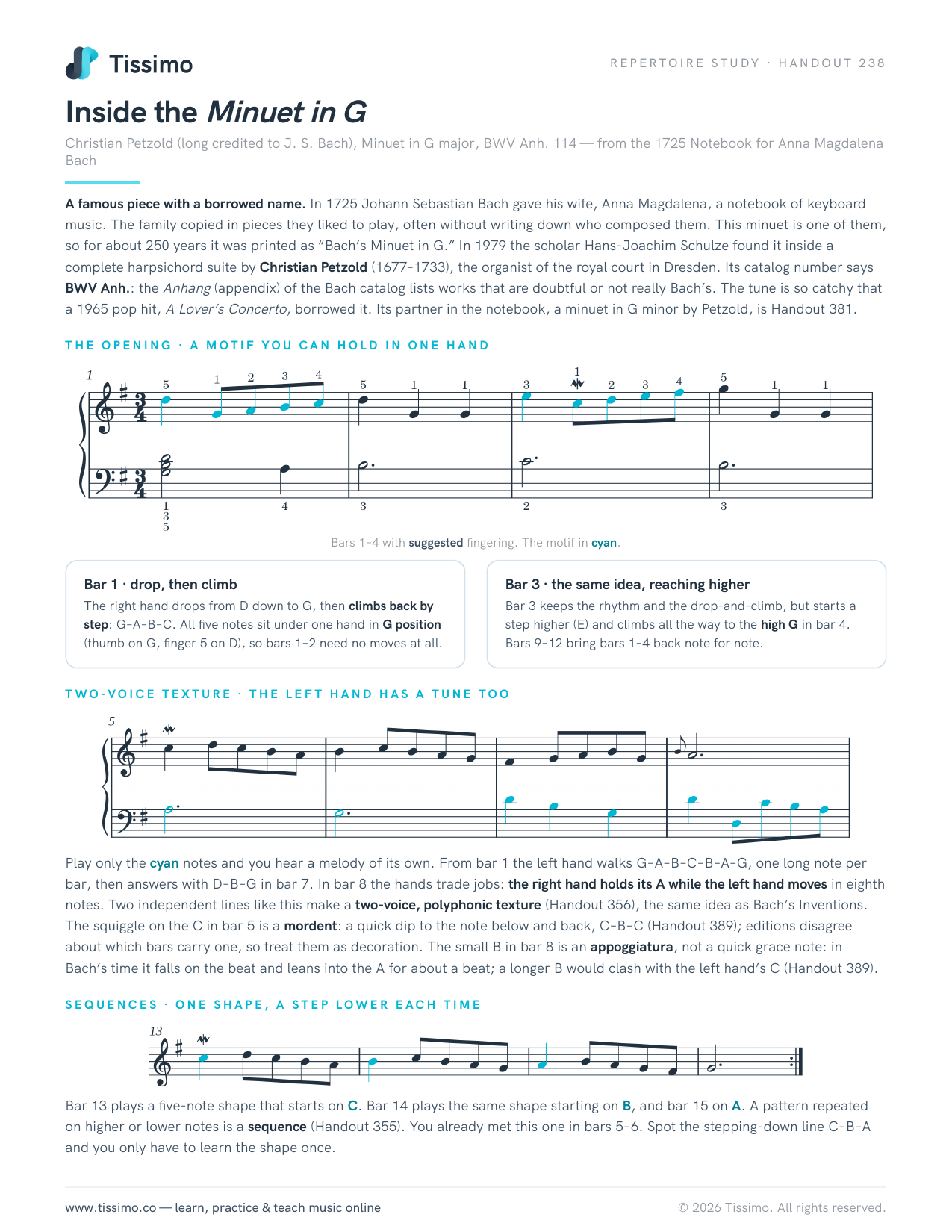 Inside the Minuet in GChristian Petzold (long credited to J. S. Bach), Minuet in G major, BWV Anh. 114 — from the 1725 Notebook for Anna Magdalena Bach
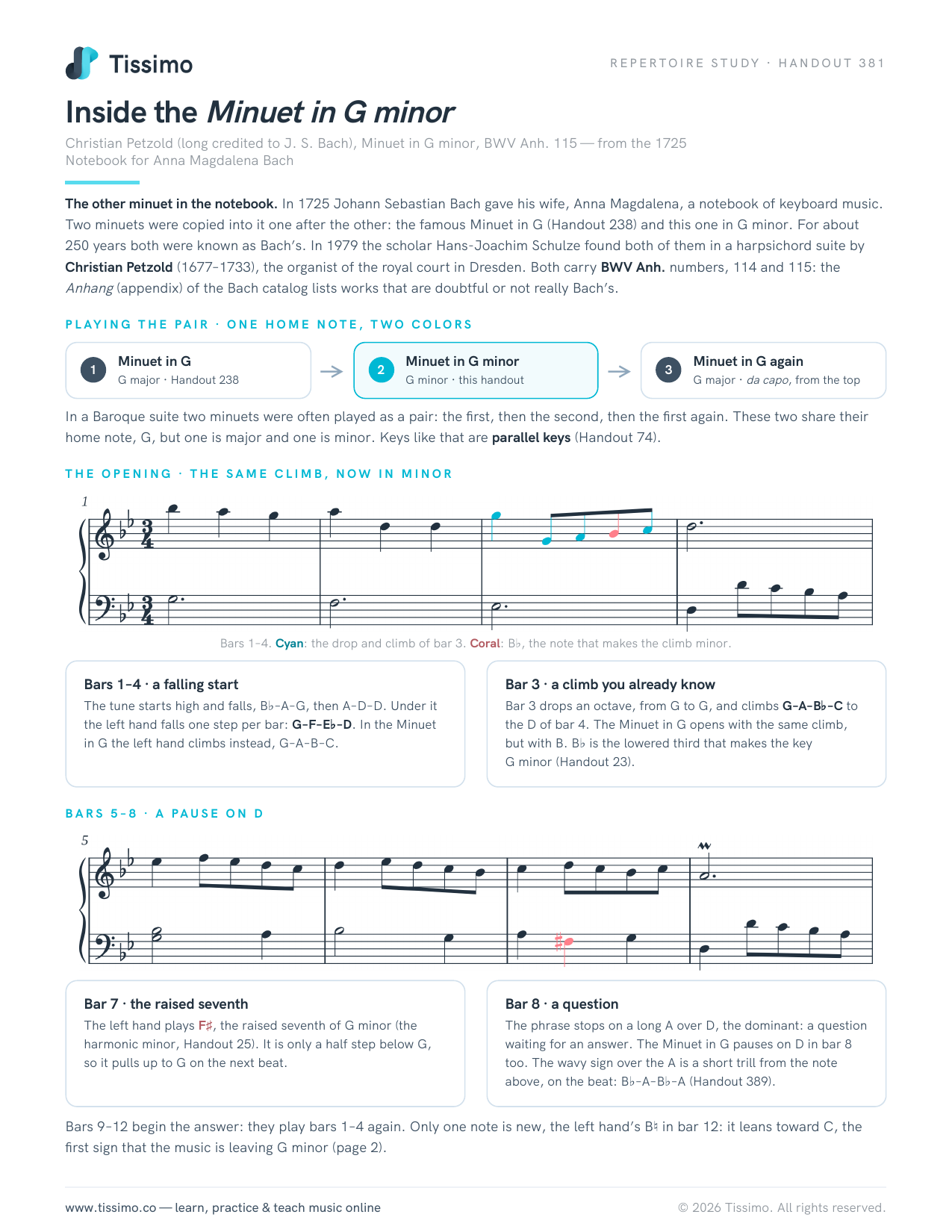 Inside the Minuet in G minorChristian Petzold (long credited to J. S. Bach), Minuet in G minor, BWV Anh. 115 — from the 1725 Notebook for Anna Magdalena Bach
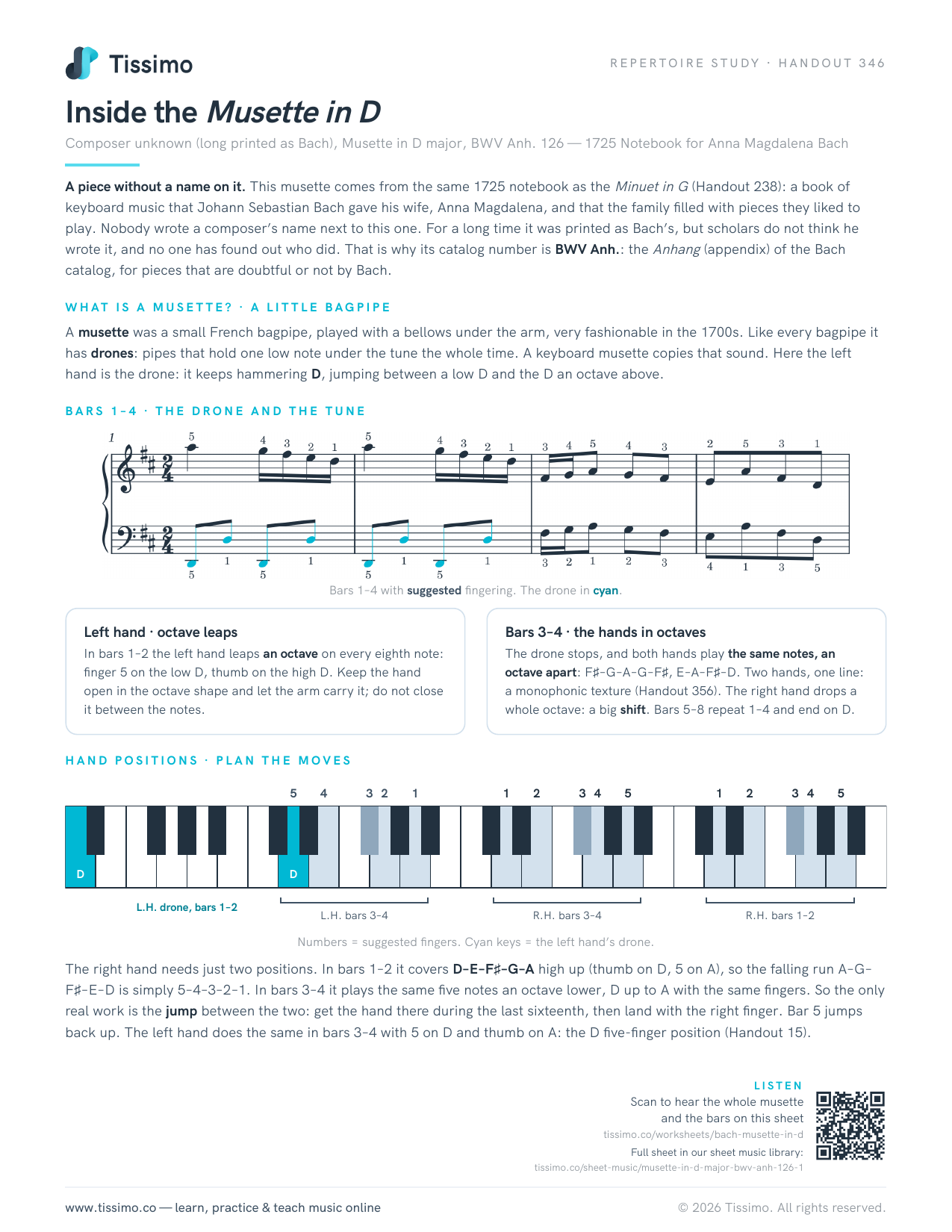 Inside the Musette in DComposer unknown (long printed as Bach), Musette in D major, BWV Anh. 126 — 1725 Notebook for Anna Magdalena Bach
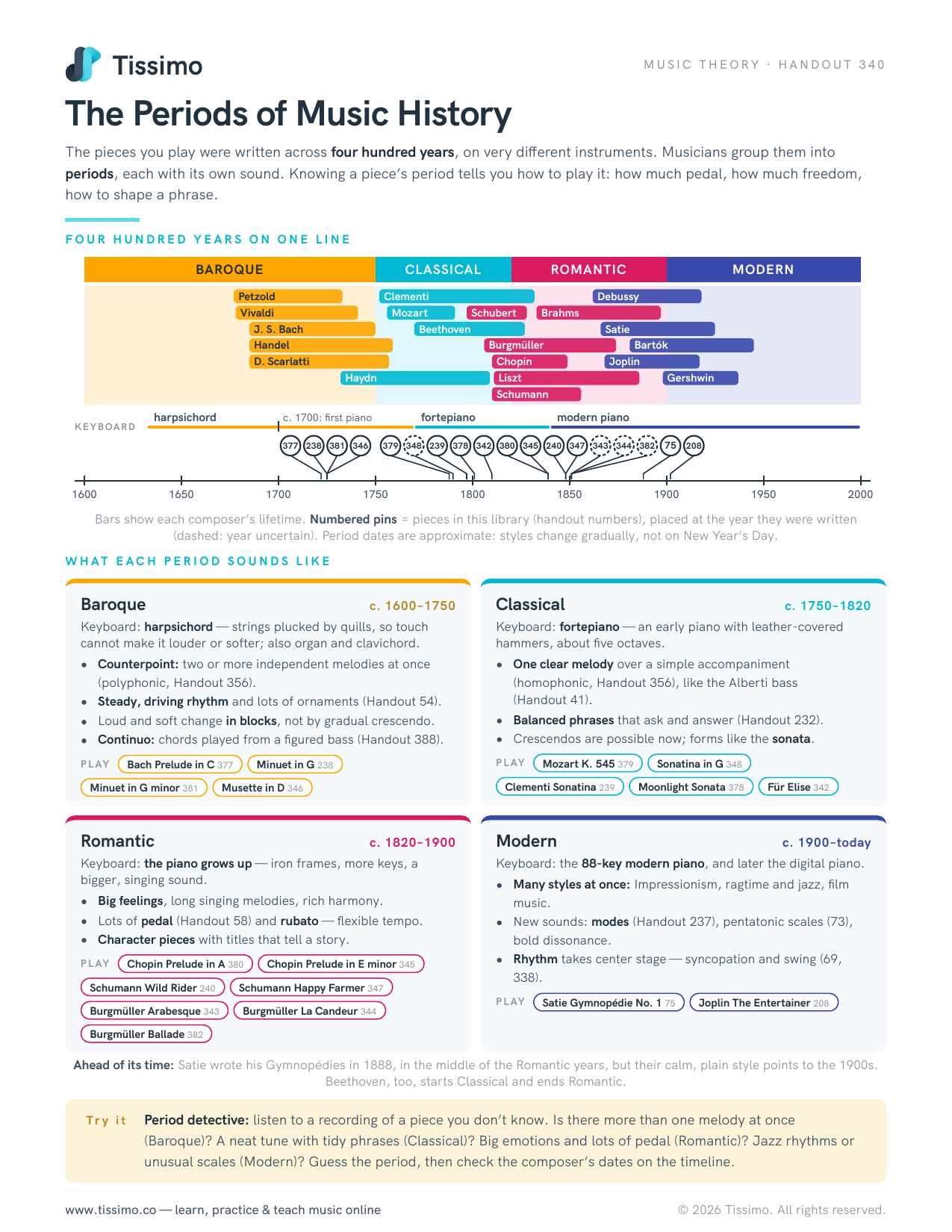 The Periods of Music HistoryThe pieces you play were written across four hundred years, on very different instruments. Musicians group them into periods, each with its own sound. Knowing a piece’s period tells you how to play it: how much pedal, how much freedom, how to shape a phrase.