Scales, Keys & Modes
Subtonic
Pronounced sub-TON-ik
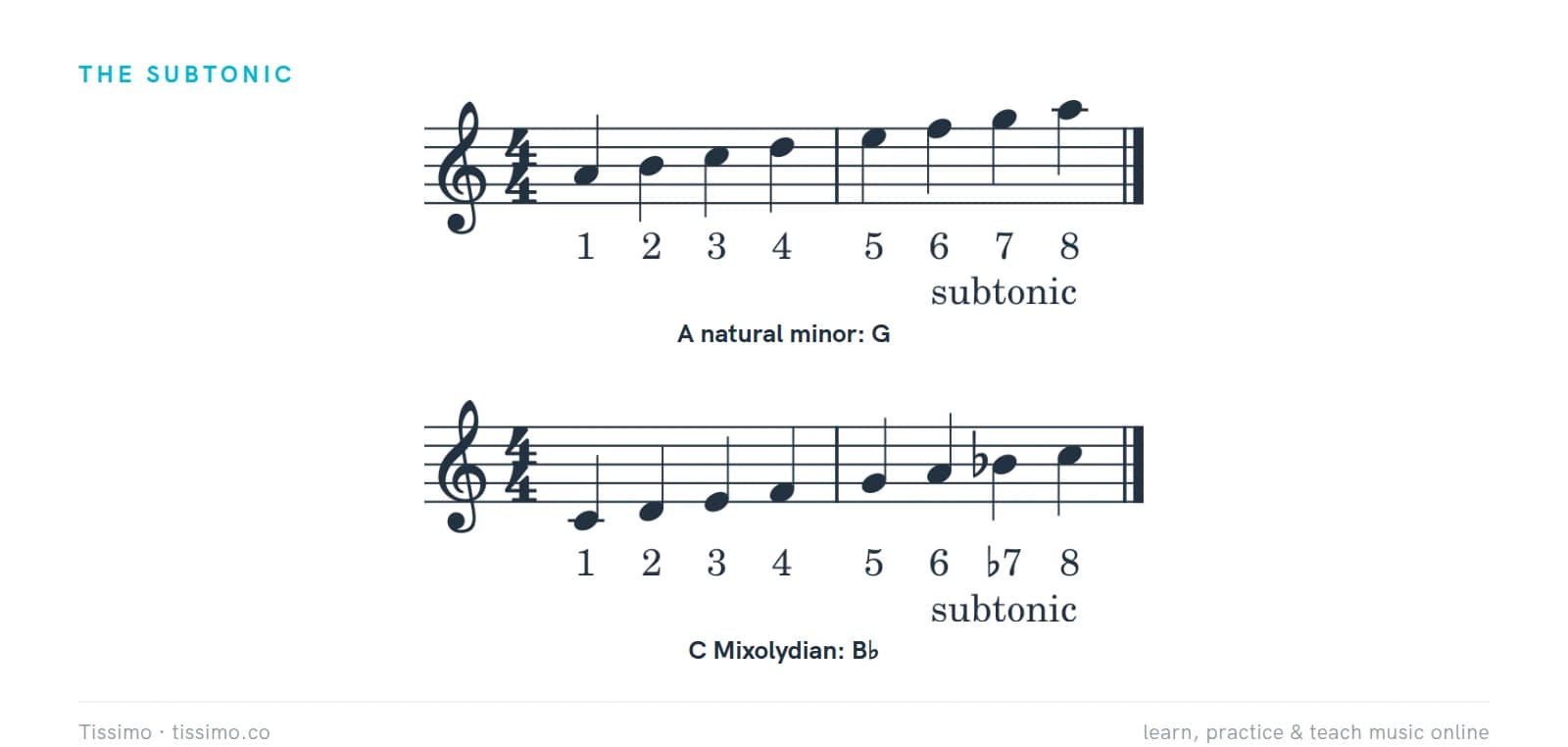
The subtonic is the seventh degree of a scale when it lies a whole step below the tonic, as G does in A natural minor. Unlike the leading tone, it has little pull toward the tonic.
The subtonic is scale degree 7 when it sits a whole step below the tonic. It is the normal 7th degree of the natural minor scale (G in A minor) and of the Mixolydian mode (F in G Mixolydian), and it is the note musicians mean when they talk about a "flat seven", such as B♭ in C.
Subtonic or leading tone?
Both names belong to the 7th degree; the distance to the tonic decides which one applies. A half step below the tonic, the 7th is the leading tone, and it pulls hard upward. A whole step below, it is the subtonic, and most of that pull disappears. Compare the two in A minor:
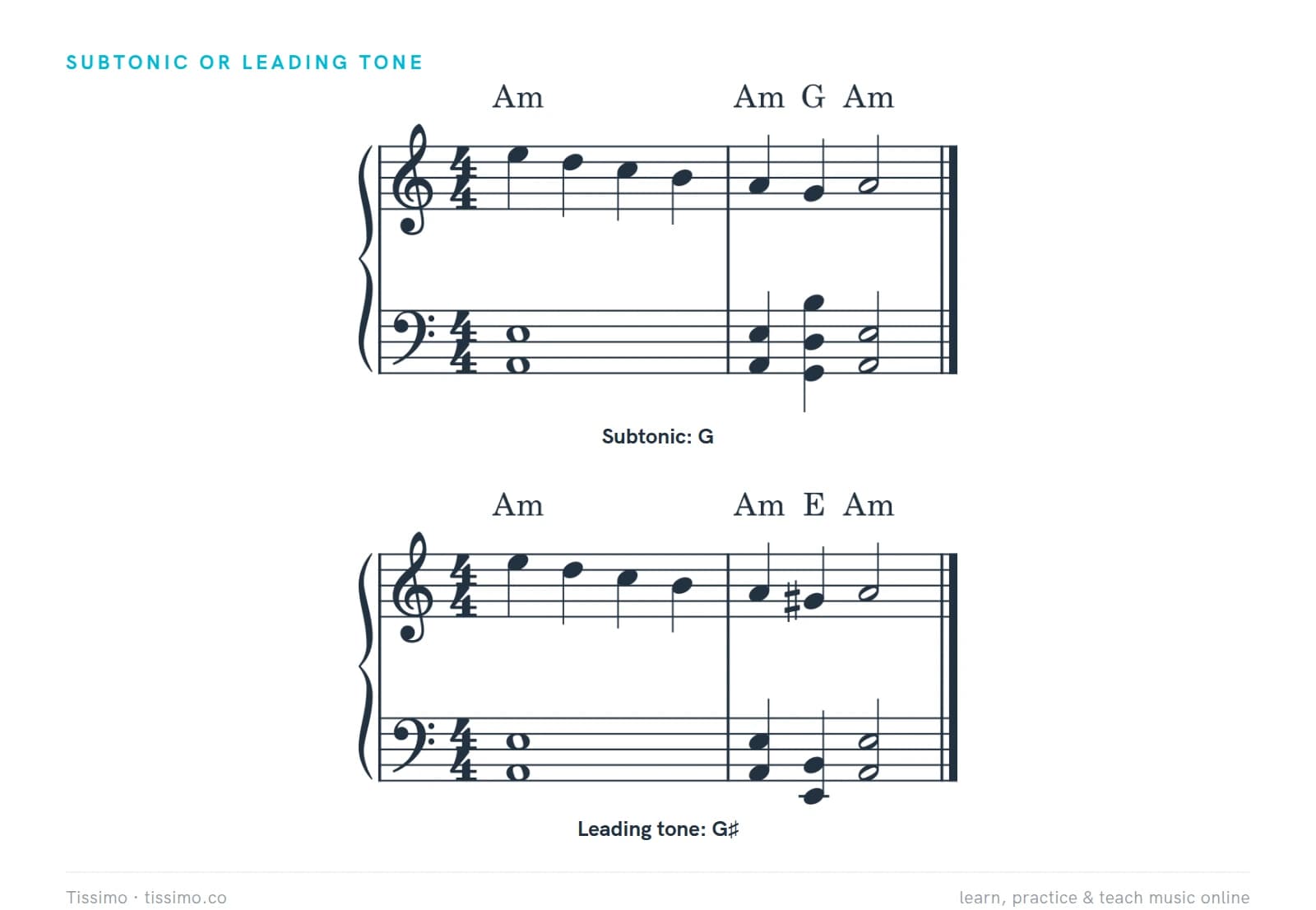
With G♯ the line sounds as if it must go to A. With G it can rise to A, but it could just as easily turn back down; the phrase feels relaxed and modal, closer to folk music than to a classical cadence.
The subtonic chord
The triad on the subtonic is major: G B D in A natural minor, or B♭ D F borrowed into C major. In rock and pop analysis it is written ♭VII. Its move to the tonic chord, ♭VII–i or ♭VII–I, is one of the defining sounds of rock and pop: it reaches home by step without any leading tone. Progressions such as i–♭VI–♭VII–i in minor and I–♭VII–IV–I in major are built around it.
In classical minor-key music, the subtonic chord (written VII) usually appears on its way somewhere else, most often as the dominant of the relative major: G major leading to C major in A minor.
Spotting it
In a major key, a lowered 7th written as an accidental (B♭ in C major) is a borrowed subtonic, often a sign of the Mixolydian mode or of a borrowed chord from the parallel minor. In a minor key, a 7th degree without the raising accidental is the subtonic; with it, the leading tone. The three minors shows both, and Minor-Key Chords: Natural or Raised Seventh? asks you to tell them apart.
Common questions
What is a ♭VII chord?
The major triad built on the subtonic: G major in A minor, or B♭ major borrowed into C major. It often moves straight to the tonic chord, a common ending in rock and pop.
Does a major key have a subtonic?
Not in its own scale: the 7th degree of a major scale is a leading tone. A lowered 7th in a major key, such as B♭ in C major, is borrowed from the parallel minor or the Mixolydian mode.
Practice it: free worksheets
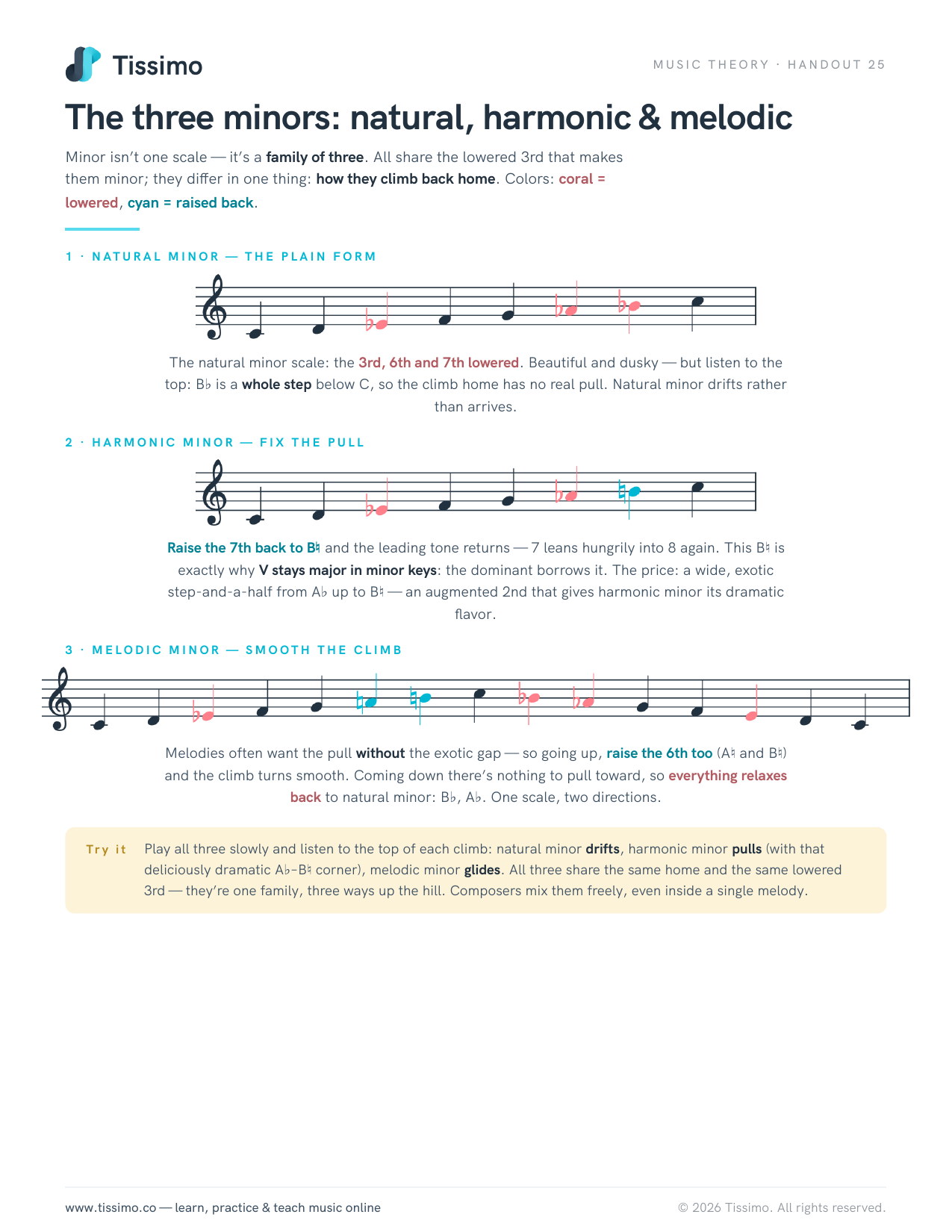 The three minors: natural, harmonic & melodicMinor isn’t one scale — it’s a family of three. All share the lowered 3rd that makes them minor; they differ in one thing: how they climb back home. Colors: coral = lowered, cyan = raised back.
 Minor-Key Chords: Natural or Raised Seventh?Natural minor uses the key signature. Harmonic minor raises only degree 7 by a half step: A minor G→G♯; E minor D→D♯; D minor C→C♯. Major: III; minor: i; diminished: ii°; augmented: III+. Use uppercase for major or augmented triads and lowercase for minor or diminished triads. Here VII means the unraised seventh; vii° uses the raised seventh.
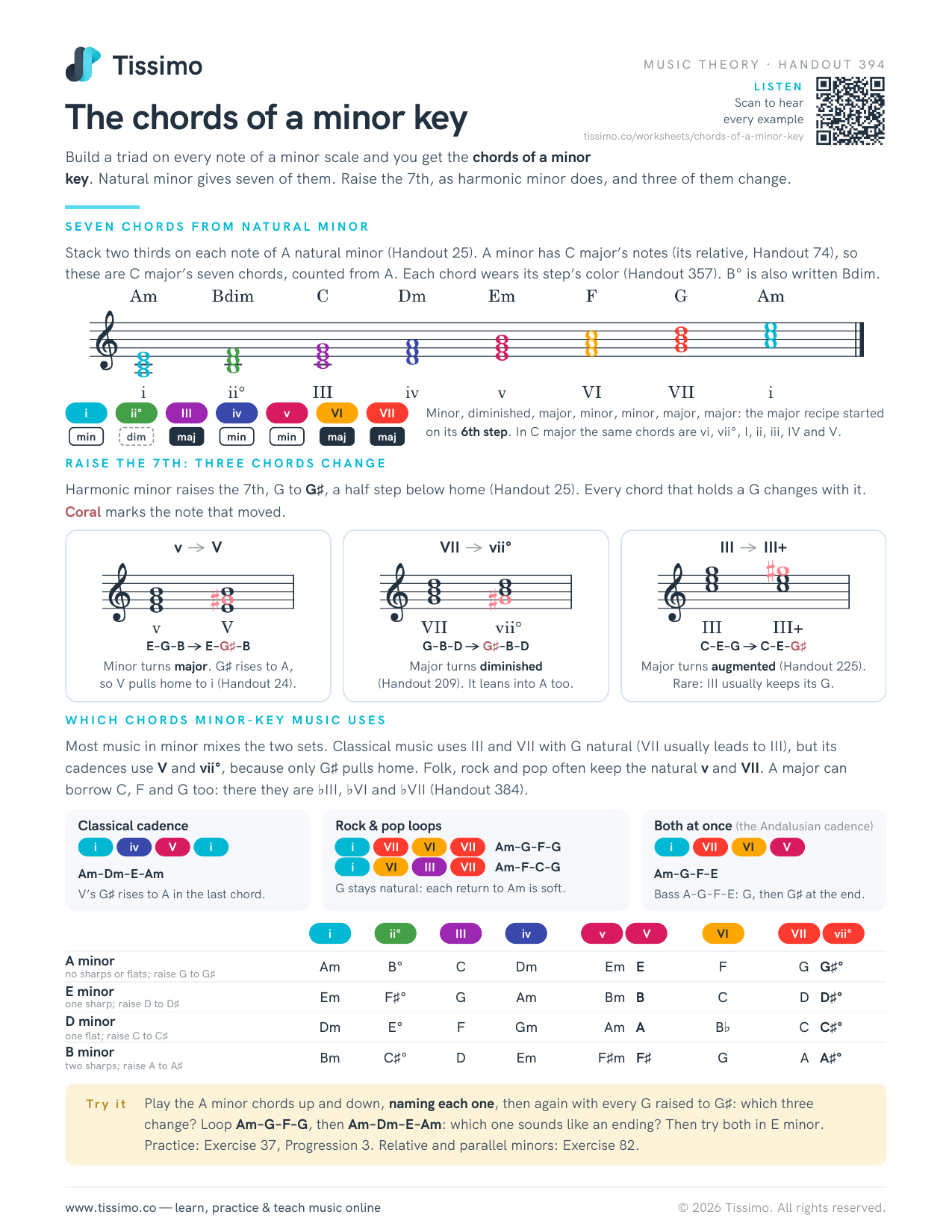 The chords of a minor keyBuild a triad on every note of a minor scale and you get the chords of a minor key. Natural minor gives seven of them. Raise the 7th, as harmonic minor does, and three of them change.
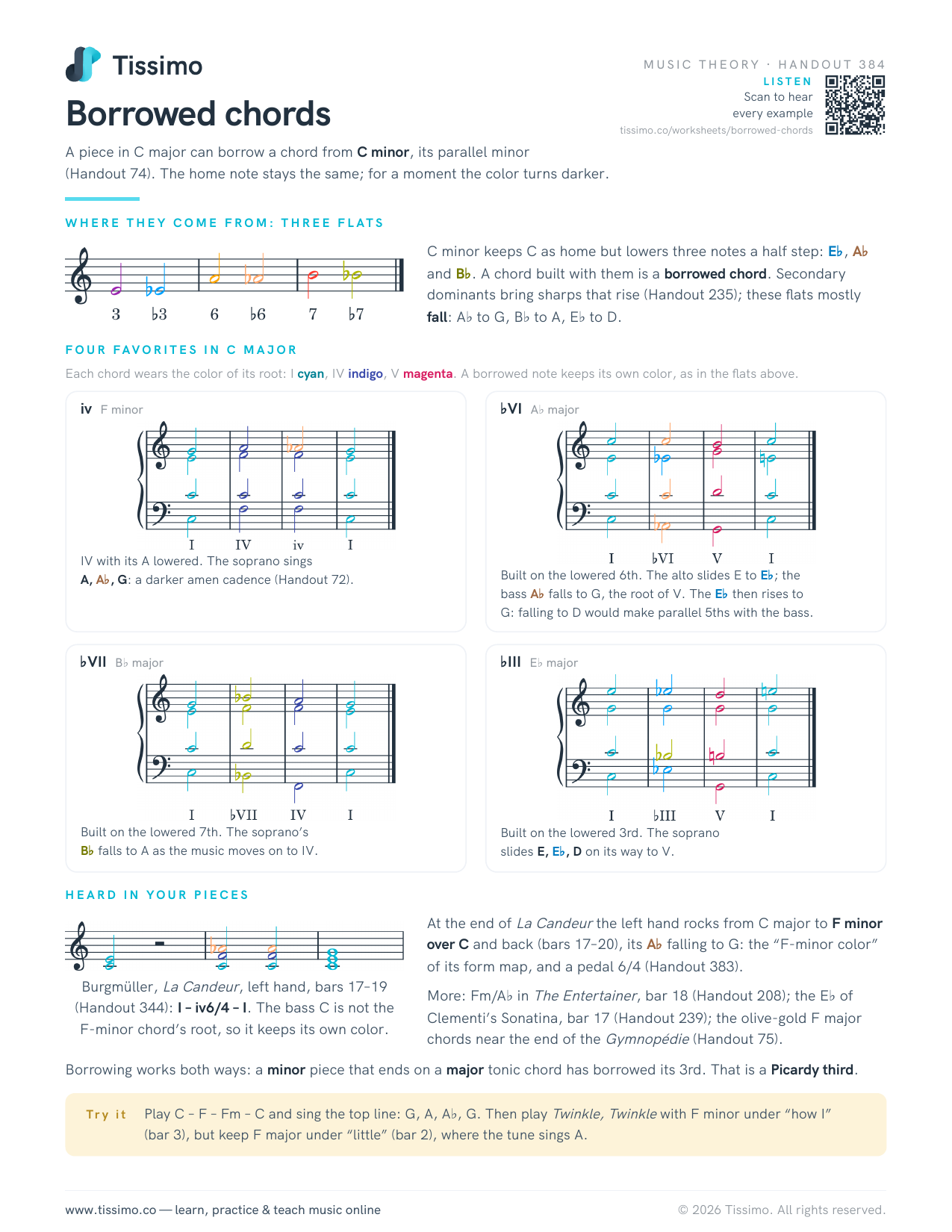 Borrowed chordsA piece in C major can borrow a chord from C minor, its parallel minor (Handout 74). The home note stays the same; for a moment the color turns darker.
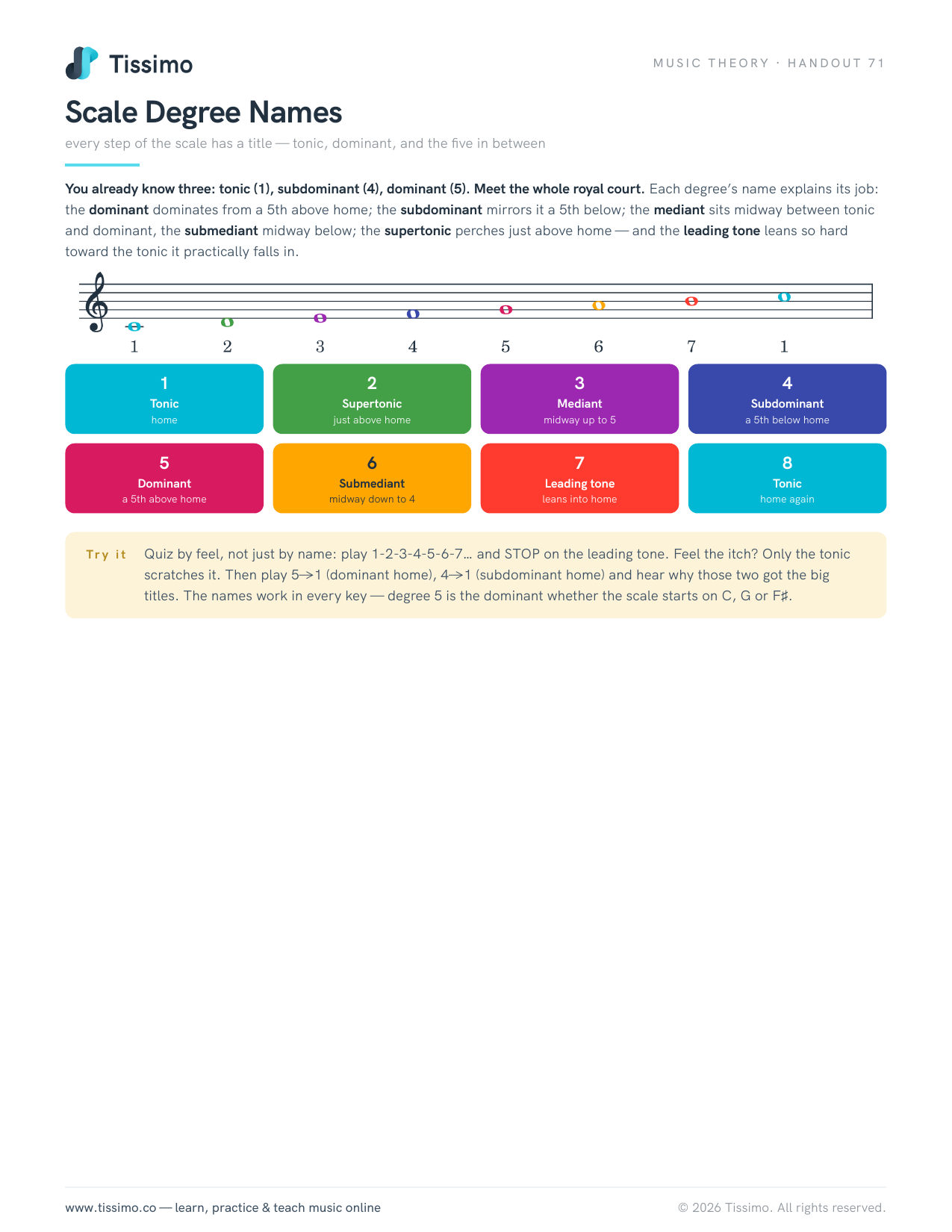 Scale Degree Namesevery step of the scale has a title — tonic, dominant, and the five in between