Scales, Keys & Modes
Major Pentatonic Scale
Pronounced pen-tuh-TON-ik
The major pentatonic scale is a five-note scale made of degrees 1, 2, 3, 5 and 6 of the major scale. In C it is C D E G A. With no half steps, its notes blend easily over many chords.
The major pentatonic scale takes the major scale and leaves out two notes, the 4th and the 7th. What is left is five notes per octave (penta is Greek for five). In C that is C D E G A, and then C again an octave up.
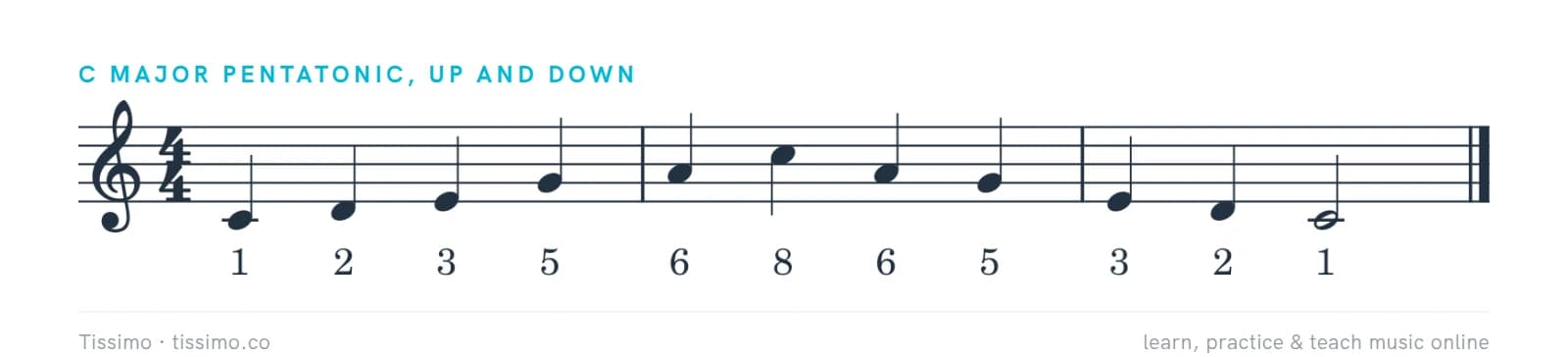
Why those five notes?
The two notes it drops, F and B in C major, are the ones that form the major scale's half steps (E–F and B–C) and its tritone (F–B). Without them, the scale has no half steps at all, only whole steps and two wider gaps of three half steps (a minor third):
W – W – (W+H) – W – (W+H)
That is why the major pentatonic sounds so open, and why it is hard to play a truly wrong note with it: no two of its notes rub against each other a half step apart.
Five black keys
The five black keys of the piano form a major pentatonic scale: G♭ A♭ B♭ D♭ E♭, the G♭ major pentatonic (or F♯ major pentatonic, by its other name). That makes the black keys a favorite first playground for improvising: stay on them, and whatever you play will fit together.
Where you hear it
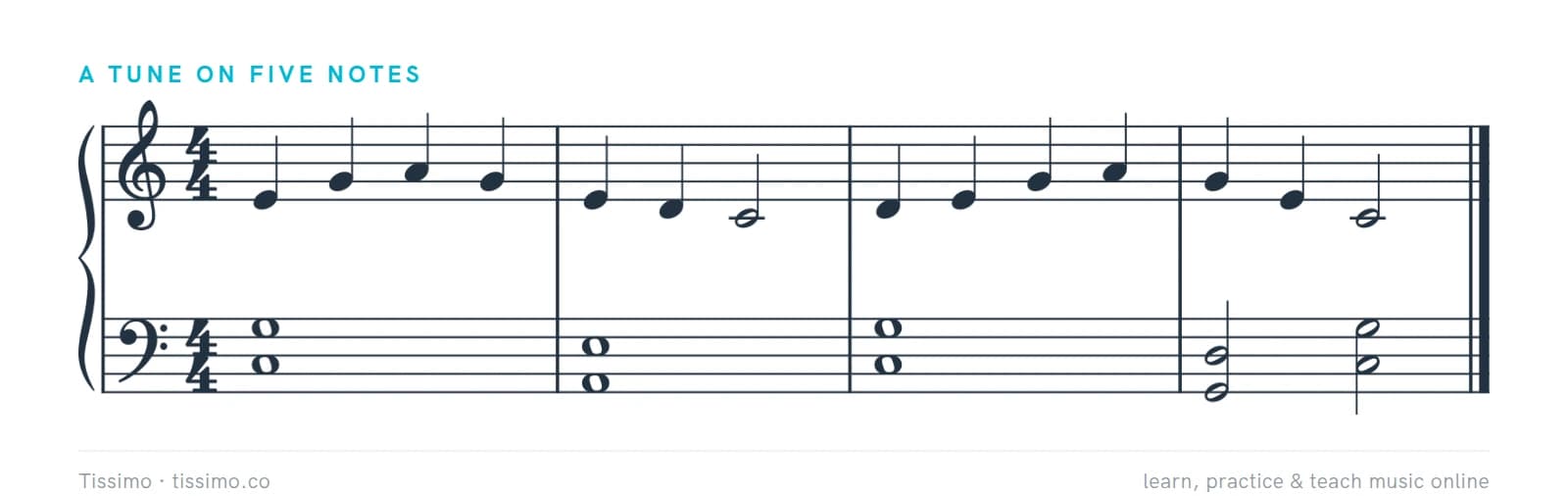
Pentatonic scales turn up in a great deal of traditional music, including folk music from East Asia and from Scotland and Ireland, and in many children's songs and spirituals. In rock, country and pop, guitarists and singers reach for the major pentatonic for bright melodies and solos over major chords. Here is a short original tune that uses only C D E G A:
Major and minor pentatonic share notes
Start the same five notes on A instead of C and you get A C D E G, the minor pentatonic scale. Just as A minor is the relative minor of C major, A minor pentatonic is the relative of C major pentatonic: the same notes with a different home. Which one you are playing depends on the note your melody treats as home and the chords underneath.
How to use it
Over a C major chord, try a melody that uses only C D E G A and lands on C, E or G at the ends of phrases. The Pentatonic & Blues Scales lays out both pentatonics, and Improvising with the Pentatonic gives you a step-by-step recipe.
Common questions
What notes are in the C major pentatonic scale?
C, D, E, G and A: degrees 1, 2, 3, 5 and 6 of the C major scale. F and B, the 4th and 7th, are left out.
Why does the pentatonic scale sound good over so many chords?
It has no half steps, so none of its notes clash sharply with each other, and its notes sit comfortably inside the most common chords of the key. You still choose which notes to land on, and landing on chord tones sounds most settled.
Practice it: free worksheets
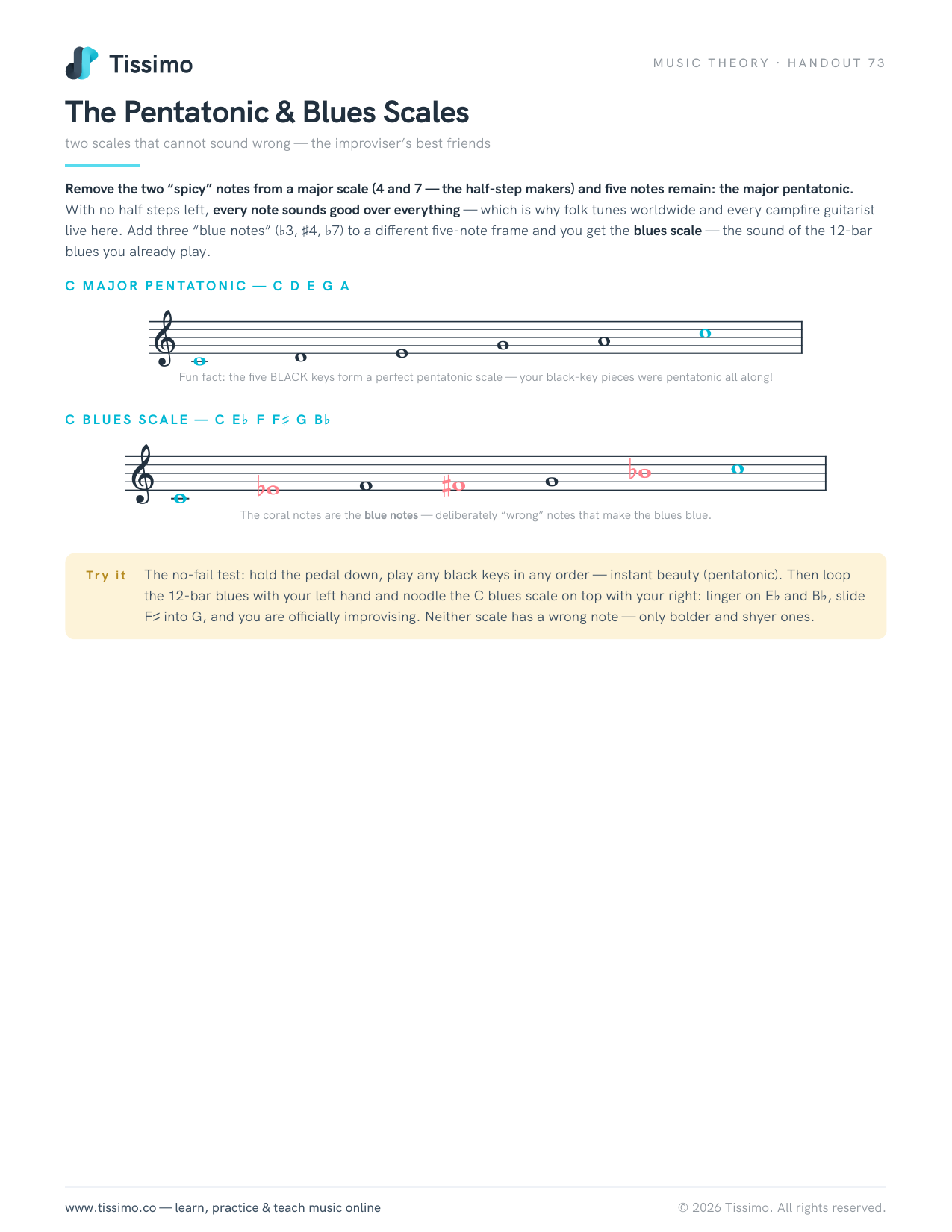 The Pentatonic & Blues Scalestwo scales that cannot sound wrong — the improviser’s best friends
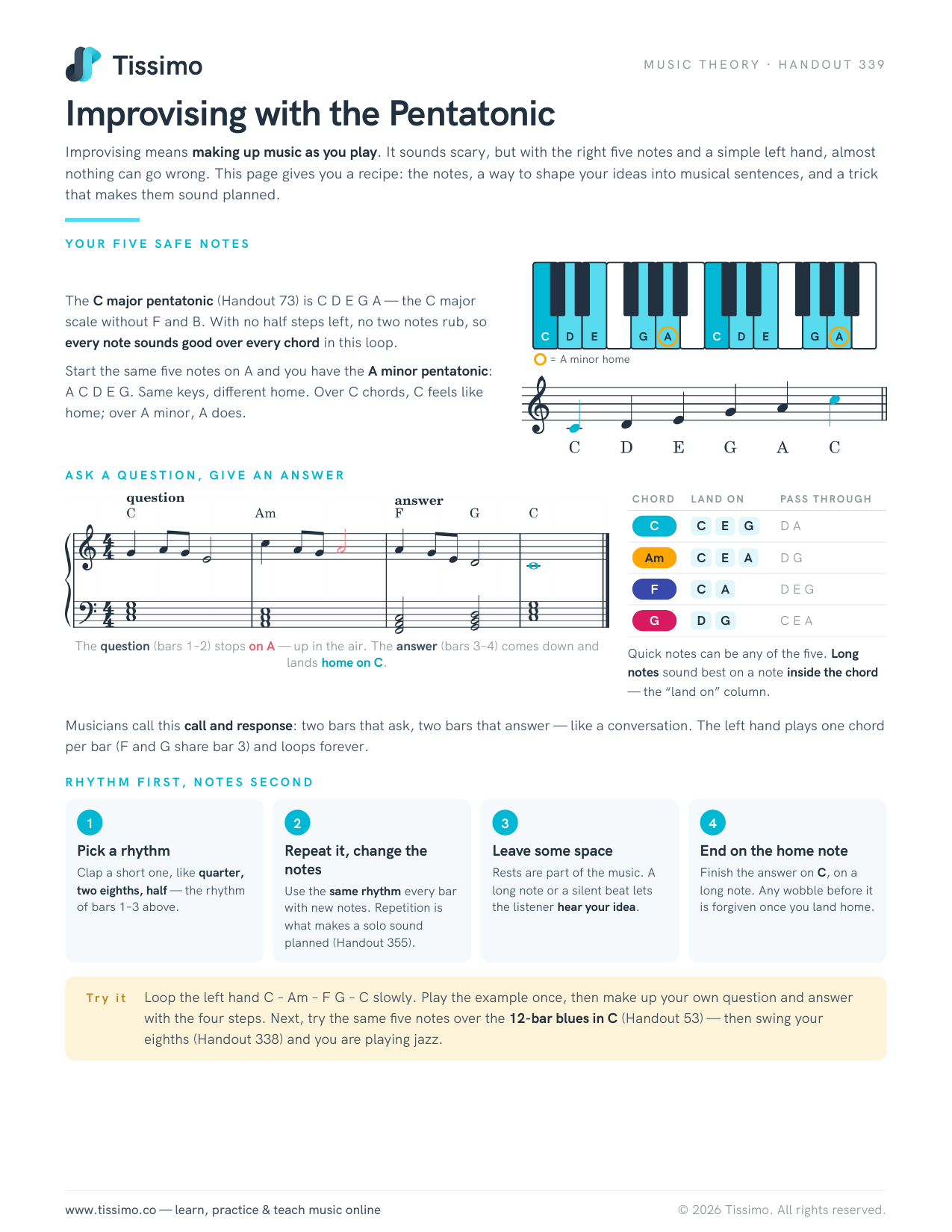 Improvising with the PentatonicImprovising means making up music as you play. It sounds scary, but with the right five notes and a simple left hand, almost nothing can go wrong. This page gives you a recipe: the notes, a way to shape your ideas into musical sentences, and a trick that makes them sound planned.
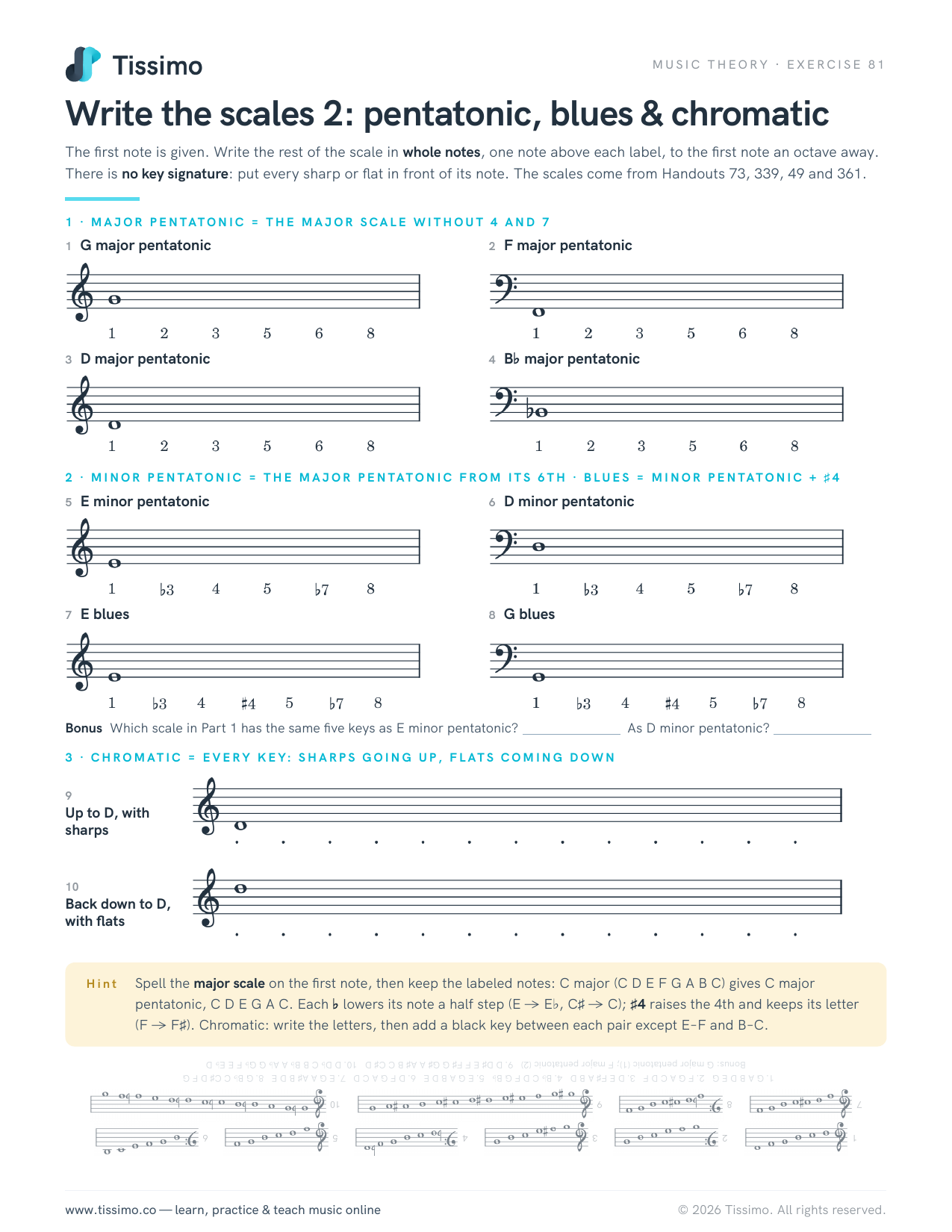 Write the scales 2: pentatonic, blues & chromaticThe first note is given. Write the rest of the scale in whole notes, one note above each label, to the first note an octave away. There is no key signature: put every sharp or flat in front of its note. The scales come from Handouts 73, 339, 49 and 361.