Pitch & Intervals
Minor Third
Written as m3
A minor third (m3) is an interval of three half steps spanning three letter names, such as A–C, D–F or C–E♭. It is the bottom interval of a minor chord and sounds darker than a major third.
A minor third spans three letter names and three half steps: A up to C, D up to F, E up to G, C up to E♭. Abbreviated m3, it measures 300 cents in equal temperament.
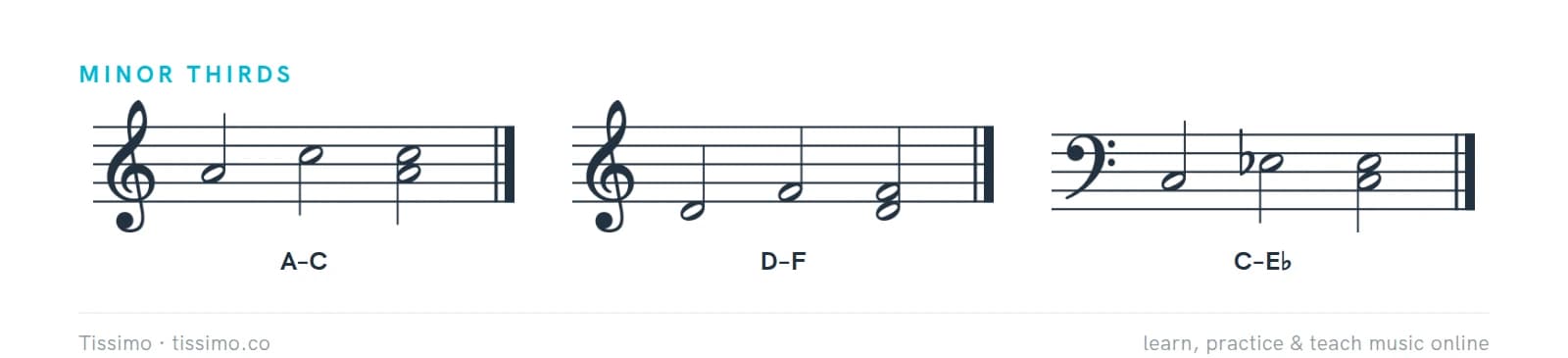
Counting it
Count the letters, including both ends: A–B–C is three, so A–C is a 3rd. Then count half steps from A: A♯ (1), B (2), C (3). Three half steps make it minor; four would make it a major third. On the staff, a 3rd goes from a line to the next line, or from a space to the next space.
Among the white keys, four of the seven 3rds are minor: D–F, E–G, A–C and B–D. The other three, C–E, F–A and G–B, are major. To turn a major third into a minor one, flatten the top note (C–E♭) or sharpen the bottom note (C♯–E).
Minor thirds in chords
A minor triad is a minor third with a major third stacked on top: A–C–E. A major triad reverses the order, major third first (C–E–G). A diminished triad stacks two minor thirds (B–D–F), and a diminished seventh chord stacks three, dividing the octave into four equal parts.
The minor third is also the distance between a major key and its relative minor: C major and A minor share a key signature, and A lies a minor third below C.
How it sounds
A rising minor third opens the folk song "Greensleeves". A falling minor third, from sol down to mi in solfège, is one of the first intervals children sing, and many playground chants are built on it. Harmonically, the minor third is a consonance (an imperfect consonance in classical theory), and it gives minor chords their darker color.
Inversion and look-alikes
Inverted, a minor third becomes a major sixth: A–C becomes C–A, and 3 + 9 = 12. The same two keys spelled with neighboring letters, such as C–D♯, form an augmented second. It sounds identical on a piano, and it appears in the harmonic minor scale between the 6th and 7th notes (F–G♯ in A harmonic minor).
Practice with Major & minor 2nds and 3rds and Name the intervals: major or minor.
Common questions
How many half steps are in a minor third?
Three. From A: A♯ (1), B (2), C (3). A major third has four.
Why does a minor third sound sad?
It doesn't always. In Western music the minor third above the root is what makes a chord minor, and listeners who grew up with that music often hear minor chords as darker or sadder. Tempo, rhythm and context matter just as much: plenty of lively dance music is in a minor key.
Practice it: free worksheets
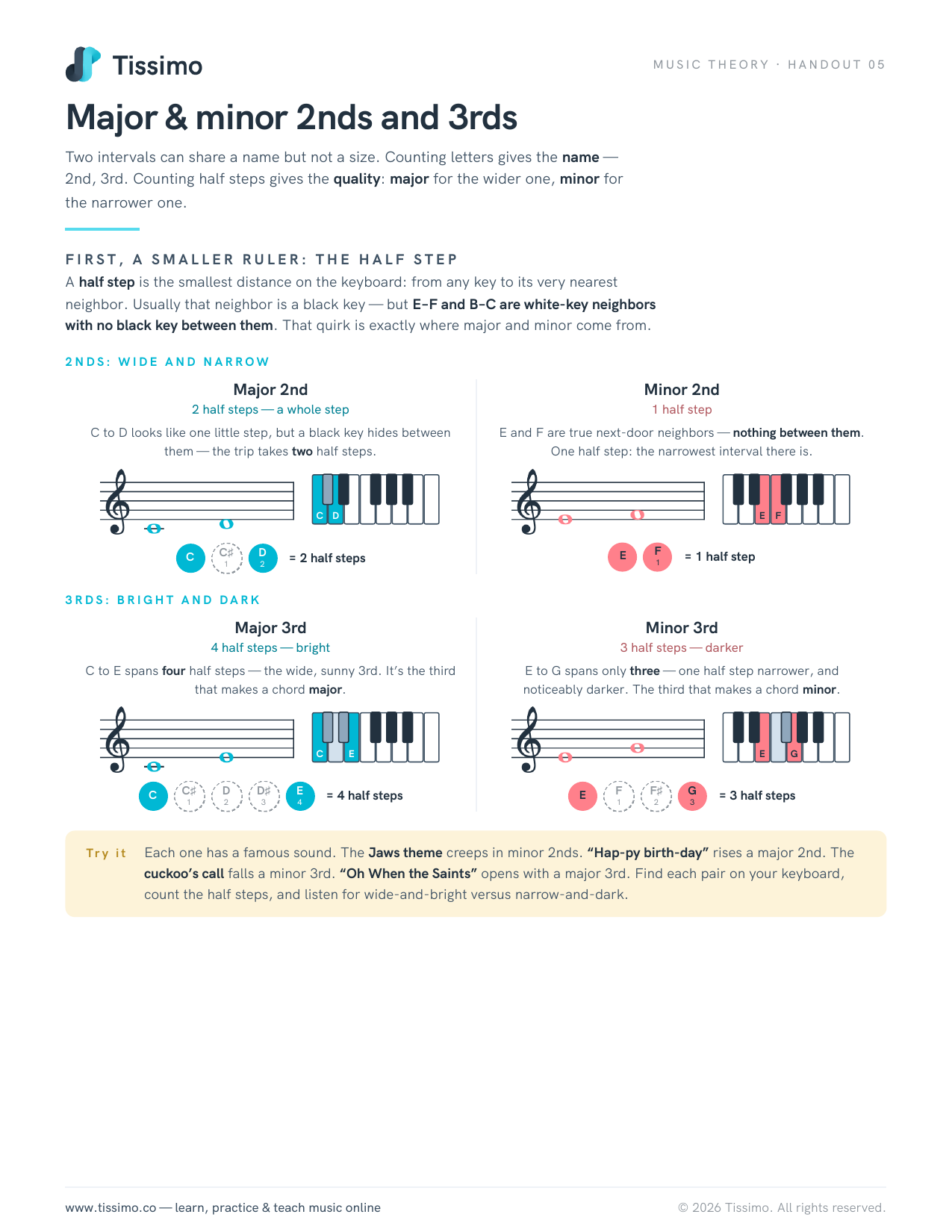 Major & minor 2nds and 3rdsTwo intervals can share a name but not a size. Counting letters gives the name — 2nd, 3rd. Counting half steps gives the quality: major for the wider one, minor for the narrower one.
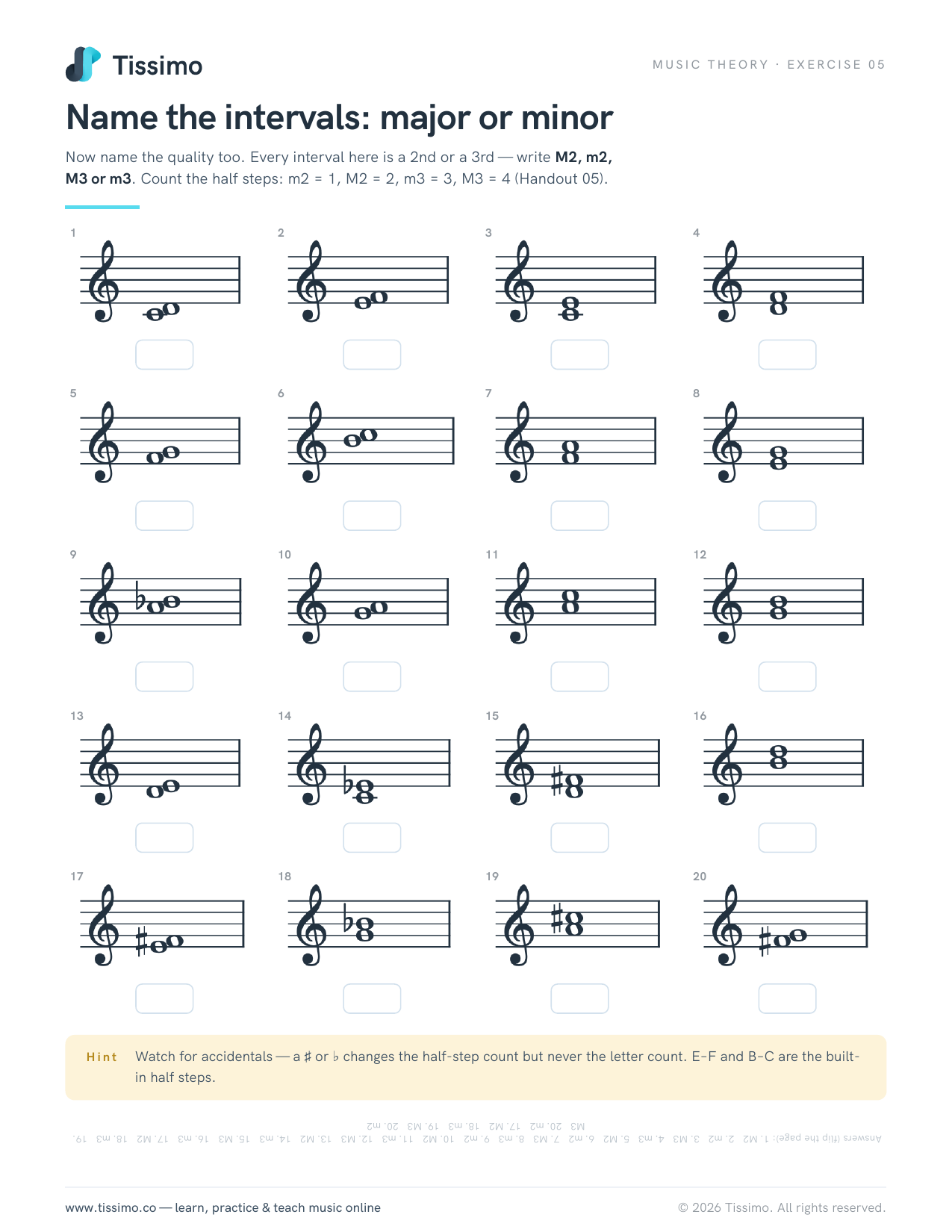 Name the intervals: major or minorNow name the quality too. Every interval here is a 2nd or a 3rd — write M2, m2, M3 or m3. Count the half steps: m2 = 1, M2 = 2, m3 = 3, M3 = 4 (Handout 05). Warm up with Exercise 52.
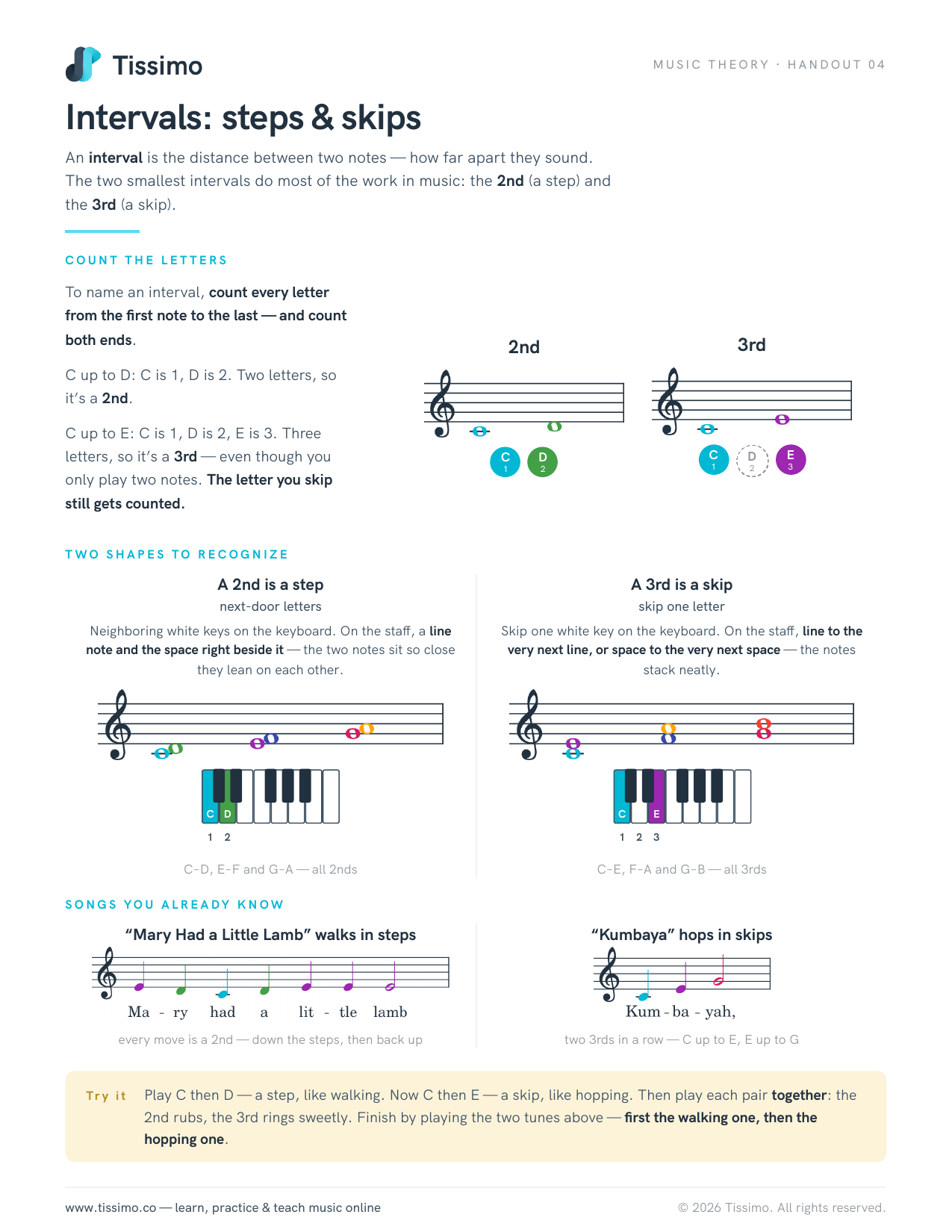 Intervals: steps & skipsAn interval is the distance between two notes — how far apart they sound. Two common melodic movements are the 2nd (a step) and the 3rd (a skip).
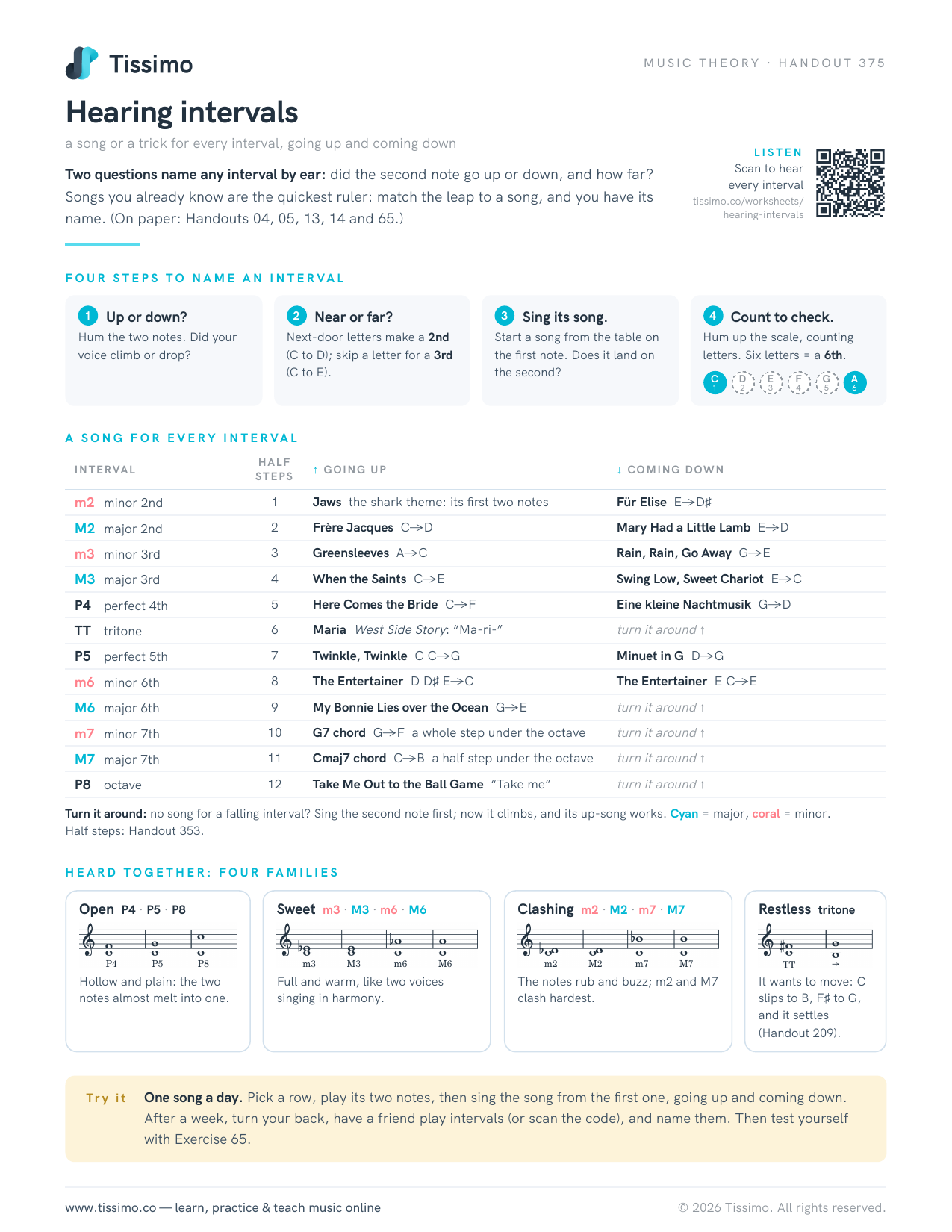 Hearing intervalsa song or a trick for every interval, going up and coming down
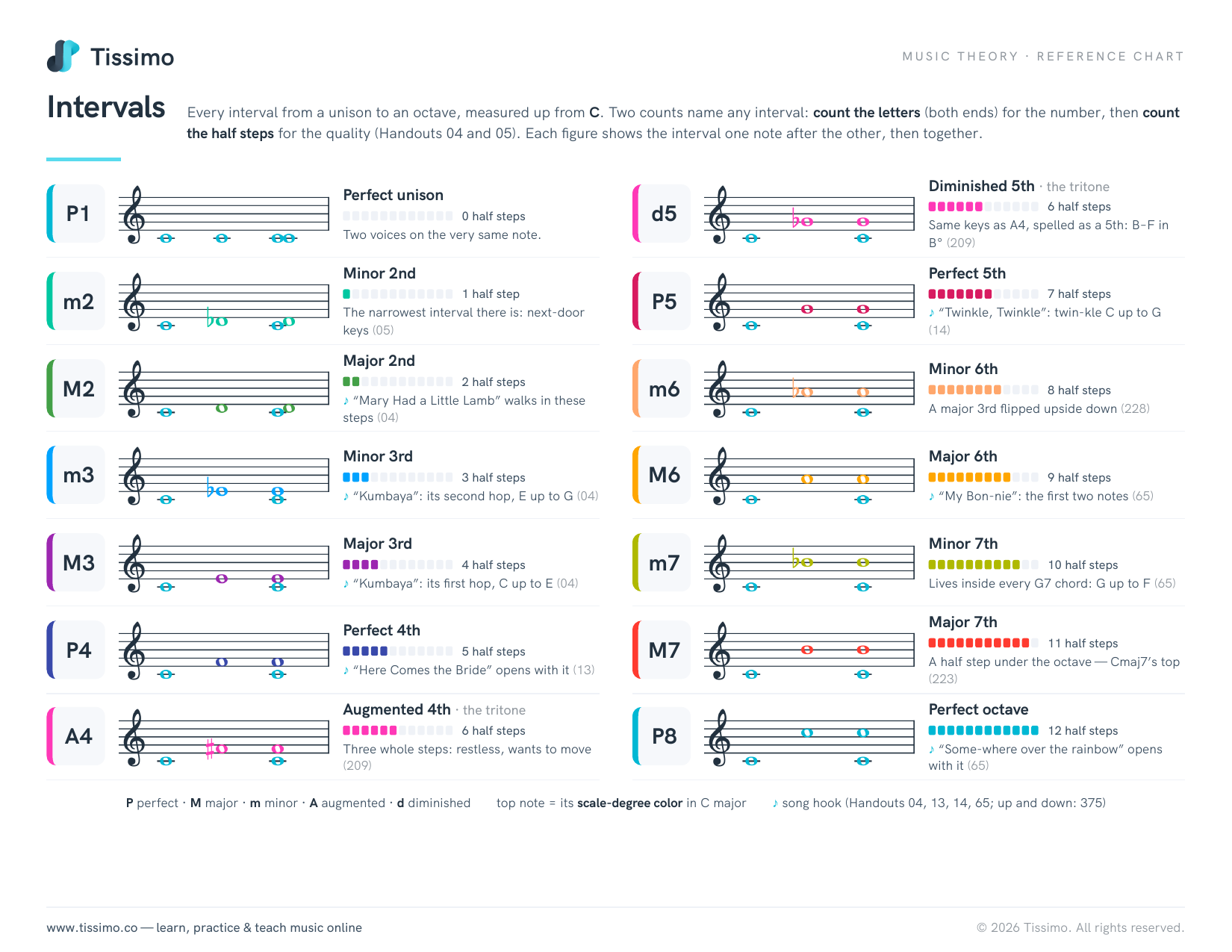 IntervalsEvery interval from a unison to an octave, measured up from C. Two counts name any interval: count the letters (both ends) for the number, then count the half steps for the quality (Handouts 04 and 05). Each figure shows the interval one note after the other, then together.