Chords & Harmony
Diminished Seventh Chord
A diminished seventh chord is four notes each a minor third apart, such as B–D–F–A♭ (B°7). Tense and symmetrical, it is built on the leading tone and usually resolves to a tonic.
A diminished seventh chord is a diminished triad with a diminished seventh added above the root, so each note is a minor third (3 half steps) above the one below it. On B it is B–D–F–A♭, written B°7 or Bdim7. It is often called a "fully diminished" seventh to set it apart from the half-diminished seventh chord. Its sound is tense, dark and dramatic, and it almost always leads somewhere.
How to build one
Stack three minor thirds: B to D, D to F, F to A♭. The seventh, from B up to A♭, is a diminished seventh: 9 half steps, the same keys as a major sixth but spelled as a kind of seventh. Keep each note on its own letter, which sometimes calls for a double flat: C°7 is C–E♭–G♭–B𝄫.
Where you find it
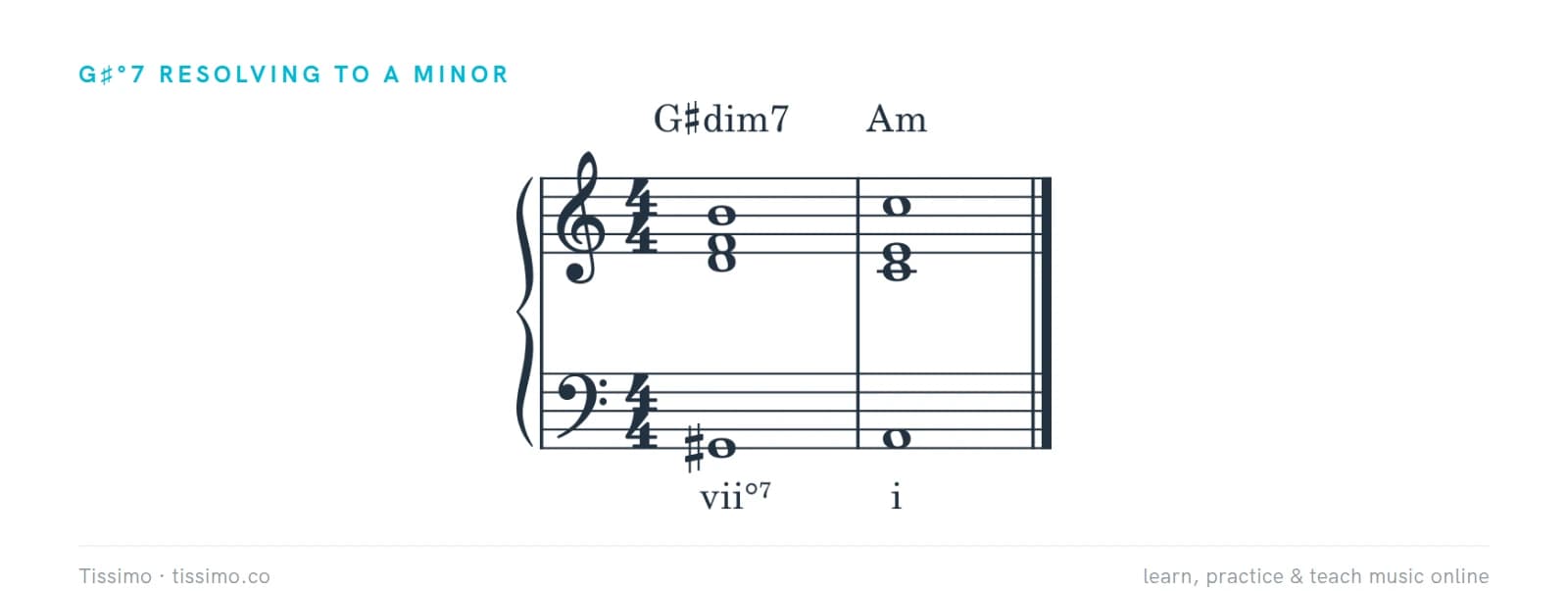
The chord occurs naturally on degree 7 of the harmonic minor scale: G♯–B–D–F in A minor (vii°7). It acts as a dominant. Its root is the leading tone, which rises to the tonic, while the other notes move by step, mostly downward. Composers also borrow it into major keys, so B°7 (with A♭) often leads to C major.
Four notes, equal spacing
Three minor thirds make 9 half steps, and one more minor third brings you back to the root an octave higher. The chord divides the octave into four equal parts, so its inversions sound like more root-position diminished seventh chords, and any of its four notes can be spelled as the root:
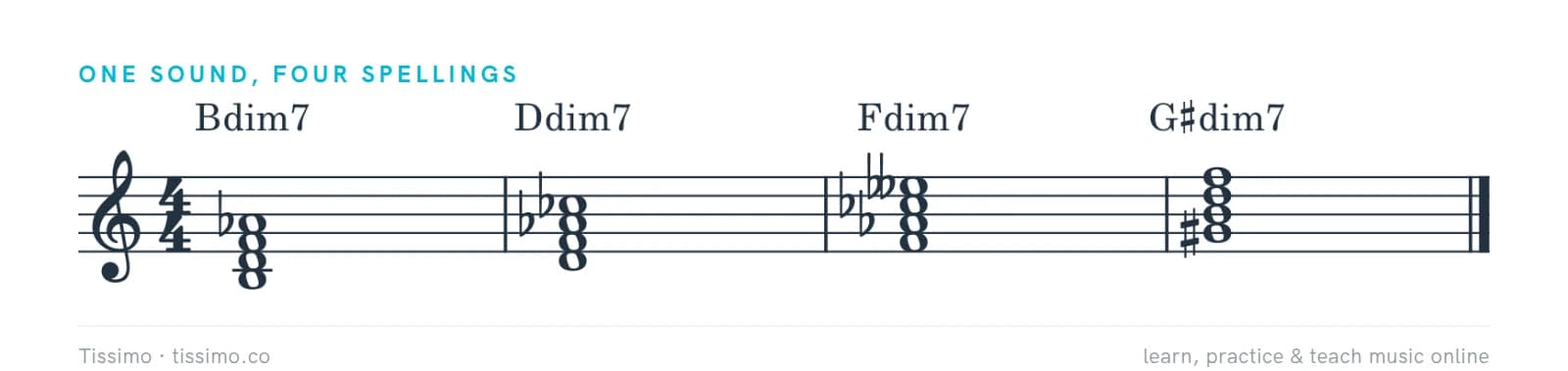
That symmetry has two consequences. In twelve-tone equal temperament, there are only three diminished-seventh pitch-class collections, though voicings and spellings can differ. And each one can lead to four different tonics, depending on which note is heard as the leading tone. Composers, especially in the 19th century, used that ambiguity as a quick pivot for modulating to a distant key.
Practice with The diminished 7th, and compare it by ear with its half-diminished cousin in Hear the Seventh: Half-Diminished or Fully Diminished?
Common questions
How many diminished seventh chords are there?
Three pitch-class collections in twelve-tone equal temperament. C°7, E♭°7, G♭°7 and A°7 share one collection, regardless of octave and enharmonic spelling. The chords on C♯, E, G and B♭ share another; those on D, F, A♭ and B share the third.
What is the difference between dim and dim7?
Dim (or °) is the three-note diminished triad, B–D–F. Dim7 (or °7) adds a diminished seventh on top, B–D–F–A♭.
Practice it: free worksheets
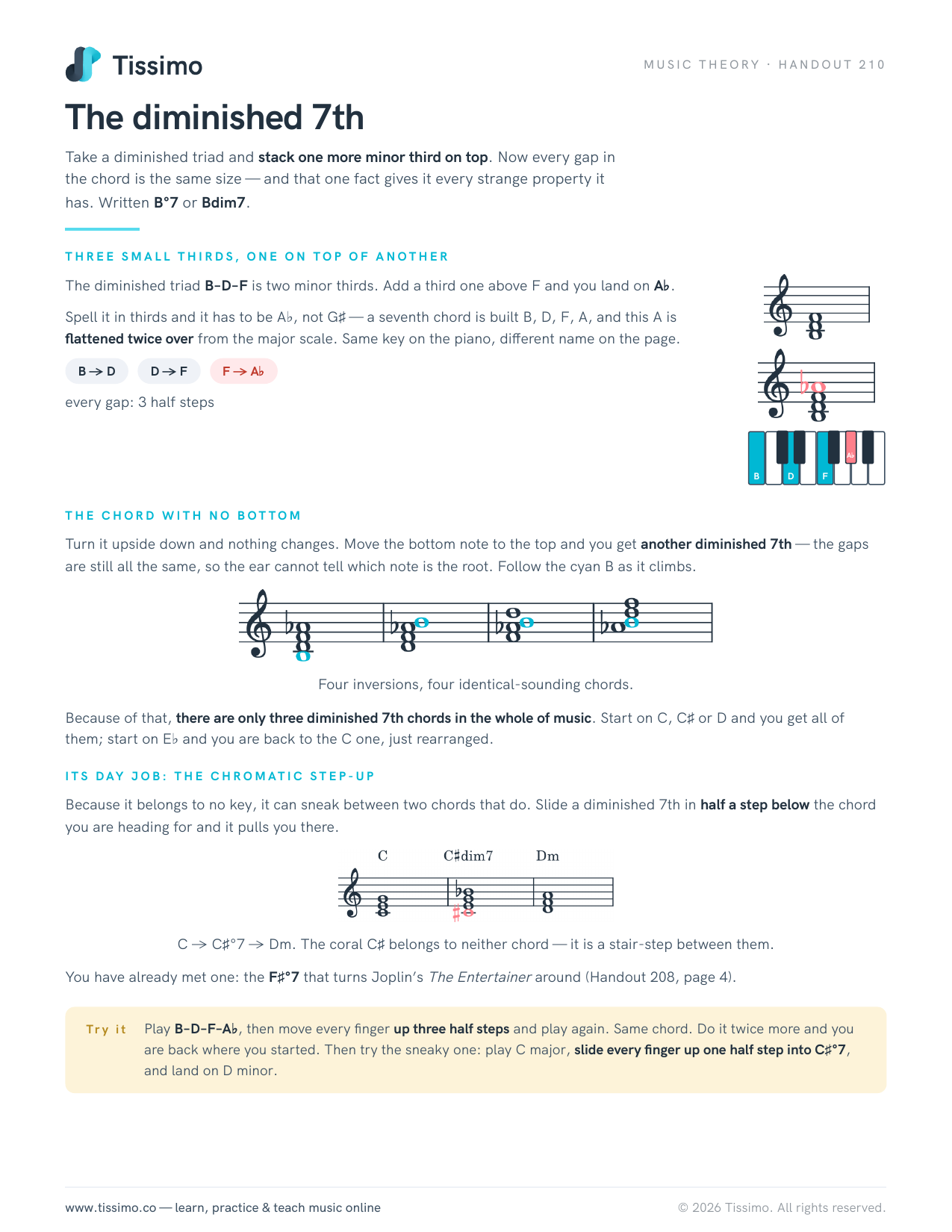 The diminished 7thTake a diminished triad and stack one more minor third on top. Now every gap in the chord is the same size — and that one fact gives it every strange property it has. Written B°7 or Bdim7.
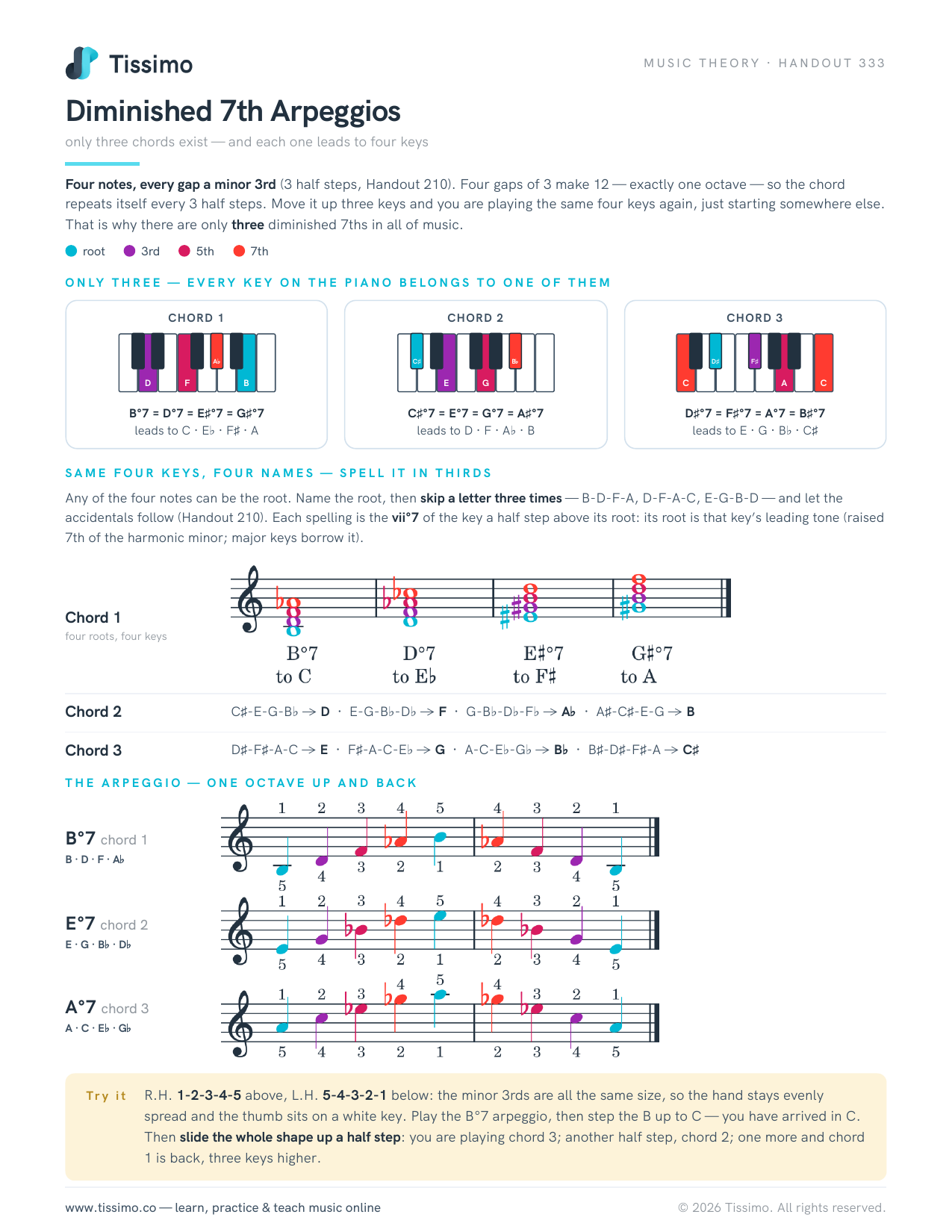 Diminished 7th Arpeggiosonly three chords exist — and each one leads to four keys
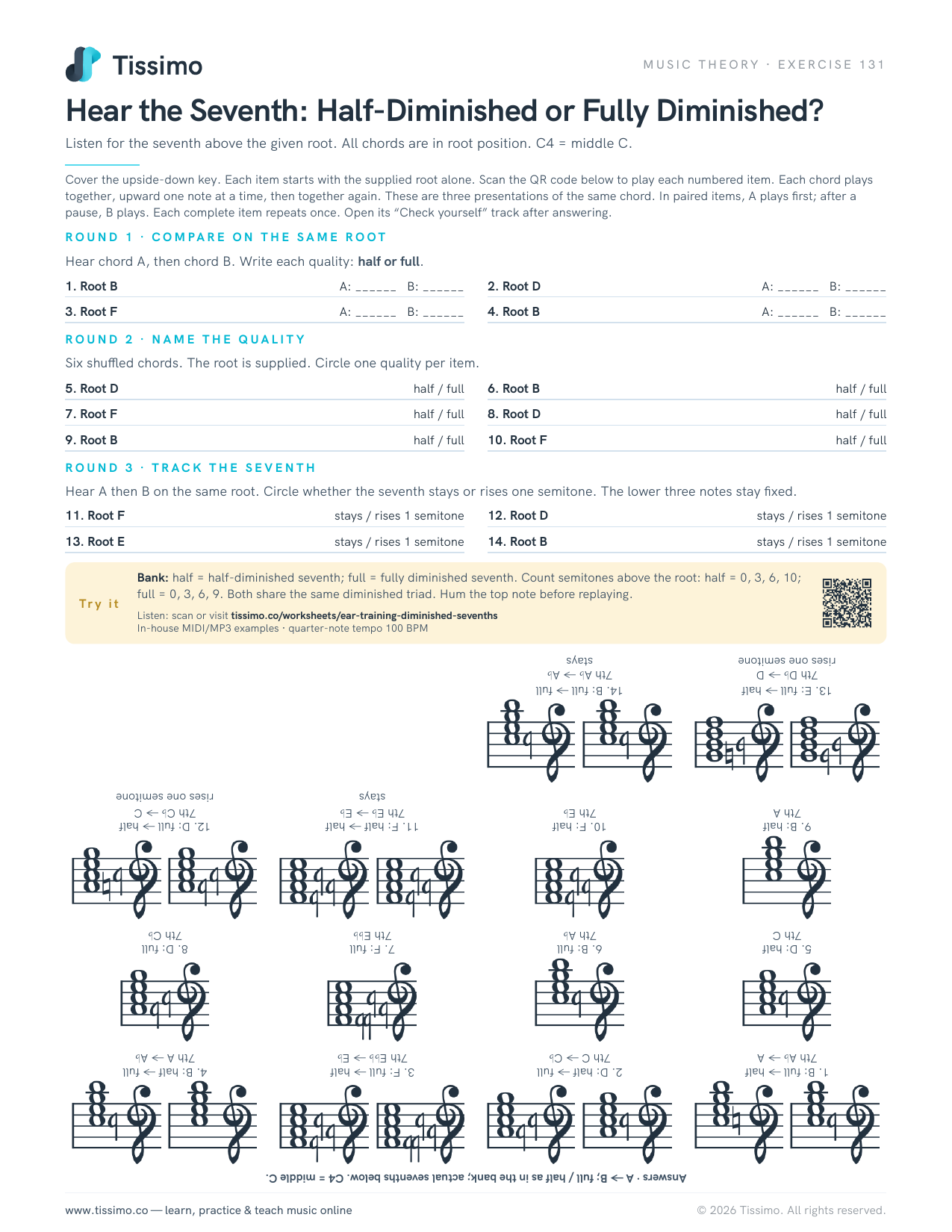 Hear the Seventh: Half-Diminished or Fully Diminished?Listen for the seventh above the given root. All chords are in root position. C4 = middle C.
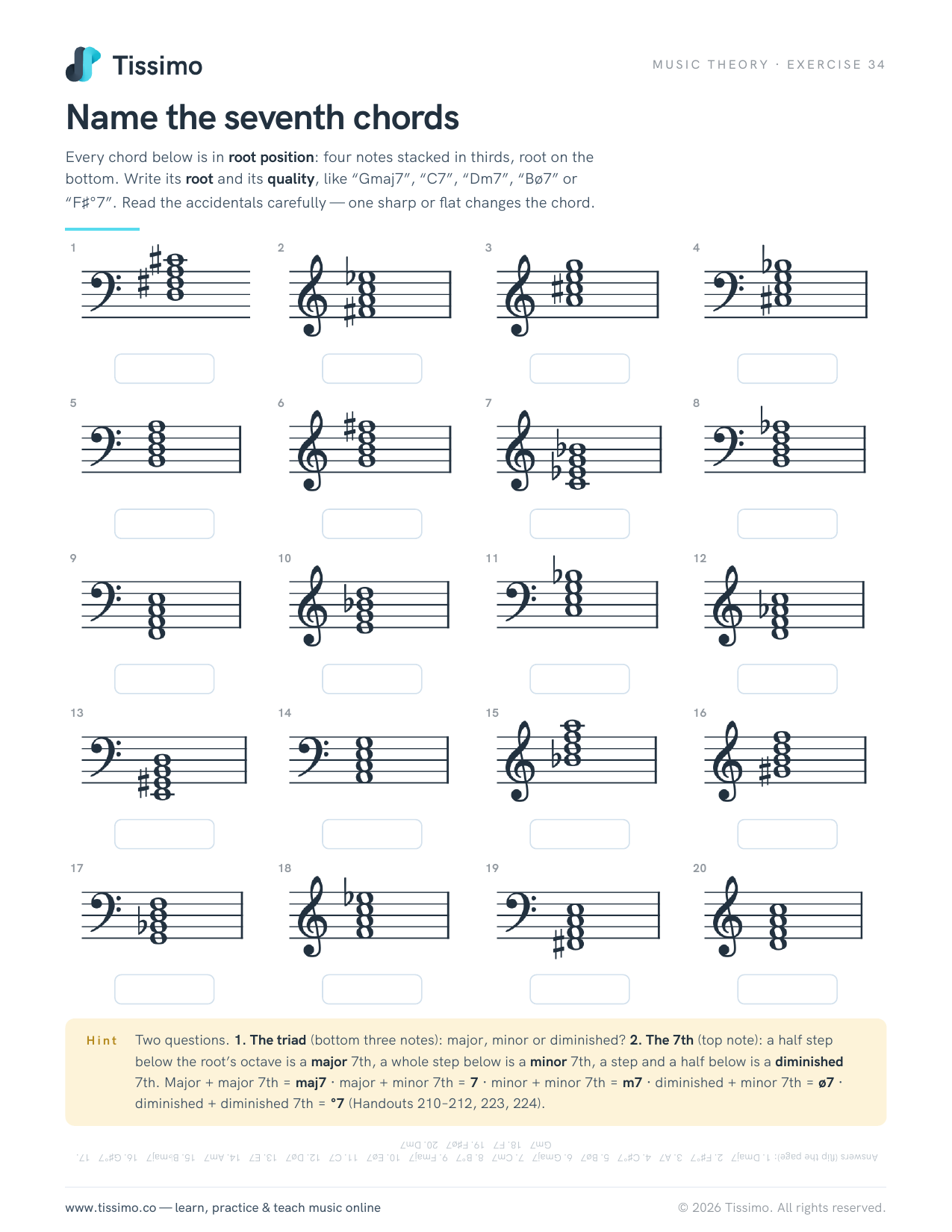 Name the seventh chordsEvery chord below is in root position: four notes stacked in thirds, root on the bottom. Write its root and its quality, like “Gmaj7”, “C7”, “Dm7”, “Bø7” or “F♯°7”. Read the accidentals carefully — one sharp or flat changes the chord.