Chords & Harmony
Minor Triad
A minor triad is a three-note chord built from a root, a minor third and a perfect fifth, such as A–C–E. Its lower third gives it a darker sound than a major triad.
A minor triad is a three-note chord built from a root, the note a minor third above it and the note a perfect fifth above it. On A it is A–C–E; on C it is C–E♭–G. Next to the bright major triad it usually sounds darker or more serious, although a fast, rhythmic piece in a minor key can sound fierce or playful rather than sad.
How to build one
Count half steps: 3 from the root to the third, then 4 from the third to the fifth, 7 in all. It is the major-triad recipe turned around, with the smaller third at the bottom.
The quickest route from a major triad: keep the root and the fifth, and lower the third by one half step. C–E–G becomes C–E♭–G; D–F♯–A becomes D–F–A.

Writing minor chords
Chord symbols add a small m: Am, Cm, F♯m. You will also see "min" and, in jazz charts, a minus sign (A−). Roman numerals use small letters: ii, iii and vi in a major key; i and iv in a minor key.
Minor triads in a key
In a major key, the triads on degrees 2, 3 and 6 are minor. In C major those are D minor (ii), E minor (iii) and A minor (vi), all on white keys. In a minor key the tonic chord itself is minor (i), and so is the chord on degree 4 (iv).

A minor uses the same notes as C major, so it is the relative minor of C. The two tonic chords overlap too: A–C–E and C–E–G share C and E, which is one reason the vi chord can stand in for I.
On the keyboard
A minor, D minor and E minor use only white keys. Place your right-hand thumb on the root, finger 3 on the third and finger 5 on the fifth, then compare each one with the major chord on the same root.
Practice with Chord quality review and The chords of a minor key.
Common questions
What is the difference between a major and a minor triad?
Only the third. A major triad has a major third above the root (4 half steps), a minor triad a minor third (3 half steps). The root and the perfect fifth are the same in both.
How do you write a minor chord symbol?
With a lowercase m after the root: Am, Em, C♯m. Some charts use min or a minus sign instead (Amin, A−).
Practice it: free worksheets
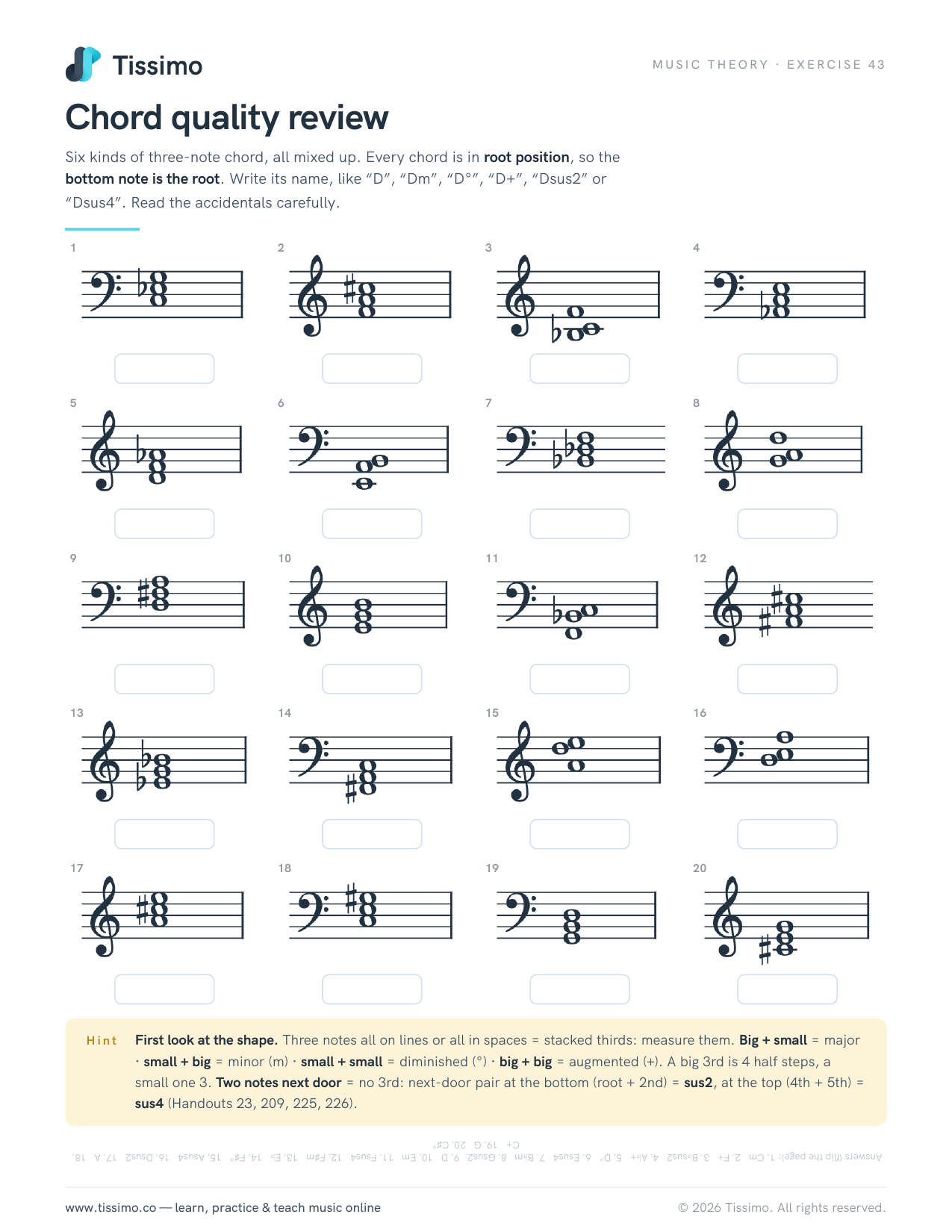 Chord quality reviewSix kinds of three-note chord, all mixed up. Every chord is in root position, so the bottom note is the root. Write its name, like “D”, “Dm”, “D°”, “D+”, “Dsus2” or “Dsus4”. Read the accidentals carefully.
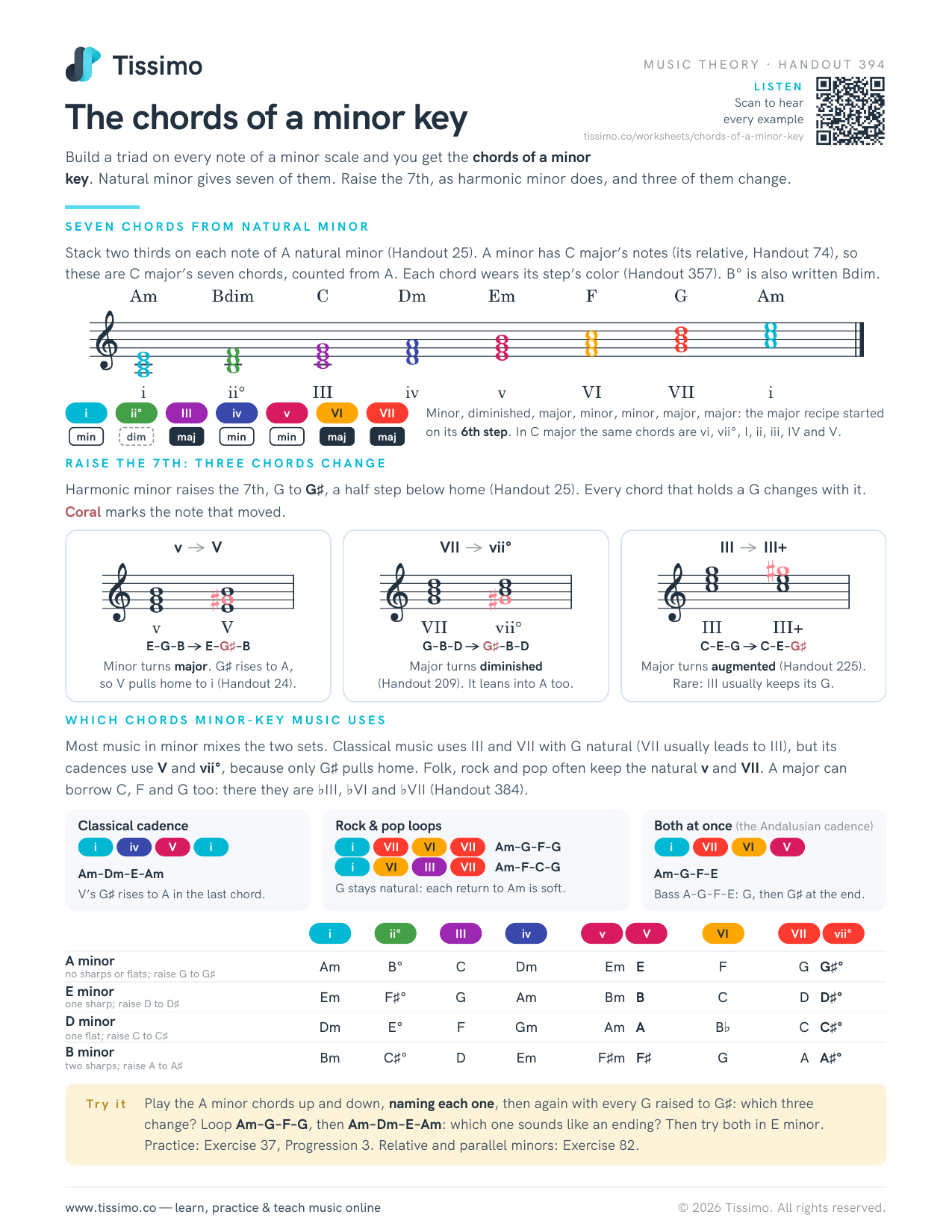 The chords of a minor keyBuild a triad on every note of a minor scale and you get the chords of a minor key. Natural minor gives seven of them. Raise the 7th, as harmonic minor does, and three of them change.
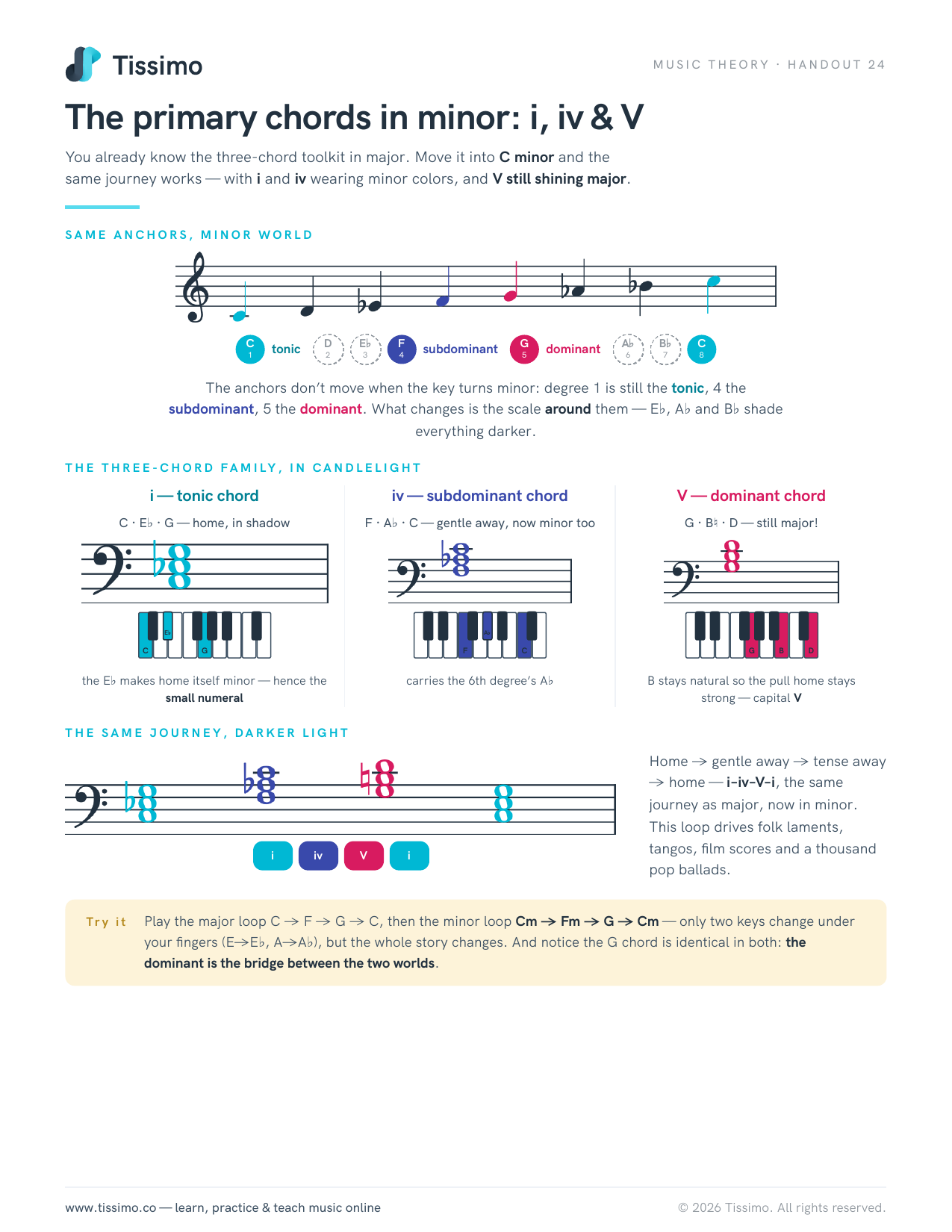 The primary chords in minor: i, iv & VYou already know the three-chord toolkit in major. Move it into C minor and the same journey works — with i and iv wearing minor colors, and V still shining major.
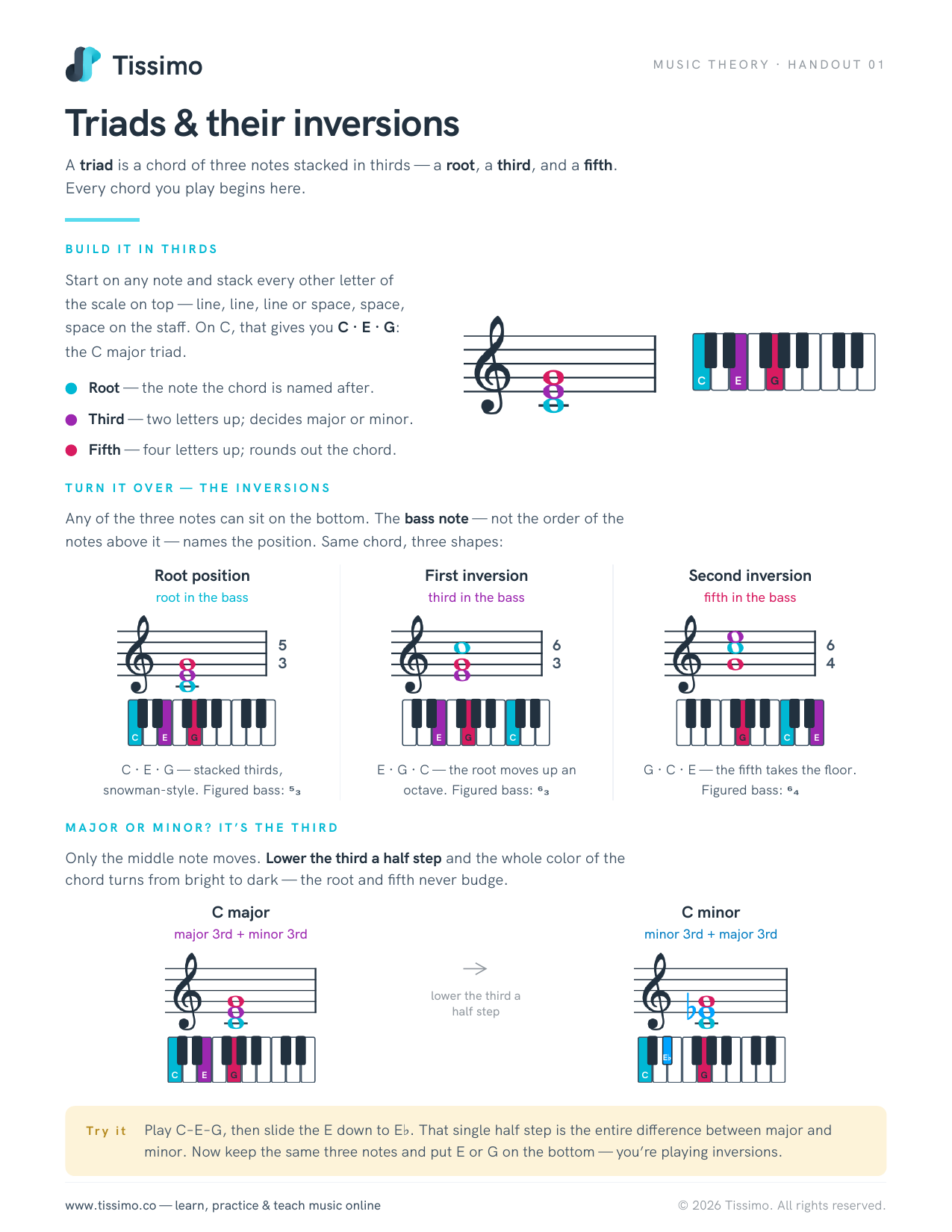 Triads & their inversionsA triad is a chord of three notes stacked in thirds — a root, a third, and a fifth. Every chord you play begins here.
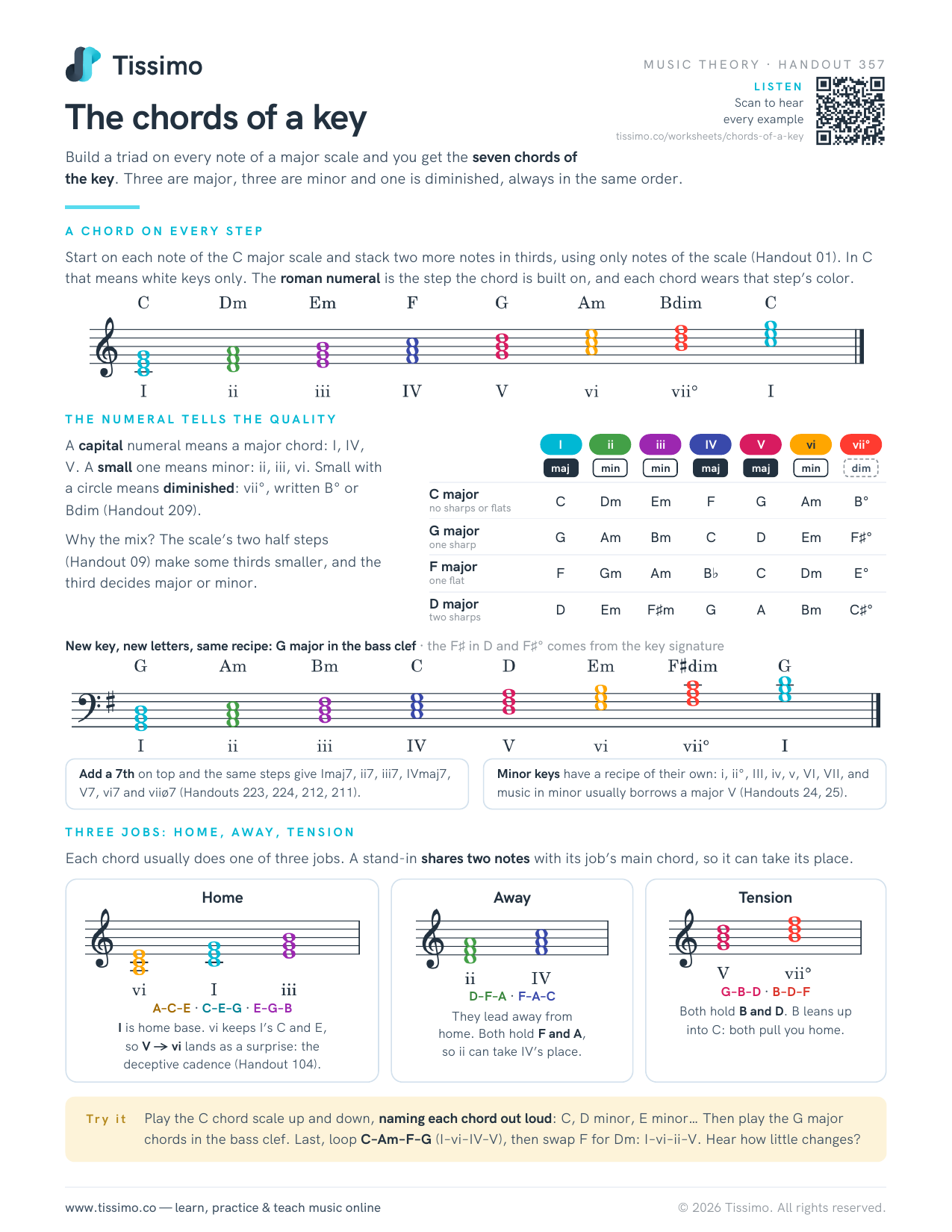 The chords of a keyBuild a triad on every note of a major scale and you get the seven chords of the key. Three are major, three are minor and one is diminished, always in the same order.