Form & Structure
Minuet
Pronounced min-yoo-ET
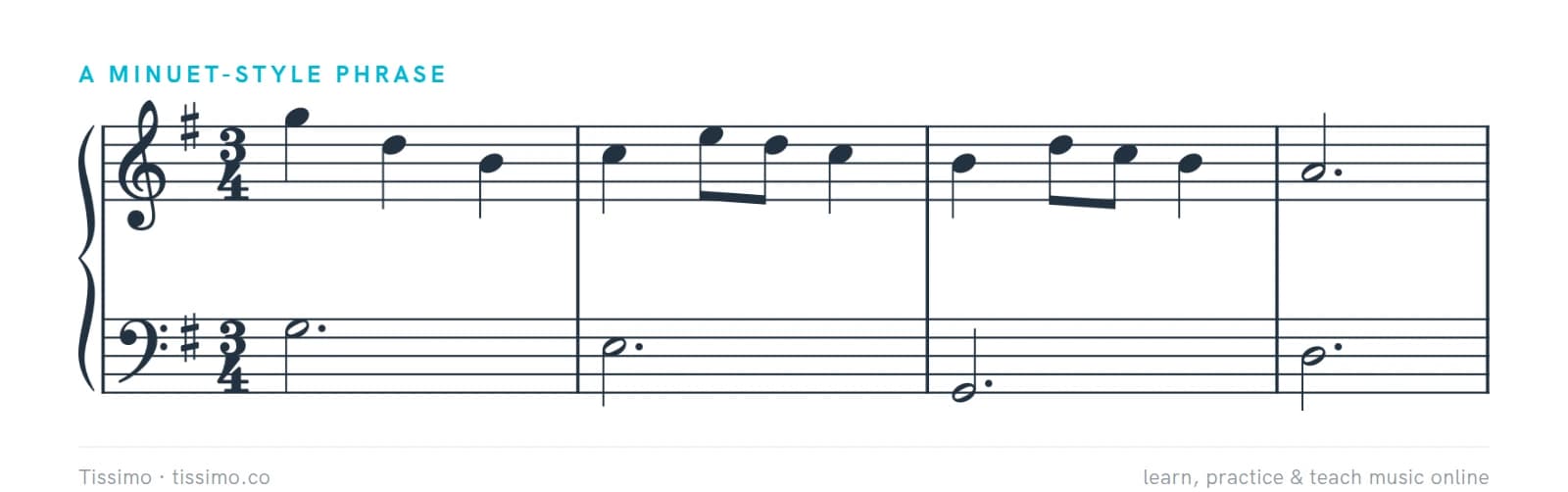
A minuet is a graceful dance in 3/4 time at a moderate tempo, popular at the French court in the 17th century, and later a standard movement, with a contrasting trio, in Classical symphonies and sonatas.
The minuet is an elegant social dance in triple meter, usually written in 3/4 at a moderate tempo. It was a favorite at the French court of Louis XIV in the later 1600s and spread across Europe as both a ballroom dance and a type of instrumental piece. You will see it spelled menuet (French) or menuetto (the Italianized spelling Haydn and Mozart often used; standard Italian is minuetto).
What a minuet sounds like
- 3/4 time, with a clear but not heavy first beat and a moderate, poised tempo.
- Regular phrases, usually four and eight bars long, that match the steps of the dance.
- Binary form: two sections, each repeated, the first often ending on the dominant or in the dominant key.
- Steady quarter notes with occasional eighth-note decorations, and cadences that fall clearly at the ends of phrases.
Minuet and trio
Baroque composers often paired two minuets, playing the first, then the second, then the first again. The second minuet came to be called the trio, probably because it was often scored for just three instruments. This produced minuet and trio form:
- Minuet (A, in binary form, with repeats)
- Trio (B, in binary form, with repeats, often lighter or quieter and sometimes in a related key)
- Minuet again (A, usually played without repeats), marked Menuetto da capo
The whole is a ternary ABA built from smaller binary forms, sometimes called compound ternary form.
In suites, sonatas and symphonies
In the Baroque suite, the minuet is one of the optional dances. In the Classical era it became the standard third movement (sometimes the second) of the symphony, string quartet and many sonatas. Beethoven gradually replaced it with the faster scherzo.
Minuets for students
Some of the best-known teaching pieces are minuets: the Minuet in G major and Minuet in G minor from the 1725 notebook for Anna Magdalena Bach, now credited to Christian Petzold rather than to Bach. See Inside the Minuet in G and Inside the Minuet in G minor.
Common questions
What time signature is a minuet in?
Almost always 3/4, three quarter-note beats per bar, at a moderate tempo. A few are written in 3/8.
What is the trio in a minuet and trio?
A second, contrasting minuet played between two performances of the first. The name probably comes from the old habit of scoring it for three instruments.
Practice it: free worksheets
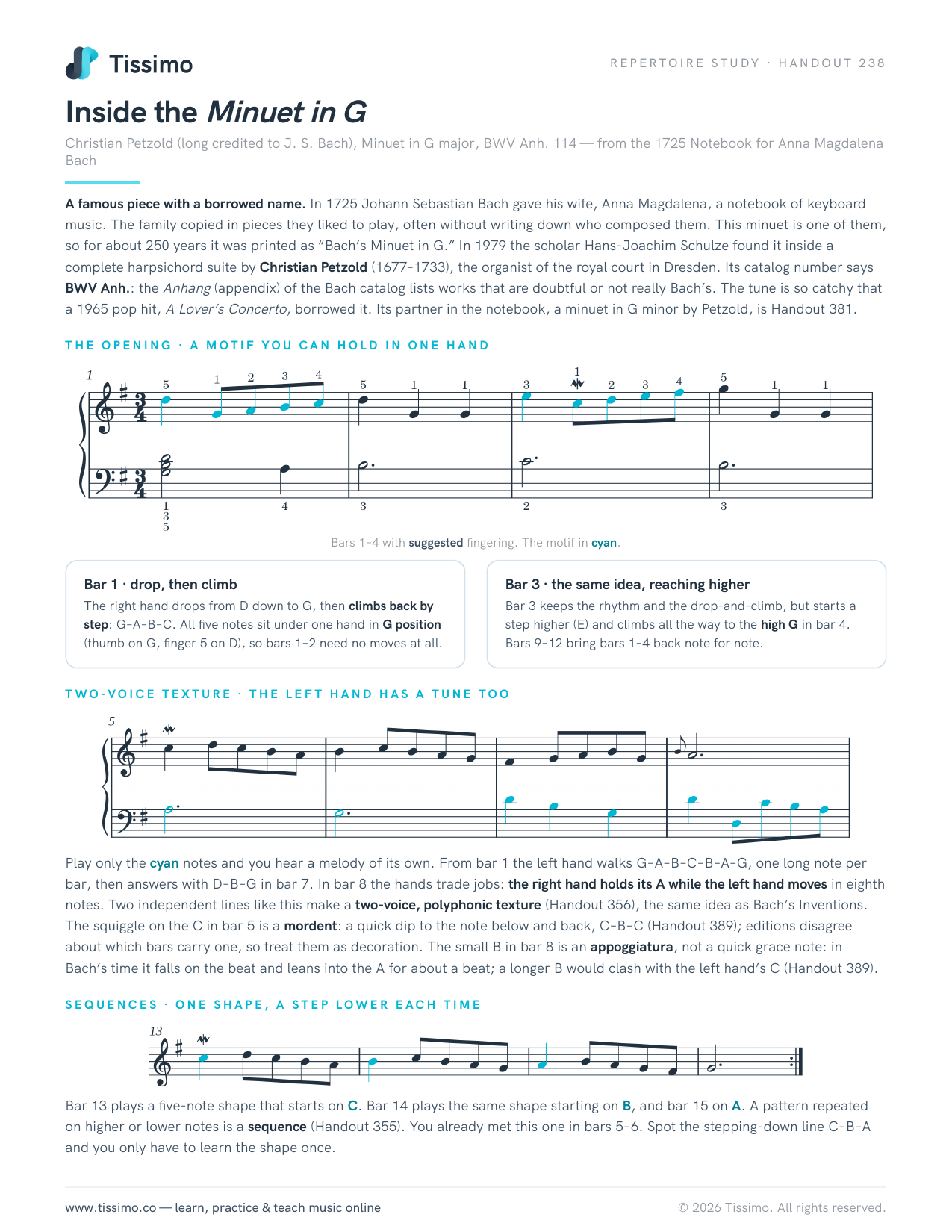 Inside the Minuet in GChristian Petzold (long credited to J. S. Bach), Minuet in G major, BWV Anh. 114 — from the 1725 Notebook for Anna Magdalena Bach
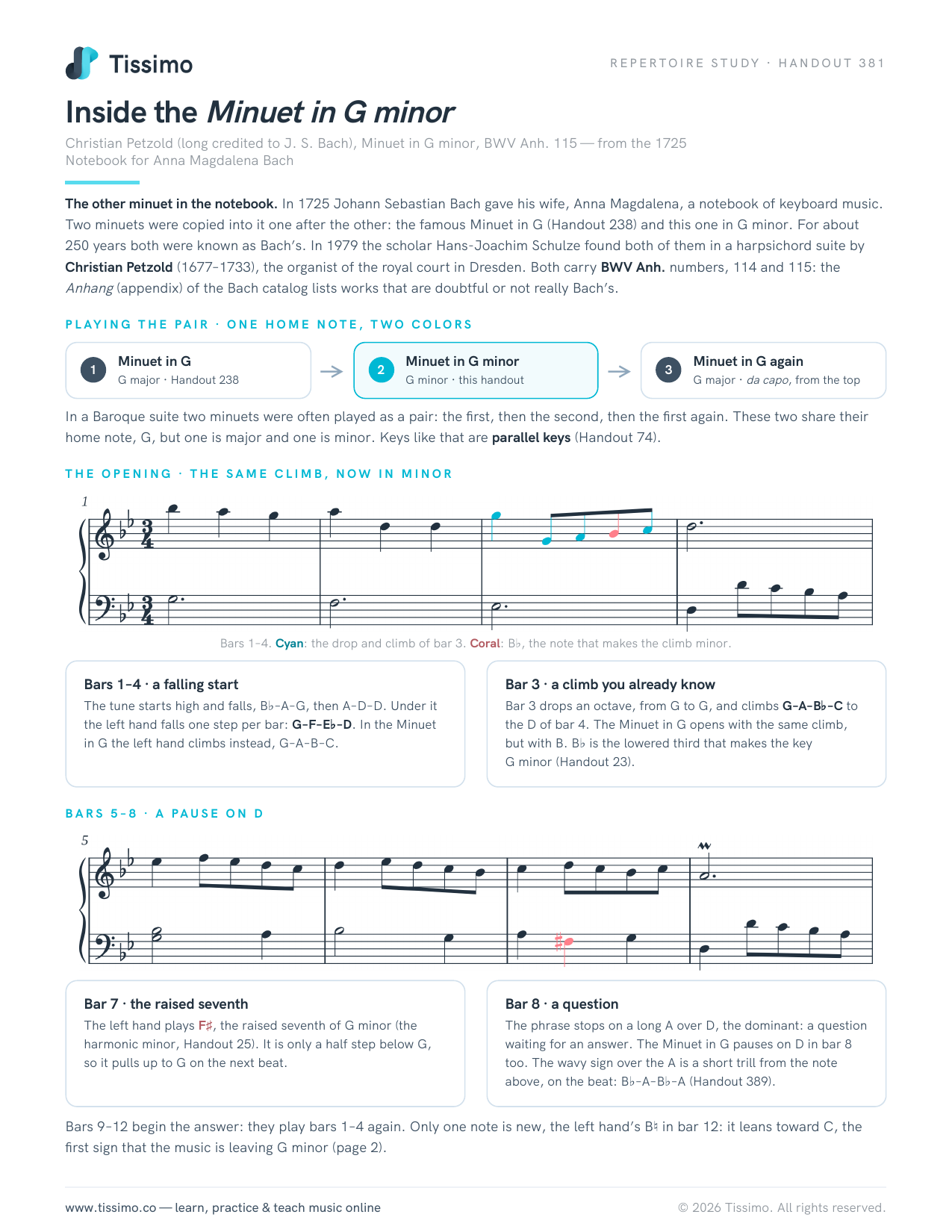 Inside the Minuet in G minorChristian Petzold (long credited to J. S. Bach), Minuet in G minor, BWV Anh. 115 — from the 1725 Notebook for Anna Magdalena Bach
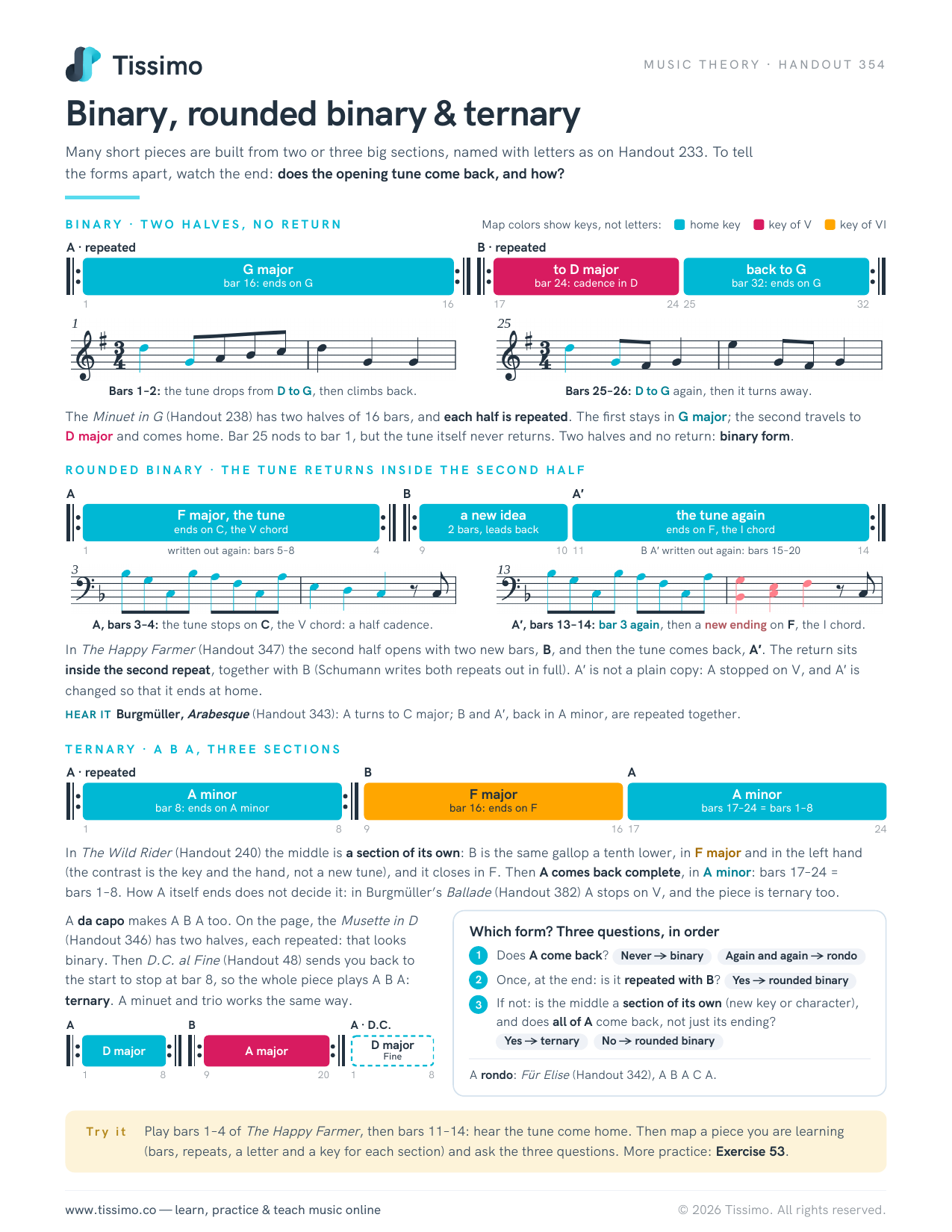 Binary, rounded binary & ternaryMany short pieces are built from two or three big sections, named with letters as on Handout 233. To tell the forms apart, watch the end: does the opening tune come back, and how?
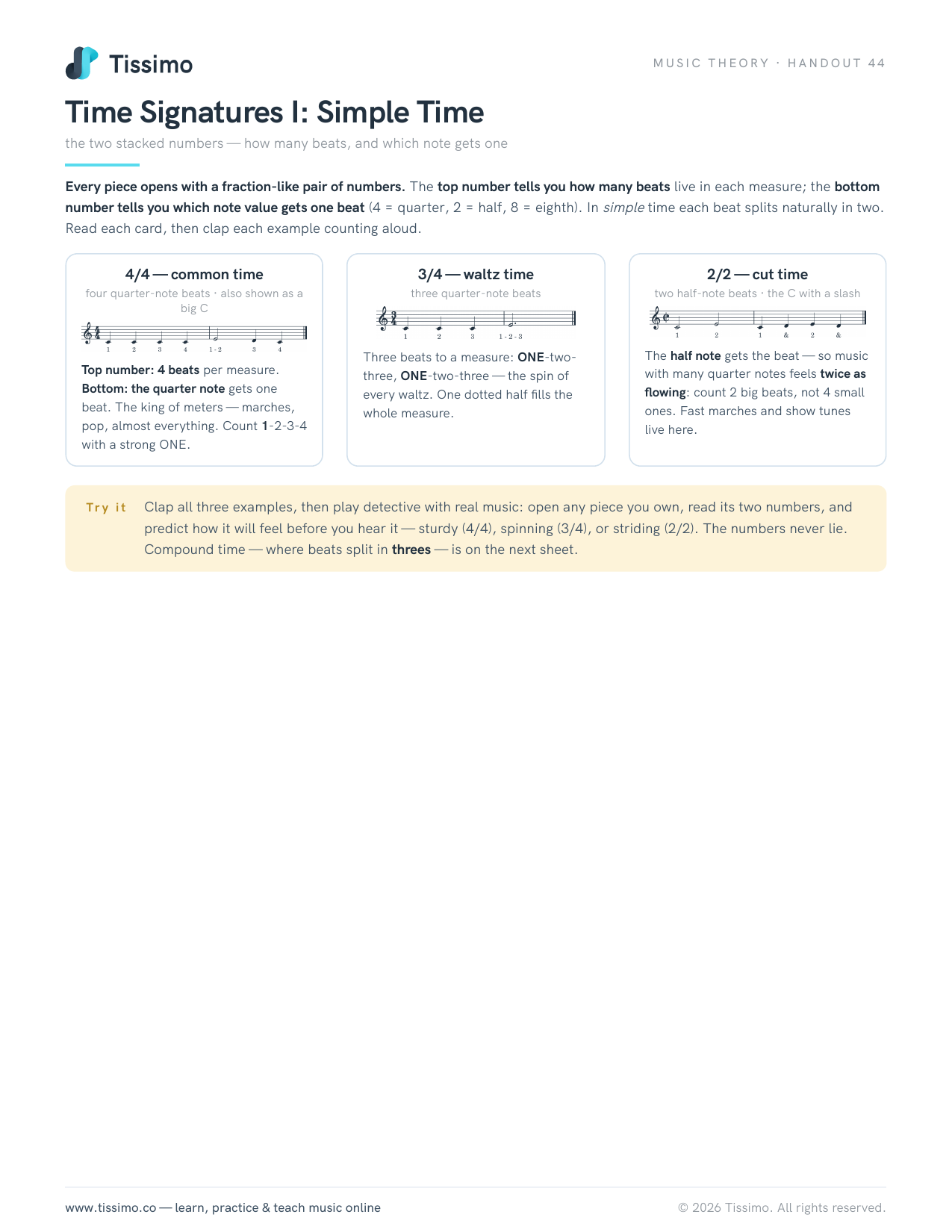 Time Signatures I: Simple Timethe two stacked numbers — how many beats, and which note gets one