Form & Structure
Form
Form is the overall plan of a piece of music: how its sections are arranged, which ones repeat, which ones contrast and which ones come back.
Form is the map of a whole piece. Melody, harmony and rhythm tell you what happens from moment to moment; form tells you how those moments are grouped into larger sections, and in what order the sections come. When you know the form of a piece, a page of notes turns into a handful of parts you can recognize, practice and memorize.
How musicians label form
Musicians name sections with capital letters. The first section is A. Music that comes back unchanged gets the same letter again; music that comes back slightly changed gets a prime mark, A′ ("A prime"); genuinely new music gets the next letter, B, then C. Repeat signs do not change the letters: a section played twice is still A.
Some books use small letters (a, b) for the phrases inside a section, so a section labeled A might be made of phrases a a b a. Check which convention a book uses before you compare its labels with another book's.
Repetition, contrast and return
Almost every form balances three forces:
- Repetition makes music easy to follow and remember.
- Contrast (a new tune, a new key, a new texture or tempo) keeps it from becoming predictable.
- Return of earlier music, often after a contrasting section, gives the ear a sense of coming home.
Common forms
- Binary (AB): two halves, usually each repeated.
- Ternary (ABA): a contrasting middle, then the opening again.
- Rondo (ABACA): a refrain that keeps returning between episodes.
- Theme and variations (A A1 A2 A3…): one theme, changed each time.
- Sonata form: exposition, development and recapitulation.
- Strophic (AAA): the same music for every verse of a song.
- Through-composed: new music all the way through.
- Verse–chorus and AABA: the most common plans in popular songs.
Form at every size
Form works on several levels at once. A few notes make a motif; motifs build a phrase; two phrases can make a period; phrases group into sections; sections make a piece or a movement; and movements make a sonata, symphony or suite.
How to hear form
Listen for the moments when the opening tune comes back, for strong cadences that close a section, and for changes of key, texture or mood that signal something new. A good habit is to sketch a timeline while you listen and write a letter each time a section starts. The Musical form worksheet walks through this with four common forms, and Binary, rounded binary & ternary shows how to tell the short forms apart.
Common questions
What are the main types of musical form?
The forms you meet most often are binary (AB), ternary (ABA), rondo (ABACA), theme and variations, sonata form, strophic form (the same music for each verse) and, in popular music, verse–chorus and AABA song forms.
What do the letters A and B mean in music?
They label sections of a piece. A is the first section; a later section with the same music is also A, a slightly changed one is A′, and new music gets the next letter (B, C and so on).
Practice it: free worksheets
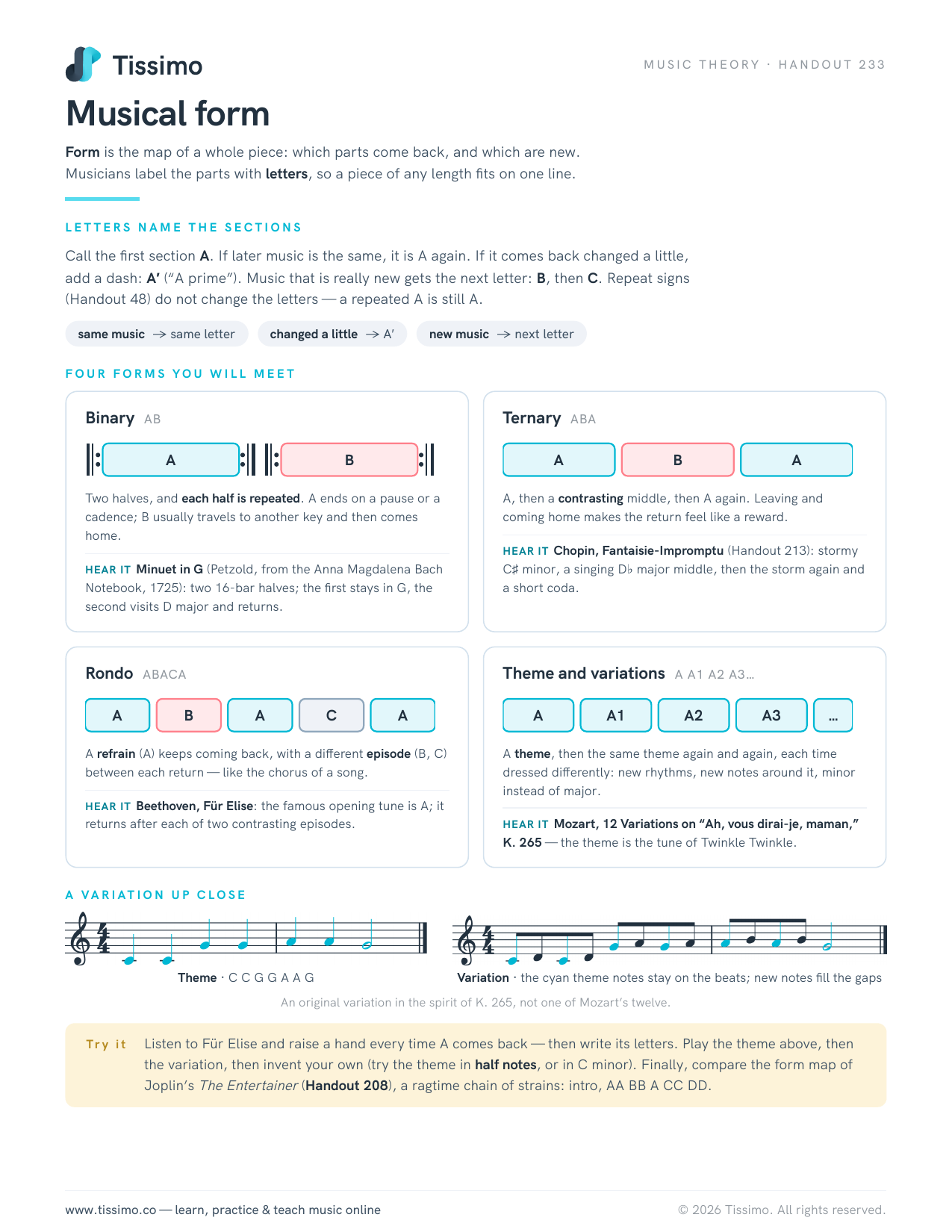 Musical formForm is the map of a whole piece: which parts come back, and which are new. Musicians label the parts with letters, so a piece of any length fits on one line.
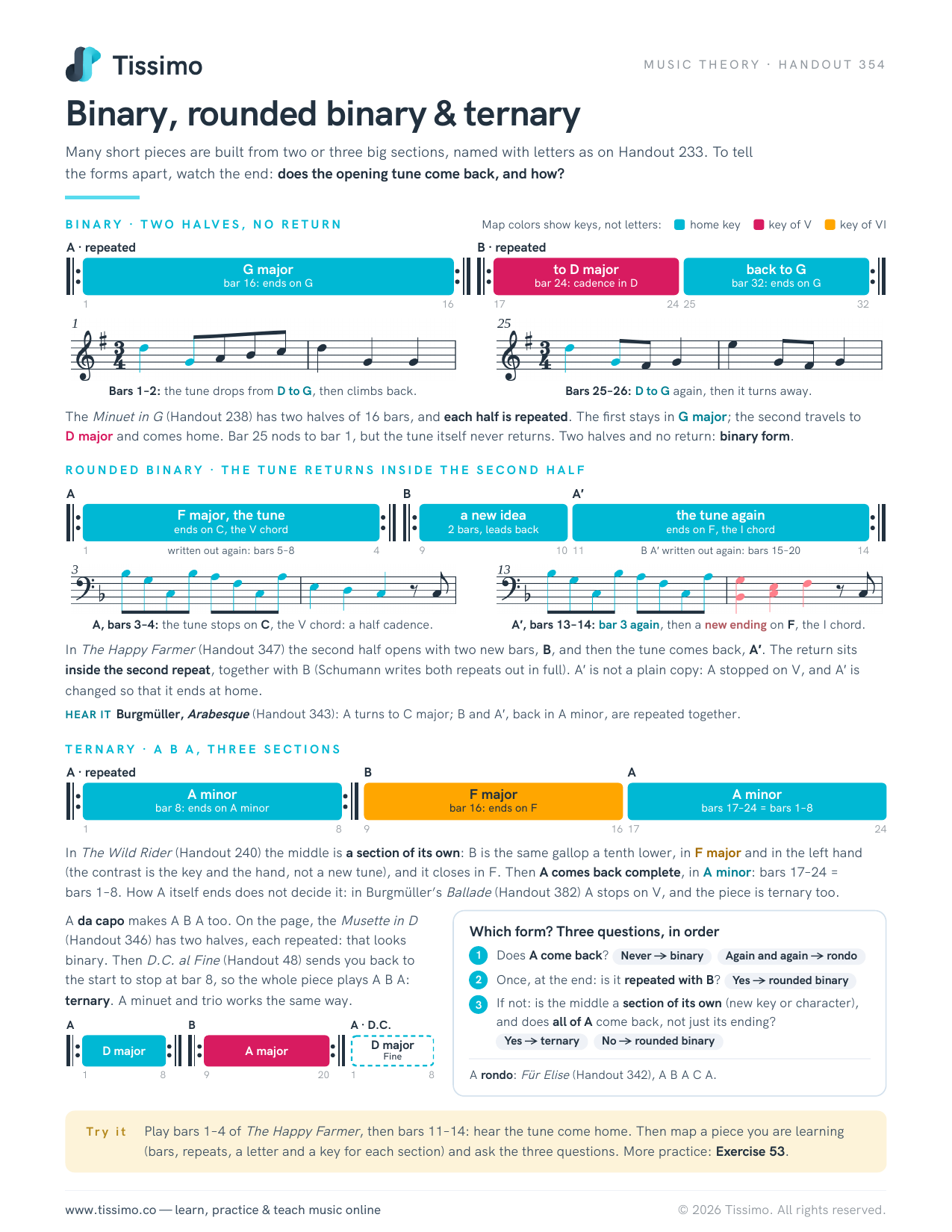 Binary, rounded binary & ternaryMany short pieces are built from two or three big sections, named with letters as on Handout 233. To tell the forms apart, watch the end: does the opening tune come back, and how?
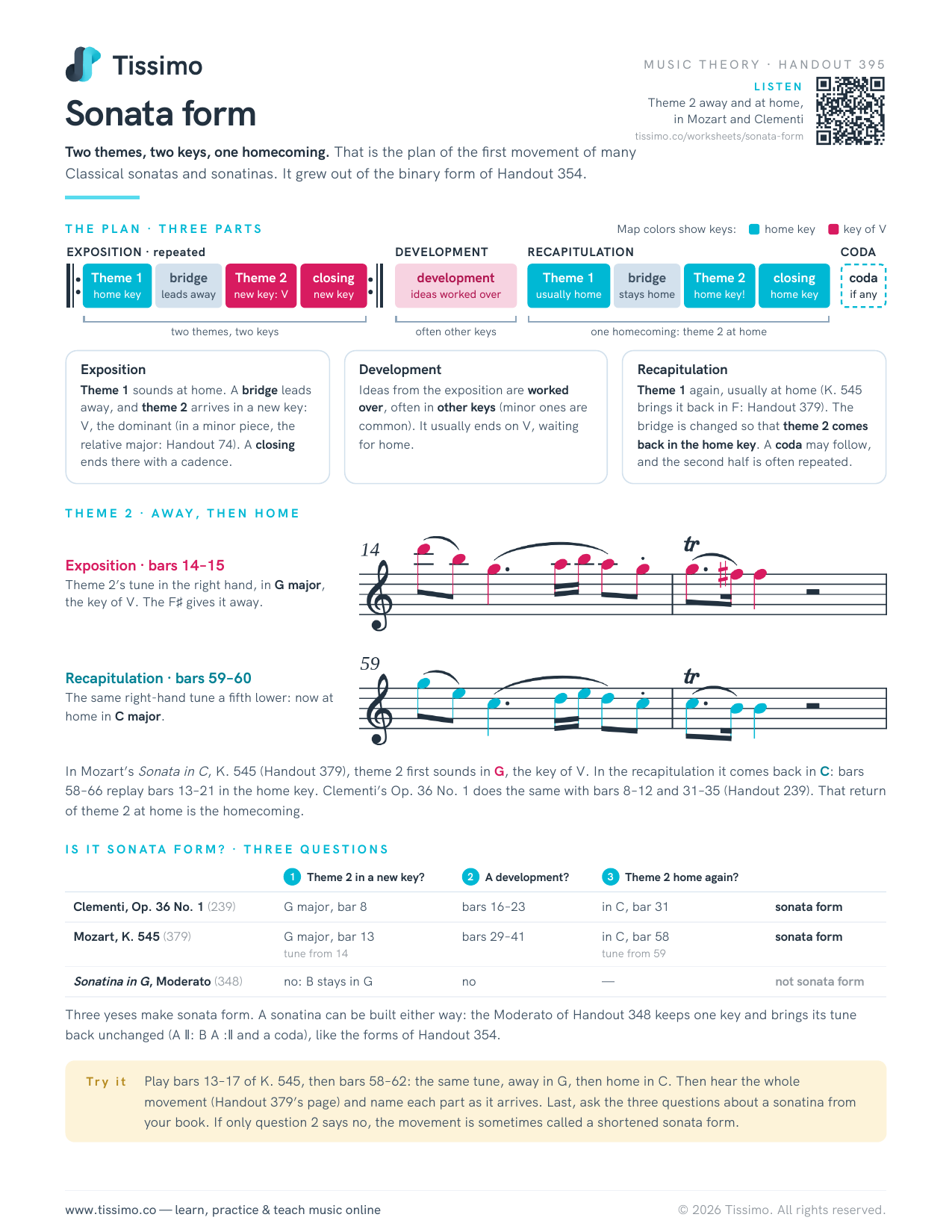 Sonata formTwo themes, two keys, one homecoming. That is the plan of the first movement of many Classical sonatas and sonatinas. It grew out of the binary form of Handout 354.
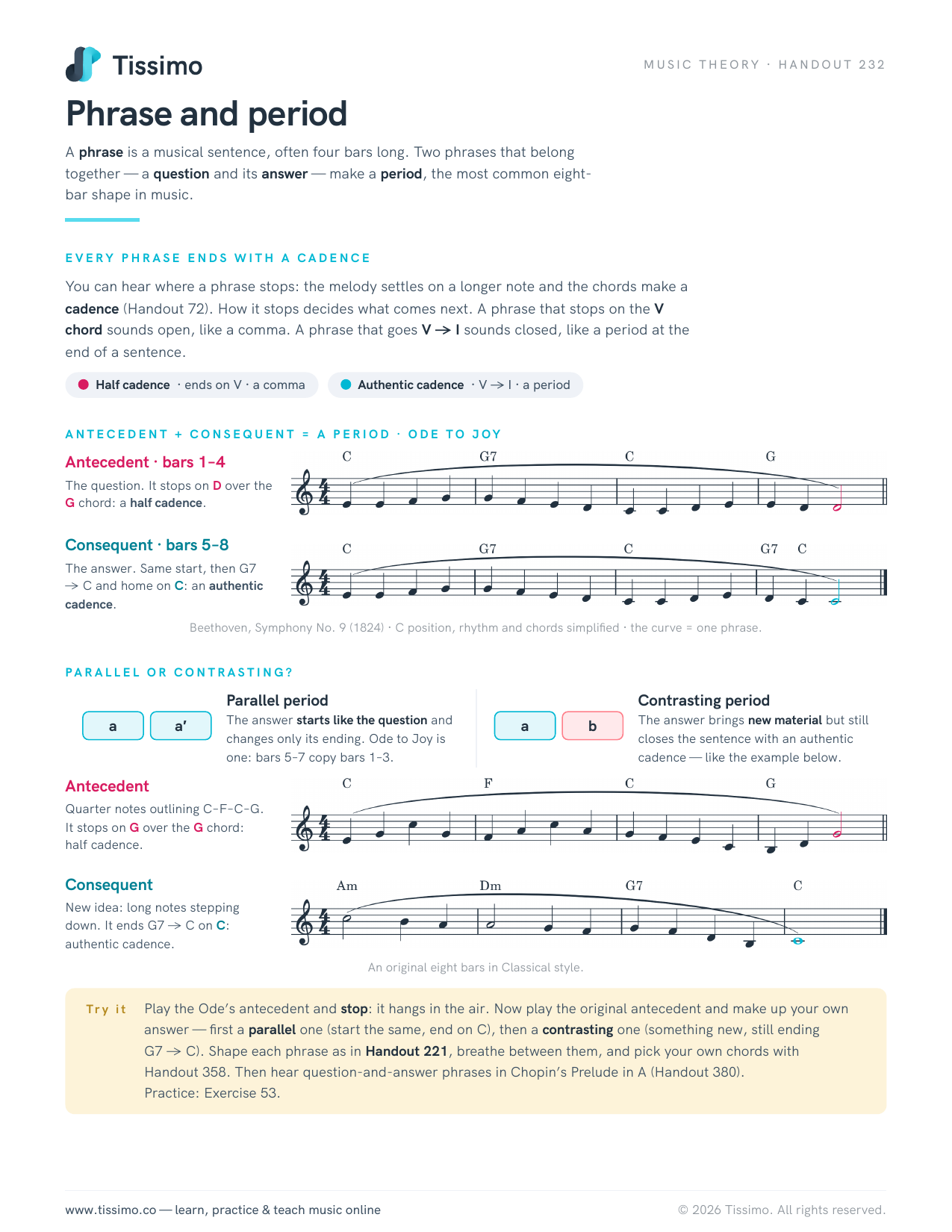 Phrase and periodA phrase is a musical sentence, often four bars long. Two phrases that belong together — a question and its answer — make a period, the most common eight-bar shape in music.