Form & Structure
Sonata Form
Sonata form is a large musical form in three main parts, exposition, development and recapitulation, built on a contrast of two keys that is resolved when the second theme returns in the home key.
Sonata form is the plan behind the first movements of most Classical sonatas, symphonies, string quartets and concertos, and many later ones too. It is also called sonata-allegro form, because those first movements are usually fast. Don't confuse it with a sonata, which is a whole multi-movement work: sonata form describes the shape of one movement.
The idea in one sentence: two themes are presented in two different keys, the music travels further away, and then both themes return in the home key.
The outline
- (Introduction): optional, often slow. Many of Haydn's later symphonies begin this way.
- Exposition: the first theme (or group of themes) in the home key; a transition, often called the bridge, that modulates; the second theme in a new key (the dominant in a major-key movement, usually the relative major in a minor-key one); and closing material that confirms the new key. In Classical movements the exposition is usually repeated.
- Development: ideas from the exposition are broken into fragments, combined and passed through several keys, often minor ones. It usually ends on a long dominant, building the expectation of home.
- Recapitulation: the first theme returns in the home key. The transition is rewritten so that it does not modulate, and the second theme now also appears in the home key.
- (Coda): an optional ending section. Beethoven often made it long and dramatic.
Why the key plan matters
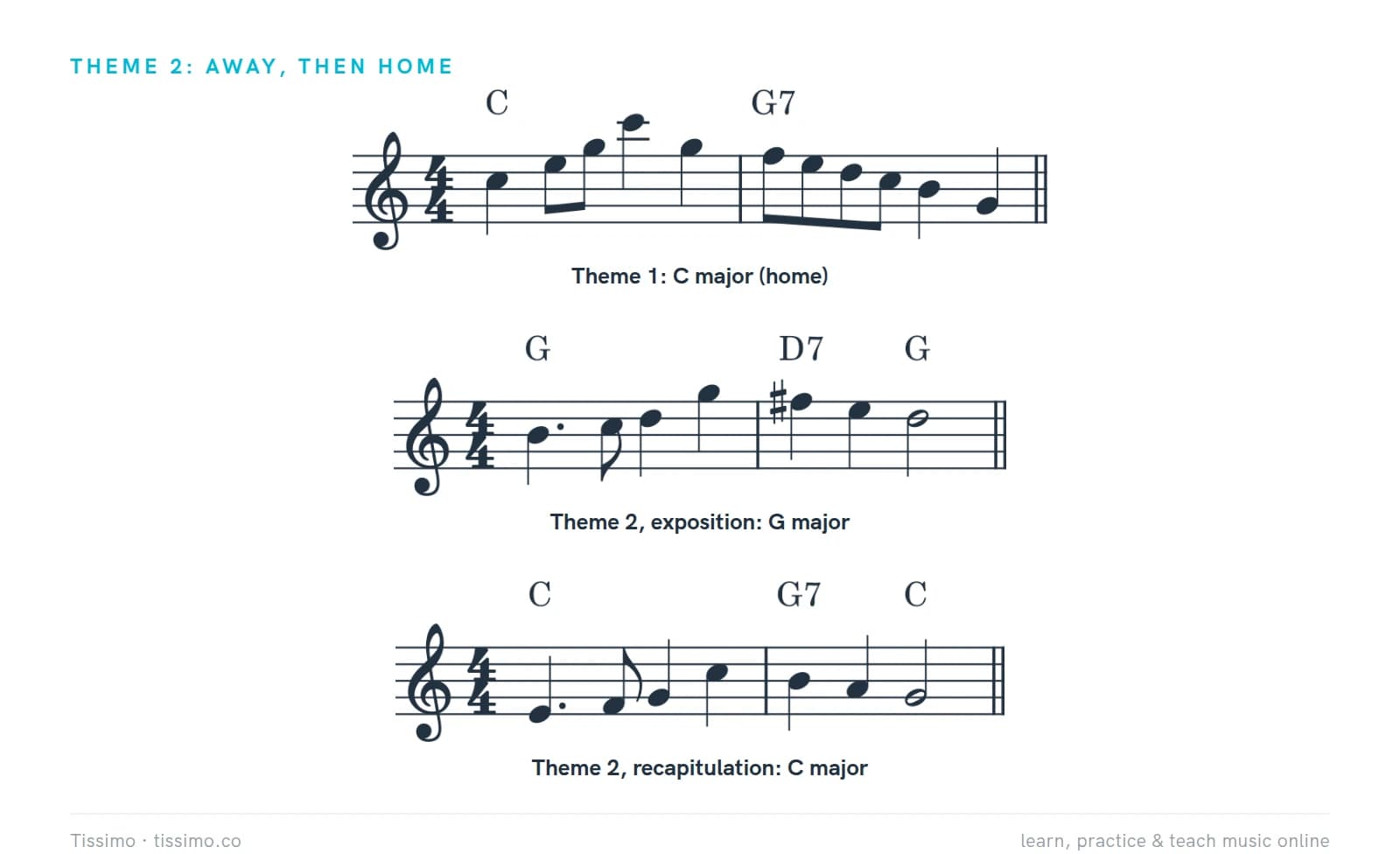
The heart of sonata form is not the number of themes but the keys. In the exposition, the second theme sets up a conflict with the home key. In the recapitulation, that same music is brought home. You can check this in Mozart's Piano Sonata in C, K. 545: its second theme sounds in G major in the exposition and returns in C major in the recapitulation (and its first theme comes back, unusually, in F major). The Sonata form worksheet follows both themes.
History in brief
Sonata form grew out of rounded binary form during the 18th century, and Haydn, Mozart and Beethoven wrote hundreds of movements in it. The name "sonata form" and the textbook description came later, from 19th-century theorists, so treat the outline as a description of common practice rather than a rule composers followed.
Where to start
A sonatina is a good first sonata-form piece. Clementi's Sonatina in C, Op. 36 No. 1, fits the whole plan into 38 bars (Clementi's Sonatina in C), and Mozart's Sonata in C, K. 545 shows the full-size version.
Common questions
What are the three parts of sonata form?
Exposition (the themes are presented, the second one in a new key), development (the themes are worked over in several keys) and recapitulation (the themes return, both in the home key). An introduction and a coda are optional extras.
What is the difference between a sonata and sonata form?
A sonata is a complete work, usually in three or four movements. Sonata form is the plan of a single movement, most often the first movement of a sonata, symphony or string quartet.
Practice it: free worksheets
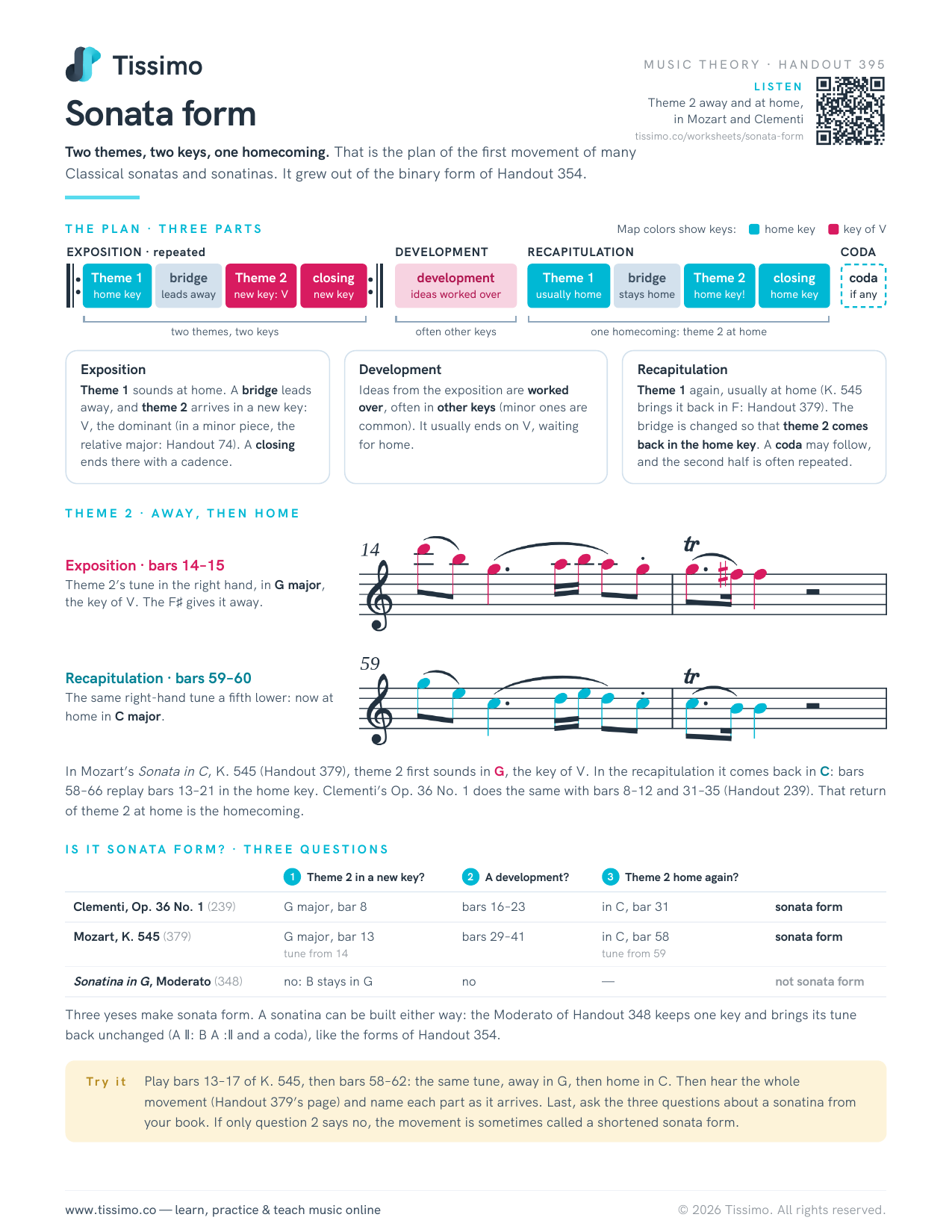 Sonata formTwo themes, two keys, one homecoming. That is the plan of the first movement of many Classical sonatas and sonatinas. It grew out of the binary form of Handout 354.
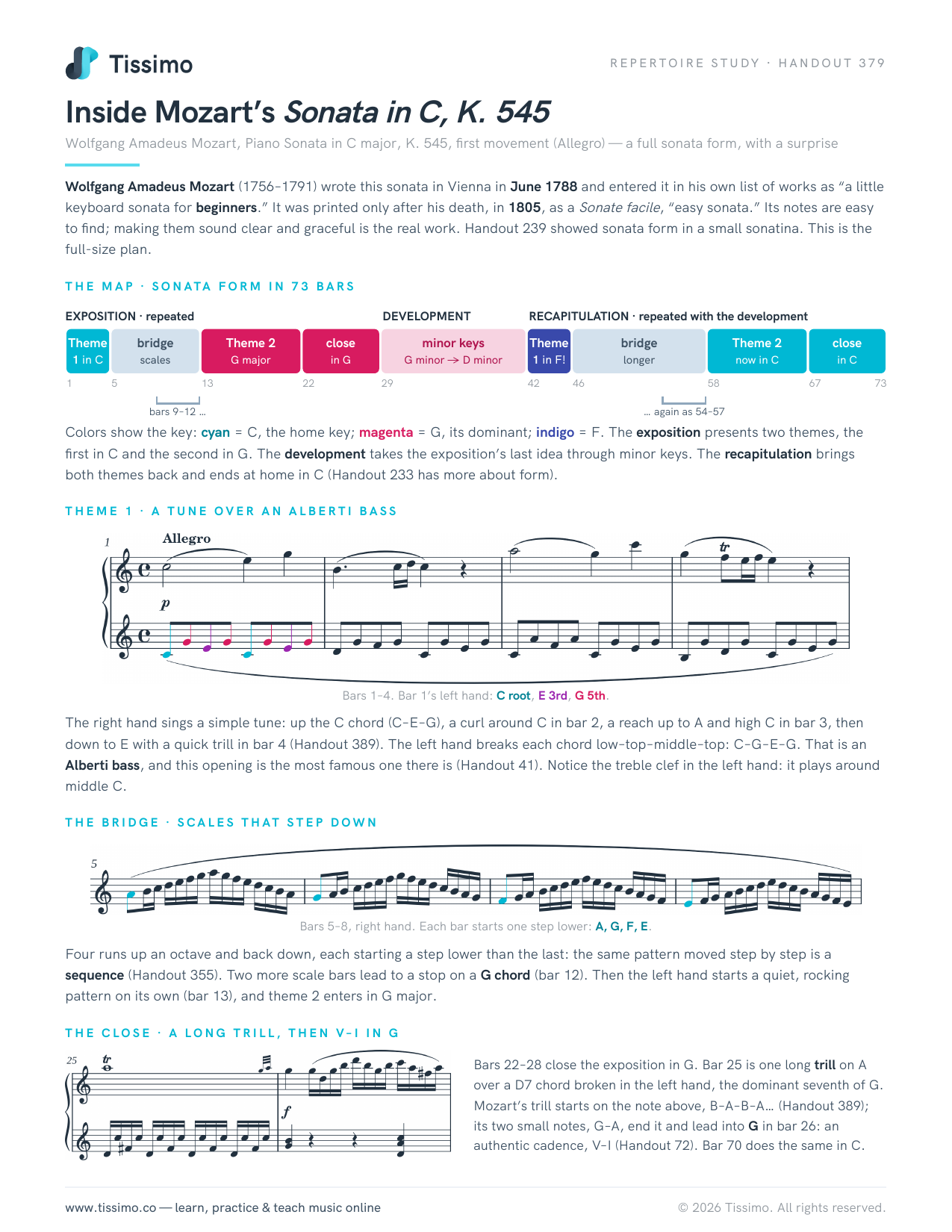 Inside Mozart’s Sonata in C, K. 545Wolfgang Amadeus Mozart, Piano Sonata in C major, K. 545, first movement (Allegro) — a full sonata form, with a surprise
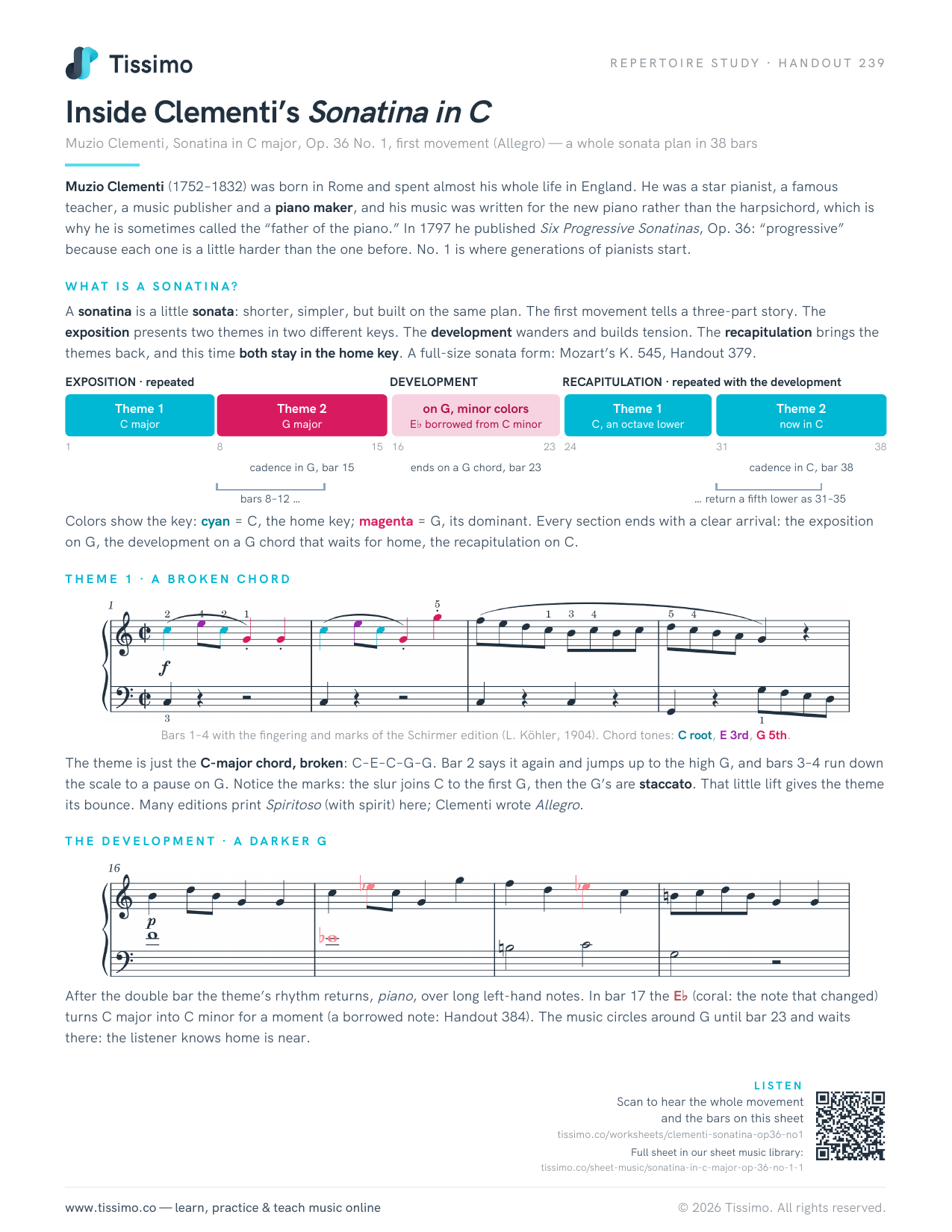 Inside Clementi’s Sonatina in CMuzio Clementi, Sonatina in C major, Op. 36 No. 1, first movement (Allegro) — a whole sonata plan in 38 bars
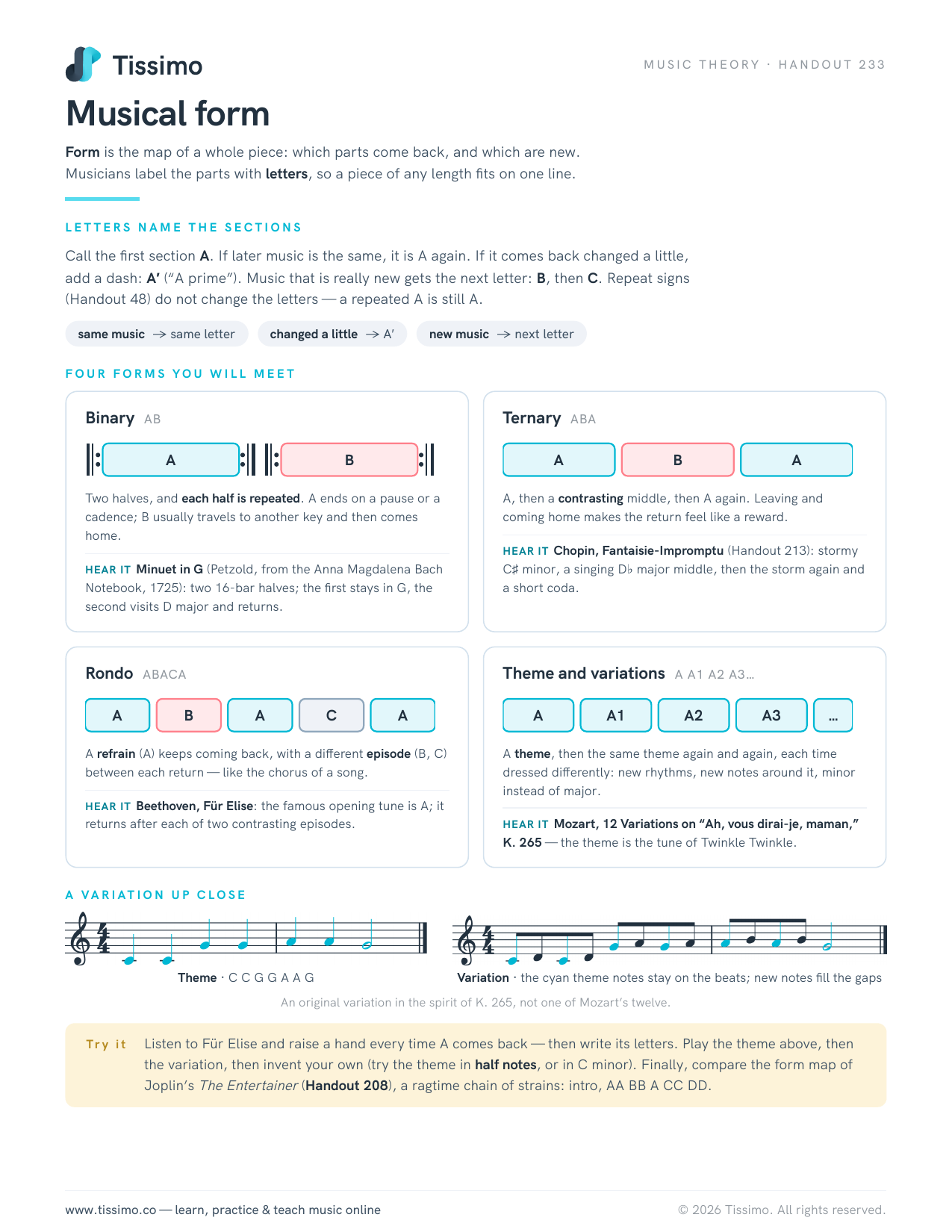 Musical formForm is the map of a whole piece: which parts come back, and which are new. Musicians label the parts with letters, so a piece of any length fits on one line.