Form & Structure
Recapitulation
The recapitulation is the third main section of a sonata-form movement, where the themes of the exposition return, now with the second theme in the home key instead of the contrasting key.
The recapitulation is the homecoming of sonata form. After the development has wandered through other keys, the first theme returns in the home key, and the movement replays the material of the exposition, with one essential change: the second theme now stays in the home key too.
What changes from the exposition
- First theme returns in the tonic key. Its return is usually one of the clearest landmarks in the movement.
- Transition is rewritten. In the exposition it modulated; now it has to arrive at the second theme without leaving home.
- Second theme appears in the home key. In C major, a second theme first heard in G major comes back in C major.
- Closing material confirms the home key, sometimes followed by a coda.
So the recapitulation is not just a repeat. It resolves the conflict of keys that the exposition set up. Mozart's Piano Sonata in C, K. 545, shows this clearly: its second theme comes back in C major exactly where the exposition had it in G. The same movement also shows that composers bent the outline: its recapitulation begins with the first theme in F major, the subdominant, and the rewritten transition brings the music back to C. Both details are traced in the Mozart K. 545 and Sonata form worksheets.
In minor-key movements
When a movement is in a minor key, the second theme of the exposition is usually in the relative major. In the recapitulation it usually returns in the tonic minor, which can change its mood dramatically, though some composers bring it back in the tonic major instead.
How to recognize it
- Listen for the opening theme returning after the most unstable stretch of the piece, very often right after a long passage on the dominant.
- In the score, look for the music of the first page reappearing, often after the key signature's natural accidentals have settled back in.
- Compare the second theme in both places: same tune, different key.
The word in other contexts
Outside sonata form, recapitulation (or reprise) can mean any return of earlier material, such as the return of A in ternary form or a song that comes back near the end of a musical.
Common questions
What is the purpose of the recapitulation?
It brings back the themes of the exposition and resolves the contrast of keys: the second theme, first heard in a new key, now returns in the home key, so the movement can end firmly at home.
Is the recapitulation the same as the exposition?
Not quite. The themes return, but the transition is rewritten so the second theme can appear in the home key, and composers often vary, shorten or extend sections and add a coda.
Practice it: free worksheets
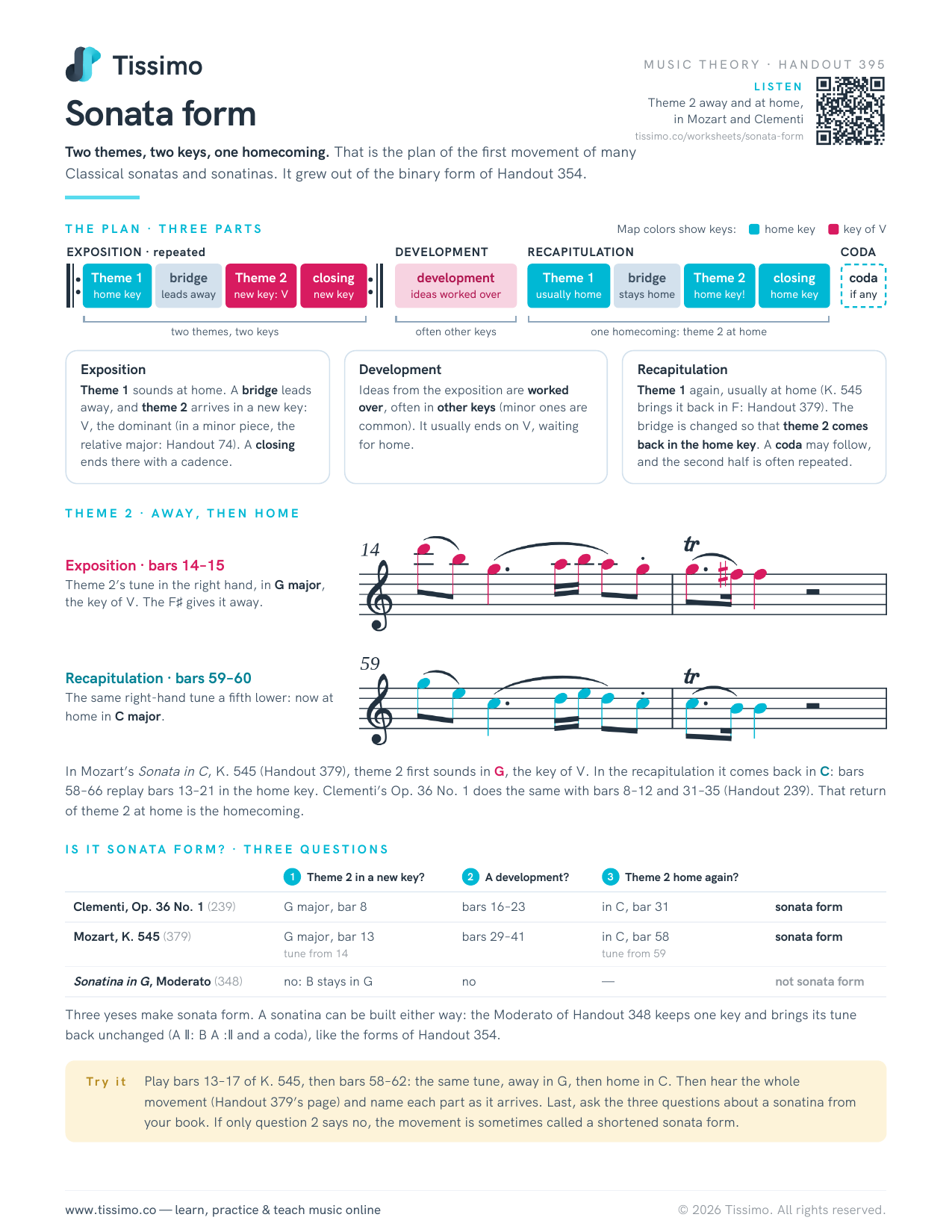 Sonata formTwo themes, two keys, one homecoming. That is the plan of the first movement of many Classical sonatas and sonatinas. It grew out of the binary form of Handout 354.
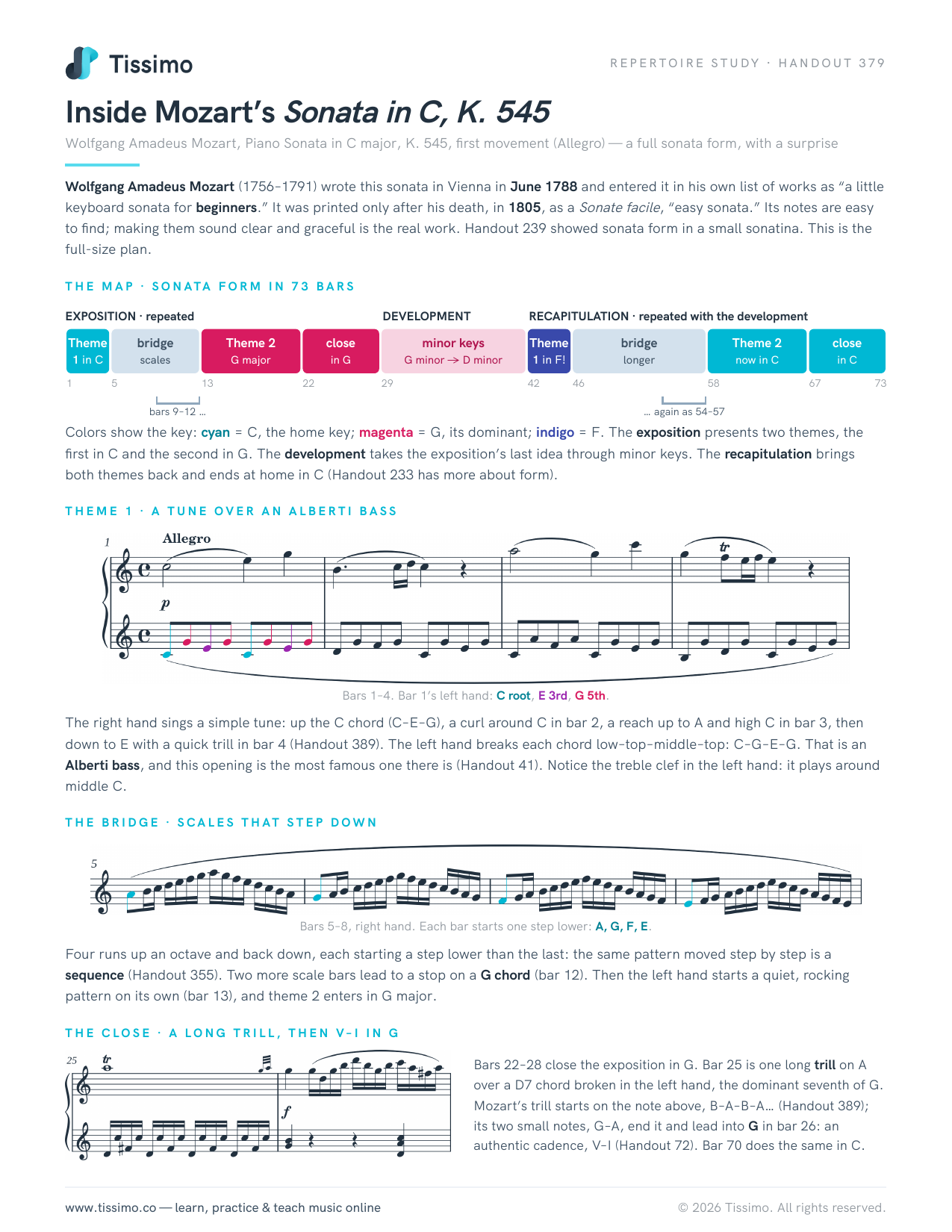 Inside Mozart’s Sonata in C, K. 545Wolfgang Amadeus Mozart, Piano Sonata in C major, K. 545, first movement (Allegro) — a full sonata form, with a surprise
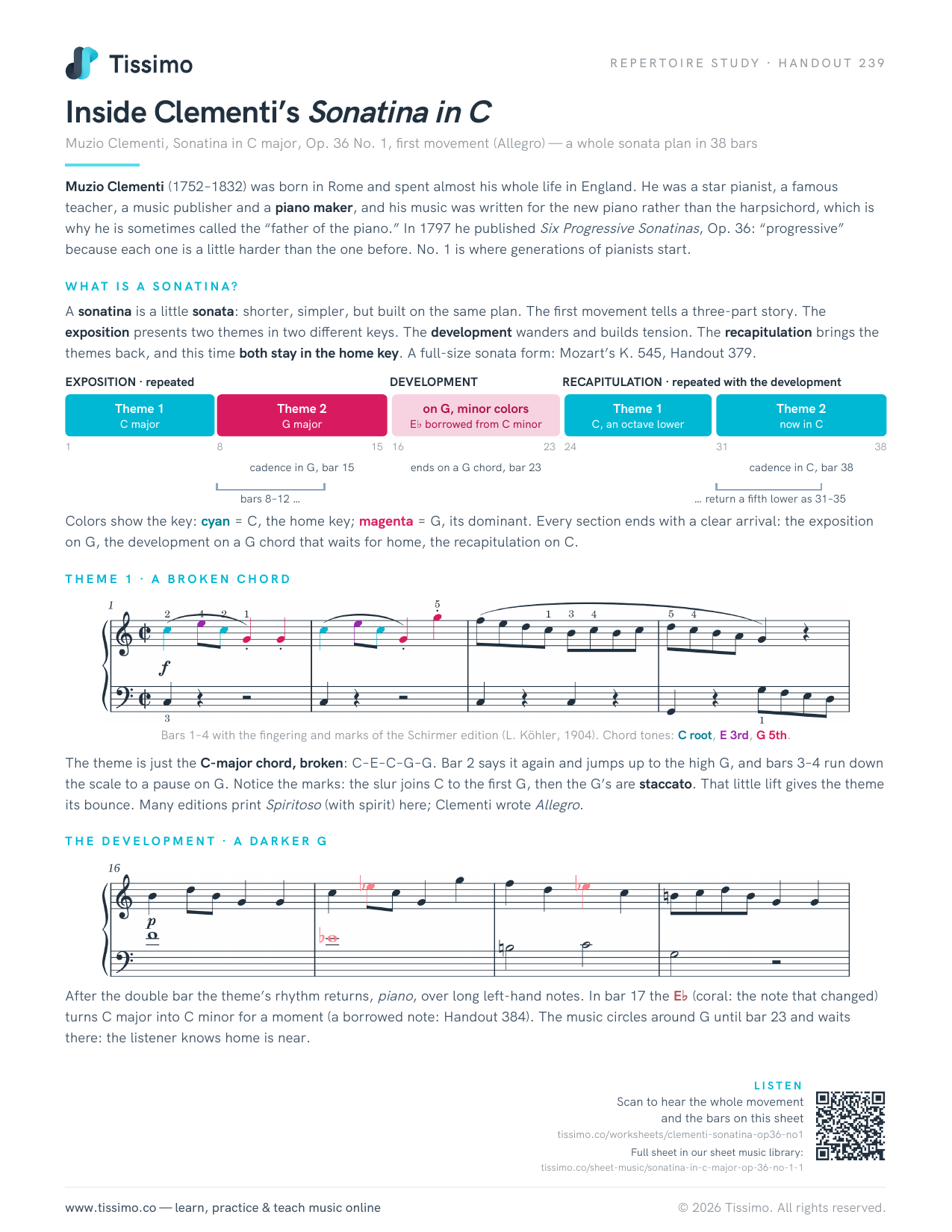 Inside Clementi’s Sonatina in CMuzio Clementi, Sonatina in C major, Op. 36 No. 1, first movement (Allegro) — a whole sonata plan in 38 bars