Form & Structure
AABA Form (32-Bar Form)
AABA form, or 32-bar form, is a song form of four eight-bar sections: a main melody (A), its repeat (A), a contrasting bridge (B), and a final return of A. It is the plan of many jazz standards.
AABA form is the classic plan of the American popular song from roughly the 1920s to the 1950s: Broadway show tunes, Tin Pan Alley songs and the many jazz standards that came from them. In its standard version it has 32 bars in four sections of eight bars each.
The outline
- A (bars 1–8): the main tune, which usually contains the song's title.
- A (bars 9–16): the same tune with new words. The ending may change slightly so that it closes more firmly in the home key.
- B (bars 17–24): the bridge, also called the release or, in Britain, the middle eight. New melody, new chords, often in a different key.
- A (bars 25–32): the main tune returns, sometimes with a short extension or tag.
The contrast is placed late, so the return of A in bars 25–32 feels like a homecoming, much as in ternary form.
Well-known AABA songs
- Harold Arlen's "Over the Rainbow" and Rodgers and Hart's "Blue Moon" are textbook AABA songs.
- George Gershwin's "I Got Rhythm" is another. Its chord progression, known to jazz musicians as rhythm changes, became the basis for countless later jazz tunes.
The "verse" in older songs
The word verse can be confusing here. In many songs of this era, the 32-bar AABA section was called the chorus or refrain, and it was often preceded by an introductory verse in a freer style that set the scene. Many performers skip that introductory verse and play only the 32-bar chorus. In jazz, one time through the 32-bar form is also called a chorus: a soloist may "take two choruses," improvising over the AABA chord progression twice.
AABA and other 32-bar forms
Not every 32-bar song is AABA. Another common plan is ABAC, in which the second half begins like the first and then heads somewhere new. And many songs stretch or shrink the sections: a 10-bar A or a 4-bar tag at the end still counts as AABA if the plan of repetition and contrast is the same.
How to practice an AABA tune
Because A appears three times, learning one eight-bar section gives you three-quarters of the song. Focus your extra practice on the bridge, and on the last bars of each A, where the endings often differ slightly. Mark the four sections on your lead sheet before you start; the Reading a lead sheet worksheet shows how such charts are laid out.
Common questions
What is 32-bar form?
A song form of 32 bars, most often divided into four eight-bar sections in the order AABA: a tune, its repeat, a contrasting bridge, and a final return of the tune.
What songs are in AABA form?
Many jazz standards and Broadway songs, for example "Over the Rainbow," "Blue Moon" and "I Got Rhythm."
Practice it: free worksheets
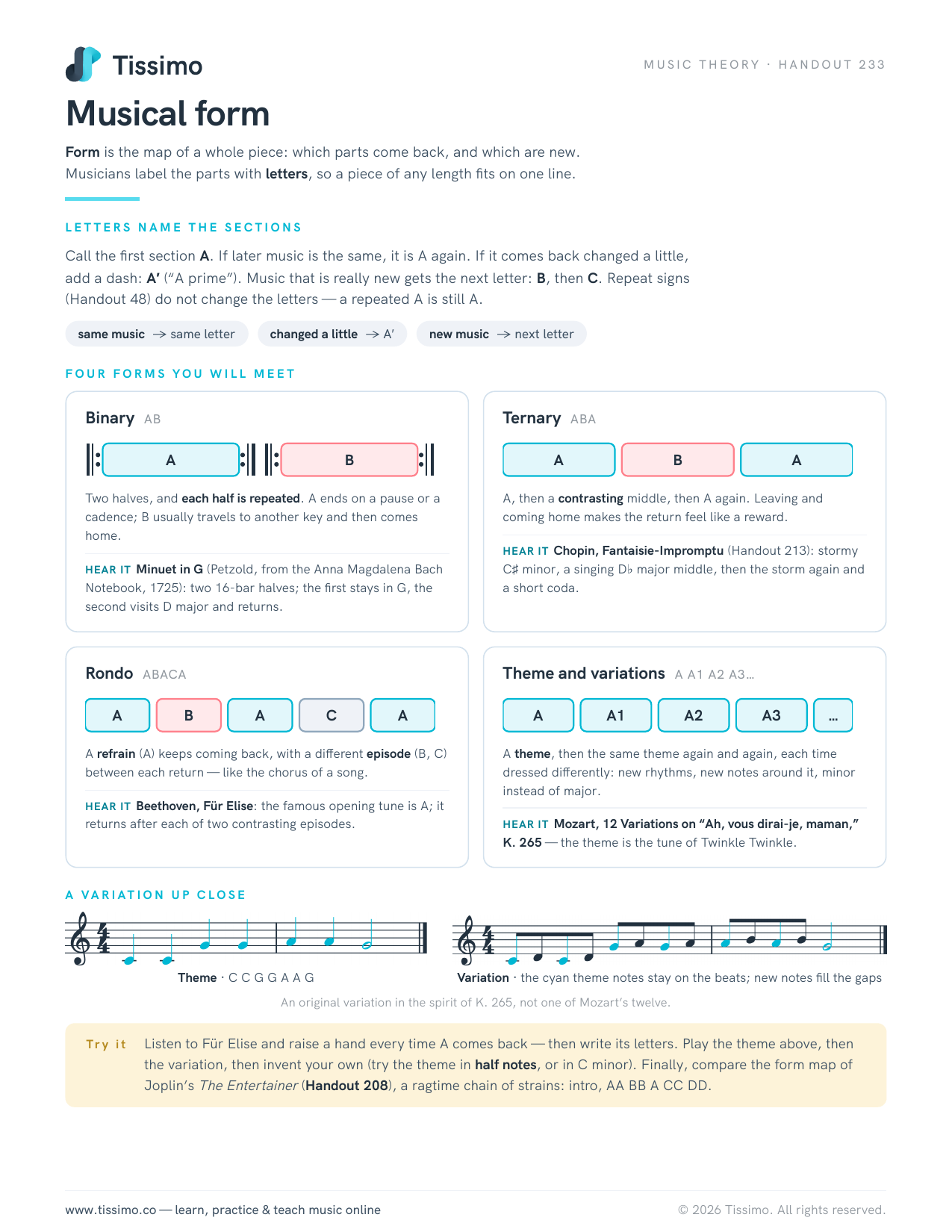 Musical formForm is the map of a whole piece: which parts come back, and which are new. Musicians label the parts with letters, so a piece of any length fits on one line.
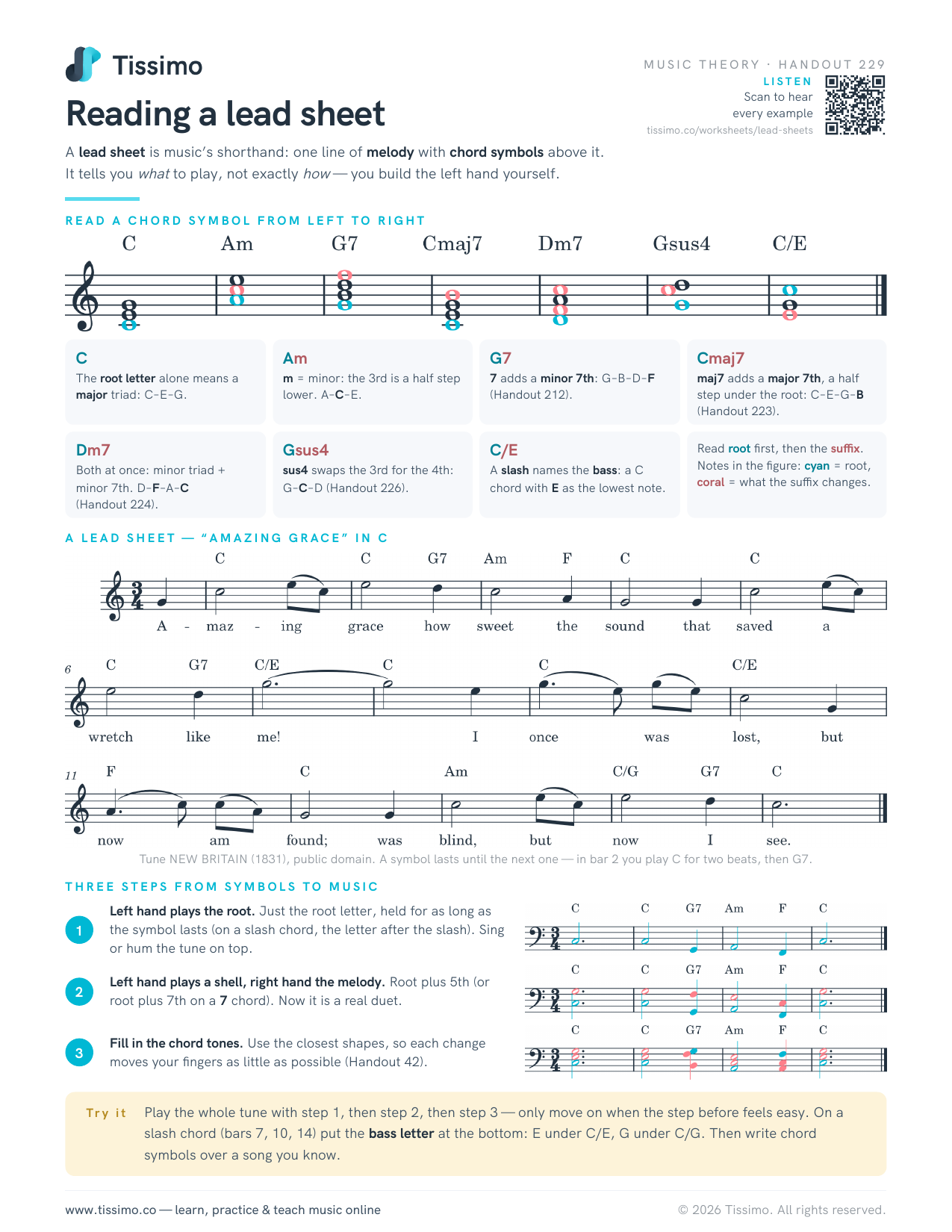 Reading a lead sheetA lead sheet is music’s shorthand: one line of melody with chord symbols above it. It tells you what to play, not exactly how — you build the left hand yourself.