Styles, Genres & Eras
Musical Theater
Musical theater is a form of stage drama that combines songs, spoken dialogue, acting and dance to tell a story. It is most closely associated with Broadway in New York and the West End in London.
A musical tells a story through a mix of songs, spoken scenes and dance. Where opera is usually sung throughout by classically trained voices, most musicals alternate dialogue with songs written in popular styles, and the singers act and often dance as well. The centers of the form are Broadway in New York and the West End in London, but musicals are produced everywhere, from schools to stadium tours.
Who makes a musical
- Book (the script and dialogue), written by the book writer.
- Lyrics (the words of the songs), by the lyricist.
- Score (the music), by the composer, often with arrangers and orchestrators.
Song types
Musical theater has developed recognizable kinds of songs:
- The "I want" song, early in the show, in which the main character sings about what they long for.
- Ballads, slow and emotional.
- Charm songs and comic numbers.
- Production numbers for the whole company, with dance.
- The "eleven o'clock number," a showstopping song late in the second act.
- Reprises, in which earlier songs return with new words or a new meaning.
A short history
Musicals grew out of operetta, vaudeville, music hall and revues. Show Boat (1927, music by Jerome Kern, book and lyrics by Oscar Hammerstein II) brought serious drama to the form. Oklahoma! (1943), by Rodgers and Hammerstein, set the model of the "book musical," in which songs and dances grow out of the plot. Leonard Bernstein's West Side Story (1957), with lyrics by Stephen Sondheim, combined symphonic writing, jazz and dance. Sondheim went on to write ambitious shows such as Sweeney Todd and Into the Woods. The 1980s brought "megamusicals" such as Les Misérables and Andrew Lloyd Webber's The Phantom of the Opera, which are almost entirely sung. More recently, Lin-Manuel Miranda's Hamilton (2015) brought hip-hop and R&B to the Broadway stage.
Singing in musicals
Musical theater singers use several vocal styles: classical "legit" singing, a speech-like mix, and belting, a powerful, chest-dominant sound used for climactic moments. Because the words carry the story, clear diction and acting through the song matter as much as the notes.
Learning a show song
Musical theater songs are usually published in vocal selections or as piano-vocal scores, and singers often need them in a different key. The Transposition worksheet shows how keys are moved, and Reading a lead sheet helps accompanists who work from chord charts.
Common questions
What is the difference between a musical and an opera?
Operas are usually sung throughout by classically trained voices without amplification. Musicals mix songs with spoken dialogue, use popular song styles and amplified voices, and often feature dance.
What is an eleven o'clock number?
A showstopping song placed late in the second act of a musical, often the emotional high point for a main character. The name comes from the time it was once reached in an evening performance.
Practice it: free worksheets
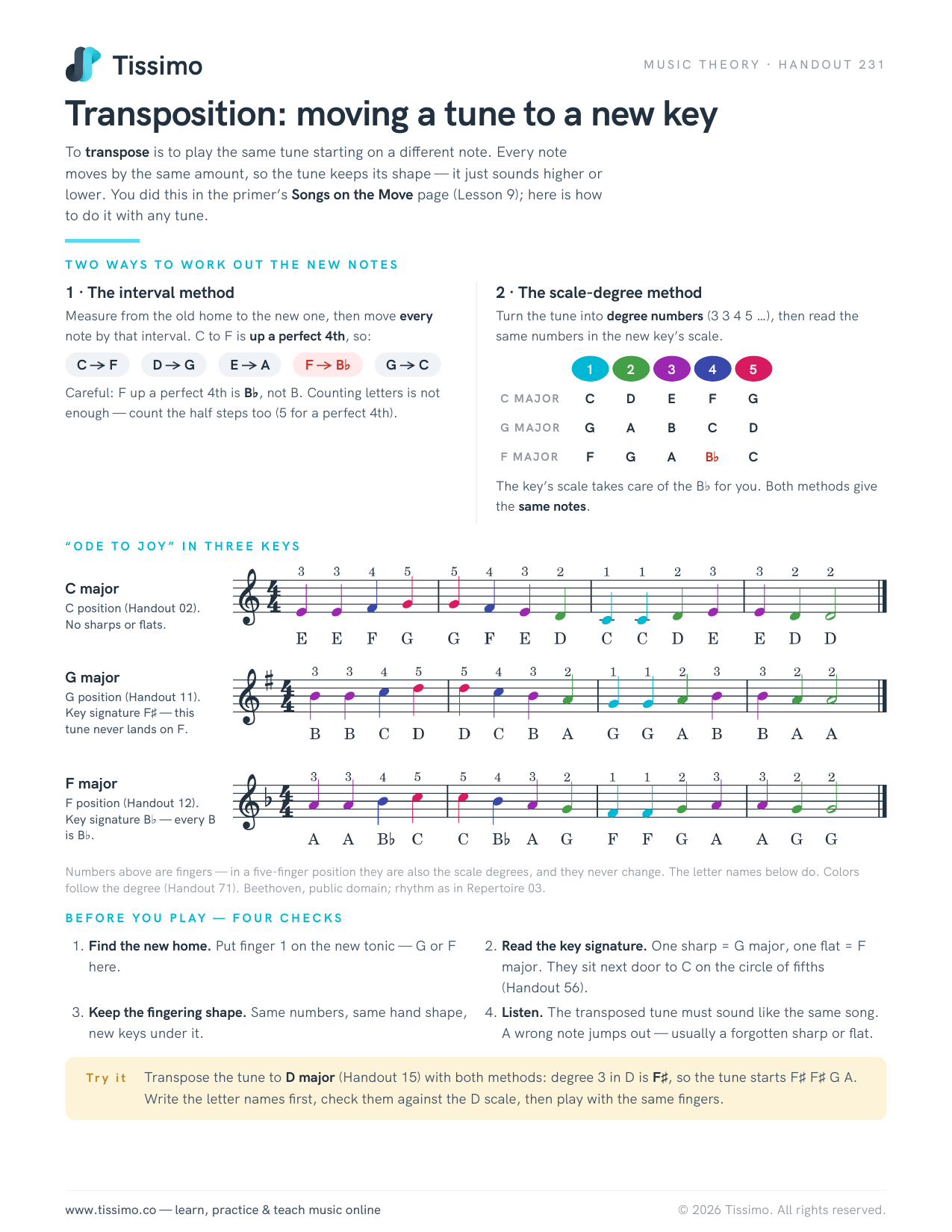 Transposition: moving a tune to a new keyTo transpose is to play the same tune starting on a different note. Every note moves by the same amount, so the tune keeps its shape — it just sounds higher or lower. Here is how to do it with any tune.
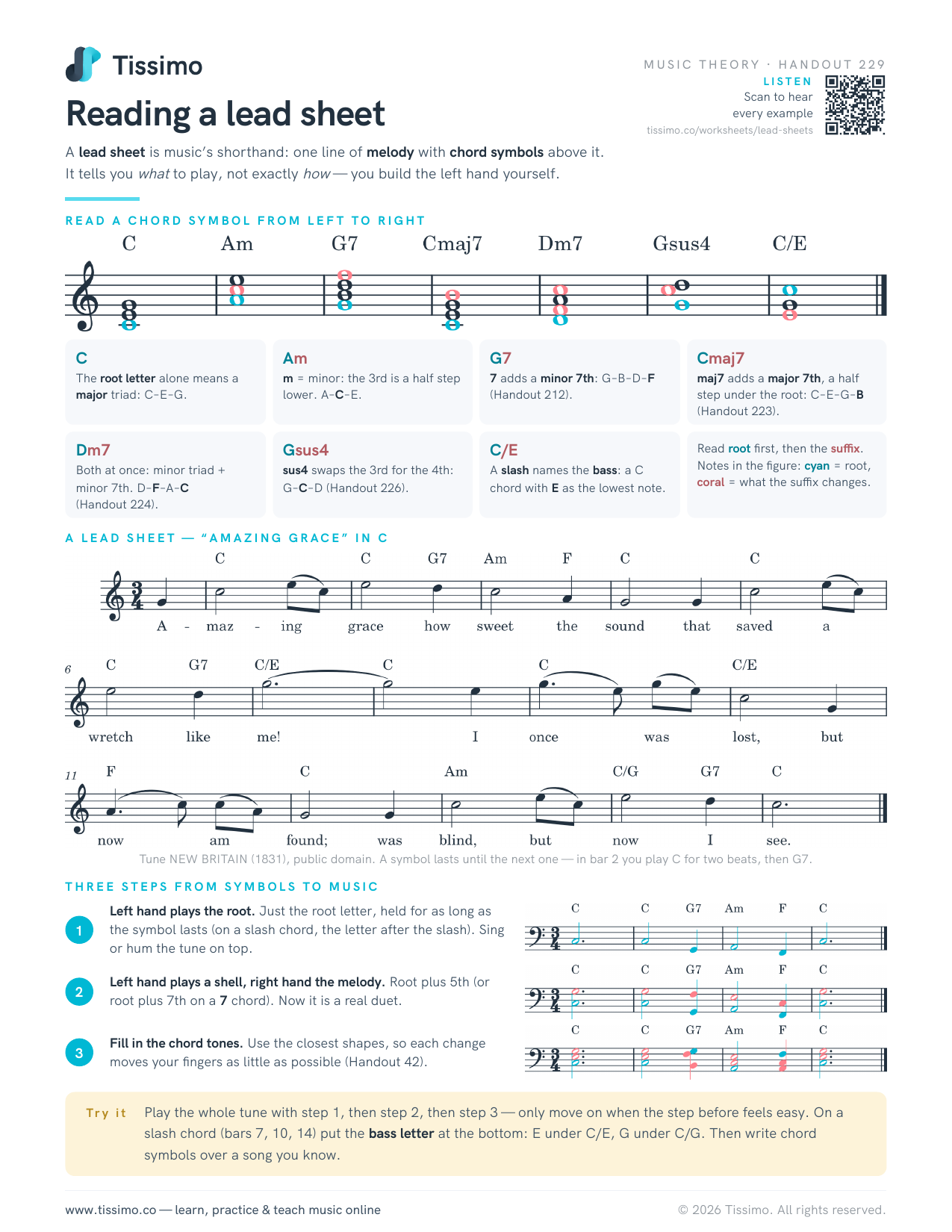 Reading a lead sheetA lead sheet is music’s shorthand: one line of melody with chord symbols above it. It tells you what to play, not exactly how — you build the left hand yourself.