Styles, Genres & Eras
Nationalism (in Music)
Nationalism in music is the use of a country's folk songs, dances, legends and landscapes to create a distinctly national style, a movement especially strong in the 19th and early 20th centuries.
For much of the 18th and early 19th centuries, the leading musical styles in Europe came from Italy, France and German-speaking lands. In the 19th century, as nations across Europe asserted their identities, composers elsewhere began to build styles of their own from their country's folk music, dances, languages, history and legends. This movement is called musical nationalism.
How composers made music sound "national"
- Folk melodies and dances, quoted directly or imitated: their scales, modes, rhythms and ornaments.
- National subjects for operas and program music: legends, heroes, landscapes, rivers.
- The sounds of local instruments, imitated by the orchestra or piano: bagpipe drones, folk fiddles, guitars.
- The rhythms of the language, shaping vocal melodies.
Important composers
- Poland: Chopin's mazurkas and polonaises turned Polish dances into concert music.
- Russia: Mikhail Glinka is often called the father of Russian music. The group known as "The Five" (Balakirev, Cui, Mussorgsky, Rimsky-Korsakov and Borodin) set out to create a Russian style independent of Western training.
- Bohemia (Czech lands): Bedřich Smetana (Má vlast, "My Country," including Vltava) and Antonín Dvořák (Slavonic Dances).
- Norway: Edvard Grieg, whose Peer Gynt music and piano pieces draw on Norwegian folk idioms.
- Finland: Jean Sibelius, whose Finlandia became a symbol of Finnish independence.
- Spain: Isaac Albéniz, Enrique Granados and Manuel de Falla.
- Hungary: Liszt's Hungarian Rhapsodies drew on popular Hungarian styles; later, Béla Bartók and Zoltán Kodály collected thousands of peasant folk songs with recording equipment and built them into modern styles.
- England: Ralph Vaughan Williams collected English folk songs and used them in his music.
- United States: Dvořák, while working in New York, urged American composers to draw on the country's own musical traditions; his Symphony No. 9, "From the New World," was written there. Later, Aaron Copland's Appalachian Spring and Rodeo created an "American" sound.
Authentic or imagined?
Nationalist composers often presented their own idea of the folk, polished for the concert hall. Bartók, by contrast, insisted on studying folk music as it was actually sung in villages. Both approaches produced lasting music.
Hearing it
Listen for dance rhythms, modal melodies and drone basses in a nationalist piece, and compare the original folk song when you can. The Modes worksheet introduces scales that many folk traditions use.
Common questions
What is nationalism in music?
A movement, strongest in the 19th and early 20th centuries, in which composers used their country's folk music, dances, legends and landscapes to create a distinctly national style.
Who were the Russian Five?
Mily Balakirev, César Cui, Modest Mussorgsky, Nikolai Rimsky-Korsakov and Alexander Borodin, a group of 19th-century composers who aimed to create a specifically Russian style.
Practice it: free worksheets
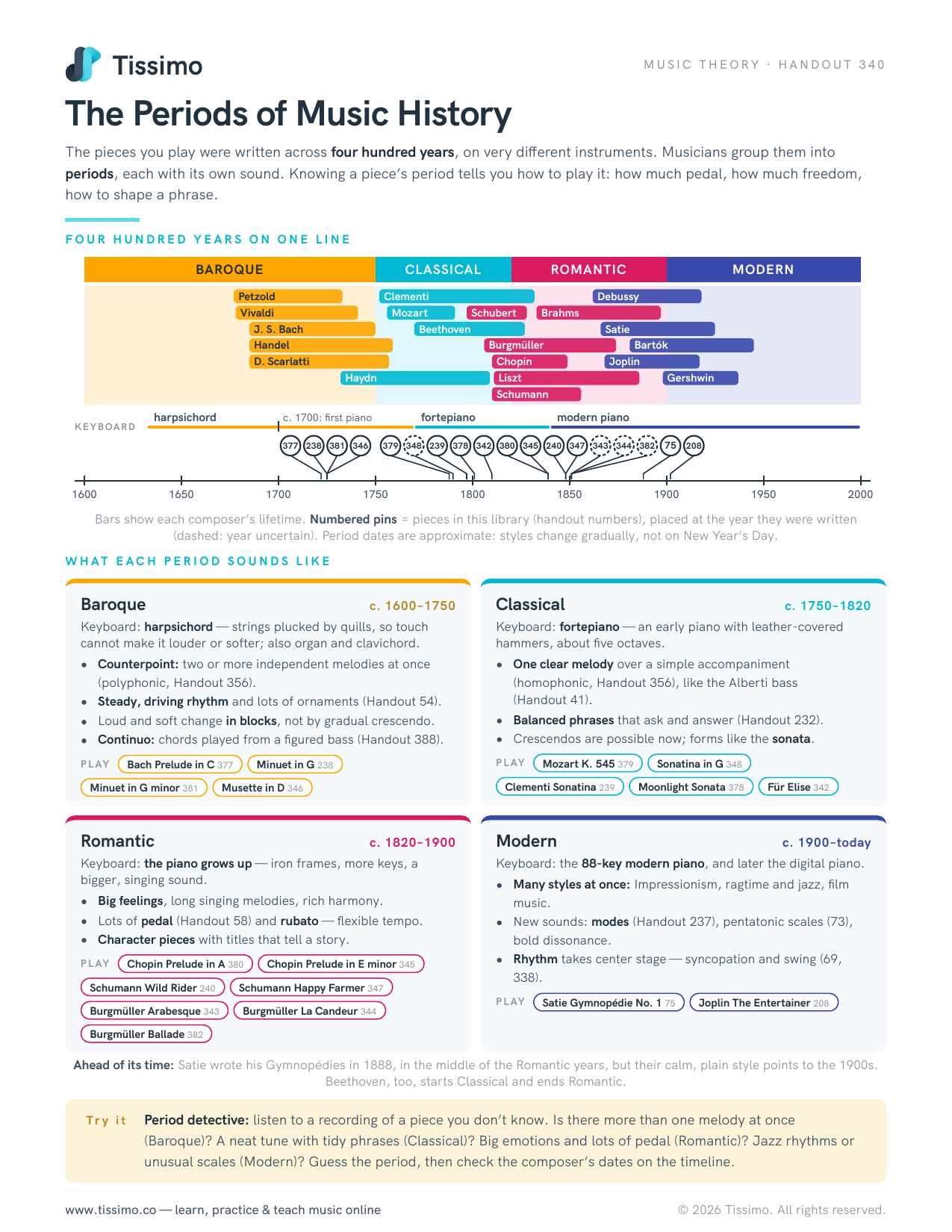 The Periods of Music HistoryThe pieces you play were written across four hundred years, on very different instruments. Musicians group them into periods, each with its own sound. Knowing a piece’s period tells you how to play it: how much pedal, how much freedom, how to shape a phrase.
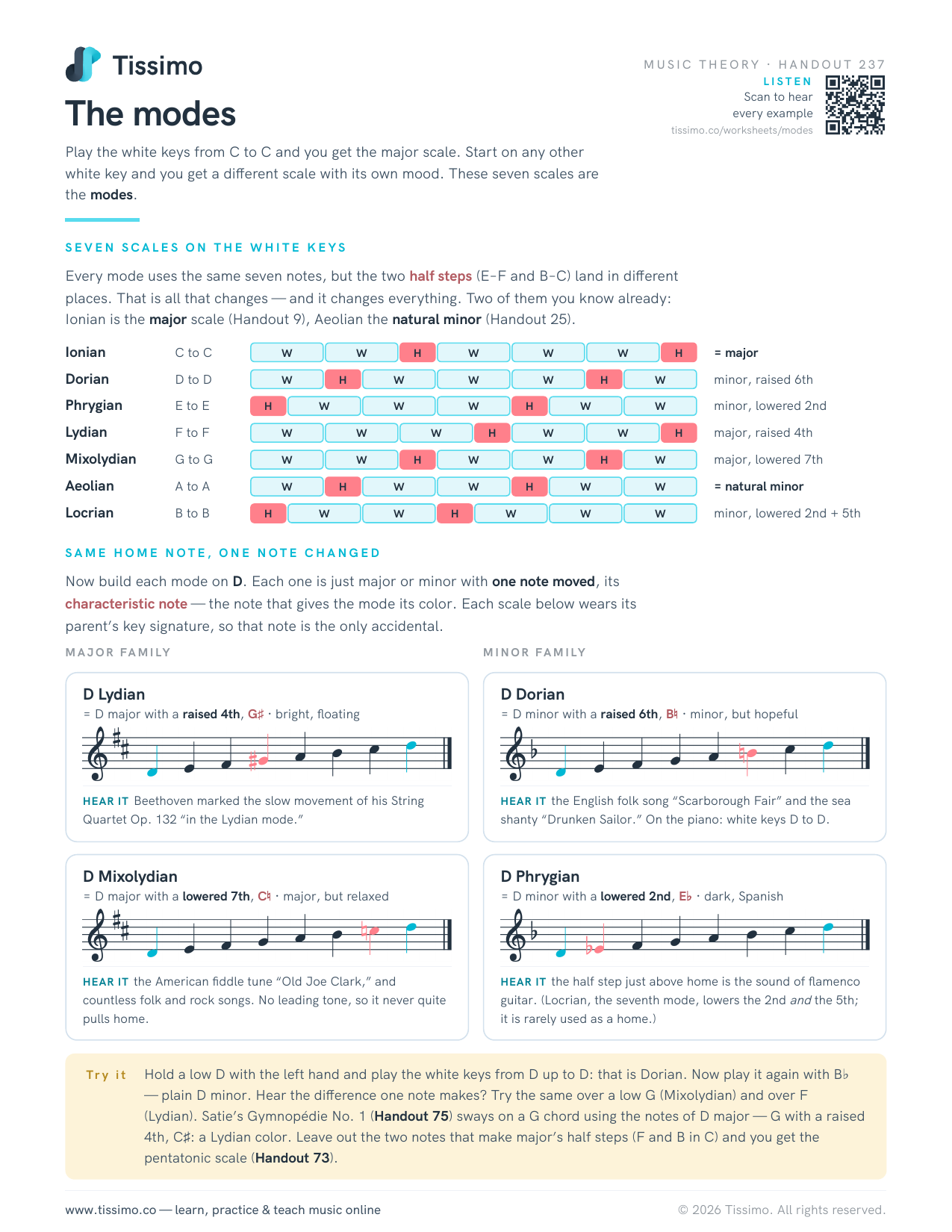 The modesPlay the white keys from C to C and you get the major scale. Start on any other white key and you get a different scale with its own mood. These seven scales are the modes.