Styles, Genres & Eras
World Music
World music is a broad label, popularized by record companies in the 1980s, for traditional and popular music from outside the Western mainstream, from Indian classical music to West African drumming.
"World music" is a marketing category more than a musical style. It was popularized in the 1980s by record labels and shops, especially in Britain, as a shelf label for music from outside the Anglo-American mainstream. It covers an enormous range: ancient classical traditions, village folk music, and modern popular styles from every continent.
Many musicians and scholars find the label problematic, because it lumps very different traditions together and implicitly treats Western music as the norm. Ethnomusicologists, who study music in its cultural context, usually prefer to name each tradition specifically. Still, the term is widely used, and the music it covers rewards close listening.
A few traditions and what they teach
- Indian classical music (Hindustani in the north, Carnatic in the south): melodies built on a raga, a melodic framework with characteristic notes, phrases and ways of moving, and rhythm organized in cycles called tala. Performances include long improvisations, accompanied by a drone from the tanpura. Instruments include sitar, sarod, veena and tabla.
- Indonesian gamelan: ensembles of tuned bronze gongs and metallophones from Java and Bali, with layered, interlocking parts and tunings (slendro and pelog) that differ from Western scales.
- West African drumming: interlocking patterns and polyrhythms, with a master drummer leading the ensemble. The griot (jali) tradition of hereditary musicians and storytellers, with the 21-string kora, is another rich West African tradition.
- Arabic and Turkish classical music: related but distinct modal traditions, Arabic maqam and Turkish makam, with characteristic melodic paths and intervals that need not match Western equal temperament (see microtone), played on instruments such as the oud and ney.
- Latin American music: Cuban son and its descendants, Brazilian samba and bossa nova, Argentine tango, Andean music.
- East Asian traditions: Japanese koto and shakuhachi, Chinese guqin and erhu, Korean pansori.
Exchange and fusion
Musicians have always borrowed across borders. Debussy was struck by gamelan, minimalist composers studied African and Indian music, the Beatles used the sitar, and albums such as Paul Simon's Graceland (1986), recorded with South African musicians, brought new audiences to music from elsewhere. Today, global pop styles such as Afrobeats and K-pop reach worldwide audiences on their own terms.
Exploring world music
Pick one tradition and listen deeply: learn its instruments, its scales and its rhythms. The Polyrhythms, Modes and Feeling 5/8 and 7/8 worksheets practice some of the rhythmic and melodic ideas found in many traditions.
Common questions
Why is the term world music controversial?
It groups thousands of very different traditions under one label and treats Western popular music as the default. Many musicians and scholars prefer to name each tradition, such as Hindustani classical music or Javanese gamelan.
What is a raga?
In Indian classical music, a raga is a melodic framework: a set of notes with characteristic phrases, ornaments and moods, on which musicians compose and improvise.
Practice it: free worksheets
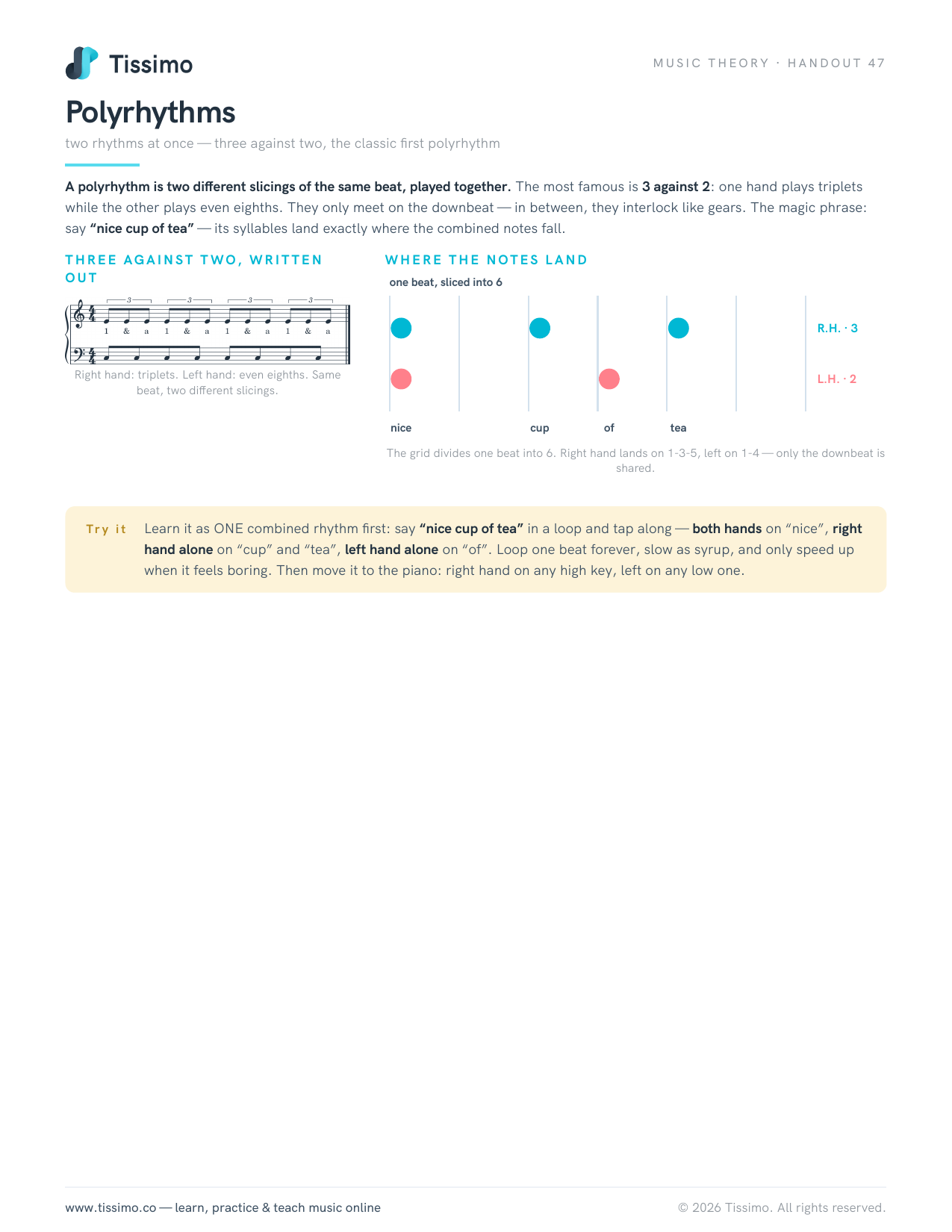 Polyrhythmstwo rhythms at once — three against two, the classic first polyrhythm
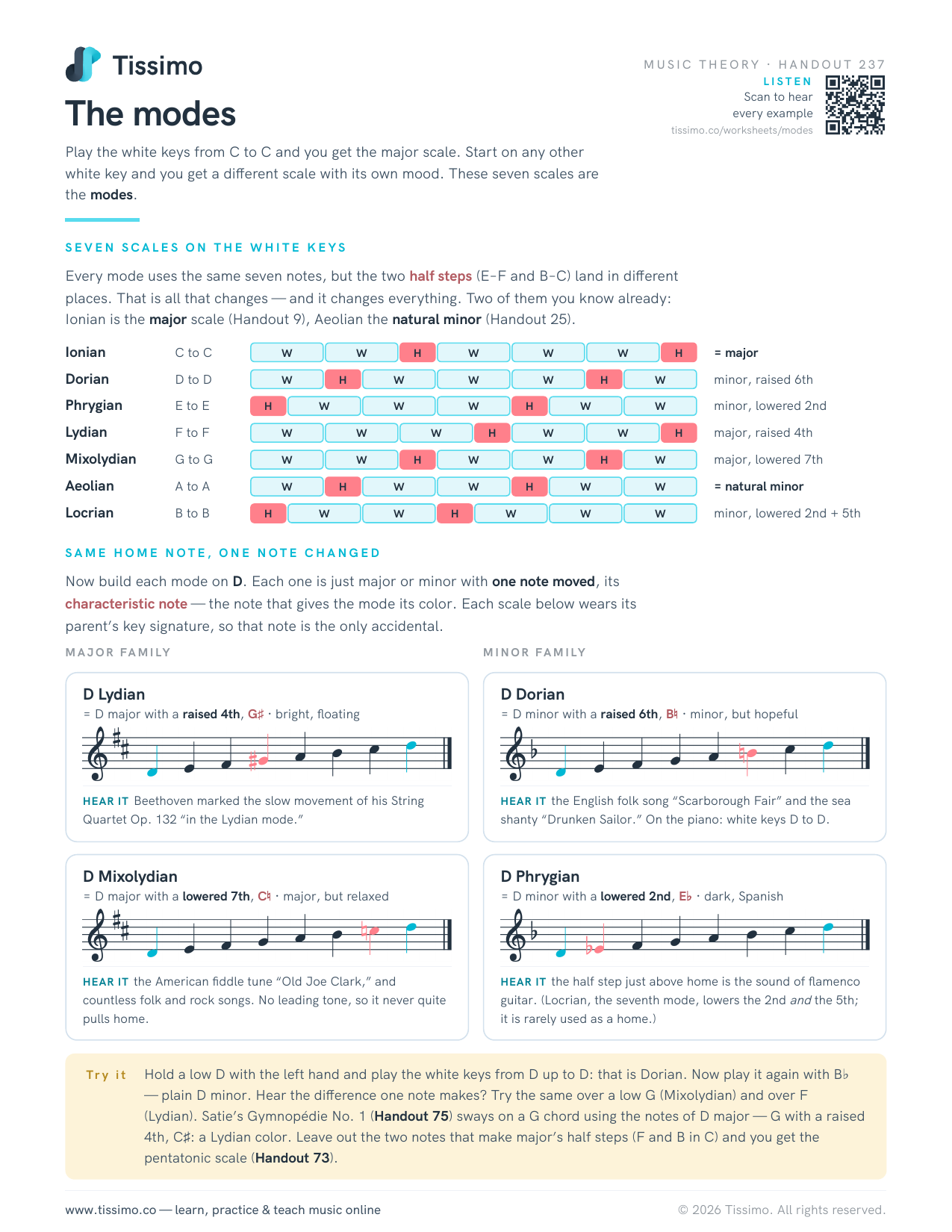 The modesPlay the white keys from C to C and you get the major scale. Start on any other white key and you get a different scale with its own mood. These seven scales are the modes.
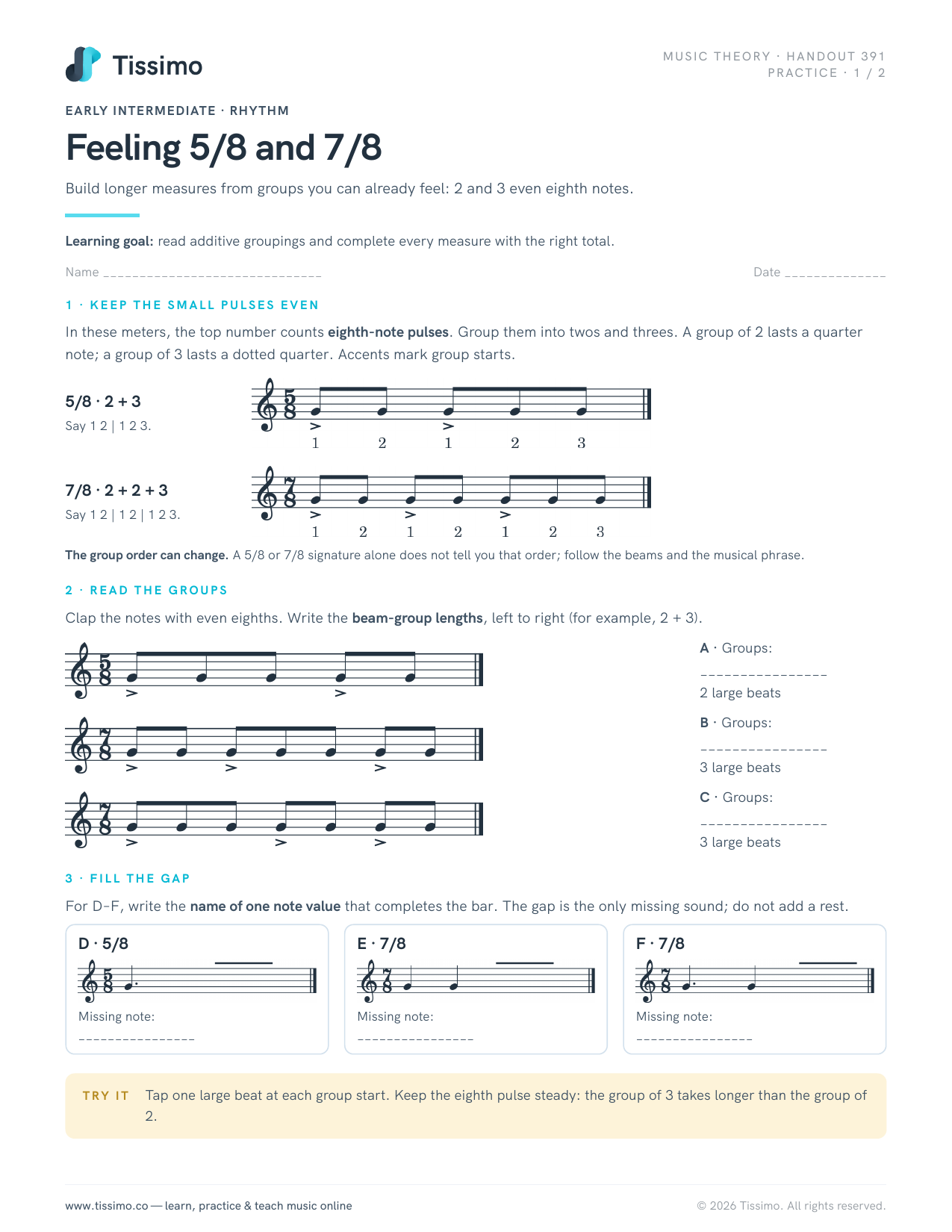 Feeling 5/8 and 7/8Build longer measures from groups you can already feel: 2 and 3 even eighth notes.
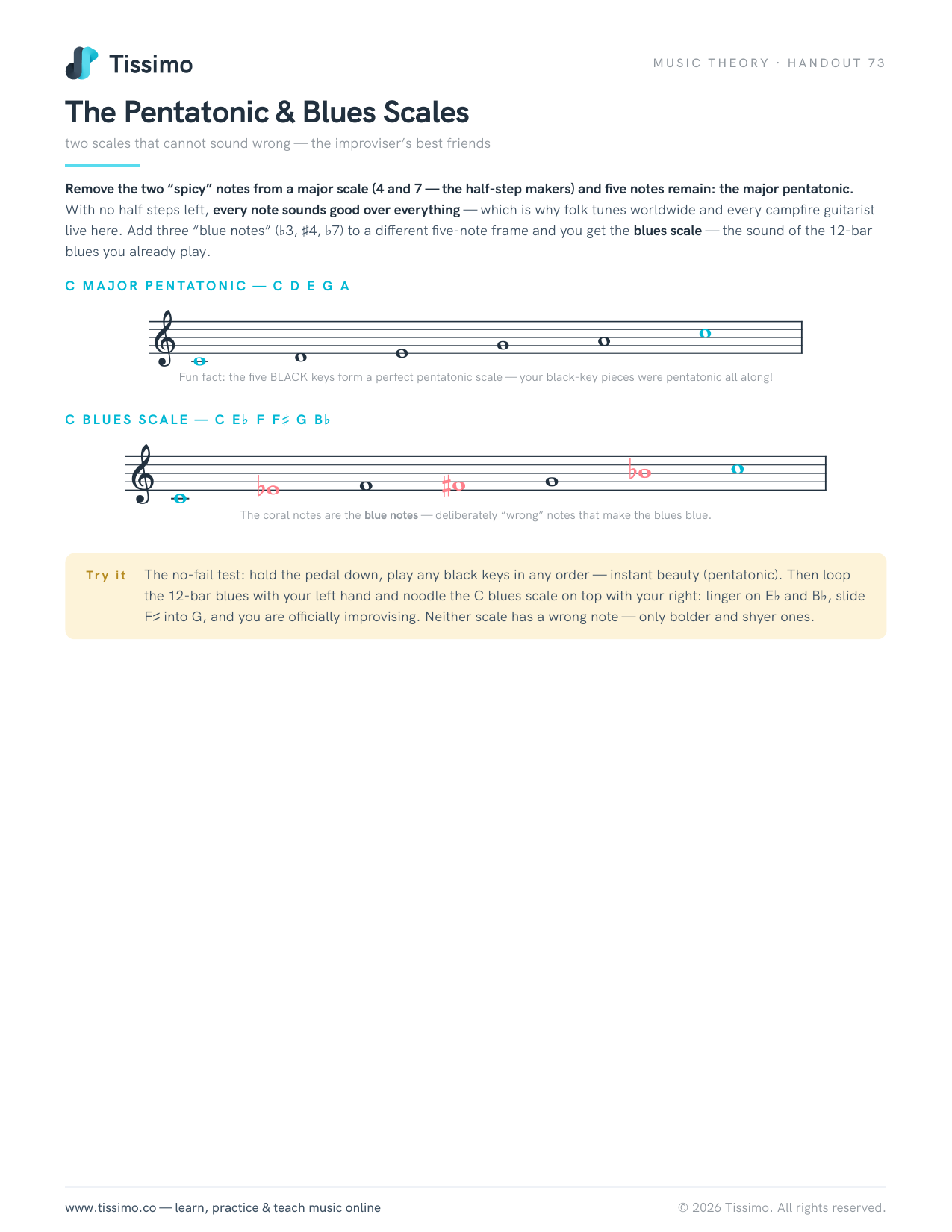 The Pentatonic & Blues Scalestwo scales that cannot sound wrong — the improviser’s best friends