Melody, Texture & Counterpoint
Heterophony
Pronounced het-uh-ROF-uh-nee
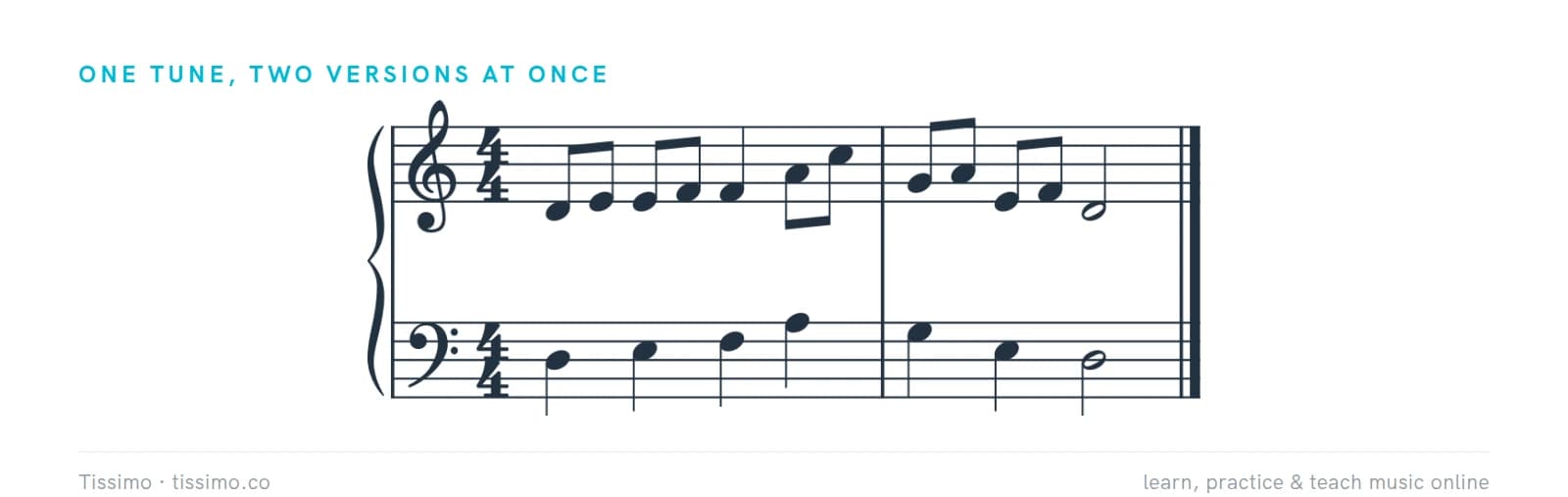
Heterophony is a texture in which several performers play or sing the same melody at the same time, each in a slightly different version, for example one plain and one ornamented.
Heterophony is a texture in which two or more performers play or sing the same melody at the same time, each in a slightly different version. One might play the tune plainly while another decorates it with extra notes, slides or small changes of rhythm. The parts drift apart and come back together, but they are always telling the same story.
Where you hear it
Heterophony is at home wherever melodies are learned by ear and every performer is expected to add their own ornaments. You can hear it, for example, in Arabic and Turkish classical ensembles, where the instruments play one tune with individual decorations; in Javanese and Balinese gamelan, where faster instruments elaborate a slower core melody; in Japanese court music, gagaku; and in Irish and Scottish traditional sessions, where fiddles, flutes and pipes play a tune together, each with its own ornaments. It also happens naturally when a crowd sings a familiar song without a leader, everyone adding small turns of their own.
Between monophony and polyphony
Heterophony is not quite any of the other textures:
- not monophony, because the parts are not identical;
- not polyphony, because the parts are versions of one melody, not independent melodies;
- not homophony, because there is no separate accompaniment.
It sits between monophony and polyphony: one tune, heard in several versions at once.
Heterophony in composed music
Western classical music uses heterophony less often, but some composers have chosen it deliberately. Benjamin Britten, inspired by Japanese Noh theater, built much of his church parable Curlew River on heterophonic textures.
How to hear it
Listen for the moments when the parts separate, often on weak beats where one player adds decorations, and for the moments when they land together on the same important note, usually on strong beats and at the ends of phrases. "Together, apart, together" is the sound of heterophony.
Common questions
What is the difference between heterophony and polyphony?
In polyphony the parts are different, independent melodies. In heterophony they are variations of the same melody played at the same time.