Melody, Texture & Counterpoint
Period (Antecedent and Consequent)
A period is a pair of phrases that belong together like a question and its answer: the antecedent ends with a weaker cadence, and the consequent ends with a stronger one on the home chord.
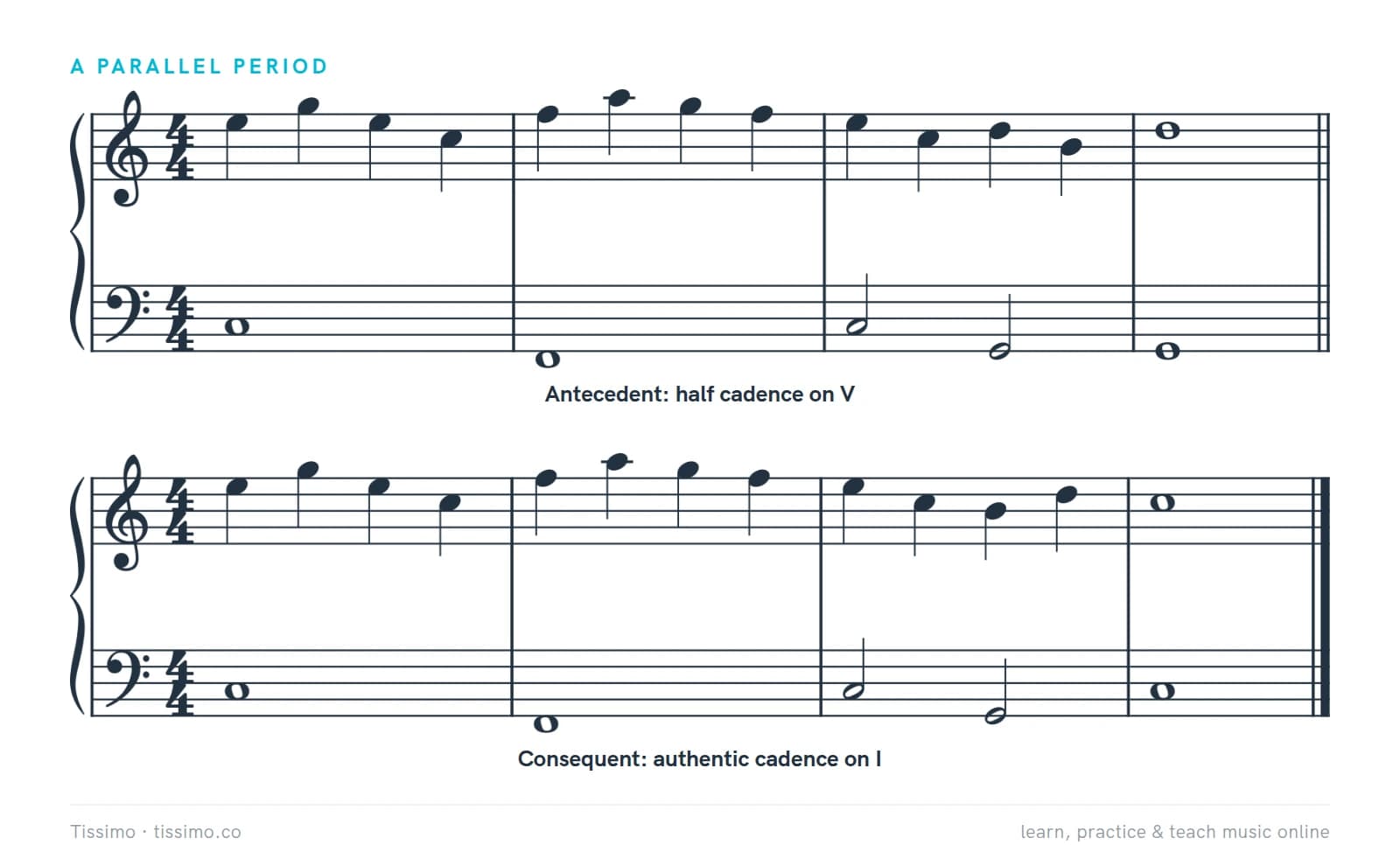
A period is two phrases that belong together like a question and its answer. The first phrase, the antecedent, ends with a weaker, open-sounding cadence, very often a half cadence on V. The second phrase, the consequent, starts again and ends with a stronger cadence, usually an authentic cadence on I. The usual length is eight bars, four plus four, which makes the period one of the most common shapes in Classical music, folk songs and hymns.
Parallel and contrasting periods
- In a parallel period, the consequent begins like the antecedent, as in the example: you hear the opening again and expect the same, but this time the ending is stronger.
- In a contrasting period, the consequent starts with different material but still answers the antecedent with the stronger cadence.
What makes it a period is the cadence relationship, not the melody: the second cadence must sound more final than the first.
Why it works
A half cadence leaves the music hanging on the dominant chord, wanting to go home. When the consequent closes on the tonic, the tension is resolved. That pull and release is easy to hear even if you know no theory, which is why periods are so satisfying in simple tunes.
Period or sentence?
Another very common eight-bar shape is the sentence: a short idea, its repeat, and then a continuation that breaks the idea into pieces and drives to one cadence. A period has two cadences, a sentence usually just one at the end. Compare them in Repeat, Continue, or Answer?.
Finding periods in your music
Look at bar 4: does the music pause on V? Then look at bar 8: does it close on I? If both are true and the two phrases match in length, you have probably found a period. Practice with Phrase and period and Question and answer.
Common questions
What is an antecedent and consequent phrase?
They are the two halves of a period. The antecedent is the question, ending with a weaker cadence (often on V); the consequent is the answer, ending with a stronger cadence on I.
How long is a musical period?
Usually eight bars, made of two four-bar phrases. Longer periods, such as sixteen bars made of two eight-bar phrases, also occur.
Practice it: free worksheets
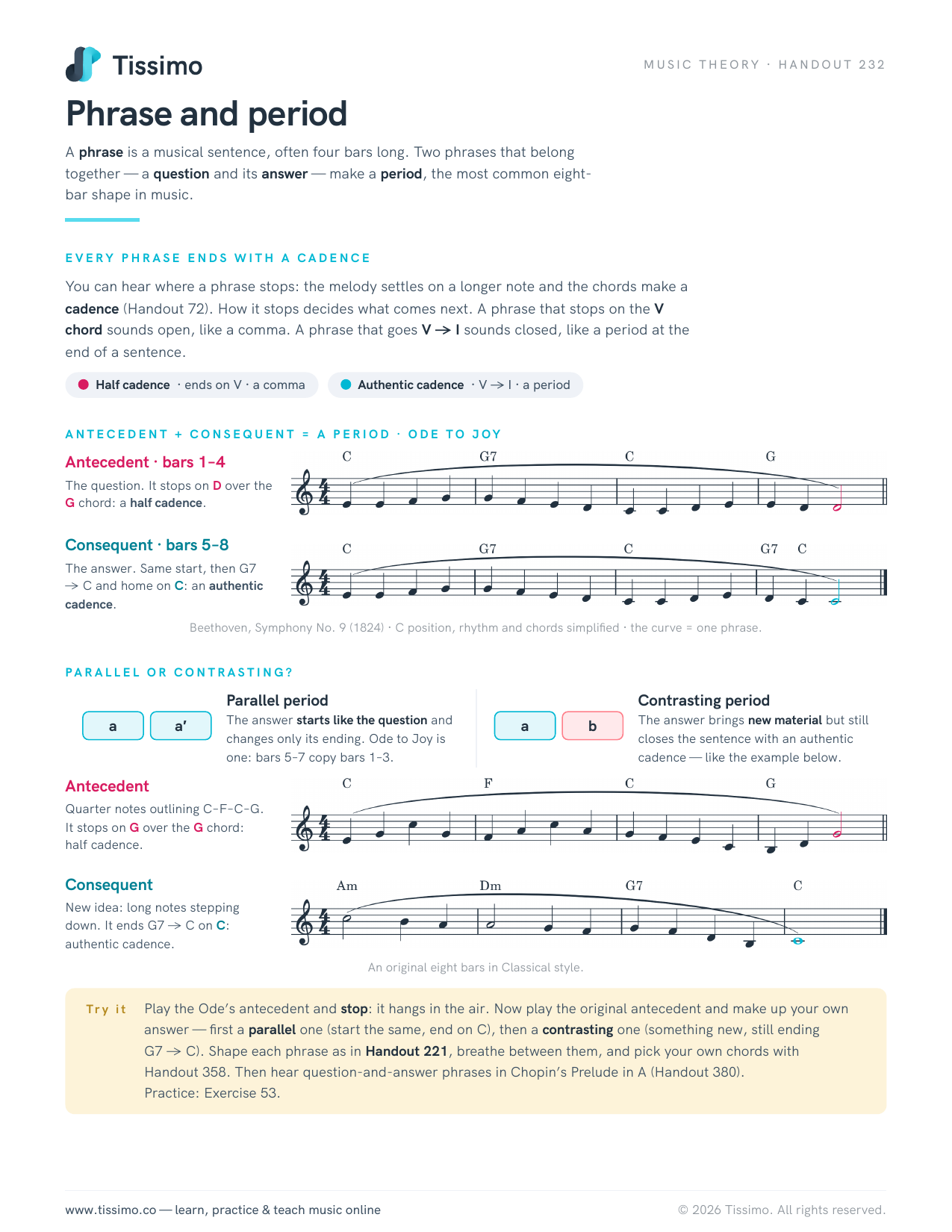 Phrase and periodA phrase is a musical sentence, often four bars long. Two phrases that belong together — a question and its answer — make a period, the most common eight-bar shape in music.
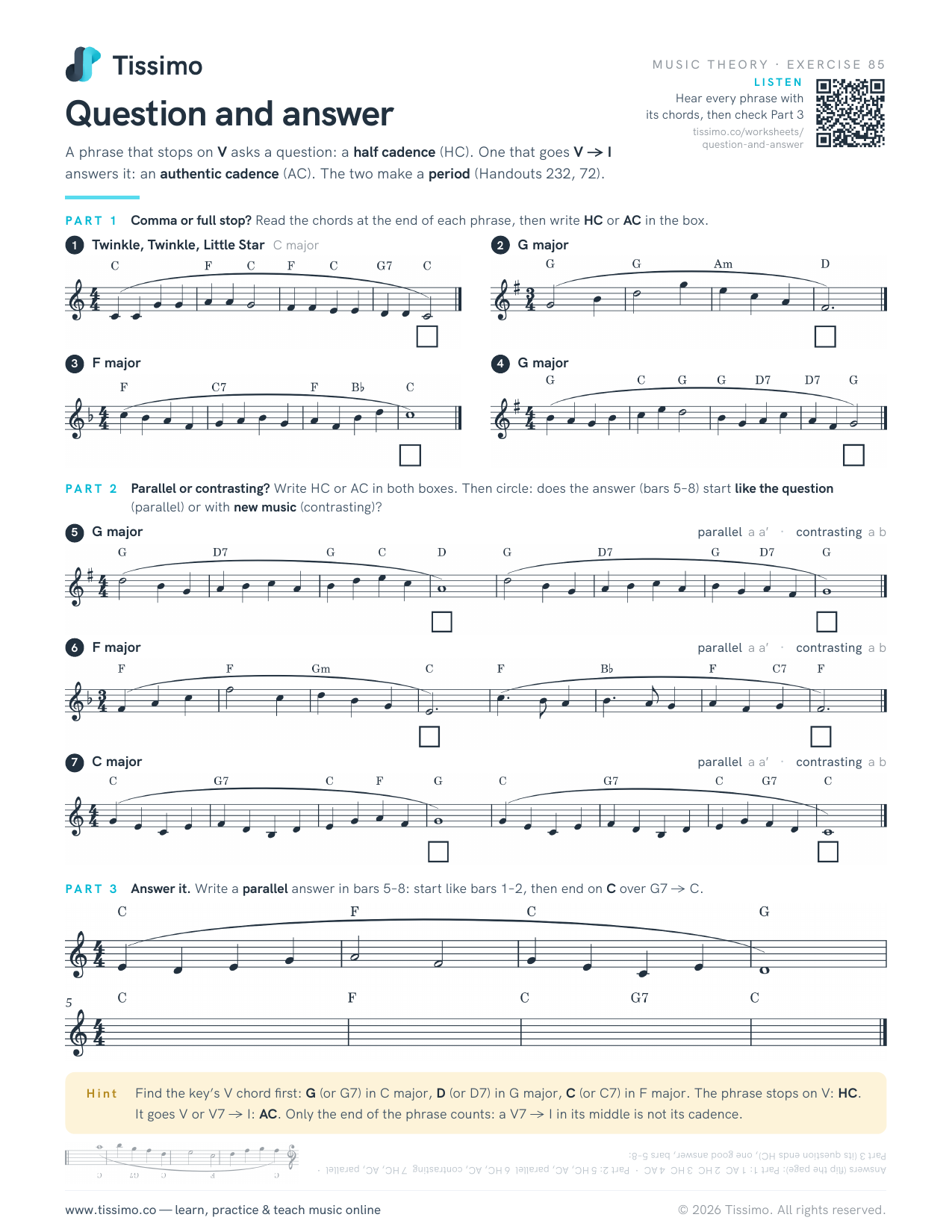 Question and answerA phrase that stops on V asks a question: a half cadence (HC). One that goes V → I answers it: an authentic cadence (AC). The two make a period (Handouts 232, 72).
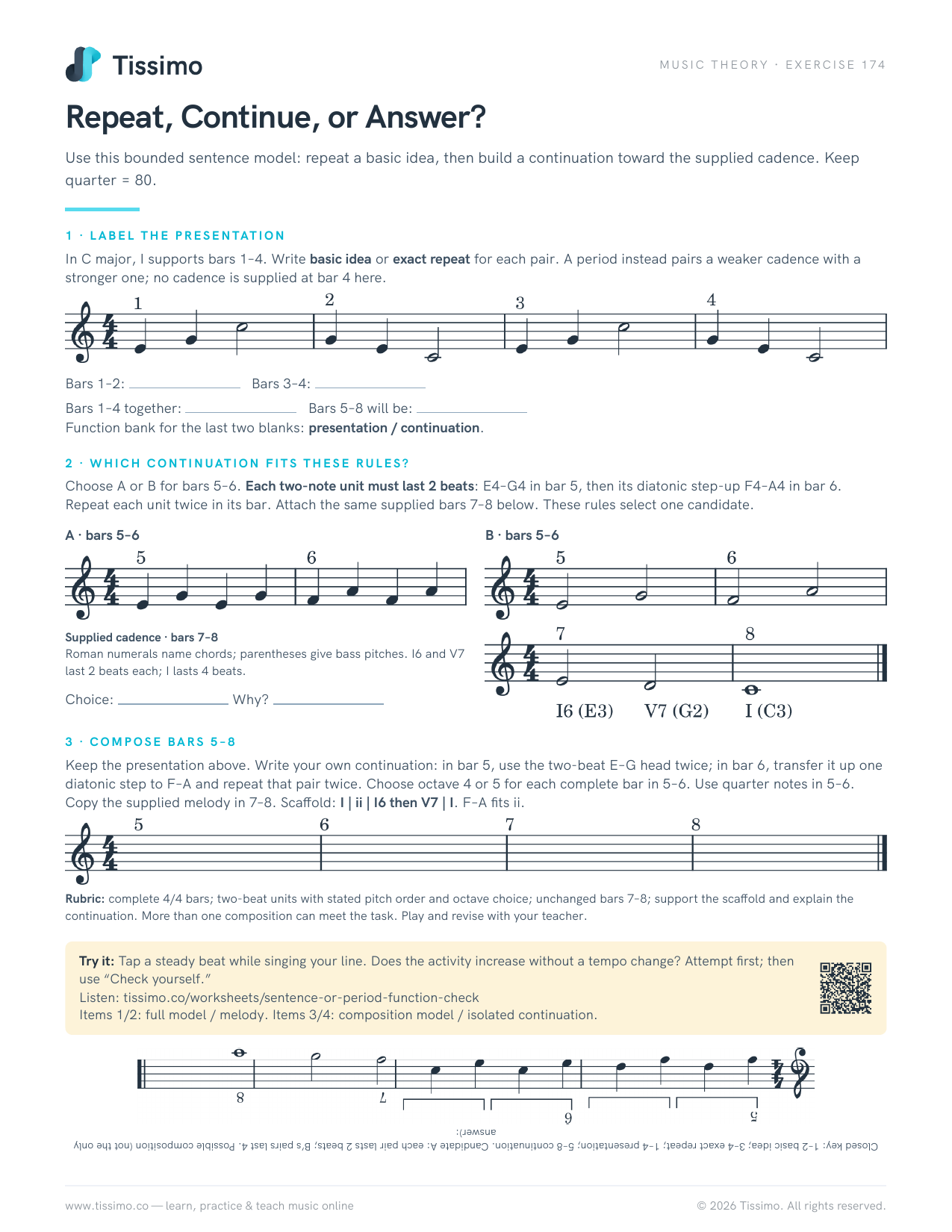 Repeat, Continue, or Answer?Use this bounded sentence model: repeat a basic idea, then build a continuation toward the supplied cadence. Keep quarter = 80.
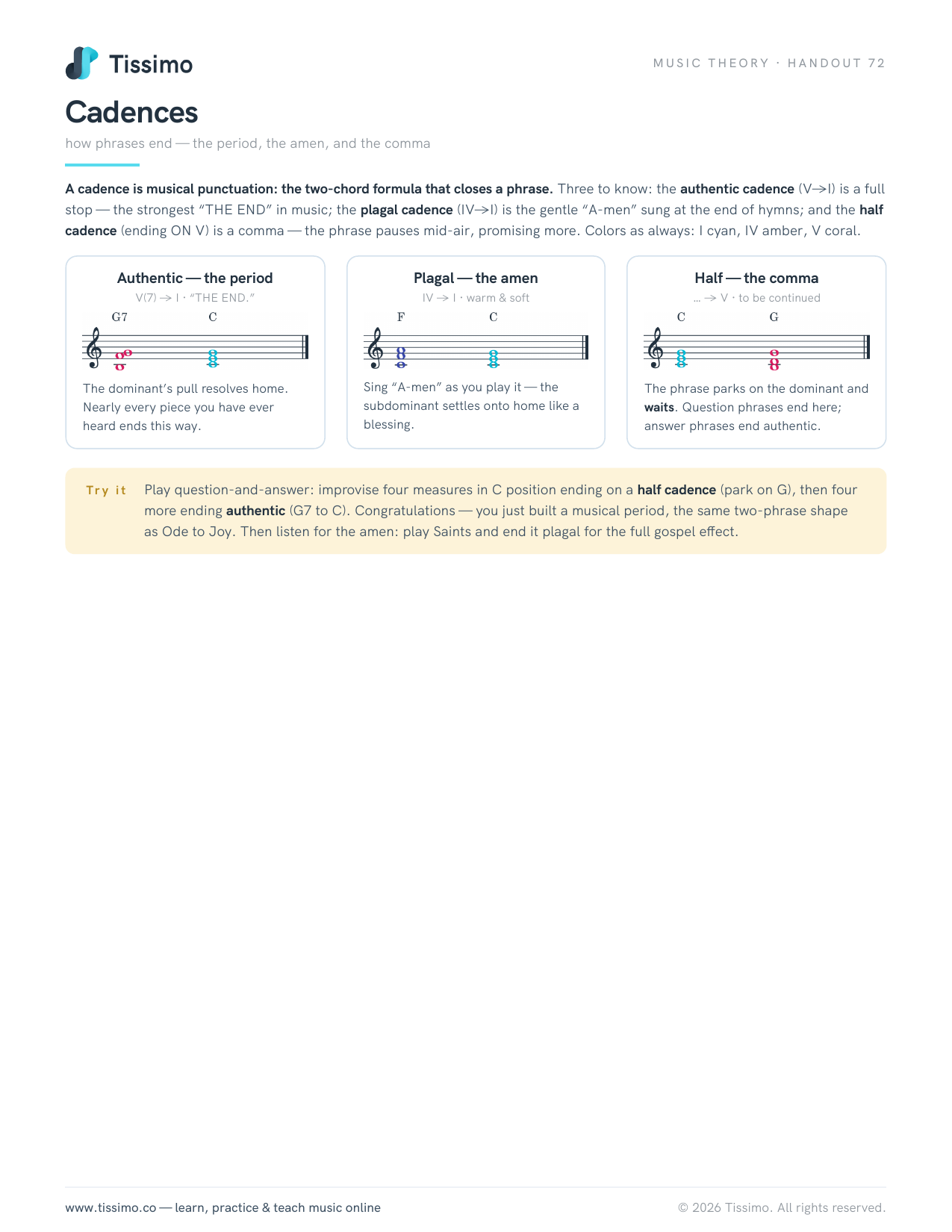 Cadenceshow phrases end — the period, the amen, and the comma
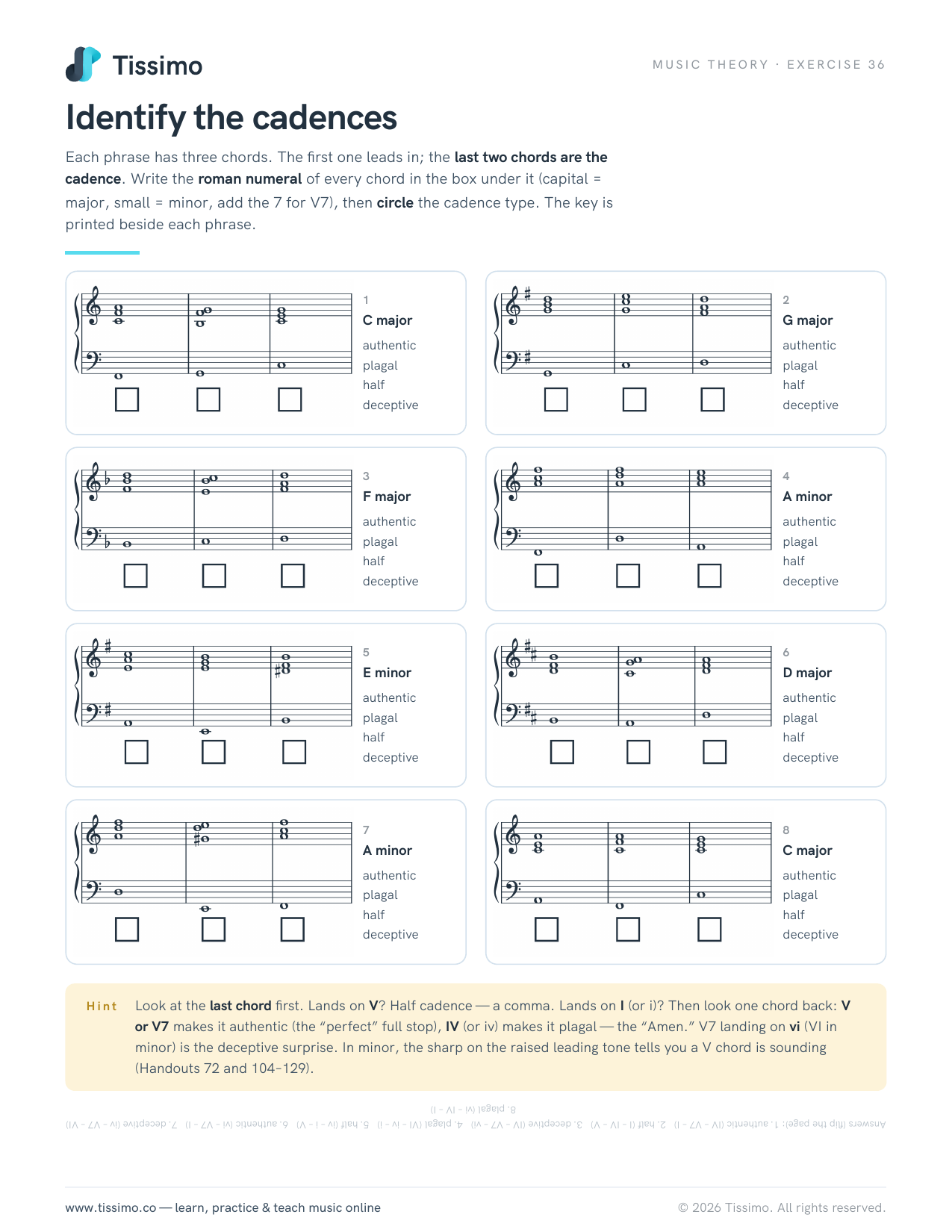 Identify the cadencesEach phrase has three chords. The first one leads in; the last two chords are the cadence. Write the roman numeral of every chord in the box under it (capital = major, small = minor, add the 7 for V7), then circle the cadence type. The key is printed beside each phrase.