Chords & Harmony
Half Cadence
A half cadence is a phrase ending that stops on the dominant chord (V), leaving the music open and unresolved, like a comma or a question. A later phrase usually answers it by ending on the tonic.
A half cadence is a phrase ending that stops on the dominant chord, V. The chord before it can be almost anything: I, IV, ii6 or a cadential six-four. Because V wants to move on to the tonic, a half cadence leaves the music open, like a comma or a question mark in a sentence. Something has to come next.
Question and answer
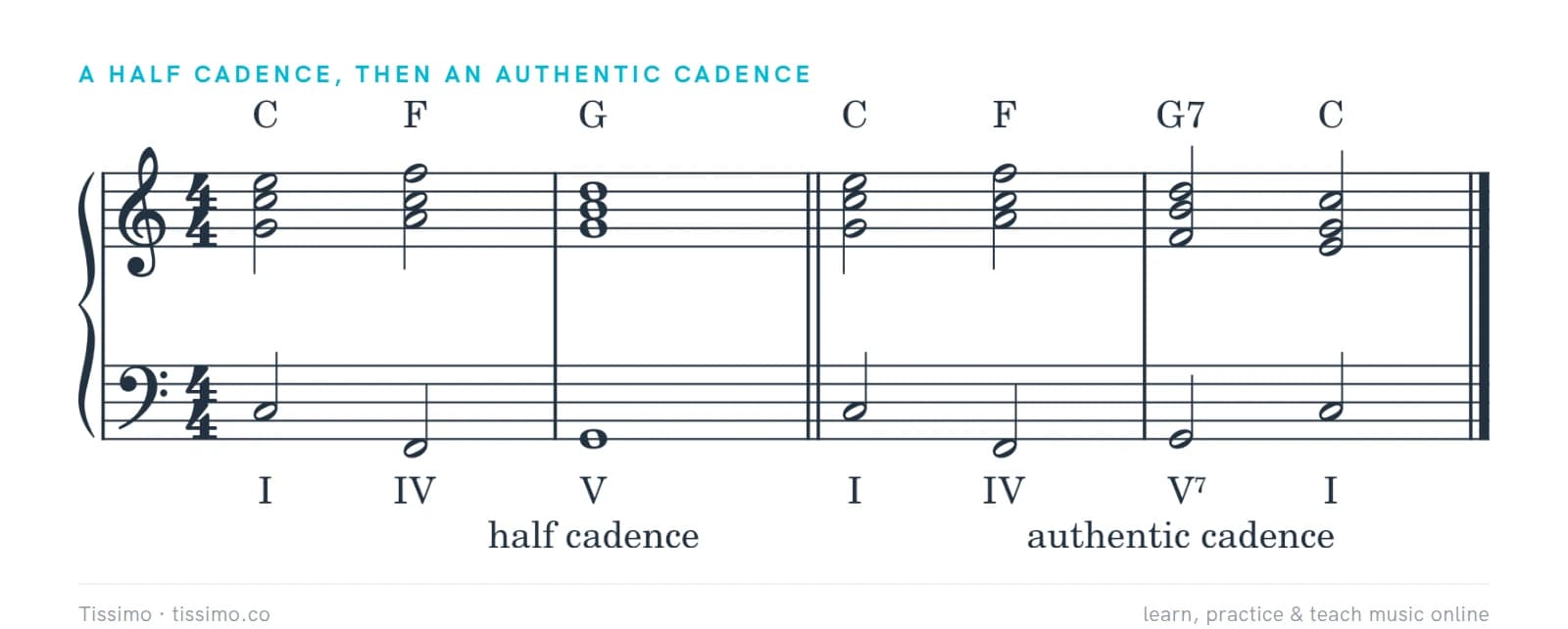
The half cadence is the "question" of a musical period. A first phrase ends on V; a second phrase, often starting the same way, ends on I with an authentic cadence. The pair sounds like a question and its answer.
How to recognize one
At the end of a phrase, listen for the bass landing on the fifth degree of the key (G in C major) and the music pausing there, unresolved. In most half cadences V is a plain triad in root position. A seventh is less common at this point, because it makes the chord sound as if it must move on at once.
The Phrygian half cadence
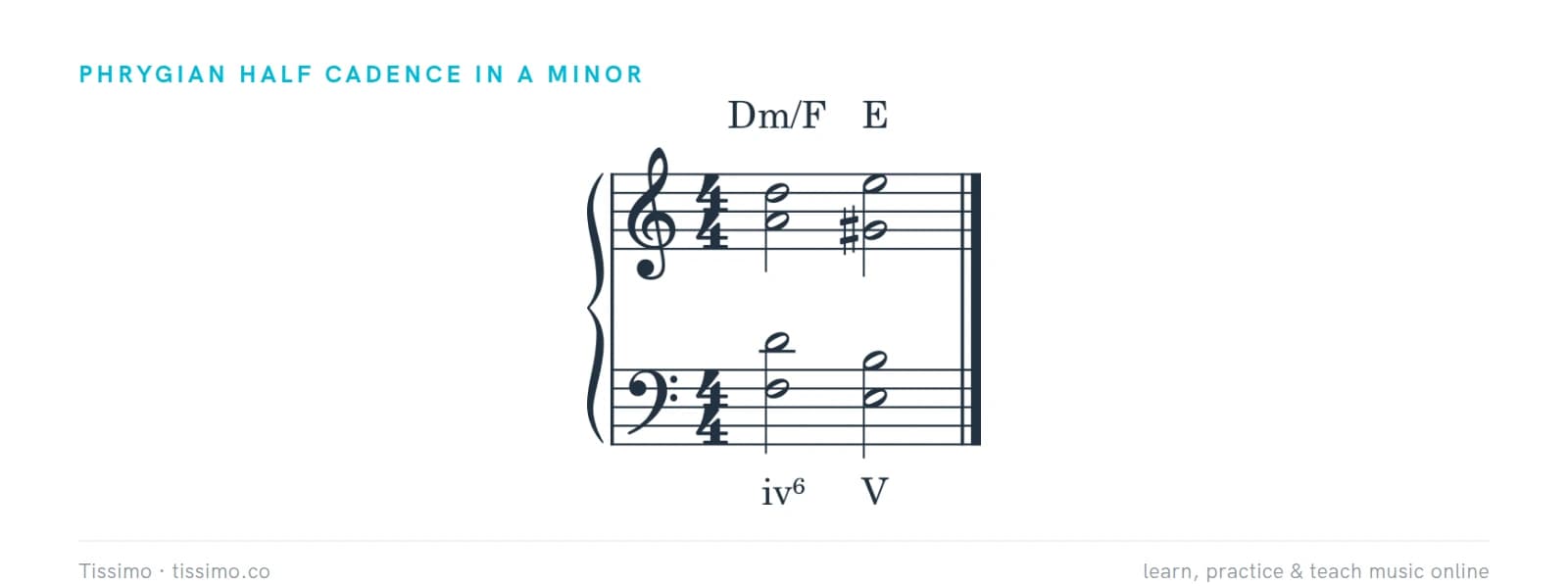
In a minor key, iv6 moving to V makes a special half cadence. The bass falls a half step (F to E in A minor) while an upper voice rises a step to meet it on E, one or more octaves higher (D to E). Baroque composers often used it to close a slow movement or slow introduction just before a faster one. The name refers to the falling half step in the bass, which recalls the Phrygian mode.
Half cadence or imperfect cadence?
In British terminology, a cadence that ends on V is called an imperfect cadence. In American usage, "imperfect" usually refers to an imperfect authentic cadence, a weaker V–I. The two terms describe different things, so check which system a book is using.
Practice with Cadences, Identify the cadences and Phrase and period.
Common questions
Does a half cadence have to end on V?
Yes. Whatever chord comes before it, a half cadence is defined by ending on the dominant chord.
What is the difference between a half cadence and an imperfect cadence?
In British terminology they are the same thing. In American usage, an imperfect authentic cadence is a weaker V–I, which is a different cadence.
Practice it: free worksheets
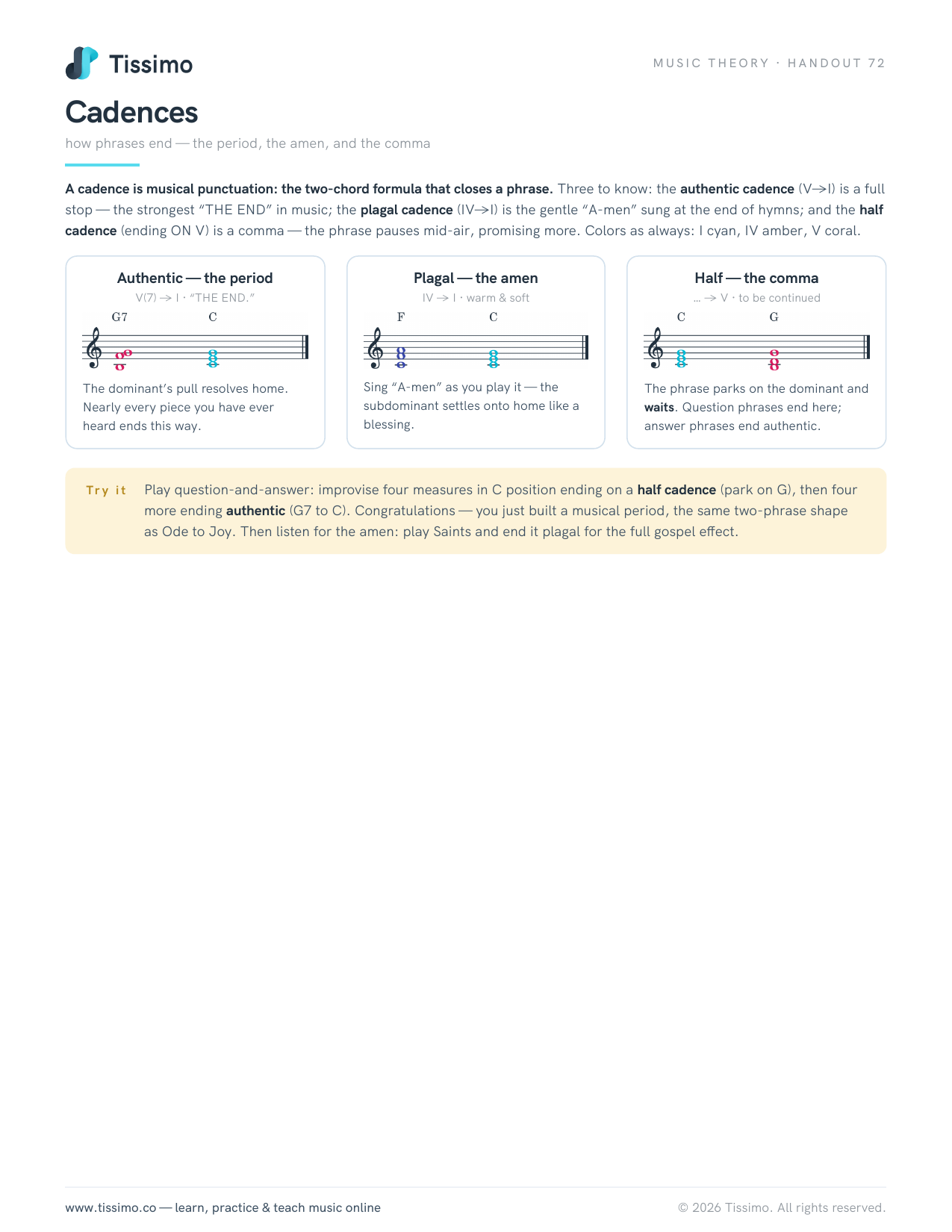 Cadenceshow phrases end — the period, the amen, and the comma
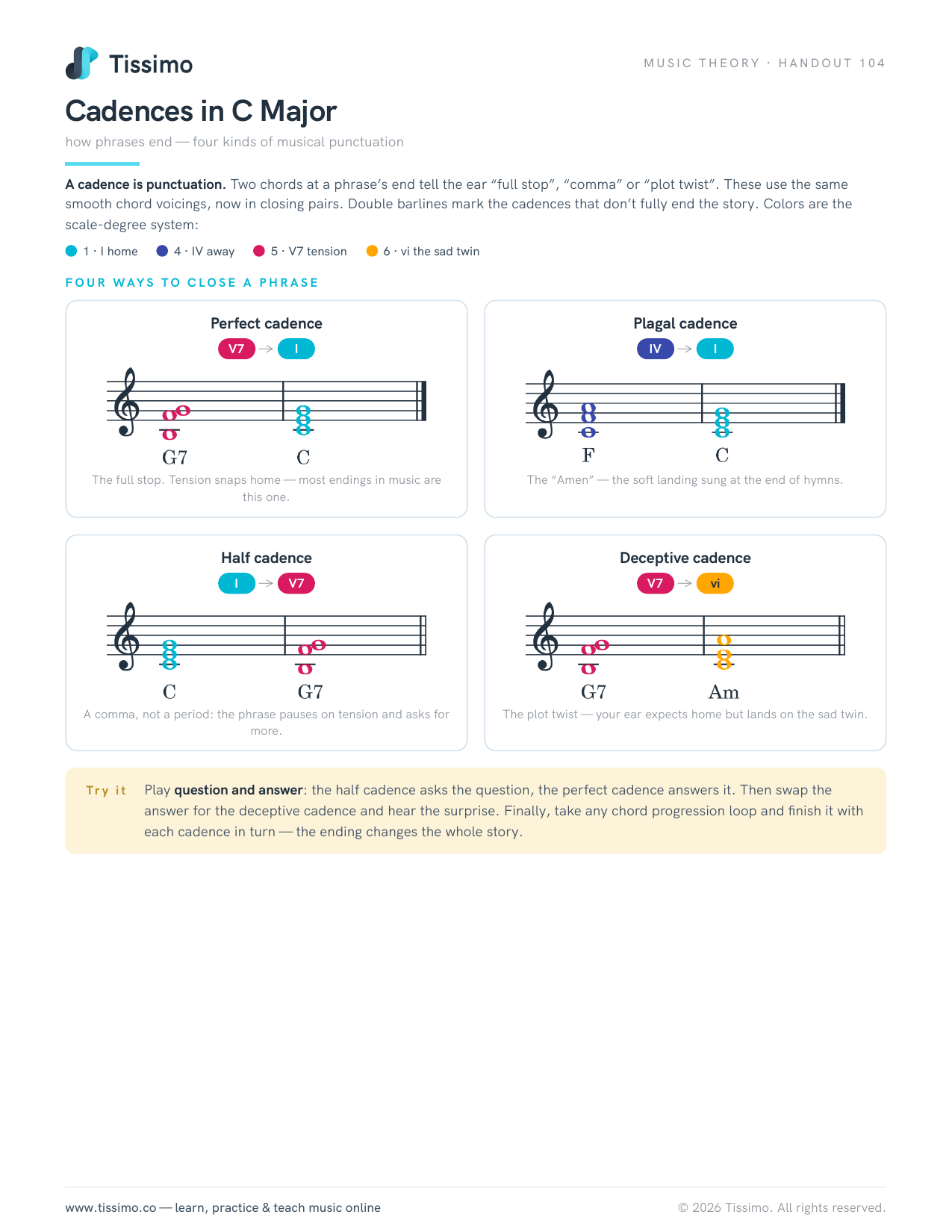 Cadences in Every KeyHow phrases end — the four kinds of musical punctuation, written out in all 24 keys.
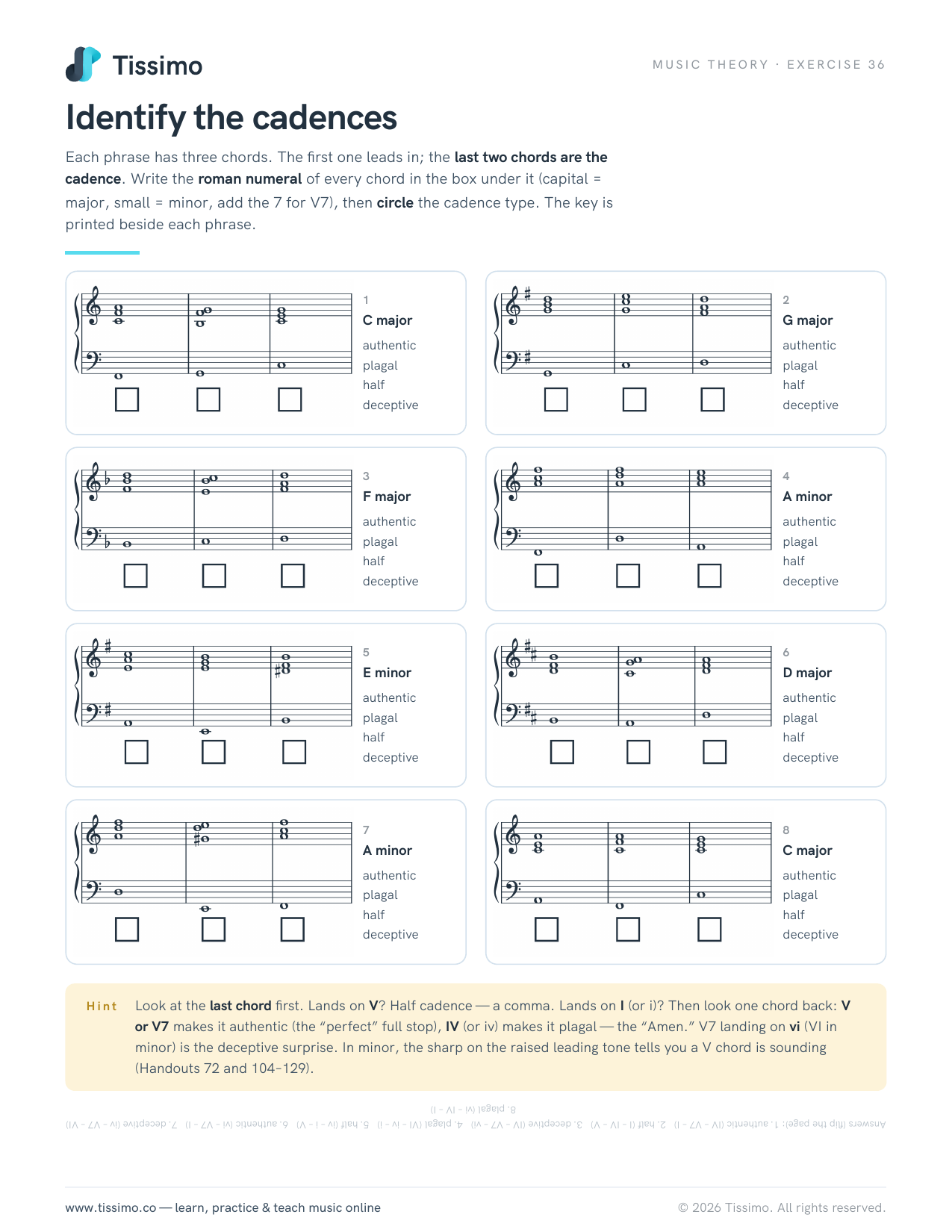 Identify the cadencesEach phrase has three chords. The first one leads in; the last two chords are the cadence. Write the roman numeral of every chord in the box under it (capital = major, small = minor, add the 7 for V7), then circle the cadence type. The key is printed beside each phrase.
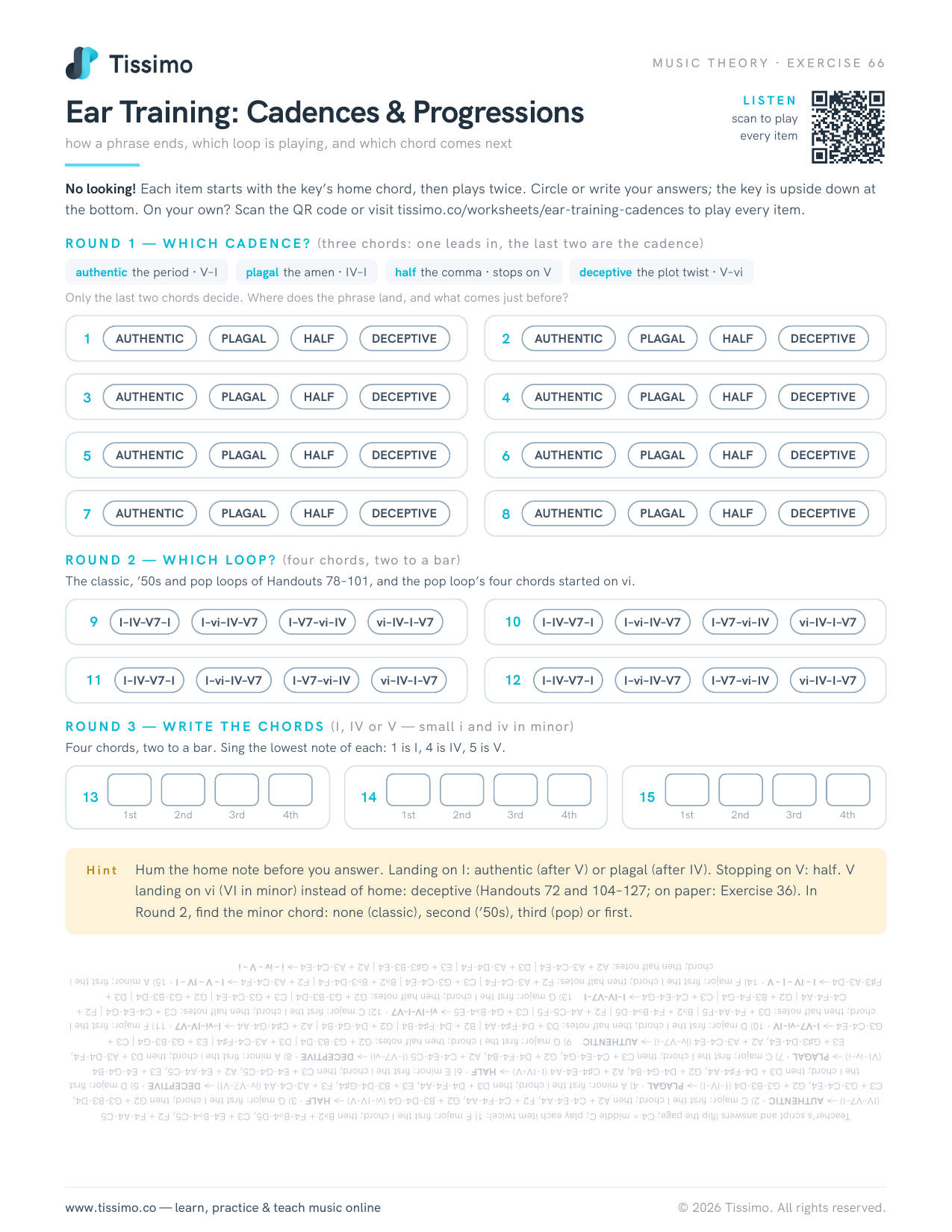 Ear Training: Cadences & Progressionshow a phrase ends, which loop is playing, and which chord comes next
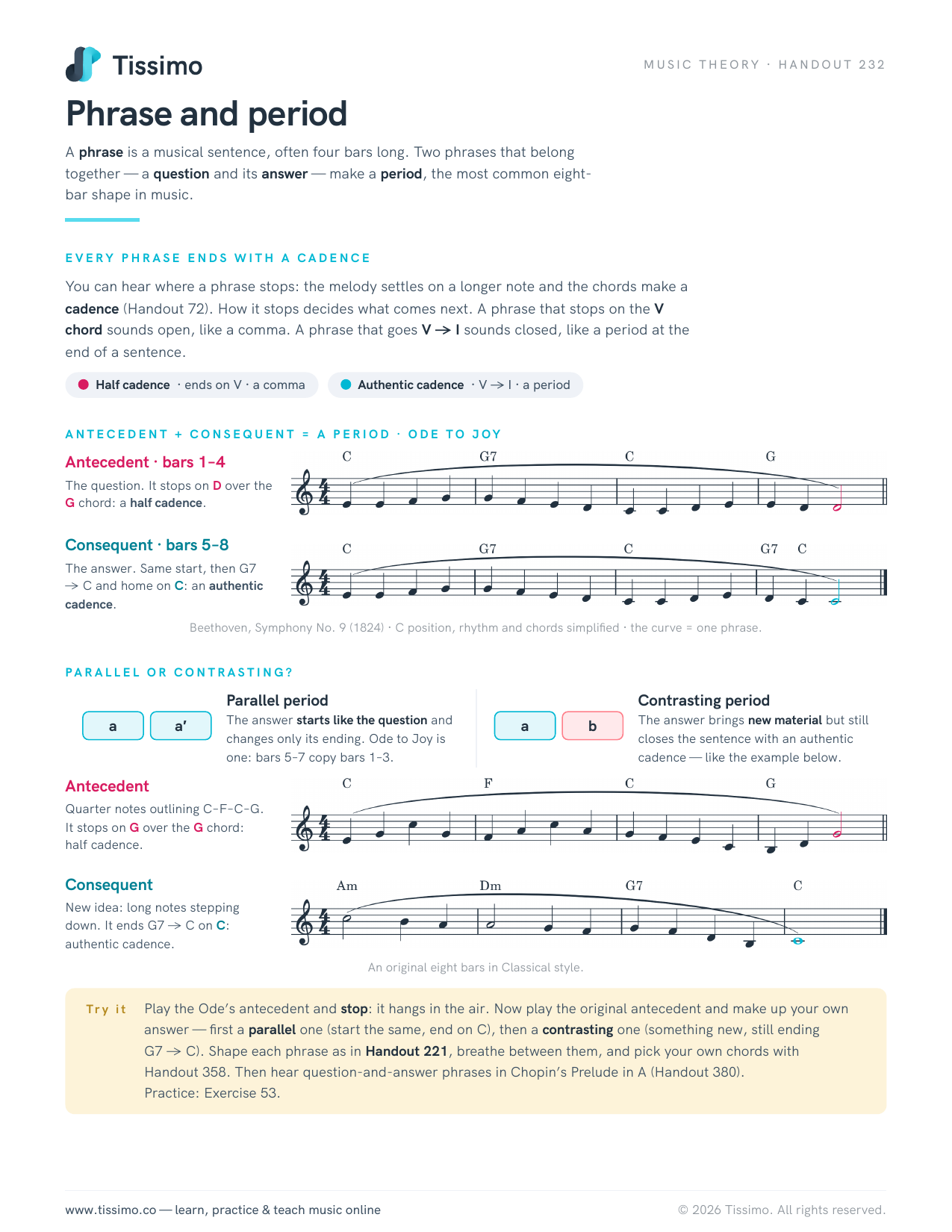 Phrase and periodA phrase is a musical sentence, often four bars long. Two phrases that belong together — a question and its answer — make a period, the most common eight-bar shape in music.
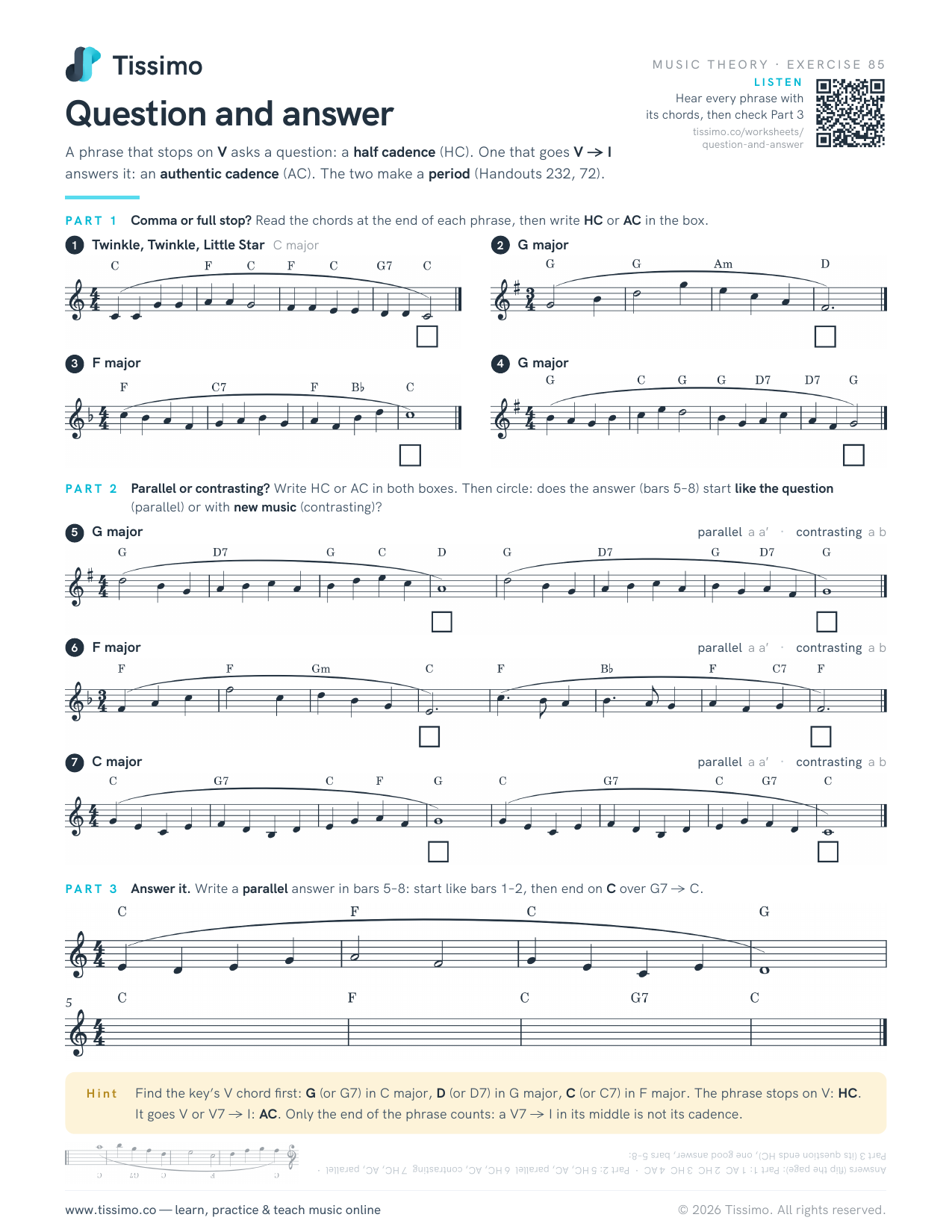 Question and answerA phrase that stops on V asks a question: a half cadence (HC). One that goes V → I answers it: an authentic cadence (AC). The two make a period (Handouts 232, 72).