Instruments & Voices
Guitar
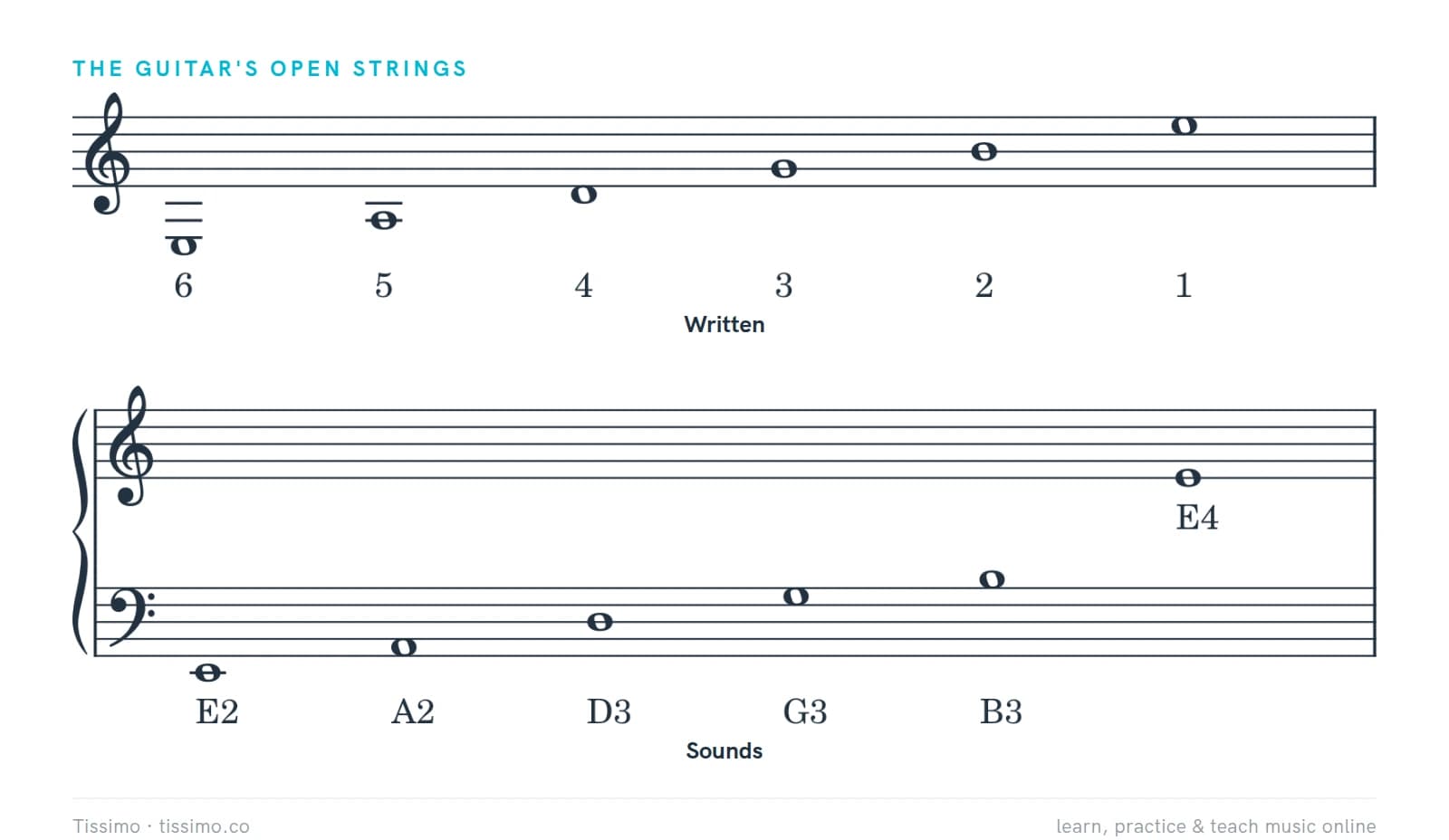
The guitar is a fretted string instrument, usually with six strings tuned E–A–D–G–B–E, that you pluck or strum. Guitar music is written in treble clef an octave higher than it sounds, and often in tablature.
The guitar is one of the most widely played instruments in the world. Its six strings run over a fretted neck and a hollow wooden body: you press the strings against the frets with one hand and pluck or strum them with the other. This entry is about the acoustic guitar, which needs no amplifier. Its amplified cousin has its own entry, the electric guitar.
How a guitar makes its sound
A plucked string vibrates and passes that vibration through the bridge to the guitar's top, a thin wooden soundboard. The top and the air inside the hollow body resonate and project the sound through the sound hole. Metal strips called frets divide the neck into half steps: pressing a string just behind the first fret raises its pitch by a half step, the second fret by a whole step, and so on. Twelve frets up, the string sounds an octave higher.
There are two main types:
- The classical guitar has nylon strings, a wide neck and a warm, soft tone. It is usually played with the fingers and is the guitar of classical music, flamenco and much Latin American music.
- The steel-string acoustic guitar has a narrower neck and a brighter, louder sound. It is the guitar of folk, country, pop and singer-songwriters, played with a pick or the fingers.
Tuning and range
In standard tuning the strings, from the thickest (string 6) to the thinnest (string 1), are E2, A2, D3, G3, B3 and E4. Each neighboring pair is a perfect fourth apart except G to B, which is a major third. The range runs from E2 up to about B5 on a 19-fret classical guitar, and a little higher on guitars with more frets.
How guitar music is written
Guitar music is written in treble clef, an octave higher than it sounds, so most notes fit on the staff instead of hanging below it on ledger lines. Some editions show this with a small 8 under the clef. Guitarists also read:
- Tablature (TAB): six lines for the six strings, with fret numbers instead of notes;
- chord diagrams, small grids that show where to put your fingers;
- chord symbols on a lead sheet, for strummed accompaniments.
Its role
The guitar works as a solo instrument, as an accompaniment for singing and as part of a band's rhythm section. A guitarist may strum chords, play melodies, or combine bass, chords and melody in fingerpicking patterns.
Tips for beginners
- Tune every time you play; a clip-on electronic tuner makes it quick.
- Start with a few open chords such as E minor, A minor, C, G and D, and practice changing between two of them in time.
- Press just behind the fret, not on top of it, and keep the nails of your fretting hand short.
- Expect sore fingertips for the first few weeks. Short daily sessions build calluses without hurting.
Common questions
What are the notes of the guitar strings?
In standard tuning, from the thickest string to the thinnest: E, A, D, G, B, E. In scientific pitch notation that is E2, A2, D3, G3, B3 and E4. A popular memory aid is "Eddie Ate Dynamite, Good Bye Eddie."
Is guitar music written at the pitch it sounds?
No. Guitar music is written in treble clef one octave higher than it sounds, which keeps the low notes on the staff. Sometimes the clef carries a small 8 underneath as a reminder; often it does not.
Should I start on an acoustic or an electric guitar?
Either works, so choose the one that plays the music you want to make. Nylon-string classical guitars are gentle on the fingertips, electric guitars usually have the lightest strings and an easy neck, and steel-string acoustics take a little more finger strength at first.
Practice it: free worksheets
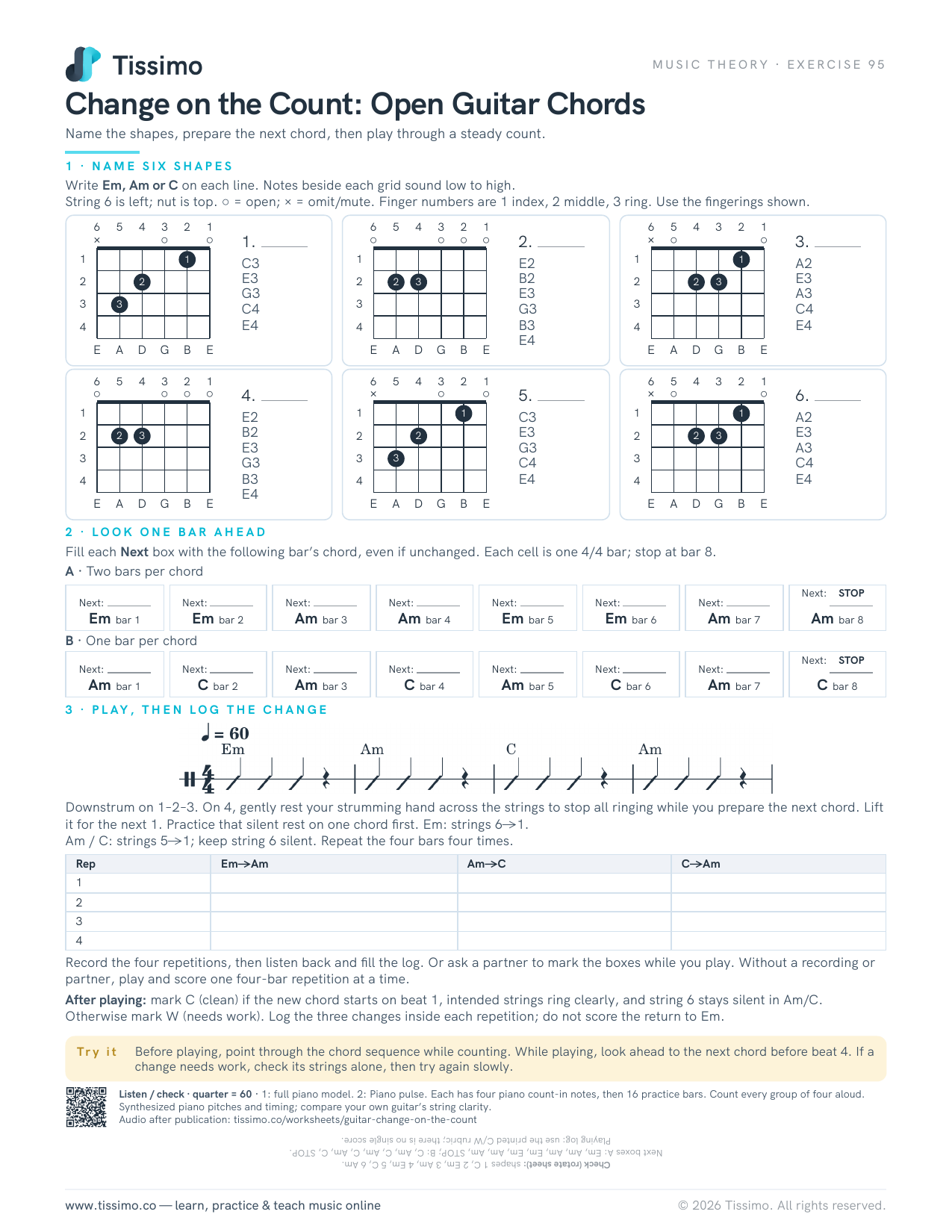 Change on the Count: Open Guitar ChordsName the shapes, prepare the next chord, then play through a steady count.
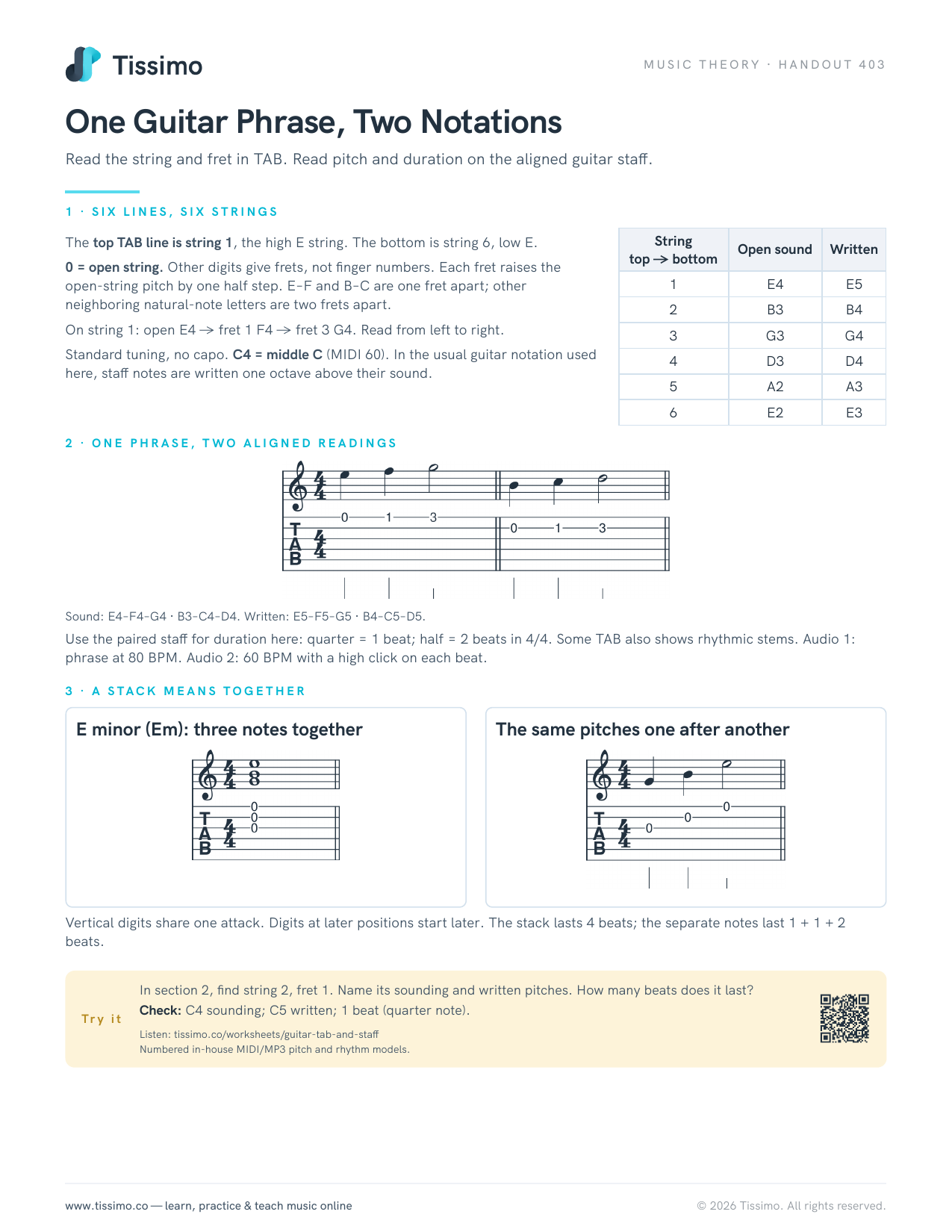 One Guitar Phrase, Two NotationsRead the string and fret in TAB. Read pitch and duration on the aligned guitar staff.
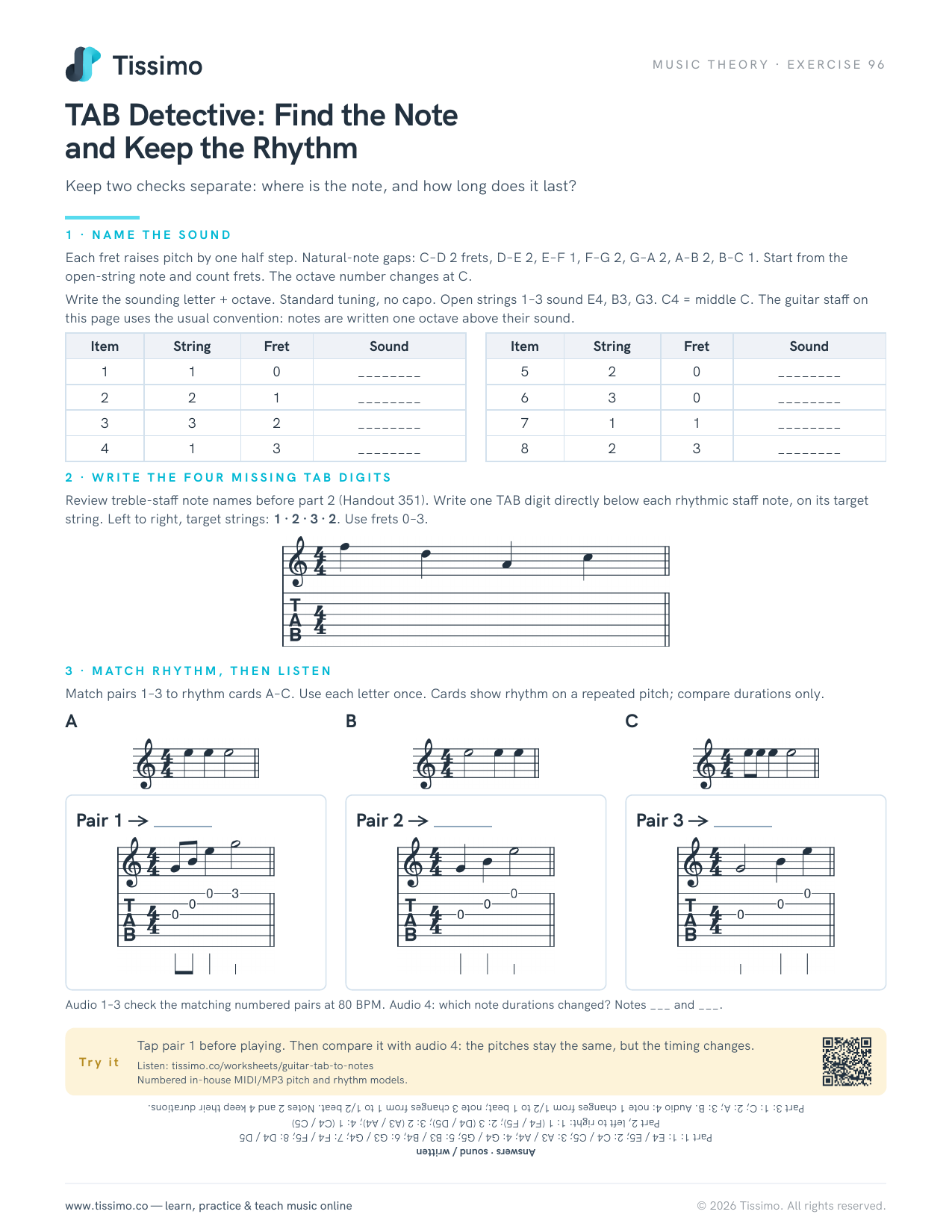 TAB Detective: Find the Note and Keep the RhythmKeep two checks separate: where is the note, and how long does it last?
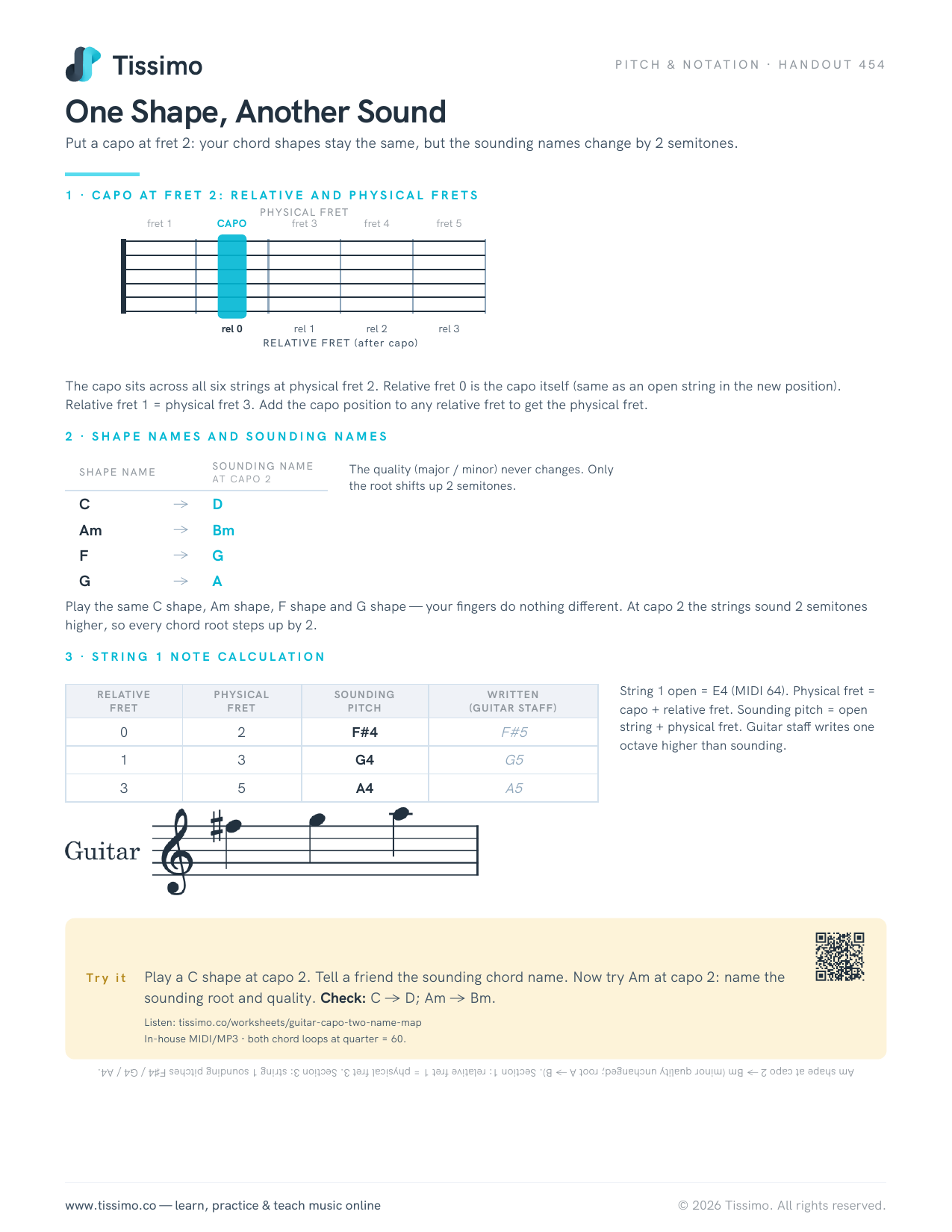 One Shape, Another SoundPut a capo at fret 2: your chord shapes stay the same, but the sounding names change by 2 semitones.
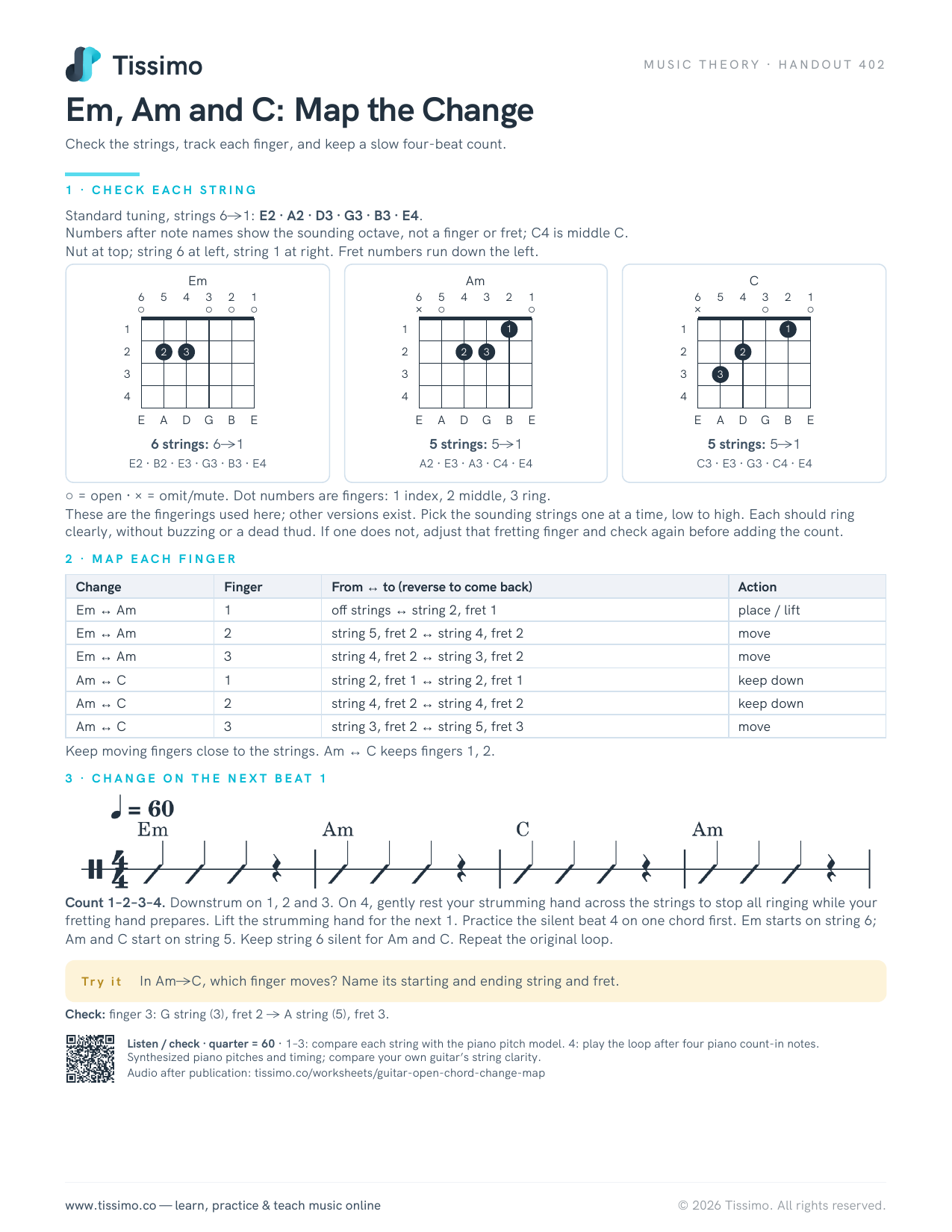 Em, Am and C: Map the ChangeCheck the strings, track each finger, and keep a slow four-beat count.
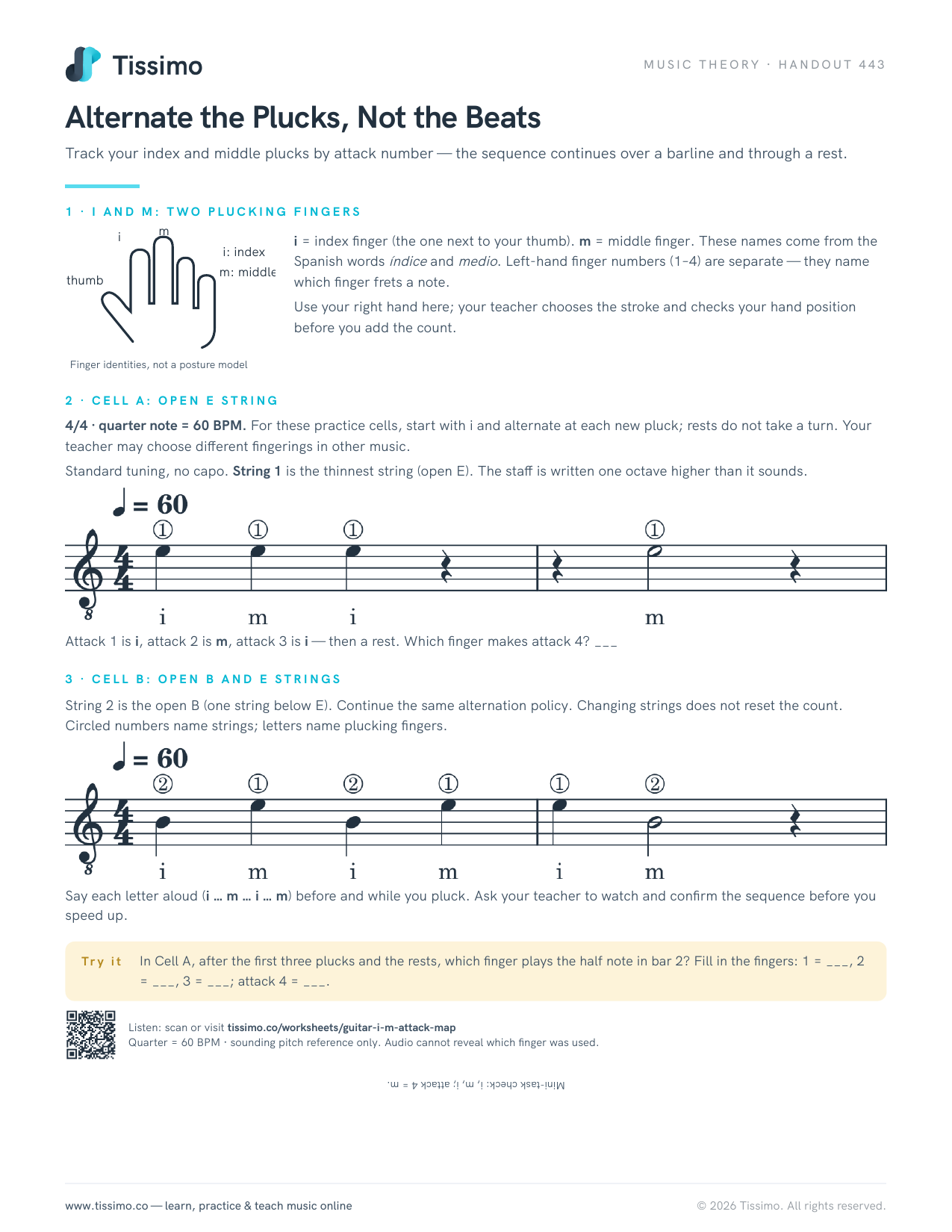 Alternate the Plucks, Not the BeatsTrack your index and middle plucks by attack number — the sequence continues over a barline and through a rest.